The real AI governance problem may be the data your organization has ignored for years.
When organizations begin discussing AI agents, one question comes up immediately: What data will the agent be able to access?
That question matters. But a more uncomfortable one sits beneath it: What data can the employee already access?
In many enterprise environments, the agent does not create the underlying access problem. It exposes it—and that distinction matters.
Agent readiness depends on data readiness. Organizations should govern the information their agents use with the same discipline they apply to the agents themselves.
The agent didn’t overshare your SharePoint site
Imagine an employee asks an agent a reasonable question: “What decisions were made during last year’s project meetings?” The agent searches the knowledge sources available in that employee’s context, finds relevant documents, meeting information, and files, and produces an answer.
The immediate reaction may be: The AI accessed all that information.
In this scenario, that is not necessarily what happened. The agent grounds the request in the knowledge sources available to the person asking and limits the response to content that person can access. Other agent designs and connected systems may use different identities or permission models, so organizations should verify how each agent authorizes access.
The agent did not necessarily create access; it reflected access that already existed. That is both the good news and the warning.
AI removes the obscurity from weak permissions
For years, an organization could maintain an overshared repository without anyone noticing. A document may have overly broad permissions. A project site may still contain information from five years ago. A former employee may remain in a group. A library may hold sensitive material that was never classified. A site may have no clear business owner.
None of these problems requires AI. They are information governance problems that often remain hidden because people are inefficient at discovering everything they can already access. We search for what we need, open the documents we know, and work within familiar systems.
An agent changes that interaction model. Instead of navigating information manually, a person can ask a question in natural language. The obscurity disappears. Agents do not necessarily broaden permissions, but they can make existing permissions far more consequential.
Your agent inherits your data governance. If your content has no lifecycle, your agent inherits the absence of one.
An agent cannot compensate for missing governance. If no one knows what information exists, owns it, reviews its access, classifies its sensitivity, or retires obsolete content, the agent must operate across an uncertain information estate. The problem may not be a poorly governed agent; it may be an environment that was never governed in the first place.
Five consequences of data without a lifecycle
When information has no lifecycle, organizations face five predictable consequences:
- Visibility: You do not know what information you have.
- Ownership: No one is clearly accountable for it.
- Control: Access is inherited rather than intentional.
- Insight: You cannot easily see how information is used.
- Disposition: Obsolete content is forgotten instead of retired.
These are not AI problems. They are information governance problems—and AI raises the stakes.
The data lifecycle comes before the agent lifecycle
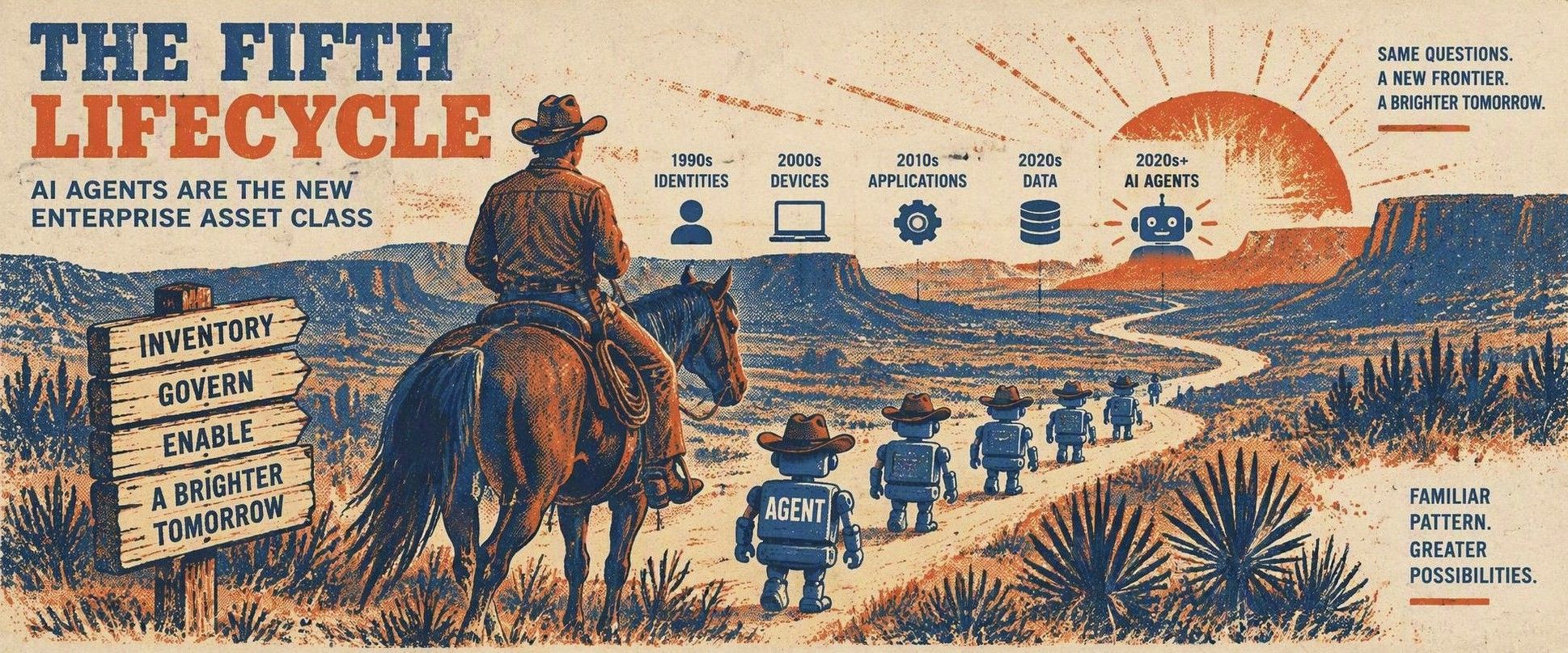
Enterprises already manage lifecycles for four critical asset classes:
- Identity
- Devices
- Applications
- Data
Agents now need a lifecycle as well. But these lifecycles are not independent; an agent depends on the assets beneath it:
- Identity: Its identity depends on identity governance.
- Access: Its access depends on access governance.
- Connections: Its connections depend on application governance.
What an agent can discover, summarize, generate, and send depends heavily on data governance. Organizations should treat agent governance as a fresh start only after assessing the health of the lifecycles beneath the agent and addressing the highest-risk gaps in identity, access, connections, and data.
The order matters: first understand and govern the information estate, then define how agents will use it. Agent-level controls are essential, but they cannot correct unowned content, stale permissions, or missing retention decisions.
The harder inventory is the information beneath the agent
When organizations prepare for agents, they naturally want to discover and catalog the agents themselves. That is necessary—but it is not sufficient.
Inventory the information those agents will encounter.
Start with the repositories that matter most. Identify where sensitive information lives, where access is broad, where reviews are overdue, where content is stale, and where ownership or classification is unclear. Prioritize the conditions that create the greatest business, security, compliance, and privacy risk. The agent lifecycle requires a healthy data foundation.
Start with the data that matters most
You do not need to solve every data governance problem before using an agent; for most large organizations, that would be an impossible prerequisite. The practical goal is to govern the information that matters most to the business processes where agents will operate.
Instead, focus on the business processes where agents will operate. Identify the repositories and data sources those processes depend on, then ask five questions:
- Inventory: What information and content do we have?
- Ownership: Who is accountable for it?
- Access: Who can access it, and is that access intentional?
- Value: Is it current and still needed?
- Disposition: What should happen when it is no longer needed?
This is the same governance pattern established in the previous article, applied to the data beneath the agent.
The paradox of AI governance
The paradox is simple: the more useful agents become, the more important existing data governance becomes.
A trivial agent needs little information. A genuinely useful enterprise agent usually needs much more:
- Context
- Knowledge
- Access to systems
- Information from across the organization
The business value of an agent is increasingly tied to the quality and accessibility of the organization’s information estate. But broader access also increases the consequences of stale, overshared, poorly classified, or ownerless content. The answer is not to make the agent blind; it is to make the information environment intentional.
The real question is not “Can the agent see it?”
Agent governance should not be reduced to a binary access question. Better questions include:
- Lifecycle: Should this information still exist, and does the business still need it?
- Access: Should this person still have access?
- Ownership: Is someone accountable for it?
- Classification: Is it appropriately classified?
- Intent: Is the access intentional?
- Currency: Is the information current?
Only after answering these questions does agent access become meaningful. An agent with properly scoped access to well-governed information is fundamentally different from one operating across years of unmanaged enterprise content.
AI does not replace data governance
AI makes weak data governance harder to ignore. Organizations do not need perfect classification, ownership, and permissions before experimenting with agents, but they do need to recognize the dependency: agent governance cannot be stronger than the data governance beneath it. Agents do not create the underlying data problem; they make it visible so the organization can begin fixing it.
The fifth lifecycle starts beneath the agent
Identity. Devices. Applications. Data. Agents.
Five enterprise asset classes. Five interconnected lifecycles. Each new layer depends on the ones beneath it. To prepare agents for enterprise data, begin with the information that matters most and follow a deliberate sequence:
- Find it.
- Classify it.
- Assign ownership.
- Review access.
- Retire what no longer belongs.
Agents inherit the information environment beneath them. The goal is not to help smarter agents navigate unmanaged content; it is to build governed agents on governed information.
This is the third article in a series exploring the “fifth lifecycle” of enterprise IT: governing AI agents alongside identities, devices, applications, and data.

 Microsoft