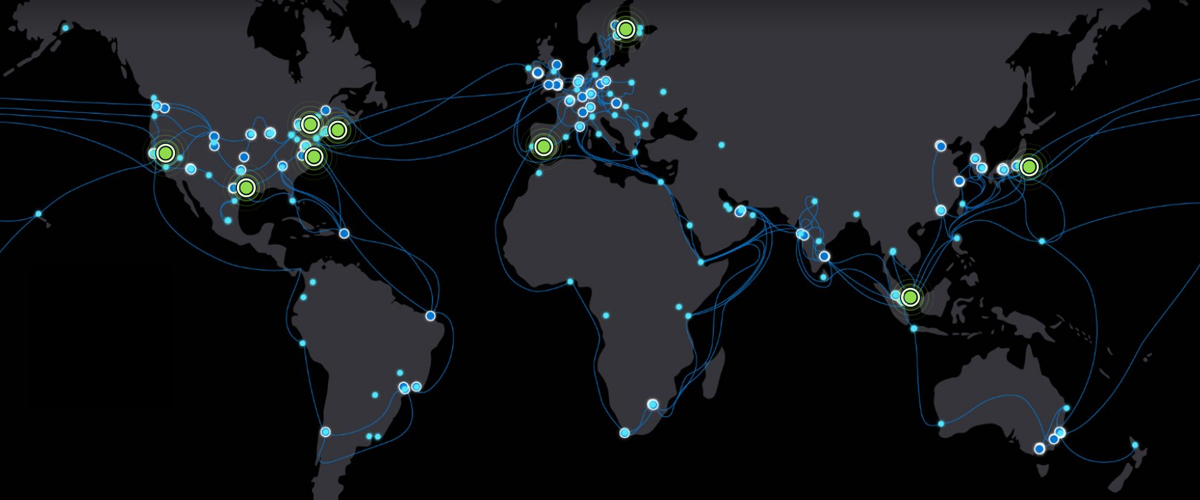
AI infrastructure is increasingly being deployed across a mix of Microsoft, partner, and customer-owned GPU environments, creating new demands for connectivity, operations, and access to cloud services. Azure ExpressRoute provides customers with private connectivity between their distributed infrastructure and Azure. Behind that customer experience, Microsoft is building AI Points of Presence (AI PoPs), a Microsoft-managed infrastructure layer designed to integrate distributed third-party GPU capacity into Azure with a consistent networking, security, and operational model. Based on current Microsoft deployment and provisioning data, AI PoP infrastructure is already connecting and provisioning hundreds of thousands of GPUs across North America, Europe, and Asia Pacific. This blog explains the model, its architecture, and how it can help scale distributed AI deployments.
Rethinking connectivity for distributed AI infrastructure
AI is changing more than the applications organizations build. It is reshaping where the infrastructure powering those applications is deployed.
For years, cloud computing has been anchored by hyperscale regions that combine compute, storage, networking, security, and operations at massive scale. That model remains foundational to Microsoft Azure. At the same time, rapid AI growth is creating a more distributed infrastructure landscape. GPU capacity is increasingly being deployed across regions, providers, facilities, and operating environments wherever the right mix of power, space, cooling, and specialized infrastructure is available.
That shift creates a practical challenge: how do organizations bring new GPU capacity online quickly while still giving AI workloads the Azure services, governance, security, and operational consistency they require?
Microsoft’s approach: extending Azure to distributed AI infrastructure
Microsoft is taking a platform approach to distributed AI infrastructure. For customers, Azure ExpressRoute offers the private connectivity experience for connecting remote sites and infrastructure to Azure. Behind that experience, AI PoPs provide Microsoft with a standardized infrastructure architecture for integrating distributed third-party GPU capacity into the Azure network and operating environment.
Rather than building a unique network and operational integration for every external GPU deployment, Microsoft can use AI PoPs to onboard and aggregate GPU capacity wherever the GPUs may be, while customers continue to connect through familiar Azure networking products such as ExpressRoute.
Azure ExpressRoute provides the private connectivity foundation for these customer-managed environments, enabling external GPU infrastructure to connect privately with Azure without traversing the public internet. Combined with the AI PoP architecture, this creates a repeatable model for integrating distributed GPU capacity with Azure, giving customers greater flexibility in where compute comes from while maintaining Azure as the platform connecting their AI environment.
Based on current Microsoft deployment and provisioning data, Azure’s AI PoP operating model is already connecting and provisioning hundreds of thousands of GPUs across North America, Europe, and Asia Pacific, giving select preview customers a consistent Azure experience for using distributed AI infrastructure. The aim is simple: bring AI capacity to market faster, wherever it is located, while expanding the range of GPU providers and deployment locations. Customers receive a more consistent Azure experience regardless of where that capacity is located.
Figure 1. Global deployment of Microsoft’s AI PoP infrastructure
Microsoft is expanding AI PoPs to more than 10 planned sites across North America, Europe, and Asia over the next 12 months.
Connecting distributed GPUs for faster connectivity and simpler operations for our customers
AI workloads depend on more than chips. They need data, orchestration, identity, monitoring, security, and reliable high-bandwidth connectivity. ExpressRoute provides customers with private, high-bandwidth connectivity to Azure. Behind the scenes, AI PoP infrastructure helps Microsoft integrate and operate distributed third-party GPUs at scale.
Together, this architecture can help customers:
- Connect privately to Azure: Use Azure ExpressRoute for private connectivity from remote sites and distributed infrastructure to Azure.
- Access distributed GPU capacity: Take advantage of GPU capacity across an expanding ecosystem of infrastructure providers without requiring customers to consume AI PoPs as a separate service.
- Use familiar Azure services: Connect workloads with Azure storage, orchestration, AI services, security, and operational tooling.
- Maintain a consistent Azure experience: Use established Azure networking and cloud services even as the physical GPU infrastructure becomes more distributed.
For customers, this means less bespoke connectivity work and more focus on putting AI capacity to use. AI PoPs is part of the Microsoft infrastructure that enables Azure to integrate third-party GPU capacity into this experience, with ExpressRoute as a customer-facing service. For infrastructure providers, it creates a clearer path for integrating specialized GPU environments with the Microsoft Cloud.
One Azure operating model, wherever AI capacity runs
As GPU capacity becomes more distributed, customers should not have to adopt a new connectivity model for every provider or location. Azure ExpressRoute provides the customer connectivity experience, while AI PoPs give Microsoft a repeatable infrastructure architecture for integrating third-party GPU capacity into the Azure network and operating environment.
That distinction matters as AI infrastructure spreads across regions and providers. Customers need flexibility in where capacity comes from, along with a reliable way to operate that capacity as part of a broader cloud environment. Microsoft is extending this model across regions to support Azure-connected AI capacity. The key principles behind the model are shown below (Figures 2–4).
Figure 2. Example of aggregating capacity across multiple locations
A single AI PoP can connect multiple GPU facilities and providers. Instead of treating each deployment as a unique project, new capacity can be onboarded through an established framework. This simplifies expansion, enables Microsoft to bring new capacity online faster, and makes it easier to scale as demand grows.
Figure 3. Private connectivity to Azure services through Azure ExpressRoute and AI PoPs
GPU capacity alone does not create an AI platform. Training and inference environments also depend on data, applications, orchestration, security, monitoring, and AI services. When GPU infrastructure sits outside Azure, the network becomes the critical bridge between compute and the Azure services it depends on.
For customer-managed deployments, Azure ExpressRoute provides private connectivity between external infrastructure and Azure without sending traffic over the public internet. AI PoPs build on this connectivity model to provide a consistent approach for integrating distributed GPU environments with Azure services.
Figure 4. AI PoPs deliver a consistent operating model
Whether capacity is supplied by Microsoft, partners, or customers, AI PoPs are designed to provide a consistent connectivity and management experience. Standardization simplifies deployment, improves repeatability, and reduces the redesign required when introducing new providers or locations.
Together, these design principles can reduce onboarding time, expand infrastructure choice, and provide a consistent Azure-connected experience.
Looking ahead
Demand for AI infrastructure continues to accelerate. Microsoft’s focus is not only on adding capacity, but also on making capacity available wherever it exists through a secure, reliable, and operationally consistent cloud platform.
The next phase will focus on onboarding additional GPU providers, strengthening automation, and expanding Microsoft's ability to integrate distributed AI infrastructure with Azure. As AI PoP infrastructure scales behind Azure, customers can continue to use established Azure products such as ExpressRoute to privately connect remote sites and workloads, while gaining access to a broader ecosystem of distributed GPU capacity.
As AI infrastructure becomes increasingly distributed, the ability to onboard capacity quickly, operate consistently across environments, and deliver a seamless Azure experience will become a meaningful differentiator. AI PoPs are one way Microsoft is helping shape that future.

 Microsoft