sovereignty
1 Topic
Production Touch Ledger (PTL): Verifiable records for operator transparency in the Sovereign Cloud
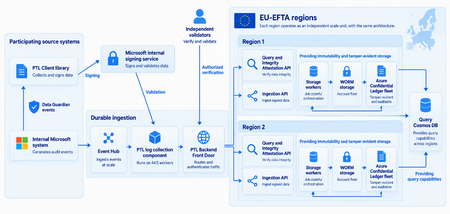
This post follows the broader Sovereign Public Cloud update by focusing on one technical mechanism for operational transparency: how PTL is designed to turn supported production-access event flows into reviewable tamper-evident records. As of October 2026, PTL is being rolled out in phases. Today, it covers production-access events from systems involved in the Data Guardian workflow in EU and EFTA cloud regions. Throughout this post, 'covered or in-scope systems' refers to these participating sources; coverage is expected to expand over time. For environments with sovereignty and regulatory requirements, the Production Touch Ledger (PTL) is designed to strengthen transparency and accountability for production-access activities. A production-access event represents an in-scope action performed during remote access by a Microsoft engineer to a production system in an EU or EFTA cloud region, captured by a supported source system - for example, reading a key in Azure Key Vault after being granted temporary access through Microsoft's just-in-time (JIT) access system. These events are recorded in an append-only, tamper-evident ledger, so any attempt to alter or delete the authoritative record — including by Microsoft — can be detected through verification. PTL records help address three critical questions: What happened? Who did it? And can unauthorized changes be detected? With PTL, authorized verification workflows can be used to verify the integrity of tamper-evident records of production activity, rather than relying solely on statements and assurances. Its architecture separates validation, signing, ingestion, processing, persistence, reconstruction, and verification so that each stage can be observed, tested, and governed. PTL provides documentation and verification of supported production-access activity. It does not replace the controls that determine whether production access is permitted. Why PTL exists In many systems, records handling can be implicit: events may be accepted, transformed, and queried in ways that make later verification difficult. PTL is designed to make records handling for supported production-access event flows explicit through defined stages and controls. PTL is engineered around three key capabilities: Verifiable records: PTL is designed to create durable, tamper-evident records of in-scope production-access events. Cryptographic integrity: PTL combines source signing, immutable storage, and cryptographic integrity proofs to support integrity verification. This verifiable-receipt model draws on is related to the approach Microsoft describes for software signing in Signing Transparency. Independent verification: Authorized verification workflows are designed to evaluate record integrity and identify inconsistencies in supported event records using integrity information maintained separately from the originating source system. Architecture at a glance PTL organizes in-scope production-access records processing into a seven-element conceptual flow: a participating source followed by six processing stages. Together, these stages show one way to combine source validation, durable ingestion, purpose-specific storage, reconstruction, and independent verification. This is one approach to combining these Azure services — not a prescriptive reference architecture — that architects can adapt to their own requirements Validation and signing: events are checked against the expected schema and cryptographically signed at the source. Durable ingestion: PTL is designed to acknowledge an event after durable capture. Downstream processing is then designed to complete or quarantine the event explicitly, so that processing failures can be surfaced for investigation. Secure processing: accepted events move through an asynchronous processing pipeline that validates each event, keeps it linked to the source system that produced it, and persists it for tamper-evident retention. Tamper-evident persistence: PTL is designed to retain signed events from supported source systems in Azure Blob Storage configured with immutability policies, record integrity references in Azure Confidential Ledger, and maintain query-ready projections in Azure Cosmos DB. Azure documentation describes Blob Storage write-once-read-many protections, Confidential Ledger's append-only and tamper-evident records, and Cosmos DB's indexing and query capabilities; PTL's end-to-end assurance still depends on its configuration, source coverage, and verification workflows. Record reconstruction: authorized workflows reconstruct event sequences and identify missing or inconsistent records. Authorized verification: authorized verification workflows are designed to evaluate event origin, integrity records, expected-event completeness, and records consistency beyond the producing system alone. Engineering deep dive Conceptual architecture: Participating source -> Validation and signing -> Durable ingestion -> Processing -> Tamper-evident persistence -> Record reconstruction -> Authorized verification. 1) Validation and source attribution PTL events are checked for structural conformance and signed at the source, then evaluated for cryptographic validity and source attribution through authorized verification workflows. 2) Asynchronous processing PTL’s ingestion design is intended to tie event acknowledgment to durable capture. After ingestion, accepted events move through an asynchronous pipeline, meaning processing continues in the background after the event is acknowledged. Controls in that pipeline help validate required attributes such as schema and signature, maintain the association between the event and their originating source system, record processing outcomes, and associate the retained event with the integrity information needed for later verification. Processing then completes, or the event is explicitly quarantined, so that processing outcomes can be surfaced for investigation. 3) Tamper-evident integrity association PTL retains signed event material alongside append-only integrity records that preserve verifiable linkage. Completeness checks help identify gaps among expected events from participating sources, while integrity verification is designed to identify inconsistencies resulting from covered modifications or deletions. These checks do not establish that every production action generated an event. 4) Purpose-specific persistence and record reconstruction PTL separates signed event material, append-only integrity records, and query-ready projections across purpose-specific Azure services. Each record surface serves a distinct role in retention, independent verification, or reconstruction of production activity. 5) Governed records retrieval PTL is designed to route records retrieval through authorized, role-scoped workflows rather than provide direct access to the underlying records stores. This keeps governance attached to records release as well as records retention. Closing PTL is best understood as a capability designed to provide reviewable records about supported production-access activity. Its architecture combines source validation and signing, durable ingestion, asynchronous processing, bounded completeness checks, tamper-evident persistence, record reconstruction, and governed retrieval. PTL is intended to support review of how in-scope production-access activity is captured, attributed, protected against undetected change, and released through governed workflows. This supports the broader Sovereign Public Cloud goal of operational oversight and transparency while remaining bounded by participating sources, configured controls, and published availability. In November 2026, Production Touch Ledger (PTL) was independently assessed by an authorized third party who evaluated its design and capabilities to provide verifiable, tamper-evident records of production access. 3P Validation report assessment supports greater transparency, trust, and accountability in sovereign and regulated environments.43Views0likes0Comments