security development lifecycle (sdl)
8 Topics
Microsoft Leads a New Era of Software Supply Chain Transparency
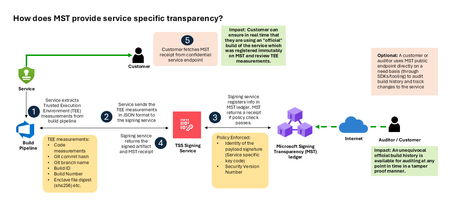
Today, Microsoft announces the general availability of Microsoft’s Signing Transparency (MST) – a first-of-its-kind capability that brings unprecedented visibility and trust to our software supply chain. With this release, Microsoft is leading the industry by recording the build of critical cloud services into a publicly readable and verifiable SCITT standard (Supply Chain Integrity, Transparency, and Trust) compliant blockchain ledger. This means every production software build for in scope services like Azure Attestation and Azure Managed HSM (Hardware Security Module), Azure confidential ledger, Microsoft Signing Transparency itself (and others over time) – is now logged in an immutable, tamper-evident record. Only builds that are in the MST ledger are deployed to production; this gives customers confidence that the supply chain for these critical services can be audited at anytime. Notably, the MST ledger is fully open source and built to align with the emerging IETF SCITT standard. By embracing SCITT’s principles and open protocols, Microsoft ensures that MST not only secures our own ecosystem but also contributes to a broader industry movement toward standardized supply chain transparency. The open-source MST ledger serves as a verifiable trust anchor that any organization or researcher can inspect, audit, or even integrate with their own tooling. MST itself meets the highest levels of transparency, backed by a tamper-proof confidential ledger, open-source, and independently verified. Specifically, we are making the foundation of our trust model transparent and accessible to everyone – reinforcing that trust must be earned through proof, not just promises. This launch marks a major milestone in our commitment to Zero Trust principles, extending “never trust, always verify” all the way into the build itself. Building on a public preview introduced late last year, MST’s general availability delivers verifiable transparency at the software level. It transforms traditional code signing with an additive trust layer that is accessible via an open verification model. Every new software update is accompanied by a publicly auditable proof of integrity, enabling security teams to proactively confirm that each update is authentic and unaltered. To help organizations get the most out of this capability, we are also introducing a free tool to explore the contents – Ledger Explorer – an offline tool that allows security teams to examine MST ledger entries, verify cryptographic proofs, and even validate the ledger’s integrity independently. This tool, combined with MST’s open design, ensures that every Microsoft customer – and the broader community – can hold us accountable in real time for the software we run on their behalf. Key Benefits of Microsoft’s Signing Transparency (MST) Verified Code Integrity – Every software release is cryptographically logged in MST’s ledgers. This makes each build tamper-evident and traceable. If an attacker attempts to inject malicious code or sign an unauthorized update, it will be evident through the well-defined validation step built into the SCITT standard. Organizations gain the assurance that code integrity can be independently confirmed at any time. Independent Verification & Zero Trust – MST enables customers and auditors to verify software authenticity on their own, without having to solely rely on vendor attestations. For each update, Microsoft provides a transparency “receipt” (proof of logging) that you can use to prove the update was officially published and unaltered. This fosters a “don’t just trust, verify” approach, empowering security teams to double-check everything running in their environment aligns with what Microsoft intended. Audit-Trail & Compliance – The transparency ledger creates a permanent, auditable timeline of code deployments. Every entry is a record of what was released and when, backed by cryptographic proofs. This simplifies compliance reporting and accelerates forensic analysis. In the event of an incident, you can quickly audit the ledger to see if any unexpected code was introduced. For highly regulated industries, MST offers concrete evidence of software integrity and policy compliance over time. Leadership & Open Standards – We are delivering real transparency now, encouraging a future where all critical software is released with verifiable integrity. MST’s open source implementation and SCITT-compliant design exemplify our commitment to openness and collaboration. We believe widespread adoption of these standards will strengthen supply chain security for everyone, making trust verification a universal practice. Next Steps Microsoft’s Signing Transparency is more than a new security feature and shapes the advances in trust technology. As threats grow more sophisticated, we must evolve the way we assure our customers about the software they depend on. With MST now generally available, we are leading by example: proving that it is possible to open up the traditionally opaque process of software deployment and turn it into a source of strength and trust, i.e., empowering each person with verifiable transparency. We invite the industry to join us on this journey and get started by reading the documentation and exploring Ledger Explorer today! Together, by embracing transparency and open standards, we can turn “trust but verify” from a slogan into an everyday reality for digital infrastructure.2.4KViews2likes3CommentsState Explosion Security Problem in AI-Era Software Supply Chains
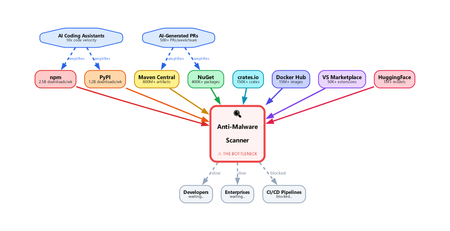
Introduction To see why this problem scales so quickly, start with the smallest possible change: a single line of code. In modern software, even a tiny edit is rarely just a local modification. It can change execution flow, introduce a new dependency, expose sensitive data, or quietly shift the purpose of the package itself. What looks trivial in a diff can create a materially different security outcome. That is why supply chain defenders cannot afford to treat small code changes as small security events. How a Single Line Changes Package Intent Every software package exists in a particular state at a particular moment in time. Imagine a benign version — State X — that behaves exactly as intended. Now add one line of code. That small edit can shift the package into a new state with different behavior and, potentially, a very different risk profile. The security issue is not the added line by itself. It is the fact that the package now has to be interpreted differently. A tiny diff can change the role of the entire component, which means defenders have to reason about the resulting behavior, not just the textual change. That is why file-level scanning breaks down so quickly. A change in one file can alter the behavior of the entire package because software semantics emerge from how components interact. Security systems therefore need to analyze packages as composed systems, not as a series of isolated file edits. Why the whole package matters This matters even more in modern supply chain attacks, where malicious intent is rarely concentrated in one obvious file. More often, the behavior is distributed across several files that look harmless when viewed independently. File A defines an encoded string constant. Looks like a config value. File B provides a decode function. Looks like a utility. File C (setup.py / postinstall) imports both, decodes, and executes. Viewed independently, each file may appear benign. No single file has to trigger a clear signature, rule, or heuristic. The malicious behavior only becomes visible when you reconstruct how the files interact as a system. Any scanner that evaluates files one by one without rebuilding that interaction is likely to miss the real behavior. Why every change demands re-analysis Every meaningful state change — a commit, pull request, version bump, or package publish — can alter the semantics of the software. That means defenders cannot stop at diff inspection or lightweight pattern matching. The real question is not only what changed, but what the software now does. Quantifying the problem The scale of the problem becomes clearer when you look at how many software state changes occur across the ecosystem every day: GitHub alone recorded nearly 1 billion commits in 2025, merged an average of 43.2 million pull requests per month, and now hosts roughly 630 million repositories. In 2026, GitHub was projected to reach roughly 38 million commits per day. npm has grown to well over 2 million packages, making JavaScript one of the largest public package ecosystems. PyPI published more than 130,000 new projects in 2025 and more than 3.9 million new files in the same year. NuGet serves package downloads at massive operational scale, with recent weekly totals in the 5 to 6 billion range. Maven Central indexed more than 20 million packages and published more than 3.2 million packages in 2025. Taken together, these ecosystems are generating an enormous stream of new software states. Some numbers describe repositories, some describe publishes, and some describe downloads, but they all point to the same reality: the scale of software movement is already massive before you even account for the acceleration from AI-assisted development. The number of state changes is already enormous, and AI-assisted development is increasing it even further. The result is not just more code, but more package states that may require meaningful security interpretation. Why the math breaks traditional scanning Assume a single semantic package analysis takes 30 seconds, which is a reasonable range for LLM-based inference. Scanning 50,000 packages would require roughly 1.5 million seconds of compute time per day — about 417 hours. But the ecosystem only gives defenders 24 hours before the next wave of packages arrives. Without aggressive parallelism and purpose-built infrastructure, backlog becomes inevitable. The scanning bottleneck This leaves modern scanning systems with a fundamental bottleneck: Heuristic and signature-based scanners are fast. They can match known patterns in milliseconds and work well for familiar malware families or repeated behaviors. Some systems also use emulation or detonation, but these approaches still struggle to deliver deep reasoning at ecosystem scale. That makes them easier to bypass with novel, well-structured, or AI-generated code that behaves maliciously without resembling previously known samples. LLM-based semantic analysis can reason about intent. It can follow behavior across files, recognize obfuscated exfiltration paths, and explain why a package is suspicious even when the code appears ordinary at first glance. The tradeoff is cost, latency, and trust: inference takes seconds rather than milliseconds, and a single package may require multiple reasoning passes. At ecosystem scale, that becomes a serious infrastructure challenge. Neither approach is sufficient on its own. Heuristics provide speed without deep understanding, while semantic models provide understanding without inherent scale. Closing the gap requires systems that combine both: package-level reasoning with the latency and throughput needed for production supply chains. Heuristics often miss novel attacks, while LLM-based approaches remain too slow to apply inline at large scale. That gap between understanding and throughput is where supply chain malware can persist. What needs to change Closing that gap will require a different class of supply chain security systems. Detonation can help in some cases, but it is too slow and expensive to apply inline to every package state change. What is needed is a system that can: Analyze entire packages as a unit — not individual files. The intent lives in the interaction between files, not within any single one. Run semantic analysis at data-plane speed — every package, every version, on the hot path, with latency low enough for inline enforcement. Not async advisories. Not CI-time checks. Inline, before delivery. Handle the state explosion — millions of state changes per day, each requiring full re-analysis. This is an infrastructure problem as much as a security problem: rate limiting, backpressure, connection pooling, regional failover, model versioning — the same hard distributed systems problems, with security stakes. Maintain high accuracy under evasion — attackers deliberately use encoding, string splitting, dynamic imports, polyglot files, and similar techniques to reduce detection quality. The scanner must continue to classify packages accurately even when the code is designed to obscure intent. The Latency-Accuracy Tradeoff: Malware Detection as an ML Problem At cloud scale, malware detection is governed by a hard tradeoff between latency, accuracy, throughput, and cost. The fastest detectors are typically shallow: signatures, heuristics, and lightweight models can make decisions in milliseconds, but they often miss novel, compositional, or intent-level attacks. Deeper semantic analysis can improve recall and resilience against evasion, but it also increases inference time, compute cost, and operational complexity. As a result, defenders cannot optimize for accuracy in isolation; they must deliver strong detection quality within strict performance constraints. This makes malware detection not just a cybersecurity problem, but a machine learning and distributed systems problem. In modern software supply chains, AI-assisted development increases the number of package states and enables attackers to generate variants at high speed, expanding the space defenders must reason over. The challenge is therefore to build detection architectures that preserve semantic depth while remaining fast enough for inline use at global scale. The gap between the rate of software change and the capacity to analyze it is widening. That gap is the attack surface. If defenders cannot inspect software at the speed it is being produced and published, attackers will continue to exploit the delay. What the industry needs now is a cloud-scale malware analysis capability that can deliver low latency, low cost, high accuracy, and the flexibility to meet different operational requirements , such as SLAs, false-positive tolerance, and enforcement policies , without compromising on package-level semantic analysis.Authorization and Identity Governance Inside AI Agents
Designing Authorization‑Aware AI Agents Enforcing Microsoft Entra ID RBAC in Copilot Studio As AI agents move from experimentation to enterprise execution, authorization becomes the defining line between innovation and risk. AI agents are rapidly evolving from experimental assistants into enterprise operators—retrieving user data, triggering workflows, and invoking protected APIs. While many early implementations rely on prompt‑level instructions to control access, regulated enterprise environments require authorization to be enforced by identity systems, not language models. This article presents a production‑ready, identity‑first architecture for building authorization‑aware AI agents using Copilot Studio, Power Automate, Microsoft Entra ID, and Microsoft Graph, ensuring every agent action executes strictly within the requesting user’s permissions. Why Prompt‑Level Security Is Not Enough Large Language Models interpret intent—they do not enforce policy. Even the most carefully written prompts cannot: Validate Microsoft Entra ID group or role membership Reliably distinguish delegated user identity from application identity Enforce deterministic access decisions Produce auditable authorization outcomes Relying on prompts for authorization introduces silent security failures, over‑privileged access, and compliance gaps—particularly in Financial Services, Healthcare, and other regulated industries. Authorization is not a reasoning problem. It is an identity enforcement problem. Common Authorization Anti‑Patterns in AI Agents The following patterns frequently appear in early AI agent implementations and should be avoided in enterprise environments: Hard‑coded role or group checks embedded in prompts Trusting group names passed as plain‑text parameters Using application permissions for user‑initiated actions Skipping verification of the user’s Entra ID identity Lacking an auditable authorization decision point These approaches may work in demos, but they do not survive security reviews, compliance audits, or real‑world misuse scenarios. Authorization‑Aware Agent Architecture In an authorization‑aware design, the agent never decides access. Authorization is enforced externally, by identity‑aware workflows that sit outside the language model’s reasoning boundary. High‑Level Flow The Copilot Studio agent receives a user request The agent passes the User Principal Name (UPN) and intended action A Power Automate flow validates permissions using Microsoft Entra ID via Microsoft Graph Only authorized requests are allowed to proceed Unauthorized requests fail fast with a deterministic outcome Authorization‑aware Copilot Studio architecture enforces Entra ID RBAC before executing any business action. The agent orchestrates intent. Identity systems enforce access. Enforcing Entra ID RBAC with Microsoft Graph Power Automate acts as the authorization enforcement layer: Resolve user identity from the supplied UPN Retrieve group or role memberships using Microsoft Graph Normalize and compare memberships against approved RBAC groups Explicitly deny execution when authorization fails This keeps authorization logic: Centralized Deterministic Auditable Independent of the AI model Reference Implementation: Power Automate RBAC Enforcement Flow The following import‑ready Power Automate cloud flow demonstrates a secure RBAC enforcement pattern for Copilot Studio agents. It validates Microsoft Entra ID group membership before allowing any business action. Scenario Trigger: User‑initiated agent action Identity model: Delegated user identity Input: userUPN, requestedAction Outcome: Authorized or denied based on Entra ID RBAC { "$schema": "https://schema.management.azure.com/providers/Microsoft.Logic/schemas/2016-06-01/workflowdefinition.json#", "contentVersion": "1.0.0.0", "triggers": { "Copilot_Request": { "type": "Request", "kind": "Http", "inputs": { "schema": { "type": "object", "properties": { "userUPN": { "type": "string" }, "requestedAction": { "type": "string" } }, "required": [ "userUPN" ] } } } }, "actions": { "Get_User_Groups": { "type": "Http", "inputs": { "method": "GET", "uri": "https://graph.microsoft.com/v1.0/users/@{triggerBody()?['userUPN']}/memberOf?$select=displayName", "authentication": { "type": "ManagedServiceIdentity" } } }, "Normalize_Group_Names": { "type": "Select", "inputs": { "from": "@body('Get_User_Groups')?['value']", "select": { "groupName": "@toLower(item()?['displayName'])" } }, "runAfter": { "Get_User_Groups": [ "Succeeded" ] } }, "Check_Authorization": { "type": "Condition", "expression": "@contains(body('Normalize_Group_Names'), 'ai-authorized-users')", "runAfter": { "Normalize_Group_Names": [ "Succeeded" ] }, "actions": { "Authorized_Action": { "type": "Compose", "inputs": "User authorized via Entra ID RBAC" } }, "else": { "actions": { "Access_Denied": { "type": "Terminate", "inputs": { "status": "Failed", "message": "Access denied. User not authorized via Entra ID RBAC." } } } } } } } This pattern enforces authorization outside the agent, aligns with Zero Trust principles, and creates a clear audit boundary suitable for enterprise and regulated environments. Flow Diagram: Agent Integrated with RBAC Authorization Flow and Sample Prompt Execution: Delegated vs Application Permissions Scenario Recommended Permission Model User‑initiated agent actions Delegated permissions Background or system automation Application permissions Using delegated permissions ensures agent execution remains strictly within the requesting user’s identity boundary. Auditing and Compliance Benefits Deterministic and explainable authorization decisions Centralized enforcement aligned with identity governance Clear audit trails for security and compliance reviews Readiness for SOC, ISO, PCI, and FSI assessments Enterprise Security Takeaways Authorization belongs in Microsoft Entra ID, not prompts AI agents must respect enterprise identity boundaries Copilot Studio + Power Automate + Microsoft Graph enable secure‑by‑design AI agents By treating AI agents as first‑class enterprise actors and enforcing authorization at the identity layer, organizations can scale AI adoption with confidence, trust, and compliance.Accelerate connectors development using AI agent in Microsoft Sentinel
Today, we’re excited to announce the public preview of a Sentinel connector builder agent, via VS code extension, that helps developers build Microsoft Sentinel codeless connectors faster with low-code and AI-assisted prompts. This new capability brings guided workflows directly into the tooling developers already use, helping accelerate time to value as the Sentinel ecosystem continues to grow. Learn more at Create custom connectors using Sentinel connector AI agent Why this matters As the Microsoft Sentinel ecosystem continues to expand, developers are increasingly tasked with delivering high‑quality, production‑ready connectors at a faster pace, often while working across different cloud platforms and development environments. Building these integrations involves coordinating schemas, configuration artifacts, Azure deployment concepts, and validation steps that provide flexibility and control, but can span multiple tools and workflows. As connector development scales across more partners and scenarios, there is a clear opportunity to better integrate these capabilities into the developer environments teams already rely on. The new Sentinel connector builder agent, using GitHub Copilot in the Sentinel VS code extension, brings more of the connector development lifecycle -- authoring, validation, testing, and deployment into a single, cohesive workflow. By consolidating these common steps, it helps developers move more easily from design to validation and deployment without disrupting established processes. A guided, AI‑assisted workflow inside VS Code The Sentinel connector builder agent for Visual Studio Code is designed to help developers move from API documentation to a working codeless connector more efficiently. The experience begins with an ISVs API documentation. Using GitHub Copilot chat inside VS Code, developers can describe the connector they want to build and point the extension to their API docs, either by URL or inline content. From there, the AI‑guided workflow reads and extracts the relevant details needed to begin building the connector. Open the VS Code chat and set the chat to Agent mode. Prompt the agent using sentinel. When prompted, select /create-connector and select any supported API. For example in Contoso API, enter the prompt as: @sentinel /create-connector Create a connector for Contoso. Here are the API docs: https://contoso-security-api.azurewebsites.net/v0101/api-doc Next, the agent generates the required artifacts such as polling configurations, data collection rules (DCRs), table schemas, and connector definitions, using guided prompts with built‑in validation. This step‑by‑step experience helps ensure configurations remain consistent and aligned as they’re created. Note: During agent evaluation, select Allow responses once to approve changes, or select the option Bypass Approvals in the chat. It might take up to several minutes for the evaluations to finish. As the connector takes shape, developers can validate and test configurations directly within VS Code, including testing API interactions before deployment. Validation of the API data source and polling configuration are surfaced in context, supporting faster iteration without leaving the development environment. When ready, connectors can be deployed directly from VS Code to accessible Microsoft Sentinel workspaces, streamlining the path from development to deployment without requiring manual navigation of the Azure portal. Key capabilities The VS Code connector builder experience includes: AI‑guided connector creation to generate codeless connectors from API documentation using natural language prompts. Support for common authentication methods, including Basic authentication, OAuth 2.0, and API keys. Automated validation to check schemas, cross‑file consistency, and configuration correctness as you build. Built‑in testing to validate polling configurations and API interactions before deployment. One‑click deployment that allows publishing connectors directly to accessible Microsoft Sentinel workspaces from within VS Code. Together, these capabilities support a more efficient path from API documentation to a working Microsoft Sentinel connector. Testimonials As partners begin using the Sentinel connector builder agent, feedback from the community will help shape future enhancements and refinements. Here is what some of our early adopters have to say about the experience: “The connector builder agent accelerated our initial exploration of the codeless connector framework and helped guide our connector design decisions.” -- Rodrigo Rodrigues, Technology Alliance Director “The connector builder agent helped us quickly explore and validate connector options on the codeless connector framework while developing our Sentinel integration.” --Chris Nicosia, Head of Cloud and Tech Partnerships Start building This public preview represents an important step toward simplifying how ISVs build and maintain integrations with Microsoft Sentinel. If you’re ready to get started, the Sentinel connector builder agent is available in public preview for all participants. In the unlikely event that an ISV encounters any issues in building or updating a CCF connector, App Assure is here to help. Reach out to us here.
Transforming Security Analysis into a Repeatable, Auditable, and Agentic Workflow
Author(s): Animesh Jain, Vinay Yadav Shaped by investigations into the strategic question of what it takes for Windows to achieve world-leading security—and the practical engineering needed to explore agentic workflows at scale and their interfaces. Our work in Windows Servicing & Delivery (WSD) is shaped by two guiding prompts from leadership: "what does it take for Windows to achieve world-leading security", and "how do we responsibly integrate AI into systems as large and high-churn as Windows?". Reasoning models open new possibilities on both fronts. As we continue experimenting, one issue repeatedly surfaces as the bottleneck for scalable security assurance: variant vulnerabilities. They are subtle, recurring, and easy to miss—making them an ideal proving ground for the enterprise-grade workflow we present here. Security Analysis at Windows Scale Security analysis shouldn’t be an afterthought—it should be a continuous, auditable, and intelligence-driven process built directly into the engineering workflow. This work introduces an agentic security analysis pipeline that uses reasoning models and tool-based agents to detect variant vulnerabilities across large, fast-changing codebases. By combining automation with explainability, it transforms security validation from a manual, point-in-time task into a repeatable and trustworthy part of every build. Why are variants the hard part? Security flaws rarely occur in isolation. Once a vulnerability is fixed, its logical or structural pattern often reappears elsewhere in the codebase—hidden behind different variables, layers, or call paths. These recurring patterns are variants—the quiet echoes of known issues that can persist across millions of lines of code. Finding them manually is slow, repetitive, and incomplete. As engineering velocity increases, so does the likelihood of variant drift—the same vulnerability class re-emerging in a slightly altered form. Each missed variant carries a downstream cost: regression, re-servicing, or, in the worst cases, re-exploitation. Modern large systems like Windows are too large, too interconnected, and ship too frequently for manual vulnerability discovery to keep pace. Traditional static analyzers and deterministic class-based scanners struggle to generalize these patterns or create too much noise, while targeted fuzzing campaigns often fail to trigger the nuanced runtime conditions that expose them. To stay ahead, automation must evolve. We need systems that reason—not just scan—systems capable of understanding relationships between code regions and applying logical analogies instead of brute-force enumeration. Reasoning Models: A Turning Point in Security Research Recent advances in AI reasoning have demonstrated that large language models can uncover vulnerabilities previously missed by deterministic tools. For example, Google’s Big Sleep agent surfaced an exploitable SQLite flaw (CVE-2025-6965) that bypassed traditional fuzzers due to configuration-sensitive logic. Similarly, an o-series reasoning model helped identify a critical Linux SMB logoff use-after-free (CVE-2025-37899), proving that reasoning-driven automation can detect complex, context-dependent flaws in mature kernel code. These breakthroughs show what’s possible when systems can form, test, and refine hypotheses about software behavior. The challenge now is scaling that intelligence into repeatable, auditable, enterprise-grade workflows—where every result is traceable, reviewable, and integrated into the developer’s daily workflow. A Framework for Agentic Security Analysis To address this challenge, we’ve developed an agentic security analysis framework that applies reasoning models within structured, enterprise grade workflow pattern. It combines large language model agents, specialized analysis tools, and structured artifact generation to make vulnerability discovery continuous, explainable, and auditable. It is interfaced as a first-class Azure DevOps (ADO) pipeline and can be integrated natively into enterprise CI/CD processes. For security analysis, it continuously reasons over large, evolving codebases to identify and validate variant vulnerabilities earlier in the release cycle. Together, these components form a repeatable workflow that helps surface variant patterns with greater consistency and clarity. Core Technical Pillars Scale – Autonomous Code Reasoning Long-context models extend analysis across massive, evolving codebases. They infer analogies, relationships, and behavioral patterns between code regions, enabling scalable reasoning that adapts as systems grow. Tool–Agent Collaboration Specialized agents coordinate to perform semantic search, graph traversal, and both static and dynamic interpretation. This distributed reasoning approach ensures resilience and precision across diverse enterprise environments. Structured Artifact Generation Every step produces versioned, auditable artifacts that document the reasoning process. These artifacts help provide reproducibility, compliance, and transparency—critical for enterprise governance and regulated industries. Together, these pillars enable scalable, explainable, and repeatable vulnerability discovery across large software ecosystems such as Windows. Every stage—from reasoning to validation—is logged and traceable, designed to make each discovery reproducible and reviewable. Inside the framework Agent-Led, Human-Reviewed The system is agent-led from start to finish and human-reviewed only at decision boundaries. Agents form hypotheses from recent fixes or vulnerability classes, test them against context, perform validation passes, and generate evidence-backed reports for reviewer confirmation. The workflow mirrors how seasoned security engineers operate—only faster and continuously. n tasks based on templatized prompts. Tool Specialists as Agents Each analytical tool functions as a domain-specific agent—performing semantic search, file inspection, or function-graph traversal. These agents collaborate through structured orchestration, maintaining specialization without sacrificing coherence. Agentic Patterns and Orchestration The framework employs reusable reasoning patterns—reflective reasoning, actor–validator loops, and parallel tool dialogues—for accuracy and scale. A central conductor agent governs task coordination, context flow, and artifact persistence across runs. Auditability Through Artifacts Every investigation yields a transparent chain of artifacts: Analysis Notes – summarize candidate issues Critique Notes – document reasoning and counter-evidence Synthesis Reports – provide developer-ready summaries, diffs, call graphs, and exploitability insights Agentic Conversation Logs - provides conversation logs so developers can backtrack on reasoning and get more context This structure makes each discovery fully traceable and auditable. CI/CD-Native Integration The interface operates as a first-class Azure DevOps pipeline, attachable to pull requests, nightly builds, or release triggers. Each run publishes versioned artifacts and validation notes directly into the developer workflow—making reasoning-driven security a seamless part of software delivery. What It Can Do Today Seeded Variant Hunts: Start from a recent fix or known pattern to enumerate analogous cases, analyze helper functions, and test reachability. Evidence-First Reporting: Every finding includes reproducible evidence—code snippets, diffs, and caller graphs—delivered within the PR or work item. Scalable Coverage: Runs across servicing branches, producing consistent and auditable validation artifacts. Improved Precision: A reasoning-based validation pass has significantly reduced false positives in internal testing. Case Study: CVE-2025-55325 During a sweep of “*_DEFAULTS” deserializers, the agentic pipeline independently identified GetPoolDefaults trusting a user-controlled size field and copying that many bytes from a caller buffer. The missing runtime bounds check—guarded only by an assertion in debug builds—enabled a potential read access violation and information disclosure. The mitigation mirrored a hardened sibling helper: enforcing runtime bounds on Size versus BytesAvailable/Version before allocation and copy. The finding was later validated by the servicing teams, confirming it matched an issue already under active investigation—illustrating how the automated reasoning process can independently surface real-world vulnerabilities that align with expert analysis. Beyond Variant Analysis The underlying architecture of this framework extends naturally beyond variant detection: Net-new vulnerability discovery through cross-binary pattern matching Model-assisted fuzzing & static analysis orchestrated through CI/CD integration Regression detection via historical code comparisons Security Development Lifecycle (SDL) enforcement and reproducibility checks The agentic patterns and tooling can support net-new vulnerability discovery through cross-binary pattern matching, regression detection using historical code comparisons, reproducibility checks aligned with SDL requirements, and model-assisted fuzzing orchestrated through CI/CD processes. These capabilities open the door to applying reasoning-driven workflows across a broader range of security & validation tasks. The Road Ahead Looking ahead, this trajectory naturally leads toward autonomous cybersecurity pipelines powered by reasoning agents that apply reflective analysis, validation loops, and structured tool interactions to complex codebases. By structuring each step as an auditable artifact, the approach supports security & validation analysis that is both explainable and repeatable. These agents could help validate security posture, analyze historical and real-time signals, and detect anomalous patterns early in the lifecycle. References Google Cloud Blog – Big Sleep and AI-Assisted Vulnerability Discovery “A summer of security: empowering cyber defenders with AI.” https://blog.google/technology/safety-security/cybersecurity-updates-summer-2025 The Hacker News – Google AI ‘Big Sleep’ Stops Exploitation of Critical SQLite Flaw https://thehackernews.com/2025/07/google-ai-big-sleep-stops-exploitation.html NIST National Vulnerability Database – CVE-2025-6965 (SQLite) https://nvd.nist.gov/vuln/detail/CVE-2025-6965 Sean Heelan – “Reasoning Models and the ksmbd Use-After-Free” https://simonwillison.net/2025/May/24/sean-heelan The Cyber Express – AI Finds CVE-2025-37899 Zero-Day in Linux SMB Kernel https://thecyberexpress.com/cve-2025-37899-zero-day-in-linux-smb-kernel NIST National Vulnerability Database – CVE-2025-37899 (Linux SMB Use-After-Free) https://nvd.nist.gov/vuln/detail/CVE-2025-37899 NIST National Vulnerability Database – CVE-2025-55325 (Windows Storage Management Provider Buffer Over-read) https://nvd.nist.gov/vuln/detail/CVE-2025-55325 NVD Microsoft Security Response Center – Vulnerability Details for CVE-2025-55325 https://msrc.microsoft.com/update-guide/vulnerability/CVE-2025-55325Hacking Made Easy, Patching Made Optional: A Modern Cyber Tragedy
In today’s cyber threat landscape, the tools and techniques required to compromise enterprise environments are no longer confined to highly skilled adversaries or state-sponsored actors. While artificial intelligence is increasingly being used to enhance the sophistication of attacks, the majority of breaches still rely on simple, publicly accessible tools and well-established social engineering tactics. Another major issue is the persistent failure of enterprises to patch common vulnerabilities in a timely manner—despite the availability of fixes and public warnings. This negligence continues to be a key enabler of large-scale breaches, as demonstrated in several recent incidents. The Rise of AI-Enhanced Attacks Attackers are now leveraging AI to increase the credibility and effectiveness of their campaigns. One notable example is the use of deepfake technology—synthetic media generated using AI—to impersonate individuals in video or voice calls. North Korean threat actors, for instance, have been observed using deepfake videos and AI-generated personas to conduct fraudulent job interviews with HR departments at Western technology companies. These scams are designed to gain insider access to corporate systems or to exfiltrate sensitive intellectual property under the guise of legitimate employment. Social Engineering: Still the Most Effective Entry Point And yet, many recent breaches have begun with classic social engineering techniques. In the cases of Coinbase and Marks & Spencer, attackers impersonated employees through phishing or fraudulent communications. Once they had gathered sufficient personal information, they contacted support desks or mobile carriers, convincingly posing as the victims to request password resets or SIM swaps. This impersonation enabled attackers to bypass authentication controls and gain initial access to sensitive systems, which they then leveraged to escalate privileges and move laterally within the network. Threat groups such as Scattered Spider have demonstrated mastery of these techniques, often combining phishing with SIM swap attacks and MFA bypass to infiltrate telecom and cloud infrastructure. Similarly, Solt Thypoon (formerly DEV-0343), linked to North Korean operations, has used AI-generated personas and deepfake content to conduct fraudulent job interviews—gaining insider access under the guise of legitimate employment. These examples underscore the evolving sophistication of social engineering and the need for robust identity verification protocols. Built for Defense, Used for Breach Despite the emergence of AI-driven threats, many of the most successful attacks continue to rely on simple, freely available tools that require minimal technical expertise. These tools are widely used by security professionals for legitimate purposes such as penetration testing, red teaming, and vulnerability assessments. However, they are also routinely abused by attackers to compromise systems Case studies for tools like Nmap, Metasploit, Mimikatz, BloodHound, Cobalt Strike, etc. The dual-use nature of these tools underscores the importance of not only detecting their presence but also understanding the context in which they are being used. From CVE to Compromise While social engineering remains a common entry point, many breaches are ultimately enabled by known vulnerabilities that remain unpatched for extended periods. For example, the MOVEit Transfer vulnerability (CVE-2023-34362) was exploited by the Cl0p ransomware group to compromise hundreds of organizations, despite a patch being available. Similarly, the OpenMetadata vulnerability (CVE-2024-28255, CVE-2024-28847) allowed attackers to gain access to Kubernetes workloads and leverage them for cryptomining activity days after a fix had been issued. Advanced persistent threat groups such as APT29 (also known as Cozy Bear) have historically exploited unpatched systems to maintain long-term access and conduct stealthy operations. Their use of credential harvesting tools like Mimikatz and lateral movement frameworks such as Cobalt Strike highlights the critical importance of timely patch management—not just for ransomware defense, but also for countering nation-state actors. Recommendations To reduce the risk of enterprise breaches stemming from tool misuse, social engineering, and unpatched vulnerabilities, organizations should adopt the following practices: 1. Patch Promptly and Systematically Ensure that software updates and security patches are applied in a timely and consistent manner. This involves automating patch management processes to reduce human error and delay, while prioritizing vulnerabilities based on their exploitability and exposure. Microsoft Intune can be used to enforce update policies across devices, while Windows Autopatch simplifies the deployment of updates for Windows and Microsoft 365 applications. To identify and rank vulnerabilities, Microsoft Defender Vulnerability Management offers risk-based insights that help focus remediation efforts where they matter most. 2. Implement Multi-Factor Authentication (MFA) To mitigate credential-based attacks, MFA should be enforced across all user accounts. Conditional access policies should be configured to adapt authentication requirements based on contextual risk factors such as user behavior, device health, and location. Microsoft Entra Conditional Access allows for dynamic policy enforcement, while Microsoft Entra ID Protection identifies and responds to risky sign-ins. Organizations should also adopt phishing-resistant MFA methods, including FIDO2 security keys and certificate-based authentication, to further reduce exposure. 3. Identity Protection Access Reviews and Least Privilege Enforcement Conducting regular access reviews ensures that users retain only the permissions necessary for their roles. Applying least privilege principles and adopting Microsoft Zero Trust Architecture limits the potential for lateral movement in the event of a compromise. Microsoft Entra Access Reviews automates these processes, while Privileged Identity Management (PIM) provides just-in-time access and approval workflows for elevated roles. Just-in-Time Access and Risk-Based Controls Standing privileges should be minimized to reduce the attack surface. Risk-based conditional access policies can block high-risk sign-ins and enforce additional verification steps. Microsoft Entra ID Protection identifies risky behaviors and applies automated controls, while Conditional Access ensures access decisions are based on real-time risk assessments to block or challenge high-risk authentication attempts. Password Hygiene and Secure Authentication Promoting strong password practices and transitioning to passwordless authentication enhances security and user experience. Microsoft Authenticator supports multi-factor and passwordless sign-ins, while Windows Hello for Business enables biometric authentication using secure hardware-backed credentials. 4. Deploy SIEM and XDR for Detection and Response A robust detection and response capability is vital for identifying and mitigating threats across endpoints, identities, and cloud environments. Microsoft Sentinel serves as a cloud-native SIEM that aggregates and analyses security data, while Microsoft Defender XDR integrates signals from multiple sources to provide a unified view of threats and automate response actions. 5. Map and Harden Attack Paths Organizations should regularly assess their environments for attack paths such as privilege escalation and lateral movement. Tools like Microsoft Defender for Identity help uncover Lateral Movement Paths, while Microsoft Identity Threat Detection and Response (ITDR) integrates identity signals with threat intelligence to automate response. These capabilities are accessible via the Microsoft Defender portal, which includes an attack path analysis feature for prioritizing multicloud risks. 6. Stay Current with Threat Actor TTPs Monitor the evolving tactics, techniques, and procedures (TTPs) employed by sophisticated threat actors. Understanding these behaviours enables organizations to anticipate attacks and strengthen defenses proactively. Microsoft Defender Threat Intelligence provides detailed profiles of threat actors and maps their activities to the MITRE ATT&CK framework. Complementing this, Microsoft Sentinel allows security teams to hunt for these TTPs across enterprise telemetry and correlate signals to detect emerging threats. 7. Build Organizational Awareness Organizations should train staff to identify phishing, impersonation, and deepfake threats. Simulated attacks help improve response readiness and reduce human error. Use Attack Simulation Training, in Microsoft Defender for Office 365 to run realistic phishing scenarios and assess user vulnerability. Additionally, educate users about consent phishing, where attackers trick individuals into granting access to malicious apps. Conclusion The democratization of offensive security tooling, combined with the persistent failure to patch known vulnerabilities, has significantly lowered the barrier to entry for cyber attackers. Organizations must recognize that the tools used against them are often the same ones available to their own security teams. The key to resilience lies not in avoiding these tools, but in mastering them—using them to simulate attacks, identify weaknesses, and build a proactive defense. Cybersecurity is no longer a matter of if, but when. The question is: will you detect the attacker before they achieve their objective? Will you be able to stop them before reaching your most sensitive data? Additional read: Gartner Predicts 30% of Enterprises Will Consider Identity Verification and Authentication Solutions Unreliable in Isolation Due to AI-Generated Deepfakes by 2026 Cyber security breaches survey 2025 - GOV.UK Jasper Sleet: North Korean remote IT workers’ evolving tactics to infiltrate organizations | Microsoft Security Blog MOVEit Transfer vulnerability Solt Thypoon Scattered Spider SIM swaps Attackers exploiting new critical OpenMetadata vulnerabilities on Kubernetes clusters | Microsoft Security Blog Microsoft Defender Vulnerability Management - Microsoft Defender Vulnerability Management | Microsoft Learn Zero Trust Architecture | NIST tactics, techniques, and procedures (TTP) - Glossary | CSRC https://learn.microsoft.com/en-us/security/zero-trust/deploy/overview