security community spotlight
5 TopicsSecurity Community Spotlight: Sathish Veerapandian
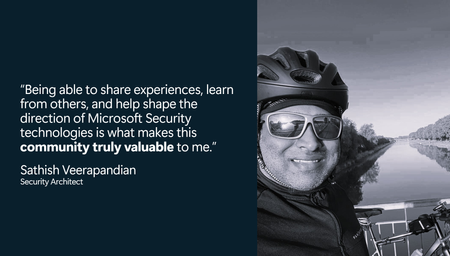
Meet Sathish Veerapandian: security architect, community collaborator, published author, and cycling enthusiast with a knack for turning real-world customer challenges into product-shaping feedback. From influencing phishing-resistant authentication and malware scanning improvements to helping organizations navigate Microsoft Purview, AI governance, and hybrid work, Sathish brings the best kind of energy to the Microsoft Security Community: curious, practical, generous, and always ready to help others move forward. What do you find most rewarding about being a member of the Microsoft Security Community? I find it most rewarding to be part of a community where knowledge sharing directly contributes to stronger, real world security outcomes. The Microsoft Security Community brings together practitioners, MVPs, engineers, and product teams, creating a space where collaboration leads to practical solutions, continuous learning, and meaningful impact. Being able to share experiences, learn from others, and help shape the direction of Microsoft Security technologies is what makes this community truly valuable to me. I have tested and provided feedback on a wide range of products via the Security Advisors program. Some examples include extending FIDO support for on-premises environments; improving Microsoft Defender for Storage malware scanning with Sentinel integration, cost estimation, delta scanning, and scheduled scans; streamlining Microsoft Purview DSPM for AI onboarding and Insider Risk visibility; and strengthening Predictive Shielding by turning risk insights into preventive Conditional Access controls. Overall, these examples reflect how I collaborate: identifying real-world gaps during implementation and operations, translating them into clear product feedback, and contributing in ways that help Microsoft engineering and the broader community. Could you share something you’re proud of or a project you’ve completed? One project I’m particularly proud of is co-authoring the book Reimagine Remote Working with Microsoft Teams with my community colleagues during the COVID pandemic. At that time, we saw a significant increase in questions from organizations on how to effectively utilize Microsoft Teams to enable efficient and productive remote work. Recognizing this need, we took the initiative to bring together our collective experience and authored the book as a team. Our main goal was to help organizations improve their collaboration. We came together as a team and shared our real-world experience. Authoring this book also motivated my colleagues to become more interested in the Microsoft MVP Program and contributing to the Tech Community forums, which helped a lot of people. Reimagine Remote Working with Microsoft Teams is available for public purchase and has been used by IT professionals, team leaders, and organizations looking to strengthen their hybrid work strategy. A copy of the book was also archived in the Microsoft Corporate Library in Redmond, which is a personal milestone and an honor as an MVP. What does your ideal community experience look like? My ideal community experience continues to be one where practitioners, MVPs, and product teams collaborate closely to share real- world insights, solve challenges together, and help shape the future of Microsoft Security. I value environments where knowledge flows openly, where hands- on learning is encouraged, and where community members can contribute through content, discussions, and events that have a meaningful impact on others. How long have you been working with Microsoft Security Products? My Microsoft Security journey began over a decade ago in the on- premises era, working with technologies such as Forefront, TMG, Exchange security, and Antispam solutions. Those early years gave me a deep foundation in securing Microsoft workloads at the infrastructure and perimeter level, long before cloud adoption became mainstream. As the industry shifted, I transitioned into the cloud security space, embracing Microsoft 365 and Azure security capabilities. This evolution led me to focus on data protection, identity, and modern collaboration security, eventually specializing in Microsoft Purview, Copilot DLP, Insider Risk, and Information Protection. What features or products have provided the most impact? The Microsoft Security products that have had the most impact for me are the ones that directly improve security outcomes while staying deployable at scale. The most impactful areas have been: 1) Microsoft Entra ID – FIDO / Passwordless (including on-prem considerations) Impact: Enabling phishing-resistant authentication in a way that works for real enterprise environments (including hybrid setups). Essential capability: FIDO/passwordless support that can extend into on-prem realities, so customers are not blocked by architecture constraints. 2) Microsoft Defender for Storage – On-demand Malware Scanning Impact: Improving security assurance for storage data, especially during high-risk operational events like large-scale migrations. Essential capabilities: More effective delta scanning and the ability to run scheduled or on-demand scans aligned to migration windows and operational needs. 3) Microsoft Purview – DSPM for AI Impact: Supporting governance and security posture for AI-related data usage, with an experience that enables customers to adopt quickly. Essential capability: A smoother enablement/onboarding experience so the subscription/capability can be activated reliably and used without friction. 4) Predictive Shielding + Conditional Access (preventive controls) Impact: Turning risk insight into preventive action by applying controls through Conditional Access. Essential capability: Preventive enforcement that helps stop risky access/behavior earlier rather than only detecting after the fact. What advice do you have for others who would like to get involved in the Microsoft Community? My advice is to simply start by sharing what you know. You don’t need to be an expert to contribute just be willing to help others, document your learnings, and stay curious. The Microsoft Community grows through collaboration, and even small contributions like answering questions, writing a short post, or sharing a demo can make a real impact. Engage consistently, connect with others who share your interests, and focus on adding value. Over time, those small steps build into meaningful involvement, strong relationships, and opportunities you never expected. Tell us more about you, including where to find you! Outside of technology, I’m very passionate about cycling. I run a local cycling community in Almere called the Almere Cycling Club, where we focus on improving the health and fitness of people through regular group rides and community activities. It’s something I truly enjoy because it brings people together, encourages a healthier lifestyle, and creates a positive impact in the place where I live. Here’s where you can connect with me online: YouTube: DevOpsInfo 391 LinkedIn: Sashtish Veerapandian Website: https://ezcloudinfo.com Purview Community Lightning Talk: From Zero to First Signal: Insider Risk Management Prerequisites That Actually Matter Sathish’s story is a reminder that strong communities are built by people who show up with curiosity, generosity, and a willingness to turn real-world experience into shared progress. Whether he’s helping shape Microsoft Security products, guiding organizations through modern security challenges, or bringing people together through cycling, Sathish leads with purpose and impact- and the Microsoft Security Community is stronger because of it. Learn and Engage with the Microsoft Security Community Visit the Microsoft Security Community home. Log in and follow this Microsoft Security Community Blog. Follow = Click the heart in the upper right when you're logged in 🤍. Subscribe to the Security Community Email List and be notified of upcoming events, product feedback surveys, and more. Get early access to Microsoft Security products and provide feedback to engineers by joining the Microsoft Security Advisors. Join the Microsoft Security Community LinkedIn Group and follow the Microsoft Entra Community on LinkedIn208Views2likes0Comments
Microsoft Leads a New Era of Software Supply Chain Transparency
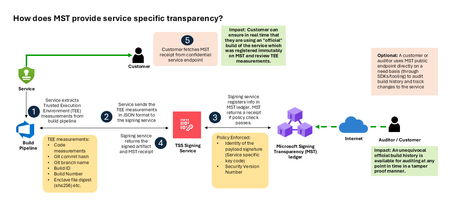
Today, Microsoft announces the general availability of Microsoft’s Signing Transparency (MST) – a first-of-its-kind capability that brings unprecedented visibility and trust to our software supply chain. With this release, Microsoft is leading the industry by recording the build of critical cloud services into a publicly readable and verifiable SCITT standard (Supply Chain Integrity, Transparency, and Trust) compliant blockchain ledger. This means every production software build for in scope services like Azure Attestation and Azure Managed HSM (Hardware Security Module), Azure confidential ledger, Microsoft Signing Transparency itself (and others over time) – is now logged in an immutable, tamper-evident record. Only builds that are in the MST ledger are deployed to production; this gives customers confidence that the supply chain for these critical services can be audited at anytime. Notably, the MST ledger is fully open source and built to align with the emerging IETF SCITT standard. By embracing SCITT’s principles and open protocols, Microsoft ensures that MST not only secures our own ecosystem but also contributes to a broader industry movement toward standardized supply chain transparency. The open-source MST ledger serves as a verifiable trust anchor that any organization or researcher can inspect, audit, or even integrate with their own tooling. MST itself meets the highest levels of transparency, backed by a tamper-proof confidential ledger, open-source, and independently verified. Specifically, we are making the foundation of our trust model transparent and accessible to everyone – reinforcing that trust must be earned through proof, not just promises. This launch marks a major milestone in our commitment to Zero Trust principles, extending “never trust, always verify” all the way into the build itself. Building on a public preview introduced late last year, MST’s general availability delivers verifiable transparency at the software level. It transforms traditional code signing with an additive trust layer that is accessible via an open verification model. Every new software update is accompanied by a publicly auditable proof of integrity, enabling security teams to proactively confirm that each update is authentic and unaltered. To help organizations get the most out of this capability, we are also introducing a free tool to explore the contents – Ledger Explorer – an offline tool that allows security teams to examine MST ledger entries, verify cryptographic proofs, and even validate the ledger’s integrity independently. This tool, combined with MST’s open design, ensures that every Microsoft customer – and the broader community – can hold us accountable in real time for the software we run on their behalf. Key Benefits of Microsoft’s Signing Transparency (MST) Verified Code Integrity – Every software release is cryptographically logged in MST’s ledgers. This makes each build tamper-evident and traceable. If an attacker attempts to inject malicious code or sign an unauthorized update, it will be evident through the well-defined validation step built into the SCITT standard. Organizations gain the assurance that code integrity can be independently confirmed at any time. Independent Verification & Zero Trust – MST enables customers and auditors to verify software authenticity on their own, without having to solely rely on vendor attestations. For each update, Microsoft provides a transparency “receipt” (proof of logging) that you can use to prove the update was officially published and unaltered. This fosters a “don’t just trust, verify” approach, empowering security teams to double-check everything running in their environment aligns with what Microsoft intended. Audit-Trail & Compliance – The transparency ledger creates a permanent, auditable timeline of code deployments. Every entry is a record of what was released and when, backed by cryptographic proofs. This simplifies compliance reporting and accelerates forensic analysis. In the event of an incident, you can quickly audit the ledger to see if any unexpected code was introduced. For highly regulated industries, MST offers concrete evidence of software integrity and policy compliance over time. Leadership & Open Standards – We are delivering real transparency now, encouraging a future where all critical software is released with verifiable integrity. MST’s open source implementation and SCITT-compliant design exemplify our commitment to openness and collaboration. We believe widespread adoption of these standards will strengthen supply chain security for everyone, making trust verification a universal practice. Next Steps Microsoft’s Signing Transparency is more than a new security feature and shapes the advances in trust technology. As threats grow more sophisticated, we must evolve the way we assure our customers about the software they depend on. With MST now generally available, we are leading by example: proving that it is possible to open up the traditionally opaque process of software deployment and turn it into a source of strength and trust, i.e., empowering each person with verifiable transparency. We invite the industry to join us on this journey and get started by reading the documentation and exploring Ledger Explorer today! Together, by embracing transparency and open standards, we can turn “trust but verify” from a slogan into an everyday reality for digital infrastructure.2.7KViews2likes3CommentsMicrosoft Security Community Spotlight: Marcel Graewer
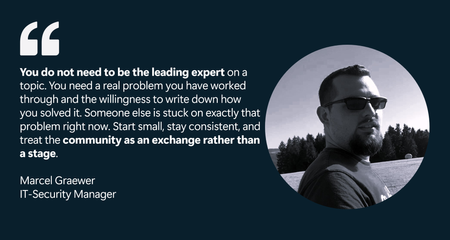
Globally, Marcel shares practical detection engineering insights on Microsoft Sentinel and Microsoft Defender XDR through forums and blog posts. Locally, he represents his employer in the IT-Security group of the Microsoft Business User Forum, where German companies using Microsoft technologies exchange real-world experience and expertise. The work Marcel values most is helping people enter the IT field. In Germany, "Fachinformatiker" is a recognized IT profession learned through a multi-year apprenticeship, and he is proud to have trained apprentices. He also serves as an examiner for the IHK (the German Chamber of Industry and Commerce), evaluating the final exams of these IT apprentices. This commitment also led him to support younger learners by teaching school cybersecurity classes and participating in Girls’ Day, where he introduced female students to the field. “I do this because most people don’t get an honest view of security work until much later in their education—if they see it at all. Showing someone early that this field is creative, varied, and genuinely interesting can change their path. Being part of that, even for a few people, means more to me than anything that fits neatly on a CV.” Let’s hear more from Marcel about his Microsoft Security Community and product paths. All responses to questions are direct quotes from Marcel. What do you find most rewarding about being a member of the Microsoft Security Community? The most rewarding part for me is how practical the exchange is. Microsoft security tooling moves fast - Microsoft Sentinel, Microsoft Defender XDR and Microsoft Security Copilot all change month to month- and no single person keeps up with all of it alone. The community is where that gap gets closed. When I read how someone else tuned a detection in their environment, or when someone responds to something I posted with a problem I hadn't considered, my own work gets better. It's a feedback loop you don't get from documentation. The other part I value is that it works in both directions: I started as a reader, learning from people more experienced than me, and now I'm at a point where I can give some of that back. Watching that shift happen has been genuinely motivating. How long have you been working with Microsoft Security Products? Over ten years! My way into Microsoft security ran through infrastructure rather than security itself. I started out administering Active Directory and VMware environments, the on-premises world, and that is where I first understood identity, endpoints and the quiet attack surface they create. At the time, security was something layered on top of infrastructure. What changed everything was the shift to the cloud. As the environments I worked in moved into Microsoft Azure and Microsoft 365, the old separation between "running things" and "securing things" stopped making sense. In a cloud-first world, the identity is the perimeter, the sign-in log is the crime scene, and the telemetry that used to be scattered across servers suddenly lives in one place you could actually query. That was the moment Microsoft's security stack became less of a product set and more of a working environment for me. As I moved from running infrastructure into roles centered on defending it, first leading IT infrastructure and security as a team lead, then as an IT Security Expert, and now as IT Security Manager focused on architecture and incident response in an Azure and M365 environment, Sentinel and Defender XDR went from tools I knew of to tools I work in every day. The infrastructure background turned out to be an advantage rather than a detour. Detection engineering makes far more sense once you have run the Active Directory and the endpoints that generate the very signals you are now writing detections against, and cloud security makes far more sense once you have felt the limits of the on-premises model it replaced. The part that keeps me engaged is that none of this stands still. The cloud security landscape changes constantly, the work is never quite finished, and that is exactly what I like about it. What Microsoft Security features or products have provided the most impact? The single biggest impact for me comes from Microsoft Sentinel as a cloud-native SIEM and SOAR platform. The move away from a self-hosted SIEM matters more than it first appears. A traditional SIEM is itself a piece of infrastructure that has to be sized, hosted, patched, and scaled, and that effort constantly competes with the actual security work. Microsoft Sentinel removes that layer. There is no platform estate to keep alive and no capacity planning for the SIEM itself, which frees attention for what actually matters: getting the right telemetry in and getting detection and response right. What I value most is how naturally Sentinel fits into modern, cloud-first environments. When the landscape you are protecting already lives in Azure and Microsoft 365, a security platform that lives in the same place removes an entire class of integration friction. The other strength is the breadth of data onboarding. With a traditional SIEM, connecting a new log source was often a small project of its own, with connectors to build and parsers to maintain. With Sentinel, that friction is largely gone. Whether a source sits on-premises, in another cloud or in a third-party product, getting it in is straightforward, and the platform still provides the integration depth that genuinely matters rather than a shallow connection. Microsoft Sentinel handles almost anything you point it at. Equally important is that SIEM and SOAR are not two separate platforms here. The orchestration and automation layer is built into the same solution, so response playbooks run on the same data that the detections are built on. For architecture, that is a real advantage: detection and response are designed as one system rather than stitched together afterwards. The central telemetry layer is one of the few decisions that is genuinely hard to reverse later, and Sentinel makes that an easy one to defend. What advice do you have for others who would like to get involved in the Microsoft Community? My advice is to start before you feel ready. I read Microsoft Tech Community (forums) for years before I posted anything myself, always with the feeling that I needed more experience first, that I would just be adding noise. That was the wrong instinct. The moment I actually started contributing, the feedback I got back made my own work better, and I realised the bar for being useful is far lower than it looks from the outside. You do not need to be the leading expert on a topic. You need a real problem you have worked through and the willingness to write down how you solved it. Someone else is stuck on exactly that problem right now. Start small, stay consistent, and treat the community as an exchange rather than a stage. Consistency matters more than any single brilliant post. Alles rund um sein Buch (All About His Book) Last year, I published "Die neue Realität der Cybersecurity" (2025). It tackles a question every security team is dealing with right now: “Where does AI genuinely strengthen security architecture and incident response, and where is it just noise?” Rather than staying abstract, the book takes the practitioner's side of that question, looking at how AI actually changes the work of designing defensible systems and responding to incidents, and where the limits and risks really are. It is written for the people doing the work, security architects, IR practitioners and the leaders who have to make decisions about AI without the marketing gloss. If that question is on your desk too, it is worth a look. Connect with Marcel Microsoft Tech Community: @marcel_graewer Linkedin: https://www.linkedin.com/in/mgraewer/ Github: https://github.com/bifrost0x Blogs: graewer.com and magra-sec.de Book: Die neue Realität der Cybersecurity (ISBN: 9783695708833) Marcel Graewer is currently an IT-Security Manager at Festool Group and holds the CISSP certification. Outside of work, he is happiest when experimenting with technology on his own terms. He runs a Proxmox-based homelab with a range of self-hosted services and Docker containers, using it as both a playground and a testing ground. It gives him space to break things, learn, and explore without the constraints of formal change processes. He also spends time on Hack The Box and TryHackMe, believing that staying sharp on the offensive side makes him a stronger defender. Away from the keyboard, his life is refreshingly analog. He and his family, including two children, live in an old house that always seems to have one more project waiting. Between the homelab and the house, there is never a shortage of things to fix, and that suits him just fine. Learn and Engage with the Microsoft Security Community Log in and follow this Microsoft Security Community Blog. Follow = Click the heart in the upper right when you're logged in 🤍. Join the Microsoft Security Community and be notified of upcoming events, product feedback surveys, and more. Get early access to Microsoft Security products and provide feedback to engineers by joining the Microsoft Security Advisors. Join the Microsoft Security Community LinkedIn Group and follow the Microsoft Entra Community on LinkedInSecurity Community Spotlight: Fabrício Assumpção
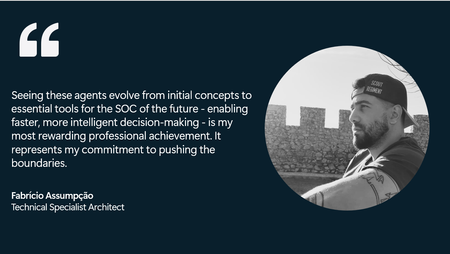
Meet Fabrício Assumpção, a Technical Specialist Architect for a Microsoft Security and Compliance Certified Partner, based in Brazil. Fabrício considers his involvement with the Microsoft Security Community defined by a dual approach: architectural innovation and technical enablement. As a Microsoft Certified Trainer (MCT) since 2021, he has been dedicated to bridging the gap between theory and real-world implementation for security professionals globally. What do you find most rewarding about being a member of the Microsoft Security Community? The most rewarding part of being a member of the Microsoft Security Community is the direct access to the pulse of cybersecurity innovation. As a Microsoft Certified Trainer (MCT) and a developer/engineer/architect focused on Cloud Security/M365 Security and SIEM, being in this ecosystem allows me to bridge the gap between complex architectural challenges and AI-driven solutions. Developing security agents for Microsoft Security Copilot is particularly fulfilling because I can see how the community’s collective knowledge shapes the future of automated defense. For me, it’s not just about the tools, but about being part of a global movement that empowers defenders to stay ahead of sophisticated threats through intelligence and automation. How would you describe your Microsoft Community involvement? In my role as a Security Architect and Engineer at adaQuest, I advocate for Microsoft’s vision by designing and deploying complex security infrastructures. My work spans the entire Microsoft Security stack, from high-level XDR (Microsoft Defender) strategies and SIEM (Microsoft Sentinel) deployments to the cutting edge of AI-driven defense. Currently, alongside my other activities, I'm focused on developing custom security agents for Microsoft Security Copilot, a task that allows me to push the boundaries of how automation and AI can empower modern SOCs. While my primary involvement has been focused on technical architecture and developing security Copilot agents, my ideal community experience would be centered on deep-tier technical co-creation. I envision a community space that facilitates direct architectural dialogues between Microsoft product teams and the engineers who are building on top of those platforms. For me, the most valuable community experience is one that prioritizes 'early-access' feedback loops and specialized hackathons where we can stress-test new features—like advanced XDR integrations or AI agent capabilities—before they hit the mainstream. My ideal is a community that functions as a high-octane R&D hub, where the collective expertise of architects and developers directly influences the roadmap of the security tools we use every day Editor’s note: The scenario Fabrício describes above is much like the Security Advisors program, which gives you early access to products, features, and private previews. Your feedback to engineering has the power to directly influence Microsoft Security products. If this interests you, consider joining! How long have you been working with Microsoft Security products? My Microsoft security journey is a story of evolution—from a cloud support engineer resolving complex L3/L4 infrastructure issues to a Security Architect leading global SOC operations. I have spent the last decade mastering the transition to the cloud, starting with identity and endpoint management (Entra ID and Intune) and progressing to end-to-end administration of the Microsoft 365 and Azure security stack. A turning point was joining adaQuest, where I took the lead on SOCaaS and began bridging the gap between governance and hands-on engineering and Sentinel. Today, my journey has reached its most exciting phase: pioneering the use of Generative AI in security to build scalable, automated solutions that protect clients worldwide. What features or products have provided the most impact? Please describe how it has helped you or your customers. The most impactful solution has been the integration of Microsoft Sentinel with Security Copilot through custom-developed security agents. This combination has revolutionized how our customers manage their security posture, allowing them to orchestrate and query the entire Defender XDR, Entra ID, and Purview stack through natural language automation. The most direct benefit for our clients has been a drastic reduction in Mean Time to Respond (MTTR) and a significant increase in operational efficiency, transforming complex security data into proactive defense. This unified approach ensures that our customers maximize their investment in the Microsoft ecosystem while maintaining high-speed resilience against sophisticated threats. You’ve indeed been instrumental in building with Microsoft Security. What can you share with us, and can you tell us about your journey? I am incredibly proud of being a pioneer in the Microsoft Security Copilot ecosystem. In early 2025, before official documentation was fully available or the feature had reached General Availability (GA), I conceptualized and developed six custom security agents designed to enhance automated defense and incident response. These agents were the result of a deep dive into the underlying architecture of AI-driven security, where I had to materialize complex ideas into functional, real-world tools without a predefined roadmap. My work was officially showcased and published during the historic announcement of the Microsoft Security Store in 2025, marking the debut of third-party security agents. Seeing these agents evolve from initial concepts to essential tools for the SOC of the future—enabling faster, more intelligent decision-making—is my most rewarding professional achievement. It represents my commitment to pushing the boundaries. Fabricio’s agents are available in the Microsoft Security Store. Here’s what he’s built (so far…) Admin Guard Insight An agent focused on privileged identity and access analysis. It reviews administrative roles, sensitive changes, and risk signals to identify exposure, misuse of privileges, and opportunities to strengthen security posture. Login Investigator An agent designed to investigate suspicious sign-in activity. It correlates authentication details, IPs, locations, devices, user risk, and related incidents to determine whether a login is legitimate or potentially malicious. Entity Guard An entity-centric investigation agent for users, devices, applications, or service principals. It consolidates signals from multiple sources to enrich entity context and identify abnormal behavior, exposure, and associated risks. Data Leak Agent An agent specialized in investigating potential data leakage and sensitive information exposure. It validates and correlates incidents across Microsoft Defender XDR and Microsoft Sentinel to produce a more reliable and contextualized investigation. L1 SOC Triage An agent built to support first-level SOC alert and incident triage. It helps classify events, enrich context, prioritize severity, and recommend next steps or escalation paths for analysts. Ransomware Kill Chain Investigator An agent focused on ransomware investigations. It correlates evidence and maps observed activity to the ransomware kill chain to help teams understand the attack, impacted assets, and priority response actions. EWS Sunset Readiness Assessor An agent that assesses an organization’s readiness for Exchange Web Services (EWS) deprecation. It identifies application and service principal dependencies and supports planning for migration to more modern and secure alternatives. What impact has integrating with Microsoft Security had on your business or your customers? Integrating with Microsoft Security has had a significant impact on both our business and our customers. For our business, it has enabled us to build higher-value security services and differentiated solutions, such as Security Copilot agents tailored to real operational challenges in identity protection, incident triage, data leakage investigations, ransomware analysis, and legacy dependency assessments. For our customers, the impact has been: improved speed, consistency, and depth in security operations. By leveraging Microsoft Security signals and platforms such as Microsoft Defender, Microsoft Sentinel, and Entra, we help teams investigate incidents faster, reduce manual effort, improve decision-making, and strengthen overall security posture. In practice, this means customers gain more actionable insights, better prioritization, and more efficient use of their security resources. What advice do you have for others who would like to get involved in the Microsoft Community? My advice is to bridge the gap between learning and building. Don’t just consume content; start creating solutions for real-world challenges, such as AI-driven automation in Security Copilot or Microsoft Sentinel. Use your practical experience to help others, and remember that teaching is one of the most powerful ways to contribute. In an era of rapid AI evolution, being a proactive 'early adopter' who shares insights is the best way to grow within the Microsoft Community and help protect the global digital landscape. Fabrício beyond Microsoft Security Beyond my technical career, I am a lifelong learner with a deep passion for understanding how the world works, from the complexities of Quantum Computing—which I studied at the University of Coimbra—to the fundamental principles of Physics, Astronomy, and Philosophy. I am currently pursuing two Master’s degrees, as I believe that diverse knowledge fuels creativity. I am also a polyglot at heart, teaching myself Italian, Spanish, Russian, and Chinese using open-source materials. My creative side is expressed through music, as I play both the violin and the piano. In my spare time, I enjoy the discipline of sports; I have a history as both a player and coach of Rugby, and I am a fan of Ice Hockey. My future plans include completing my Doctorate and embracing a nomadic lifestyle to experience different cultures and perspectives. For me, life is about the continuous pursuit of wisdom and the belief that we can always expand the boundaries of our own understanding. Connect with Fabrício on LinkedIn. ____________________________________________________________________________________________ Learn and Engage with the Microsoft Security Community Log in and follow this Microsoft Security Community Blog. Follow = Click the heart in the upper right when you're logged in 🤍. Join the Microsoft Security Community and be notified of upcoming events, product feedback surveys, and more. Get early access to Microsoft Security products and provide feedback to engineers by joining the Microsoft Security Advisors. Join the Microsoft Security Community LinkedIn Group and follow the Microsoft Entra Community on LinkedIn321Views2likes0CommentsSecurity Community Spotlight: Luca Romero Arrieche Heller
Meet Luca, Modern Workplace and Cloud Consultant at SoftwareOne Iberia, a Microsoft Partner. Luca has been working with Microsoft Security and cloud technologies for over a decade, closely following the evolution of the Microsoft Security ecosystem. Today, Luca focuses on Modern Work and security transformation projects, including large-scale Microsoft 365 migrations, enterprise messaging modernization with Exchange Online, endpoint management deployments with Microsoft Intune, and identity-driven security architectures across Microsoft environments. In addition to implementation projects, Luca also delivers technical workshops focused on threat protection and Microsoft security technologies, helping organizations better understand and implement solutions such as Microsoft Defender XDR, Microsoft Entra ID, endpoint security, and Zero Trust strategies to strengthen their overall security posture. Here’s what Luca had to say about his winding road through Microsoft Security and its Community. All responses are quotes from Luca. Microsoft Security Community How would you describe your Microsoft Security Community involvement or advocacy, globally and/or locally? When did you begin? My involvement with the Microsoft Community began early in my career through regional Microsoft community and influencer programs in Brazil. During that time, I became involved with Microsoft Virtual Academy (MVA) and started writing security-focused technical articles based on real project experience. My early technical journey began working with on-premises technologies such as ISA Server, Exchange Server, and Active Directory, which provided a strong foundation in Microsoft infrastructure and security. Through community participation and my blog, I began documenting real-world implementations and lessons learned related to Microsoft Security and cloud technologies. Over the years, my professional work has remained closely connected to the Microsoft ecosystem, implementing technologies such as Advanced Threat Analytics (ATA), Advanced Threat Protection (ATP), Microsoft Defender XDR, Microsoft Entra ID, and Microsoft Intune in enterprise environments. Today, my community advocacy is strongly connected to real-world experience, focusing on Zero Trust architectures, identity protection, modern endpoint security, and large-scale Microsoft 365 transformations and migrations. I noticed you’ve also answered a number of questions and have helped provide solutions in Microsoft Tech Community forums. How did you come across this and what inspired you to help? I have always been encouraged to participate in the technical community and share knowledge. Since the early days of TechNet, I have been involved in learning from others and contributing whenever possible. The culture of collaboration within the Microsoft ecosystem played an important role in my professional development. Many of the challenges I faced early in my career were solved thanks to the knowledge shared by the community. Because of that, contributing back feels natural. In the Microsoft Security Tech Community forums, I often see questions that are very similar to challenges I face in my daily work as a consultant. Sharing my experience becomes a practical way to help others navigate similar situations. Experience is important not only for solving problems, but also for knowing where to look and how to approach a solution. When I see questions without answers or clear guidance, I try to contribute by sharing practical insights, troubleshooting approaches, and real-world solutions. What do you find most rewarding about being a member of the Microsoft Security Community? What I find most rewarding is knowing that the community played a direct role in shaping my professional journey. Early in my career, I learned extensively through forums, technical discussions, and shared knowledge. That collaborative environment enabled me to grow into increasingly complex enterprise projects. Over the years, I have followed the evolution of Microsoft Security solutions... the community has always been part of that journey. Today, being able to contribute insights gained from large-scale security architectures, identity modernization, and enterprise Microsoft 365 migrations is my way of giving back. Additionally, as a founding member of Microsoft Virtual Academy, I published security-focused technical articles and created my blog to document real-world implementations, always referencing sources and applied knowledge. Speaking of Microsoft Security solutions...which feature or product has provided the most impact? How has it helped you or your customers? The combination of Entra ID Protection with Conditional Access and the unified visibility of Defender XDR (are the Microsoft Security products that have) delivered the greatest impact by reducing compromised credential risks and accelerating incident response through identity, endpoint, and cloud workload correlation. Back to the Microsoft Community- what advice do you have for others who would like to get involved? My advice is simple: start by learning, then share what you have genuinely implemented in practice. The community values real-world experience, technical honesty, and genuine collaboration. It’s not about visibility — it’s about adding value. Be consistent, support others, and document your journey. Impact follows naturally. Linking up with Luca Do you have anything you’d like to promote or recommend? I recommend diving deeper into Intune, Defender, and Exchange Online, especially focusing on the integration between identity, endpoint protection, and email security within a well-structured Zero Trust Where can people get in touch with you or follow your content? LinkedIn: https://www.linkedin.com/in/lucarheller GitHub: https://github.com/LucaARHeller Blog: https://lucaheller.wordpress.com/ Microsoft Tech Community: LucaHeller Please share anything else essential to you. Before thinking about advanced security tools, it is essential to understand how the underlying technologies work. Whether it is something simple like DNS resolution, how authentication flows operate, or how policies are applied across enterprise environments, these foundational concepts are what allow security architectures to be built correctly. For me, combining strong technical fundamentals with modern security technologies and real-world implementation experience is what enables organizations to build secure and resilient Microsoft environments. Luca’s story is a strong reminder of what makes the Microsoft Security Community thrive: practical contributions grounded in real-world experience. Through training, documenting, and showing up to help others, Luca demonstrates how continuous learning and compassion can benefit everyone. The community is better for his continued involvement, and his journey is an invitation for others to participate, share what they’ve learned, and keep strengthening security together. __________________________________________________________________________________________________________________________________________________________________ Learn and Engage with the Microsoft Security Community Log in and follow this Microsoft Security Community Blog. Follow = Click the heart in the upper right when you're logged in 🤍. Join the Microsoft Security Community and be notified of upcoming events, product feedback surveys, and more. Get early access to Microsoft Security products and provide feedback to engineers by joining the Microsoft Security Advisors. Join the Microsoft Security Community LinkedIn Group and follow the Microsoft Entra Community on LinkedIn.