posetteconf
12 TopicsLast Call: Join Live the PostgreSQL Community at POSETTE: An Event for Postgres 2026 (T‑1 week)
In just one week, the PostgreSQL community gathers again for one of the most anticipated global moments of the year: POSETTE: An Event for Postgres 2026. From June 16–18, this free and fully virtual event brings together PostgreSQL contributors, engineers, architects, and practitioners across 4 livestreams, 44 talks, and 50 speakers. But you might be wondering, why should I participate in POSETTE during the livestreams? Why join it live? Explore the schedule and choose your livestreams on the official site: Join POSETTE: An Event for Postgres 2026 Why joining live makes all the difference Yes, every talk will be available afterward. But the real value of POSETTE: An Event for Postgres 2026 happens while it is unfolding live. Be part of the virtual hallway track Participating live gives you access to the #posetteconf Discord channel, where attendees and speakers interact in real time, asking questions, sharing perspectives, and comparing approaches. This is where conversations extend beyond the talks and where ideas are challenged and refined collectively. Learn and validate your thinking in real time POSETTE is not just about listening. It is about sharpening how you think about PostgreSQL: Are you partitioning effectively? Are you approaching replication with the right mental model? Are your performance strategies aligned with how PostgreSQL actually behaves? Joining live means you can test those ideas immediately with people who build and run PostgreSQL systems at scale. Connect with practitioners solving the same problems A recurring insight from POSETTE participants is how often they discover others facing the same challenges, whether around scaling, performance, or operability. That shared experience often leads to the most valuable takeaways: not just what works, but why. What makes this year’s speakers worth your time POSETTE: An Event for Postgres 2026 brings together a diverse set of voices: PostgreSQL core contributors Engineers and architects working on production systems Specialists in performance, replication, and security Developers shaping how PostgreSQL is used in modern applications Azure Database for PostgreSQL and Azure HorizonDB engineers and experts These are practitioners who have built, debugged, and scaled real systems, and who are ready to share what they learned. Learn directly from the POSETTE speakers who are shaping PostgreSQL Bruce Momjian: understanding PostgreSQL from the inside out Read Bruce Momjian’s interview Bruce Momjian, a co-founder and core member of the PostgreSQL Global Development Group, has spent decades helping people understand how PostgreSQL really works. His session on the write-ahead log (WAL) reflects that same focus: taking something fundamental but often misunderstood and making it approachable. If you want to move beyond “using” PostgreSQL and start truly understanding its internals, how durability, recovery, and replication actually function, this is a rare opportunity to learn directly from someone who has helped build the system. Chris Ellis: making PostgreSQL practical for developers Read Chris Ellis’s interview Chris Ellis focuses on how to turn PostgreSQL’s extensive feature set into practical design choices. His session on design patterns highlights a reality many developers face: PostgreSQL offers powerful primitives, but knowing how to combine them effectively is what makes the difference. His work consistently centers on simplifying application architecture by using the database well, rather than pushing complexity into application code. Chun Lin Goh: understanding performance in real environments Read Chun Lin Goh’s interview Chun Lin Goh brings a cloud architecture and observability perspective to PostgreSQL performance. His session on performance degradation in burstable environments shows how the database behaves under real-world infrastructure constraints. This is especially relevant if you run PostgreSQL in cloud environments, where system behaviour, not just query design,can have a major impact. Derk van Veen: lessons from real-world partitioning Read Derk van Veen’s interview Derk van Veen’s work is grounded in hands-on experience operating PostgreSQL at scale. His partitioning session focuses not just on how to do things right, but also on what can go wrong,and why. Partitioning decisions often look simple early on but have long-term consequences. Learning from real mistakes and trade-offs is what makes these sessions so valuable. Hari Kiran: thinking deeply about replication Read Hari Kiran’s interview Hari Kiran’s session explores logical decoding and replication, two foundational aspects of how PostgreSQL systems scale and integrate with other systems. If your work involves distributed systems, data pipelines, or event-driven architectures, understanding these mechanics is essential. Jimmy Angelakos: uncovering subtle behavior Read Jimmy Angelakos’s interview Jimmy Angelakos focuses on practical, often overlooked aspects of PostgreSQL behavior. His session on NOTIFY highlights how features that seem simple on the surface can introduce complexity in real systems. These are exactly the kinds of nuances that can save hours or days of debugging in production. Sakshi Nasha: securing PostgreSQL for production Read Sakshi Nasha’s interview Sakshi Nasha’s work emphasizes security and production readiness. Her session on securing PostgreSQL reflects a broader shift: as PostgreSQL becomes central to more systems, security needs to be built in from the start. Her perspective is especially relevant for teams moving from development environments into production systems. Taiob Ali: connecting community and real-world usage Read Taiob Ali’s interview Taiob Ali brings a strong community-driven perspective to PostgreSQL, shaped by experience as both a practitioner and an advocate. Sessions like his often help bridge the gap between concepts and how PostgreSQL is actually used across different teams and environments. Xuneng Zhou: an independent perspective from the ecosystem Read Xuneng Zhou’s interview As an independent PostgreSQL hacker, Xuneng Zhou represents a perspective deeply rooted in the open source ecosystem itself. That viewpoint often brings a focus on fundamentals, experimentation, and how PostgreSQL evolves over time, valuable context for anyone who wants to understand not just where PostgreSQL is today, but where it is heading. This is more than a conference POSETTE: An Event for Postgres 2026 is a shared moment for the PostgreSQL community. It is an opportunity to: Learn from practitioners and contributors Challenge assumptions and refine your thinking Understand where PostgreSQL is heading next Stepping into the livestream is not just about attending talks, it is about participating in that moment. Your next step: join live If PostgreSQL is part of your work, or becoming central to it, the best way to experience POSETTE: An Event for Postgres 2026 is live. Pick the sessions that matter to you. Add the livestreams to your calendar. Join the discussion as it happens. Start here: Check out the POSETTE schedule to figure out which livestreams & which talks are for you. For any other answer you may still have, don't forget to take a look at the Ultimate Guide to POSETTE: An Event for Postgres 2026 See you live at POSETTE Whether you are exploring PostgreSQL internals, building modern applications, or scaling production systems, POSETTE: An Event for Postgres 2026 is where those conversations come together. See you at POSETTE on 16-18 June 2026.145Views1like0CommentsPostgreSQL Meets AI at POSETTE: An Event for Postgres 2026 (T-3 weeks)
POSETTE: An Event for Postgres 2026 is where that evolution comes into focus, please visit conference’s site to register and add the event to your calendar! Artificial intelligence is changing how we build applications, but not in the way many people expected. The hardest problems aren’t about writing the perfect prompt or choosing the “best” model. Once teams move past demos and start putting systems in front of real users, the pain shows up somewhere else: in the data layer. The recurring failure modes of production AI are remarkably consistent. Systems return answers that sound plausible but aren’t grounded. They pull the wrong records, miss key context, or stitch together fragments from unrelated sources. Sometimes they are correct, but wildly expensive. And when you let an AI system generate queries dynamically, the operational questions get sharper very quickly: what stops it from issuing a destructive statement, scanning a massive table, or repeatedly hammering a hot index until your p95 latency falls off a cliff? In other words, the hard part is not generation. The hard part is retrieval, how data is accessed, shaped, governed, and observed. That’s exactly why the AI track at POSETTE: An Event for Postgres 2026 is so compelling this year: it treats PostgreSQL not as a passive database at the end of a request, but as an active foundation for the next wave of AI, native applications. What’s emerging across the agenda is a new mental model. PostgreSQL, long trusted as a durable, transactional system, has become the place where “truth” lives for many applications. And as AI agents become the interface to those applications, Postgres increasingly becomes the retrieval backbone that keeps those agents honest. From queries to agents: when the database becomes a tool In traditional application design, we assume a deterministic relationship between intent and query. The application decides what it needs, SQL expresses it precisely, and the database returns a predictable result set. We tune the query, we add an index, we cache the hot path, and we move on. Agentic systems break that contract. An agent doesn’t just execute a query. It interprets intent, decides what tools to use, and often iterates, sometimes several times, based on intermediate results. That “tool use” framing is central to Pamela Fox’s session An MCP for your Postgres DB, which explores how MCP (Model Context Protocol) turns a database into an explicit, discoverable interface, one where design choices directly influence whether an LLM behaves safely and predictably when it interacts with Postgres. In parallel, Abe Omorogbe’s From Queries to Agents: The Next Era of Data Retrieval on PostgreSQL frames the evolution in a way that resonates with anyone building production systems: as agents move from demos to reality, the challenge isn’t the model, it’s “reliable, safe, and context, aware data retrieval.” In practice, that means dealing with failures that don’t show up in toy examples: agents producing SQL that’s syntactically valid but semantically wrong; pulling the right table but the wrong slice; or forming queries that quietly explode costs because there’s no natural “stop” condition. Once you accept that agents are going to query your system in ways you didn’t anticipate, PostgreSQL becomes part of your application’s safety boundary. It must handle unpredictable access patterns without falling over. It must protect you from unsafe operations, whether accidental or adversarial. And increasingly, it must support multi, modal retrieval, because the context an agent needs rarely lives in a single shape of data. That’s the pivot POSETTE: An Event For Postgres 2026 is capturing: the database is no longer just queried, it is increasingly negotiated with by AI systems. RAG in practice: why PostgreSQL keeps showing up Retrieval, Augmented Generation (RAG) has become the default architecture for serious AI applications. It’s a pragmatic response to a simple reality: models are good at language, but they aren’t systems of record. If you care about accuracy, freshness, or traceability, you retrieve relevant information first, then generate a response grounded in that retrieved context. The interesting question isn’t “does RAG work?”, it does. The interesting question is where teams choose to implement it. A growing number of teams are using PostgreSQL as the core retrieval substrate for RAG pipelines because it lets them keep the system cohesive. You can store structured records, join across metadata, filter and rank, and now, thanks to the ecosystem, incorporate vector similarity search without standing up a separate database whose contents need to be continuously synchronized. That’s the practical framing behind Julia Schröder Langhaeuser and Paula Santamaría’s session Production RAG at Scale with Azure Database for PostgreSQL. Their talk centers on what it takes to go from prototype to production, including architecture choices, performance tuning, and the operational discipline required when you’re serving RAG workloads at meaningful scale. The message is less “Postgres can do vectors” and more “RAG becomes real when you can observe it, tune it, and trust it.” This distinction matters, because the failure modes of RAG systems are rarely about embeddings. They are about context assembly. The best answer in the world is useless if the system retrieved the wrong snippets, missed an important constraint, or pulled stale policy text from last quarter. PostgreSQL’s value here is subtle but powerful: it gives you a place to combine retrieval signals, structured filters, semantic similarity, graph, like relationships, business rules, inside a system whose behavior you can reason about. The real problem is retrieval, not generation If you spend time around production AI teams, you start to hear the same phrase: retrieval is the hard part. Models can generate fluent text easily. But without high, quality input, and without guardrails around what the system is allowed to do, they generate confident nonsense, partial answers, and occasionally harmful advice. In the worst cases, they can become operational liabilities: issuing expensive queries repeatedly, pulling sensitive data into prompts, or creating “self, inflicted incidents” that look like outages but are really uncontrolled tool usage. That’s why POSETTE’s AI programming doesn’t just celebrate capability. It spends real time on safety and operational control. Building safety tooling for risk, free AI tuning of Postgres: Fast cars need fast brakes by Mohsin Ejaz captures this mindset perfectly. The title says what many teams learn too late: if you’re going to let an automated system tune or optimize database behavior, the safety net matters more than the accelerator. Guardrails, validation, monitoring, and rollback discipline aren’t “nice to have”, they’re the difference between a neat demo and a system you can run while you sleep. When you connect that back to the agent conversation, you get a coherent picture. Whether the system is generating queries, selecting tools, or attempting optimizations, the foundation of reliability is the same: controlled access, predictable performance, and strong observability. PostgreSQL contributes here not because it’s magical, but because it’s mature. It has deep access control primitives, transactional guarantees, and an ecosystem that has spent decades building operational muscle. The AI shift doesn’t eliminate those fundamentals, it makes them more important. The emerging retrieval stack: what sits between agents and data One of the most useful ways to interpret this year’s sessions is as the early shape of a new architectural layer: a retrieval stack that lives between AI agents and your data systems. This stack is not a single product. It’s a set of practices and components that make agent, to, data interactions safe and effective. It includes abstraction layers (like MCP, style tool interfaces), orchestration logic that can combine relational queries with vector similarity (and, increasingly, graph, aware traversal), context shaping that ranks and filters results into something a model can actually use, and governance controls that define what data may be accessed in which situations. What’s exciting about POSETTE: An Event For Postgres 2026 is that the agenda treats this as a real engineering problem, not a buzzword. Pamela Fox’s work on MCP surfaces the interface, design angle: when you expose Postgres as tools, the shape of those tools determines whether the agent behaves well. Abe Omorogbe’s framing pushes toward retrieval architectures that are robust by design rather than bespoke glue code. Julia Schröder Langhaeuser and Paula Santamaría bring the production perspective: what breaks at scale, and what you need to monitor. And Mohsin Ejaz anchors the safety story: the more automation you introduce, the more you need reliable brakes. That same story now extends all the way to the developer experience. In Matt McFarland’s session PostgreSQL Tooling Across AI Editors and Agents, the focus shifts from retrieval architecture inside applications to the environments where developers and AI assistants actually work. By showing how PostgreSQL capabilities such as connection management, query execution, schema analysis, plan inspection, and performance insights can be surfaced consistently across VS Code, Cursor, and the GitHub Copilot CLI through an MCP server, the session adds an important dimension to the overall AI track: if agents are going to become part of everyday software development, PostgreSQL tooling also needs to become agent-aware, portable, and usable wherever those workflows happen. It’s a practical reminder that the AI future of Postgres is not only about what runs in production, but also about how humans and AI systems collaborate around the database during development itself. Together, these sessions sketch a coherent future: PostgreSQL isn’t just where data sits. It’s becoming one of the engines that powers retrieval, first application design. Why this matters if you build real systems If you’re building applications today, this shift is not theoretical. It changes how you think about database design, performance tuning, security, and cost. You can’t assume query predictability anymore, because agents don’t behave like carefully written application code. You can’t treat access control as a static checklist, because prompts are leaky abstractions and tool use creates new attack surfaces. And you can’t ignore cost modeling, because AI, generated queries can be expensive in ways that traditional workloads rarely are, especially when they iterate. POSETTE: An Event For Postgres 2026 tackles these realities head, on. Not with hype, but with practical patterns, real failure modes, and the kind of engineering trade, offs you only learn when systems meet production constraints. What you’ll take away from the AI track at POSETTE: An Event for Postgres this year If there’s a single theme to keep in mind, it’s this: AI isn’t replacing databases. It’s forcing us to use them differently. The AI sessions at POSETTE: An Event For Postgres 2026 will help you build a clearer mental model of how agents interact with PostgreSQL, how RAG systems become production, ready, and what it means to design retrieval layers with safety and observability from day one. And, importantly, you’ll leave with a vocabulary for discussing these systems without hand, waving: where the risk is, where the cost is, and where the true engineering work lives. PostgreSQL’s flexibility and extensibility make it a natural foundation for this transition, but the real advantage will go to teams that treat retrieval as an engineering discipline, not an afterthought. At POSETTE, that transformation is on full display. A quick call to action POSETTE: An Event for Postgres 2026 is a can’t, miss event for the PostgreSQL community. Register to get updates and save the livestream sessions you want to attend on your calendar.212Views1like0CommentsUltimate Guide to POSETTE: An Event for Postgres, 2026 edition
POSETTE: An Event for Postgres 2026 is back for its 5th year: free, virtual, and unapologetically all about Postgres. No travel budget required and no jet lag involved. Just your laptop, a decent internet connection, and curiosity. This year the POSETTE 2026 schedule has 4 livestreams (16-18 June) with 44 talks at ~25 minutes each—covering everything from query performance and partitioning to Postgres 19 features, extensions, and use cases. Which is awesome but also a bit of work to figure out which talks are for you. Hence this ultimate guide post. Every talk will land on YouTube afterward (un-gated, of course) so if you miss anything you care about, you can watch it later. But if you can catch a livestream in June, do it. That’s when the “virtual hallway track” happens on Discord—where you can ask the POSETTE speakers questions and compare notes with other attendees. Meeting other attendees who have the same weird Postgres problems you do can be reassuring somehow. And yes, there will be swag. This guide is your cheat sheet: I’ve categorized and tagged all 44 talks so you don’t have to read 44 abstracts back-to-back. In this post you'll get: “By the numbers” summary Map of the 44 talks 2 Keynote sessions 23 Postgres core talks 11 Postgres ecosystem talks 8 Azure Database talks Why participate on the virtual hallway track on Discord A big thank you to our amazing speakers Join us for POSETTE 2026 & mark your calendars Official POSETTE 2026 Trailer “By the numbers” summary for POSETTE 2026 Here’s a quick snapshot of what you need to know about POSETTE this year: 3 days 16-18 June 2026 4 livestreams In Americas & EMEA time zones but of course you can watch from anywhere 44 talks All free, all virtual 2 invited keynotes Driving Postgres forward at Microsoft (Livestream 1), and Postgres 19 Hackers Panel: What’s In, What’s Out, & What’s Next (Livestream 2) 25 minutes Average length per talk ~1100 minutes Total minutes in POSETTE 2026 talks 50 speakers POSETTE 2026 speakers include PostgreSQL hackers and contributors, users, application developers, PG community members, Azure engineers, & Azure customers 6 keynote speakers Affan Dar & Charles Feddersen (Livestream 1); and Álvaro Herrera, Heikki Linnakangas, Melanie Plageman, & Thomas Munro (Livestream 2) 19 countries Speakers reside in 19 different countries 23 companies Speakers hail from 23 different companies 17.6% CFP acceptance rate 42 talks selected from 238 submisssions 75% general Postgres talks 33 talks are not cloud-specific at all, they’re about the Postgres technology & ecosystem 25% Azure-related talks 11 of 44 talks feature Azure Database for PostgreSQL or Azure HorizonDB 1 organizing company Organized by the Postgres team at Microsoft, in partnership with AMD 17 languages Published talk videos will have captions available in 17 languages, including English, Czech, Dutch, French, German, Hindi, Italian, Japanese, Korean, Polish, Portuguese, Russian, Spanish, Turkish, Ukrainian, and Chinese Simplified & Chinese Traditional Map of the 44 talks To help you quickly navigate all 44 talks, here’s a map of the high-level categories and detailed topics. : A map of the POSETTE 2026 talks—high-level categories and detailed tags to help you find what you care about 2 Keynote sessions Affan Dar and Charles Feddersen lead the PostgreSQL engineering and product teams at Microsoft, In this keynote, they’ll walk through how Microsoft is contributing to Postgres, both upstream in the open source project and in the cloud database service they build on top of it. Driving Postgres forward at Microsoft, by Affan Dar & Charles Feddersen (Azure Database for PostgreSQL, Azure HorizonDB, VS Code, Dev tools, community, Postgres hacking, open source, PosetteConf, livestream-1) Want to understand how Postgres features get decided? This keynote panel with 4 PostgreSQL committers & hackers will peel back the curtain. You’ll hear what made it into Postgres 19, what didn’t (and why), and get a sneak peek into a few of the things in the oven for Postgres 20. Postgres 19 Hackers Panel: What’s In, What’s Out, & What’s Next, by Álvaro Herrera, Heikki Linnakangas, Melanie Plageman, & Thomas Munro (Postgres 19, Postgres hacking, panel, open source, collaboration, multithreading, livestream-2) 23 Postgres core talks Data Modeling JSON in PostgreSQL - evil data type or just needs to be tamed?, by Boriss Mejias (JSON, performance, data modeling, livestream-1) PostgreSQL Design Patterns, by Chris Ellis (data modeling, SQL, PG use cases, livestream-1) Graph Data Exploring property graphs with SQL/PGQ in PostgreSQL, by Ashutosh Bapat (SQL/PGQ, graph data, data modeling, Postgres 19, livestream-4) LISTEN/NOTIFY LISTEN Carefully: How NOTIFY Can Trip Up Your Database, by Jimmy Angelakos (LISTEN/NOTIFY, PG use cases, triggers, livestream-4) Performance Maintaining Large Tables in PostgreSQL, by Sarat Balijepalli (WAL, performance, scaling Postgres, vacuum, autovacuum, statistics, partitioning, monitoring, livestream-3) My Postgres partitioning cookbook, by Derk van Veen (partitioning, PG use cases, data modeling, performance, livestream-4) PostgreSQL 17 vs 18: Side‑by‑Side Performance Wins in Real‑World Queries, by Divya Bhargov (performance, PG use cases, livestream-3) Vacuuming Enhancements in PostgreSQL 18: Faster, Smarter, More Predictable, by Shashikant Shakya (vacuum, async IO, monitoring, performance, livestream-4) PG Internals Linux and PostgreSQL in the Multiverse of Connections, by Josef Machytka (Linux, PG internals, connection pooling, livestream-2) pg_stats: How Postgres Internal Stats Work, by Richard Yen (statistics, pg_stats, PG internals, query planner, livestream-2) Postgres isn’t slow, your storage is, by Sai Srirampur (storage, IO, performance, livestream-3) PostgreSQL queues done right with PgQ, by Alexander Kukushkin (queues, PG internals, extensions, livestream-2) random_page_cost in Postgres - why the default is 4.0 and should you lower it?, by Tomas Vondra (PG internals, IO, performance, livestream-1) The Wonderful World of WAL, by Bruce Momjian (WAL, PG internals, replication, livestream-3) What's new with constraints in Postgres 18, by Gülçin Yıldırım Jelínek (constraints, data modeling, livestream-2) Postgres Hacking Fuzzing PostgreSQL, by Adam Wolk (PG internals, testing, Dev tools, libpq, security, livestream-1) Journey of developing a performance optimization feature in PostgreSQL, by Rahila Syed (Postgres hacking, PG internals, performance, WAL, replication, livestream-4) The Hitchhiker’s Guide to PostgreSQL Hacking: Don’t Panic, Just Start Small, by Xuneng Zhou (Postgres hacking, PG internals, community, livestream-2) Replication Past, Present, and Future: Logical Decoding and Replication in PostgreSQL, by Hari Kiran (replication, logical decoding, PG internals, livestream-4) Where Does My INSERT Go? A Logical Replication Story, by Hamid Akhtar (replication, PG internals, WAL, livestream-4) Security From Dev to Prod: Securing Postgres the Right Way, by Sakshi Nasha (security, roles, PG use cases, extensions, monitoring, livestream-4) From trust to Tokens: A Short History of PostgreSQL Authentication, by Murat Tuncer (authentication, security, livestream-2) PostgreSQL vs. SQL Server: Security Model Differences, by Taiob Ali (security, authentication, SQL Server, roles, livestream-1) 11 Postgres ecosystem talks Analytics pg_lake: Postgres as a lakehouse, by Marco Slot (pg_lake, extensions, OLAP, data warehouse, Iceberg, DuckDB, analytics, livestream-2) Apache AGE Querying & Visualizing Graphs in Postgres with Apache AGE, by Christian Miles (Apache AGE, graph data, data visualization, SQL/PGQ, Azure HorizonDB, livestream-1) Autotuning Building safety tooling for risk-free AI tuning of Postgres: Fast cars need fast brakes, by Mohsin Ejaz (autotuning, AI, performance, monitoring, livestream-2) Change Data Capture Building Event-Driven Systems with PostgreSQL Logical Replication and Drasi, by Diaa Radwan (Drasi, replication, WAL, CDC, livestream-3) Citus Move Less, Move Faster: Speeding Up Citus Cluster Scaling, by Muhammad Usama (Citus, extensions, performance, scaling Postgres, livestream-4) Dev Tools An MCP for your Postgres DB, by Pamela Fox (MCP, AI, Python, Dev tools, livestream-1) pgcov: Bringing Real Test Coverage to PostgreSQL Code, by Pavlo Golub (testing, Postgres hacking, Dev tools, extensions, CI/CD, livestream-3) PostgreSQL Tooling Across AI Editors and Agents, by Matt McFarland (Dev tools, VS Code, Cursor, AI, data visualization, Apache AGE, graph data, Azure, MCP, Copilot, livestream-1) Django PostgreSQL Generated Columns by Example, by Paolo Melchiorre (app dev, Django, generated columns, livestream-2) Kubernetes Quorum-Based Consistency for Cluster Changes with CloudNativePG Operator, by Jeremy Schneider & Leonardo Cecchi (CloudNativePG, Kubernetes, PG use cases, livestream-3) Performance Modelling Postgres Performance Degradation on Burstable Cloud Instances, by Chun Lin Goh (performance, burstable, compute, QA, livestream-4) 8 Azure Database for PostgreSQL & Azure HorizonDB talks AI-related talks From Queries to Agents: The Next Era of Data Retrieval on PostgreSQL, by Abe Omorogbe (AI, MCP, Azure Database for PostgreSQL, graph data, Apache AGE, Azure HorizonDB, livestream-3) Production RAG at Scale with Azure Database for PostgreSQL, by Julia Schröder Langhaeuser & Paula Santamaría (Azure Database for PostgreSQL, AI, RAG, PG use cases, livestream-3) AMD Choose the Right Azure Infrastructure to Improve Postgres Performance by Over 60%, by Andrew Ruffin (AMD, performance, Azure, compute, Azure Database for PostgreSQL, livestream-1) Azure HorizonDB Why we built Azure HorizonDB for PostgreSQL, by Dingding Lu (Azure HorizonDB, scaling Postgres, livestream-3) Flexible Server pg_duckdb in Action: Accelerating Analytics on Azure Database for PostgreSQL, by Nitin Jadhav (DuckDB, Azure Database for PostgreSQL, extensions, OLAP, analytics, performance, livestream-4) The Rise of PostgreSQL as the Everything Database, by Varun Dhawan (Postgres history, extensions, graph data, Apache AGE, Azure Database for PostgreSQL, DuckDB, Citus, livestream-3) What I’ve Learned Teaching Postgres to 200+ field engineers at Microsoft, by Paula Berenguel (training, Azure, Postgres skilling, livestream-1) Oracle to Postgres Migrating VLDBs from Oracle to Azure Database for PostgreSQL, by Adithya Kumaranchath (migration, Azure Database for PostgreSQL, Oracle to Postgres, livestream-2) Why participate in the virtual hallway track on Discord If you’ve checked out the schedule and plan to watch some of the talks, you might still be wondering: why join live—and why bother with the virtual hallway track on Discord? Here’s how a few of last year’s attendees described the experience: “Very impressed by all the speakers and content I am absolutely shattered as there was so much great content in all the talks over the past 3 days but I have probably learnt more in these sessions than I could have in months of reading up.” “Want to let y’all know how much I got from this onine conference, the speakers were excellent, well-prepared and well-presented. The hosts were informative, engaging, & amusing. The discord hallway channel made me feel connected. I learned a lot and found some new inspiration. I’ll be back next year!” “I have no idea how I’m going to summarise all the interesting stuff for coworkers.” The common thread: the live, shared experience—being able to ask questions, compare notes, and learn alongside other people in real time. How to join the virtual hallway track Head to the #posetteconf channel on Discord (on the Microsoft Open Source Discord) That’s where speakers and attendees hang out during the livestreams—it’s where you can ask questions, share reactions, and just say hi Big thank you to our amazing speakers Every great event starts with great talks—and great talks start with great speakers. Want to learn more about the people behind these talks? Visit the POSETTE 2026 Speaker page Click a speaker’s bio to see their written interview (if available) If a speaker has been a guest on the Talking Postgres podcast in the past, then you’ll find a link to their episode there, too Join us for POSETTE 2026! Mark your calendars I hope you join us for POSETTE 2026. Consider yourself officially invited. As part of the talk selection team, I’m definitely biased—but I truly believe these speakers and talks are worth your time. I’ll be hosting Livestream 1 and you’ll find me in the #posetteconf Discord chat. I hope to see you there. And please: tell your Postgres friends, so they don’t miss out! 🗓️ Add the livestreams to your calendar Livestream 1: Tue 16 June, 8am–2pm PDT (UTC-7) [ register for updates ] and/or [ add to calendar ] Livestream 2: Wed 17 June, 8am–2pm CEST (UTC+2) [ register for updates ] and/or [ add to calendar ] Livestream 3: Wed 17 June, 8am–2pm PDT (UTC-7) [ register for updates ] and/or [ add to calendar ] Livestream 4: Thu 18 June, 8am–2pm CEST (UTC+2) [ register for updates ] and/or [ add to calendar ] Watch last year’s POSETTE 2025 talks in advance: And if you want to get ready, you can watch talks from the POSETTE 2025 playlist on YouTube anytime, anywhere. Lots of solid, useful, and evergreen Postgres talks in there. “Official Trailer” for POSETTE 2026 is on YouTube To help more developers, community members, and Postgres users discover POSETTE 2026, our team created this short video trailer. Take a peek and share it with friends as an invitation of sorts. We’re trying to make sure that people don’t miss their opportunity to be part of the livestreams and ask questions on the discord during the conference (as well as watch the talks on YouTube after the event is over.) Watch and share the trailer: Official Trailer for POSETTE: An Event for Postgres 2026 Acknowledgements & Gratitude I’ve already thanked the 50 amazing speakers above. In addition, thanks go to Silvano Coriani, Cornelia Biacsics, Aaron Wislang, and My Nguyen for reviewing parts of this post before publication. I also want to thank the team at AMD for their partnership and support of POSETTE this year! And of course, big thank you to the POSETTE 2026 organizing team and POSETTE talk selection team—without you, there would be no POSETTE! Figure 3: Visual invitation to join the virtual hallway track for POSETTE 2026 on the Microsoft Open Source Discord, so you can chat with the speakers & others in the Postgres community1.3KViews3likes0CommentsYou don't want to miss POSETTE: An Event for Postgres 2026 (T-6 weeks)
PostgreSQL has quietly become one of the most important pieces of modern application infrastructure — and in 2026, that momentum is just impossible to ignore. From AI‑powered applications and real‑time analytics to globally distributed systems and mission‑critical workloads, PostgreSQL is no longer “just” a relational database. It has evolved into a versatile, extensible platform that sits at the center of how modern systems are built. POSETTE: An Event for Postgres 2026is where that evolution comes into focus, please visit conference’s site to register and add the event to your calendar! This year’s conference is not about chasing hype or showcasing isolated features. It’s about how PostgreSQL is actually being built, operated, extended, and trusted in production — by the people who write the code, run it at scale, and depend on it every day. This post kicks off our POSETTE 2026 blog series. It introduces the major themes shaping the conference and sets the stage for deeper technical dives in the weeks ahead. PostgreSQL as the “Everything Database” One idea shows up again and again across the POSETTE 2026 program: PostgreSQL is becoming the everything database. Once viewed primarily as an OLTP engine, PostgreSQL now supports a surprising range of workloads and access patterns: Rich document models with JSON and JSONB Full‑text search and fuzzy matching Time‑series and event‑driven data Vector embeddings for AI and semantic search Graph traversal and property graph queries Analytical workloads through extensions and hybrid execution engines Instead of spreading data across specialized systems, many teams are choosing a different path: keep data closer together, reduce architectural sprawl, and let PostgreSQL adapt through extensions, planner improvements, and new query capabilities. At POSETTE 2026, you’ll see this evolution in practice — from Postgres acting as a lakehouse-style analytics engine, to SQL-native graph queries, to design patterns that simplify applications by leaning into Postgres’ breadth rather than working around it. One of the upcoming posts in this series will explore how far PostgreSQL can realistically go, where it shines, and where drawing clear boundaries still matters. PostgreSQL Meets AI: Agents, RAG, and Retrieval at Scale AI is no longer an experiment bolted onto databases after the fact. It’s changing how applications retrieve, interpret, and reason over data. A core theme at POSETTE 2026 is PostgreSQL’s role in AI‑driven systems, especially Retrieval‑Augmented Generation (RAG) and agent‑based workflows. Sessions throughout the conference dig into questions teams are actively struggling with today: How do you use PostgreSQL as a reliable retrieval backbone for AI systems? How do relational data, vectors, and graphs work together to provide better context? How do you expose databases to LLMs safely, without creating operational or security risks? How do you prevent accidental writes, unbounded queries, or runaway costs? The pattern emerging across these talks is clear: production‑grade AI depends far more on disciplined data access, safeguards, and observability than on the model itself. PostgreSQL’s extensibility, strong consistency, and transactional guarantees make it a compelling foundation when AI systems move beyond demos into real workloads. We’ll dedicate a full blog post in this series to PostgreSQL, MCP, RAG, and agent architectures, unpacking what works today and what’s coming next. Performance, Elasticity, and the Reality of Scale Scaling PostgreSQL isn’t just about adding more CPU. Modern workloads are bursty and unpredictable. APIs spike without warning. Background jobs collide with user traffic. Analytics compete with OLTP. Cloud pricing penalizes both over‑provisioning and reactive resizing. That’s why POSETTE 2026 puts a strong emphasis on performance realism — the practical realities teams face once systems leave the comfort zone of steady-state benchmarks. Across multiple sessions, you’ll see deep focus on topics such as: Why storage, not CPU, is often the real bottleneck How planner costs, vacuum behavior, and maintenance evolve in PostgreSQL 18 What changes — and what doesn’t — when moving from fixed capacity to elastic compute How to reason about distributed scaling without treating it as a magic switch These are not theoretical discussions. They reflect real production systems under sustained load, and the trade‑offs teams make when performance and reliability actually matter. Future posts in this series will break down common Postgres performance myths, highlight meaningful changes in recent releases, and share lessons learned from running PostgreSQL under pressure. Inside PostgreSQL: Internals, Evolution, and What’s Next POSETTE has always maintained a close connection to the PostgreSQL core community, and 2026 continues that tradition. This year’s agenda includes deep dives into: WAL, logical replication, and change data capture Major features landing in PostgreSQL 18, with early signals for 19 The engineering trade‑offs behind planner, executor, and I/O improvements Practical guidance for contributors getting started with PostgreSQL hacking These sessions offer a rare look behind the curtain — not just at what PostgreSQL does, but why it behaves the way it does, and how decisions make it from patch review to production release. If you’ve ever wondered how PostgreSQL keeps evolving at scale without losing its stability or community trust, POSETTE 2026 is where those answers take shape. Security and Operations: Running PostgreSQL Like It Matters As PostgreSQL adoption grows, expectations shift. “Works on my machine” isn’t enough. Databases must be secure by default, observable in production, and resilient when things go wrong. POSETTE 2026 includes sessions aimed squarely at operators, architects, and platform teams responsible for production systems, covering topics such as: PostgreSQL authentication and authorization models Designing least‑privilege schemas and safer defaults Managing large tables without accumulating hidden risk Avoiding subtle operational pitfalls that only appear at scale These are the talks that surface lessons learned the hard way — and help teams avoid repeating them. More Than a Conference: A PostgreSQL Community Event What ultimately sets POSETTE apart isn’t just the agenda. It’s the people. POSETTE 2026 brings together PostgreSQL contributors, extension authors, cloud engineers, platform teams, and practitioners from across the ecosystem. It’s a space to learn from each other, challenge assumptions, and reconnect with why PostgreSQL continues to thrive after decades of evolution. And this blog series is only just beginning. In the coming weeks, we’ll go deeper into individual themes, highlight standout sessions, and explore the ideas shaping PostgreSQL’s next chapter. If PostgreSQL matters to your work — or if it’s becoming central faster than you expected — POSETTE: An Event for Postgres 2026 is the event you don’t want to miss. Go ahead and register! Up next: Why PostgreSQL Is Becoming the “Everything Database.”179Views1like0CommentsJune 2025 updates for Azure Database for PostgreSQL
Big news this month — PostgreSQL 17 is now GA with in-place upgrades, and our Migration Service fully supports PG17, making adoption smoother than ever. Also in this release: Online Migration is now generally available SSD v2 HA (Preview) with 10s failovers and better resilience Azure PostgreSQL now available in Indonesia Central VS Code extension enhancements for smoother dev experience Enhanced role management for improved admin control Ansible collection updated for latest REST API Check all these updates in this month’s recap blog: https://techcommunity.microsoft.com/blog/adforpostgresql/june-2025-recap-azure-database-for-postgresql/4412095 Check it out and tell us which feature you're most excited about!Scaling PostgreSQL at OpenAI: Lessons in Reliability, Efficiency, and Innovation
At POSETTE: An Event for Postgres 2025, Bohan Zhang of OpenAI delivered a compelling talk on how OpenAI has scaled Azure Database for PostgreSQL- Flexible Server to meet the demands of one of the world’s most advanced AI platforms running at planetary scale. The Postgres team at Microsoft has partnered deeply with OpenAI for years to enhance the service to meet their performance, scale, and availability requirements, and it is great to see how OpenAI is now deploying and depending on Flexible Server as a core component of ChatGPT. Hearing firsthand about their challenges and breakthroughs is a reminder of what’s possible when innovation meets real-world needs. This blog post captures the key insights from Bohan’s POSETTE talk, paired with how Azure’s cloud platform supports innovation at scale. PostgreSQL at the Heart of OpenAI As Bohan shared during his talk, PostgreSQL is the backbone of OpenAI’s most critical systems. Because PostgreSQL plays a critical role in powering services like ChatGPT, Open AI has prioritized making it more resilient and scalable to avoid any disruptions. That’s why OpenAI has invested deeply in optimizing PostgreSQL for reliability and scale. Why Azure Database for PostgreSQL? OpenAI has long operated PostgreSQL on Azure, initially using a single primary instance without sharding. This architecture worked well—until write scalability limits emerged. Azure’s managed PostgreSQL service provides the flexibility to scale read replicas, optimize performance, and maintain high availability to provide global low latency reads without the burden of managing infrastructure. This is why we designed Azure Database for PostgreSQL to support precisely these kinds of high-scale, mission-critical workloads, and OpenAI’s use case is a powerful validation of that vision. Tackling Write Bottlenecks PostgreSQL’s MVCC (Multi-Version Concurrency Control) design presents challenges for write-heavy workloads—such as index bloat, autovacuum tuning complexity, and version churn. OpenAI addressed this by: Reducing unnecessary writes at the application level Using lazy writes and controlled backfills to smooth spikes Migrating extreme write-heavy workloads with natural sharding keys to other systems. These strategies allowed OpenAI to preserve PostgreSQL’s strengths while mitigating its limitations. Optimizing Read-Heavy Workloads With writes offloaded, OpenAI focused on scaling read-heavy workloads. Key optimizations included: Offloading read queries to replicas Avoiding long-running queries and expensive multi-way join queries Using PgBouncer for connection pooling, reducing latency from 50ms to under 5ms Categorizing requests by priority and assigning dedicated read replicas to high-priority traffic As Bohan noted, “After all the optimization we did, we are super happy with Postgres right now for our read-heavy workloads.” Schema Governance and Resilience OpenAI also implemented strict schema governance to avoid full table rewrites and production disruptions. Only lightweight schema changes are allowed, and long-running queries are monitored to prevent them from blocking migrations. To ensure resilience, we categorized requests by priority and implemented multi-level rate limiting—at the application, connection, and query digest levels. This helped prevent resource exhaustion and service degradation. Takeaway OpenAI’s journey is a masterclass in how to operate PostgreSQL at hyper-scale. By offloading writes, scaling read replicas, and enforcing strict schema governance, OpenAI demonstrated PostgreSQL on Azure meets the demands of cutting-edge AI systems. It also reinforces the value of Azure’s managed database services in enabling teams to focus on innovation rather than infrastructure. We’re proud of the work we’ve done to co-innovate with OpenAI and excited to see how other organizations can apply these lessons to their own PostgreSQL deployments. Check out the on-demand talk “Scaling Postgres to the next level at OpenAI” and many more PostgreSQL community sessions from POSETTE.2.1KViews5likes0CommentsJust published: What's new with Postgres at Microsoft, 2025 edition
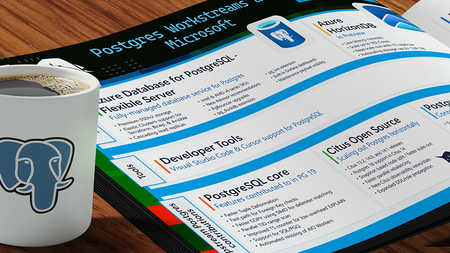
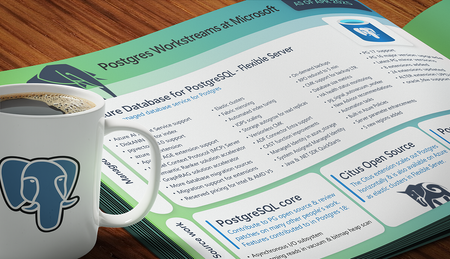
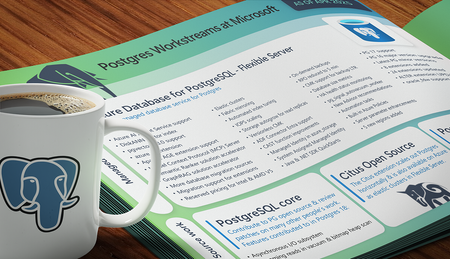
If you’re using Postgres on Azure—or just curious about what the Postgres team at Microsoft has been up to during the past 12 months—this annual update might be worth a look. The blog post covers: New features in Azure Database for PostgreSQL – Flexible Server Open source code contributions to Postgres 18 (including async I/O) Work on the Citus extension to Postgres Community efforts like POSETTE, helping with PGConf.dev, our monthly Talking Postgres podcast, and more There’s also a hand-made infographic that maps out the different Postgres workstreams at Microsoft over the past year. It's a lot to take in, but the infographic captures so much of the work across the team—I think it's kind of a work of art. 📝 Read the full post here: https://techcommunity.microsoft.com/blog/adforpostgresql/whats-new-with-postgres-at-microsoft-2025-edition/4410710 And, I'd love to hear your thoughts or questions.