pnp
655 Topics
Invoke-PnPSiteTemplate slower than it used to be
Hi everyone, Since last Friday, our provisioning engine has become noticeably slower than usual, and it's now blocking site creation for one of our customers. Setup Azure Function App (Windows OS, Consumption plan, hard 10-min timeout) Provisioning engine applies a PnP site template to newly created SharePoint sites via Invoke-PnPSiteTemplate PnP PowerShell: 2.12.0 PowerShell: 7.6 What changed Previously, if a run went over the 10-min limit, it wasn't a real problem: our retry mechanism kicked in, and the second pass was much faster because a large part of the template had already been provisioned. Now, however, every run stays slow and consistently hits the 10-min timeout, so the retry never gets far enough to complete. The result is that the customer's sites are no longer being created. My question Has anyone else seen this same slowdown since last Friday? Could this be related to the recent CSOM issue with Invoke-PnPSiteTemplate / Set-PnPDefaultColumnValues? (Invoke-PnPSiteTemplate AND Set-PnPDefaultColumnValues error since this morning | Microsoft Community Hub) Any confirmation or workarounds would be greatly appreciated. Thanks!80Views0likes1Comment
Invoke-PnPSiteTemplate AND Set-PnPDefaultColumnValues error since this morning
Since this morning we experience a blocking issue with Invoke-PnPSiteTemplate cmdlet which is failing as soon as there are lists included in a pnp site template (which is pretty much every template in our case). We see this behaviour on all of our own tenants and all customer tenants. This is a very important part of our provioning engine so it's blocking all new sites & teams in all tenants. Context We have a provisioning engine that runs in Azure. It automatically creates SharePoint-sites and applies a configured PnP site template (either .pnp or .xml) Expected behavior Normally, the template gets applied correctly without any error Actual behavior An error occurs in our logging, also visible when reproducing this locally: Error applying default column values Microsoft.SharePoint.Client.ServerException: Exception of type 'Microsoft.SharePoint.Client.ServiceUnavailableException' was thrown. Microsoft.SharePoint.Client.ClientRequest.ProcessResponseStream(Stream responseStream) StackTrace: at Microsoft.SharePoint.Client.ListExtensions.SetDefaultColumnValuesImplementation(List list, IEnumerable1 columnValues) at Microsoft.SharePoint.Client.ListExtensions.SetDefaultColumnValues(List list, IEnumerable1 columnValues, Boolean overwriteExistingDefaultColumnValues) at PnP.Framework.Provisioning.ObjectHandlers.ObjectListInstance.ProvisionObjects(Web web, ProvisioningTemplate template, TokenParser parser, ProvisioningTemplateApplyingInformation applyingInformation) at PnP.Framework.Provisioning.ObjectHandlers.SiteToTemplateConversion.ApplyRemoteTemplate(Web web, ProvisioningTemplate template, ProvisioningTemplateApplyingInformation provisioningInfo, Boolean calledFromHierarchy, TokenParser tokenParser) at CallSite.Target(Closure , CallSite , Object , Object , Object , Object ) Steps to reproduce behavior Create a PnP template Apply the template, using invoke-pnpsitetemplate -Path "..." We also see the same error happening when executing this cmdlet: Set-PnPDefaultColumnValues -List "Documents" -Field Status -Value "MyDefaultValue" -Connection $pnpConnTargetSite So it seems related... anyone getting the same issues?534Views6likes10Comments
SharePoint Multi-geo: accessing a user's home-geo custom SharePoint properties from a different geo
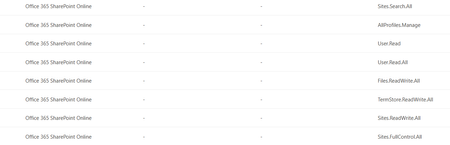
Setup M365 tenant, multi-geo (NAM + EMEA). SharePoint custom user profile properties are synced only in the user’s home geo (their Preferred Data Location). SPFx webparts running on the NAM tenant, using PnP/SP or AadTokenProvider. Goal: when an EMEA user opens a NAM page, read their SharePoint custom properties from the EMEA tenant. Issue 1 — Can’t read profile properties from a different geo-tenant What I’m doing const sp = spfi(emeaTenantUrl).using(SPFx(webpartContext), SPFxToken(webpartContext)); const result = await sp.profiles.getPropertiesFor(basicInfo.data.LoginName); Error Access Denied: This application does not have the required permissions to access profile information. The core problem — token is missing my approved scopes Approved Scopes in webApiPermissionManagement (Office 365 SharePoint Online) in SharePoint Admin Center: Sites.Search.All, AllProfiles.Manage, User.Read, User.Read.All, Files.ReadWrite.All, TermStore.ReadWrite.All, Sites.ReadWrite.All, Sites.FullControl.All. Token issued for the SharePoint resource only contains: Files.ReadWrite.All, M365BillingPlatform.Read.All, Sites.FullControl.All, Sites.ReadWrite.All, TermStore.ReadWrite.All. So AllProfiles.Manage, User.Read.All, Sites.Search.All are not in the token and an unexpected M365BillingPlatform.Read.All is. Also tried calling the SharePoint REST API directly with a token from AadTokenProvider → same Access Denied. Questions Why is the issued token missing my approved scopes (and where is M365BillingPlatform.Read.All coming from)? Is there a supported way to read a user’s SharePoint profile custom properties from a different geo-tenant from an SPFx webpart? Approved Scopes in Admin center Issue 2 — Search query template {User.*} properties not resolving cross-geo What I’m doing A SharePoint Search query in the webpart uses a query template that pulls custom user properties dynamically: {|owstaxidmetadataalltagsinfo:{User.customProperty1}} OR {|owstaxidmetadataalltagsinfo:{User.customProperty2}} The SP object is created the same way as in Issue 1. What’s not working When an EMEA user loads the webpart on the NAM tenant, the {User.*} tokens don’t resolve — the query modification shows the static property name itself instead of the user’s values from EMEA. Question How do I get the query template to resolve {User.customProperty} using the user’s home-geo (EMEA) profile values?86Views0likes0Comments
Rest API Error:"The parameter Members does not exist in method AddTenantTheme"
Using the following code. $colorPairs = @{ "themePrimary" = "#003538"; "themeLighterAlt" = "#cbe6e7"; "themeLighter" = "#a1cfd1"; "themeLight" = "#7cb8bb"; "themeTertiary" = "#5ba2a5"; "themeSecondary" = "#3f8c90"; "themeDarkAlt" = "#28767a"; "themeDark" = "#166064"; "themeDarker" = "#094b4e"; "neutralLighterAlt" = "#f8f8f8"; "neutralLighter" = "#f4f4f4"; "neutralLight" = "#eaeaea"; "neutralQuaternaryAlt" = "#dadada"; "neutralQuaternary" = "#d0d0d0"; "neutralTertiaryAlt" = "#c8c8c8"; "neutralTertiary" = "#98a9da"; "neutralSecondary" = "#4863b4"; "neutralPrimaryAlt" = "#113191"; "neutralPrimary" = "#002081"; "neutralDark" = "#001963"; "black" = "#001249"; "white" = "#ffffff"; } $content = @{ "name" = "MyCustomTheme" "themeJson" = $jsonBody } | ConvertTo-Json $apiUrl = "https://<<domain>>-admin.sharepoint.com/_api/thememanager/AddTenantTheme" Invoke-PnPSPRestMethod -Url $apiUrl -Method "Post" -Content $content Tried many different combinations but kept getting Invoke-PnPSPRestMethod: {"odata.error":{"code":"-1, Microsoft.SharePoint.Client.InvalidClientQueryException","message":{"lang":"en-US","value":"The parameter Members does not exist in method AddTenantTheme."}}} Wondering if somebody can run this code successfully and let me know what I am missing.143Views0likes2Comments
SPFx CDN URLs not consistently added to Trusted Script Sources (CSP)
Hi everyone, We’re currently investigating an issue related to SharePoint Online Content Security Policy (CSP) and Trusted Script Sources (TSS) for SPFx solutions. [SharePoint Online] [SPFx] [CSP] Scenario We deployed multiple SPFx .sppkg packages via App Catalog These solutions load scripts from an external CDN (cdnBasePath, with includeClientSideAssets: false) Expected Behavior As per documentation, CDN URLs used by SPFx solutions should be available/registered in Trusted Script Sources so that scripts can load under CSP enforcement Observed Behavior Only some CDN URLs (from certain packages) appear in Trusted Script Sources Others are missing, even though they are similarly configured and deployed Due to this, scripts from those missing sources are blocked by CSP, and the extension fails to load Additional Notes No use of eval() or inline scripts in our code Re-deploying packages sometimes resolves the issue (CDN URLs get registered afterward) Behavior appears inconsistent across environments Question Has anyone encountered a similar issue where: Trusted Script Sources were partially auto-populated from App Catalog deployments? CDN URLs from some SPFx packages were not registered automatically? Any insights on: Root cause Known limitations Best practices to ensure consistent registration would be really helpful. Thanks in advance!223Views1like1CommentIs Creating Multiple ClientContext Instances Efficient in CSOM for one Site Url?
Is it efficient to create a new ClientContext for each site URL and for each query, such as getting site users, lists, groups, and group members from the Web object? These queries can return a very large number of items, and CSOM does not support paging when retrieving data from Web properties. Because of this, there is a risk of memory issues. In this case, is creating multiple ClientContext objects a good approach? Also, how does ClientContext work internally, and how does it handle memory and performance?60Views0likes0Commentsany possible to extend client ID and secret for app registered in SharePoint Online
Hi Team, is there any possible to extend client ID and secret for app registered in SharePoint Online? right now, we are not allowed to create any new app registration from SharePoint Online, only way is from Azure AD - App registration. how about the client ID and secret getting expired which is created earlier using SharePoint Online? is there any way like powershell script something to extend the validity of Client ID and secret for app registered in SharePoint Online? if yes, please share the detailed instructions and guidelines to perform. if no, then what is the possible way for next step of actions to do? you can reachout to me - mailto:email address removed for privacy reasons for further discussion about this issue. Thanks for the help!
SPFX 1.21.1 in monorepo - utility module could not be exported
I am trying to migrate multiple projects to monorepo. I need to migrate some common utilities functions in a common module. There is an export warning that the module has no exports, while it does has. Running npm run spfx1:build works fine. But when I do npm run spfx1:serve it throws a warning export 'DemoUtilities' (imported as 'DemoUtilities') was not found in 'utilities-library/utils' (module has no exports) Opening the a SharePoint page online, it errors with missing exports. Can you point me to possible solutions? Here is a very simple OOB SPFX solution structure: utilities-library - src -- utils.ts - index.ts - package.json - tsconfig.json spfx1 - config - sharepoint - src -- skipped for brevity - gulpfile.js - package.json - tsconfig.json package.json tsconfig.base.json Specifics for per files utilities-library -> package.json { "name": "utilities-library", "version": "1.0.0", "main": "lib/index.js", "types": "lib/index.d.ts", "scripts": { "start": "node index.js", "test": "echo \"test\"" }, "type": "module", "workspaces": [ "true" ], "devDependencies": { "typescript": "^5.3.5" } } utilities-library ->tsconfig.json { "compilerOptions": { "composite": true, "declaration": true, "outDir": "lib" }, "include": ["**/*.ts"] } utilities-library ->index.ts export { DemoUtilites } from './src/utils'; utilities-library -> utils.ts import { ISPFXContext, spfi, SPFx } from "@pnp/sp"; import "@pnp/sp/webs"; import "@pnp/sp/lists"; export const DemoUtilites = { checkListExists: async ( listTitle: string, context: ISPFXContext ): Promise<boolean> => { const sp = spfi().using(SPFx(context)); return new Promise<boolean>((resolve) => { sp.web.lists .getByTitle(listTitle)() .then(() => { resolve(true); }) .catch((error) => { if (!(error?.status === 404)) { console.log(`Error checking list ${listTitle}`, error); } resolve(false); }); }); } } spfx1 -> gulpfile.js 'use strict'; const build = require('@microsoft/sp-build-web'); const path = require("path"); build.addSuppression(`Warning - [sass] The local CSS class 'ms-Grid' is not camelCase and will not be type-safe.`); build.configureWebpack.mergeConfig({ additionalConfiguration: (generatedConfig) => { generatedConfig.resolve = generatedConfig.resolve || {}; generatedConfig.resolve.alias = { ...(generatedConfig.resolve.alias || {}), 'utilities-library': path.resolve(__dirname, '../utilities-library/lib'), 'utilities-library/utils': path.resolve(__dirname, '../utilities-library/lib/utils') }; return generatedConfig; } }); var getTasks = build.rig.getTasks; build.rig.getTasks = function () { var result = getTasks.call(build.rig); result.set('serve', result.get('serve-deprecated')); return result; }; build.initialize(require('gulp')); spfx1 -> package.json { ... "dependencies": { "@microsoft/decorators": "1.21.1", "@microsoft/sp-core-library": "1.21.1", "@microsoft/sp-dialog": "1.21.1", "@microsoft/sp-listview-extensibility": "1.21.1", "@pnp/sp": "^4.12.0", "utilities-library": "^1.0.0", "office-ui-fabric-react": "^7.204.1", "react": "17.0.1", "react-dom": "17.0.1", "tslib": "2.3.1" }, ... } spfx1 -> tsconfig.json { "extends": "../tsconfig.base.json", "compilerOptions": { "rootDir": "src", "outDir": "lib" }, "include": ["src/**/*.ts", "src/**/*.tsx"], "references": [ { "path": "../utilities-library" } ] } root -> package.json { "name": "monorepo-test", "workspaces": [ "spfx1", "utilities-library" ], "scripts": { "spfx1:build": "gulp build -f ./spfx1/gulpfile.js --workspace spfx1", "spfx1:clean": "gulp clean -f ./spfx1/gulpfile.js --workspace spfx1", "spfx1:serve": "gulp serve -f ./spfx1/gulpfile.js --workspace spfx1 --nobrowser", "spfx1:bundle": "gulp bundle -f ./spfx1/gulpfile.js --workspace spfx1", "spfx1:pkg": "gulp package-solution -f ./spfx1/gulpfile.js --workspace spfx1", "spfx1:prod": "gulp build -f ./spfx1/gulpfile.js --workspace spfx1 --ship & gulp bundle -f ./spfx1/gulpfile.js --workspace spfx1 --ship & gulp package-solution -f ./spfx1/gulpfile.js --workspace spfx1 --ship", "utilities-library:build": "tsc --project utilities-library/tsconfig.json", "utilities-library:watch": "npm run utilities-library:build -- --watch", "clean:node": "rm -rf **/node_modules" }, "devDependencies": { "npm-run-all": "^4.1.5" } } root -> tsconfig.base.json { "extends": "./node_modules/@microsoft/rush-stack-compiler-5.3/includes/tsconfig-web.json", "compilerOptions": { "target": "es5", "forceConsistentCasingInFileNames": true, "module": "esnext", "moduleResolution": "node", "jsx": "react", "declaration": true, "sourceMap": true, "experimentalDecorators": true, "skipLibCheck": true, "outDir": "lib", "inlineSources": false, "noImplicitAny": true, "rootDir": ".", "baseUrl": ".", // Important for path mapping "paths": { "utilities-library/*": [ "utilities-library/lib/*" ] }, "typeRoots": [ "./node_modules/@types", "./node_modules/@microsoft" ], "types": [ "webpack-env" ], "lib": [ "es5", "dom", "es2015.collection", "es2015.promise" ] }, "include": [ "src/**/*.ts", "src/**/*.tsx" ] }322Views0likes2CommentsFunction of "GET IT" button in Sharepoint app?
Hello, I have a question related to Sharepoint deployment. Context: I have two Sharepoint sites. Both have the same webpart application but different version. But they both display the lastest version of the webpart. Questions: - What the function of the "GET IT" button in details of the application if both running different version and still have same webpart? - How can I deploy different version to each site because I plan to have two sites DEV and PRO? Thank in advance.Solved163Views0likes1CommentSharepoint Online: fastest way to retrieve folder count in a document library
Hi all I'm really looking for what the title says. Right now I'm doing Get-PnPFolderItem -ItemType Folder (using Pnp.Powershell but can try other options) but with more than a few 10s of folders, this is REALLY slow. The thing is, I just need a count (recursively), not all info as I'm getting with Get-PnPFolderItem. Any ideas?Solved587Views0likes1Comment