networking
7 TopicsJoin us at Microsoft Azure Infra Summit 2026 for deep technical Azure infrastructure content
Microsoft Azure Infra Summit 2026 is a free, engineering-led virtual event created for IT professionals, platform engineers, SREs, and infrastructure teams who want to go deeper on how Azure really works in production. It will take place May 19-21, 2026. This event is built for the people responsible for keeping systems running, making sound architecture decisions, and dealing with the operational realities that show up long after deployment day. Over the past year, one message has come through clearly from the community: infrastructure and operations audiences want more in-depth technical content. They want fewer surface-level overviews and more practical guidance from the engineers and experts who build, run, and support these systems every day. That is exactly what Azure Infra Summit aims to deliver. All content is created AND delivered by engineering, targeting folks working with Azure infrastructure and operating production environments. Who is this for: IT professionals, platform engineers, SREs, and infrastructure teams When: May 19-21, 2026 - 8:00 AM–1:00 PM Pacific Time, all 3 days Where: Online Virtual Cost: Free Level: Most sessions are advanced (L300-400). Register here: https://aka.ms/MAIS-Reg Built for the people who run workloads on Azure Azure Infra Summit is for the people who do more than deploy to Azure. It is for the people who run it. If your day involves uptime, patching, governance, monitoring, reliability, networking, identity, storage, or hybrid infrastructure, this event is for you. Whether you are an IT professional managing enterprise environments, a platform engineer designing landing zones, an Azure administrator, an architect, or an SRE responsible for resilience and operational excellence, you will find content built with your needs in mind. We are intentionally shaping this event around peer-to-peer technical learning. That means engineering-led sessions, practical examples, and candid discussion about architecture, failure modes, operational tradeoffs, and what breaks in production. The promise here is straightforward: less fluff, more infrastructure. What to expect Azure Infra Summit will feature deep technical content in the 300 to 400 level range, with sessions designed by engineering to help you build, operate, and optimize Azure infrastructure more effectively. The event will include a mix of live and pre-recorded sessions and live Q&A. Throughout the three days, we will dig into topics such as: Hybrid operations and management Networking at scale Storage, backup, and disaster recovery Observability, SLOs, and day-2 operations Confidential compute Architecture, automation, governance, and optimization in Azure Core environments And more… The goal is simple: to give you practical guidance you can take back to your environment and apply right away. We want attendees to leave with stronger mental models, a better understanding of how Azure behaves in the real world, and clearer patterns for designing and operating infrastructure with confidence. Why this event matters Infrastructure decisions have a long tail. The choices we make around architecture, operations, governance, and resilience show up later in the form of performance issues, outages, cost, complexity, and recovery challenges. That is why deep technical learning matters, and why events like this matter. Join us I hope you will join us for Microsoft Azure Infra Summit 2026, happening May 19-21, 2026. If you care about how Azure infrastructure behaves in the real world, and you want practical, engineering-led guidance on how to build, operate, and optimize it, this event was built for you. Register here: https://aka.ms/MAIS-Reg Cheers! Pierre Roman6.1KViews2likes2CommentsDeploy Open Web UI on Azure VM via Docker: A Step-by-Step Guide with Custom Domain Setup.
Introductions Open Web UI (often referred to as "Ollama Web UI" in the context of LLM frameworks like Ollama) is an open-source, self-hostable interface designed to simplify interactions with large language models (LLMs) such as GPT-4, Llama 3, Mistral, and others. It provides a user-friendly, browser-based environment for deploying, managing, and experimenting with AI models, making advanced language model capabilities accessible to developers, researchers, and enthusiasts without requiring deep technical expertise. This article will delve into the step-by-step configurations on hosting OpenWeb UI on Azure. Requirements: Azure Portal Account - For students you can claim $USD100 Azure Cloud credits from this URL. Azure Virtual Machine - with a Linux of any distributions installed. Domain Name and Domain Host Caddy Open WebUI Image Step One: Deploy a Linux – Ubuntu VM from Azure Portal Search and Click on “Virtual Machine” on the Azure portal search bar and create a new VM by clicking on the “+ Create” button > “Azure Virtual Machine”. Fill out the form and select any Linux Distribution image – In this demo, we will deploy Open WebUI on Ubuntu Pro 24.04. Click “Review + Create” > “Create” to create the Virtual Machine. Tips: If you plan to locally download and host open source AI models via Open on your VM, you could save time by increasing the size of the OS disk / attach a large disk to the VM. You may also need a higher performance VM specification since large resources are needed to run the Large Language Model (LLM) locally. Once the VM has been successfully created, click on the “Go to resource” button. You will be redirected to the VM’s overview page. Jot down the public IP Address and access the VM using the ssh credentials you have setup just now. Step Two: Deploy the Open WebUI on the VM via Docker Once you are logged into the VM via SSH, run the Docker Command below: docker run -d --name open-webui --network=host --add-host=host.docker.internal:host-gateway -e PORT=8080 -v open-webui:/app/backend/data --restart always ghcr.io/open-webui/open-webui:dev This Docker command will download the Open WebUI Image into the VM and will listen for Open Web UI traffic on port 8080. Wait for a few minutes and the Web UI should be up and running. If you had setup an inbound Network Security Group on Azure to allow port 8080 on your VM from the public Internet, you can access them by typing into the browser: [PUBLIC_IP_ADDRESS]:8080 Step Three: Setup custom domain using Caddy Now, we can setup a reverse proxy to map a custom domain to [PUBLIC_IP_ADDRESS]:8080 using Caddy. The reason why Caddy is useful here is because they provide automated HTTPS solutions – you don’t have to worry about expiring SSL certificate anymore, and it’s free! You must download all Caddy’s dependencies and set up the requirements to install it using this command: sudo apt install -y debian-keyring debian-archive-keyring apt-transport-https curl -1sLf 'https://dl.cloudsmith.io/public/caddy/stable/gpg.key' | sudo gpg --dearmor -o /usr/share/keyrings/caddy-stable-archive-keyring.gpg curl -1sLf 'https://dl.cloudsmith.io/public/caddy/stable/debian.deb.txt' | sudo tee /etc/apt/sources.list.d/caddy-stable.list sudo apt update && sudo apt install caddy Once Caddy is installed, edit Caddy’s configuration file at: /etc/caddy/Caddyfile , delete everything else in the file and add the following lines: yourdomainname.com { reverse_proxy localhost:8080 } Restart Caddy using this command: sudo systemctl restart caddy Next, create an A record on your DNS Host and point them to the public IP of the server. Step Four: Update the Network Security Group (NSG) To allow public access into the VM via HTTPS, you need to ensure the NSG/Firewall of the VM allow for port 80 and 443. Let’s add these rules into Azure by heading to the VM resources page you created for Open WebUI. Under the “Networking” Section > “Network Settings” > “+ Create port rule” > “Inbound port rule” On the “Destination port ranges” field, type in 443 and Click “Add”. Repeat these steps with port 80. Additionally, to enhance security, you should avoid external users from directly interacting with Open Web UI’s port - port 8080. You should add an inbound deny rule to that port. With that, you should be able to access the Open Web UI from the domain name you setup earlier. Conclusion And just like that, you’ve turned a blank Azure VM into a sleek, secure home for your Open Web UI, no magic required! By combining Docker’s simplicity with Caddy’s “set it and forget it” HTTPS magic, you’ve not only made your app accessible via a custom domain but also locked down security by closing off risky ports and keeping traffic encrypted. Azure’s cloud muscle handles the heavy lifting, while you get to enjoy the perks of a pro setup without the headache. If you are interested in using AI models deployed on Azure AI Foundry on OpenWeb UI via API, kindly read my other article: Step-by-step: Integrate Ollama Web UI to use Azure Open AI API with LiteLLM Proxy5.1KViews2likes1Comment
Azure VMware Solution with vWAN Routing Intent and Palo Alto Cloud NGFW
In this article, you will learn how Virtual WAN with Routing Intent works with the Palo Alto SaaS firewall to connect and route traffic between different networks. You will see how this applies to an Azure VMware Solution private cloud, on-premises sites, and Azure native networks. This article does not cover how to set up or configure Virtual WAN with Routing Intent and Palo Alto SaaS.7.6KViews3likes1CommentMicrosoft Student Summit March 2023 - Start and Accelerate Your Career in Tech
Student Summit - Start and Accelerate Your Career in Tech In partnership with Microsoft Reactor this exciting 90-minute event will help build your confidence and motivation to skill on the Microsoft Cloud, and coach you on the next steps to continue your learning on topics including - Application Development and Developer Tools, Low Code/ No-Code / Fusion Development, and AI, Data and Machine Learning.10KViews2likes1CommentHow to transfer files to your Azure VM with no public open RDP port
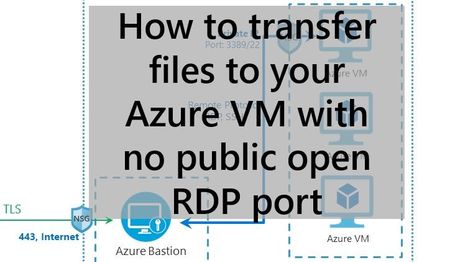
Azure Bastion provides a session to your Azure VM with no public RDP port open, but you can't transfer files via your browse. Now you can use the native RDP client and tunnel through the Azure Bastion host. File transfer is then copy and paste!39KViews2likes2CommentsUsing scenario driven methods to teach about 5G, AI and the Edge
I teach a full-stack AI course at the University of Oxford. By 'full-stack,' I mean that the course covers Cloud, Edge, and MLOps practices within the context of machine learning and deep learning algorithms. In this blog I will explain how we are using Microsoft LEARN to teach concepts of 5G. I hope the wider edtech community can benefit from our experience. I also welcome your feedback, especially if you plan to teach 5G from an Enterprise perspective.3.8KViews1like1Comment