mitre att&ck
1 Topic
“Automating Export of Microsoft Sentinel Analytic Rules mapped to MITRE Tactics & Techniques”
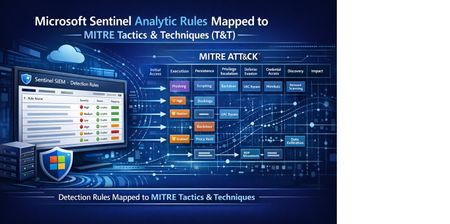
1. Introduction In modern Security Operations Centers (SOCs), mapping detections to the MITRE ATT&CK framework is critical. MITRE ATT&CK provides a structured, globally recognized model of adversary behavior, categorized into Tactics (goals) and Techniques (methods). Microsoft Sentinel analytic rules frequently include MITRE mappings, but viewing or exporting these at scale isn’t straightforward within the portal. Security teams often need: • A centralized view of existing detections mapped to MITRE ATT&CK • A CSV export for reporting, audits, and threat coverage assessments • Insights for SOC maturity, gap analysis, and threat-informed defense Having an automated way to extract this information ensures accuracy, consistency, and faster operational insights — all essential for high-performing SOCs. 2) Why This Script Is Required While Sentinel analytic rules individually display MITRE mappings, organizations typically need a workspace-wide export for: Detection Coverage & Gap Analysis Identify which Tactics & Techniques are covered. Highlight missing ATT&CK areas. Support threat modelling or purple team exercises. Security Operations Reporting Governance and oversight meetings Compliance documentation SOC KPI reporting and dashboards. Detection Engineering Lifecycle Maintaining a detection catalogue. Versioning and documentation Supporting change management and audits Exporting rules into a CSV using automation avoids manual errors, saves analyst time, and ensures accurate, up-to-date data. 3) Script to Export Microsoft Sentinel Analytic Rules with MITRE Tactics & Techniques (TO BE RUN FROM AZURE CLI) Important: This Bash script must be executed from Azure CLI, either: Azure Cloud Shell, or A workstation/server with Azure CLI installed (Linux, macOS, or WSL on Windows) The script uses az rest and jq to pull analytic rules and generate a CSV containing MITRE Tactics, Techniques, Severity, Enabled state, and KQL query. Bash Script (Run in Azure CLI) ------------------------------------------------------------------------------------------------------------------------ #!/bin/bash # Variables export SUB="99005f96-e572-4035-b476-836fd9d83d64" export RG="CyberSOC" export WS="CyberSOC" API="2024-03-01" # Step 1: Set subscription az account set --subscription "$SUB" # Step 2: Fetch alert rules echo "Fetching alert rules..." az rest \ --method GET \ --uri "https://management.azure.com/subscriptions/$SUB/resourceGroups/$RG/providers/Microsoft.OperationalInsights/workspaces/$WS/providers/Microsoft.SecurityInsights/alertRules?api-version=$API" \ --output json > rules.json # Step 3: Validate file if [ ! -s rules.json ]; then echo "Error: rules.json is empty or missing." exit 1 fi echo "Total rules found:" jq '.value | length' rules.json # Step 4: Generate CSV with MITRE mapping, severity, enabled echo "Generating CSV..." jq -r ' (["RuleName","Tactics","Techniques","MITRE_Map","Severity","Enabled","Query"] | @csv), ( .value[] | select(.kind == "Scheduled") | . as $r | ($r.properties // {}) as $p | [ ($p.displayName // $r.name // "N/A"), (( $p.tactics // $p.attackTactics // [] ) | join(";")), (( $p.techniques // $p.attackTechniqueIds // [] ) | join(";")), ( ( ($p.tactics // []) | map("TA" + (.[2:]? // "")) ) as $tacs | ( ($p.techniques // []) | map(.) ) as $techs | ( [$tacs[], $techs[]] | join(";")) ), ($p.severity // "N/A"), ($p.enabled | tostring), (( $p.query // "" ) | gsub("\\r?\\n"; " ")) ] | @csv ) ' rules.json > Scheduled_Rules_TTP_Query.csv ------------------------------------------------------------------------------------------------------------------------ 4) Summary Mapping detections to MITRE ATT&CK is a cornerstone of threat-informed defense. This script simplifies the process of exporting Microsoft Sentinel analytic rules with their MITRE mappings into a CSV — enabling SOC teams to: Analyze coverage across ATT&CK Identify detection gaps. Strengthen red–blue team collaboration. Build dashboards and ATT&CK heatmaps. Enhance SOC governance & reporting. Automating this export ensures faster insights, reduces manual workload, and supports a mature detection engineering program.