microsoft defender for endpoint
58 Topics
Microsoft Defender XDR / Defender for Endpoint data connectors inconsistent failures
Hello, We are deploying our SOC (Sentinel) environments via Bicep. Now the Defender XDR ( MicrosoftThreatProtection) and Defender for Endpoint ( MicrosoftDefenderAdvancedThreatProtection) data connectors are failing to deploy inconsistantly. It seems to be a known issue due to the following posts: - https://github.com/Azure/SimuLand/issues/23 - https://techcommunity.microsoft.com/t5/microsoft-sentinel/quot-missing-consent-invalid-license-quot-defender-for-endpoint/m-p/3027212 - https://github.com/Azure/Azure-Sentinel/issues/5007 Next to this issue I see almost no development on the data connectors API, is there some news to be spread how to enable data connectors automated in the future, since it seems to be moving to Content Hub. It is hard to find any docs about how to deploy this for example via Bicep!? Also I have a question regarding 'Tenant-based Microsoft Defender for Cloud (Preview)' data connector. We deploy this now via GenericUI data connector kind, but this has no option to enable it via automation. Same as the question in the previous paragraph, how would this be made possible?1.3KViews0likes1Comment
Monitoring work from home
My boss has asked me if there is a way to see just how "busy" people who are working from home are. I have this data in Sentinel: Entra sign-in logs Defender for Endpoint logs Office 365 logs Most, if not all, on premise AD login events Netskope (current ZTNA solution) logs I have my known office location IPs so i could just exclude those and look for activity from other IPs however many times people will work in the morning or on the way to work appearing from a non corporate IP, come into the office appearing to come from a corporate IP, and then from home again in the evening. I need a way to query Sentinel looking for people who appear to be working but not coming from Corp IP. If they came from different IPs on the same day including Corp check to see if those non Corp are before and after business hours and exclude those. Anyone know of a good query to achieve this? Or maybe a tool that can extract and generate a report?226Views0likes0CommentsSentinel - Defender XDR KQL Queries Library
Hello all, I’ve been building something over the past few weeks that I think the security community might find useful. https://goxdr.fyi is a searchable KQL query library for Microsoft Sentinel and Defender XDR. The name comes from a nickname my colleagues gave me (GoX) combined with XDR. I also picked up https://goxdr.fyi as a short and easy to remember domain for it. You can check it out here: https://goxdr.fyi The idea came from my own day to day work as someone working in IAM and SOC operations. I constantly find myself writing and refining KQL queries for threat hunting, detection engineering and incident investigation. Over time I realized I had a growing collection of queries that I kept going back to and I thought why not make these available to others? It currently has 117 queries covering identity security, BEC/AiTM detection, NTLM and LDAP attack hunting, OAuth governance, AI/Copilot security, Sentinel alert trending, SOC performance metrics and more. Some of these queries are ones I wrote from scratch based on real scenarios I encountered in production environments. Others are community queries I tested and validated in my own setup. Only the ones I found genuinely useful and that actually worked against real data made it in. Each query comes with a description explaining what it detects and why it matters, along with severity levels, platform tags (Sentinel, XDR or both) and a copy button so you can paste it directly into Advanced Hunting or use it as the basis for an Analytics Rule. The site is open source, hosted on GitHub Pages and licensed under CC BY 4.0. No sign-up, no paywall, no tracking. The source is available. I’ll keep adding queries as new scenarios come up. If there’s enough interest I’m also considering adding Cortex XQL queries for Palo Alto environments. Suggestions, feedback or ideas for new detections are always welcome. Feel free to reach out. Thanks314Views0likes0CommentsThe Worm in the Supply Chain: How Defender for Endpoint and Sentinel for SAP BTP Caught Shai-Hulud
On 29 April 2026, malicious versions of multiple SAP ecosystem npm packages were briefly published, creating a supply-chain exposure for SAP Cloud Application Programming (CAP) development environments and CI/CD pipelines. For a brief window that morning, affected developers have executed a credential-stealing payload on a workstation or, in higher-impact cases, within a CI/CD pipeline. SAP developers don't usually think of themselves as a juicy npm target. CAP, BTP, Fiori - that's enterprise turf, not crypto-stealer type territory – Until it is. Join me for the ride. See our latest click-video for an even more dynamic experience of SAP compromises. Affected packages and scope Four official npm packages from the SAP development ecosystem were published in malicious versions that day. Security researchers are calling the campaign "Mini Shai-Hulud" - the little cousin of the worm family that has been chewing its way through open-source registries for months. So, the "mini" part is a generous description in my opinion. Shai-Hulud has wriggled directly into the SAP supply chain, and that detail alone deserves a pause... SAP CAP is now interesting enough to have become a target. Four packages, all wearing legitimate SAP branding, all quietly swapped for evil twins: @cap-js/sqlite v2.2.2 @cap-js/postgres v2.2.2 @cap-js/db-service v2.10.1 mbt v1.2.48 These packages are not peripheral dependencies. The @cap-js/* modules are part of the SAP CAP Model used across custom development on SAP BTP, while mbt is the Cloud MTA Build Tool commonly embedded in CI/CD workflows that package and deploy Multi-Target Applications to BTP and on-premises environments. At roughly 930,000 weekly downloads, the combined exposure created meaningful downstream attack surface. The good news: SAP spotted the compromise fast, yanked the bad versions, and shipped clean replacements. The official guidance lives in SAP Security Note 3747787 - which carries the list of indicators of compromise, file hashes, and mitigation steps. Enough theory and evidence talk! Now, SHOW ME the detection! When the worm stirs beneath the sand, weak defenses vanish first. Observed telemetry in Microsoft Security products See below excerpt of Microsoft Defender for Endpoint from a compromised developer machine. The worm was neutralized immediately. Check the detection time (same day of release): Windows Defender AV detected malware ToString: DefenderDetection: File: /Users/User***/Projects/dara-api-manager-ui/node_modules/mbt/File***.js, Sha256: *** [Trojan:JS/SPchnStlr.BB], BlockingStatus: Prevented, BlockingStatusPriority: 900 DetectionTime: 2026-04-29 11:52:11Z DetectorName: Microsoft.Cyber.ObservationDetectors.DefenderConcreteDetector Observations (2): DefenderObservation Description: Defender detected and quarantined 'Trojan:JS/SPchnStlr.BB' in file 'File***.js' ThreatCategory = Trojan, ThreatFamily = SPchnStlr, How the Threat Actors Operationalized the Stolen Data The compromise allowed harvesting GitHub tokens, AWS/Azure/GCP secrets, npm credentials, Kubernetes config, SSH keys, .npmrc and .git-credentials files, and CI/CD environment variables. The hackers created a public GitHub repository on the victim’s own account, tagged with the description “A Mini Shai-Hulud has Appeared“ to exfiltrate their reaping. Within hours, more than a thousand such repositories were visible in public GitHub search. For additional views on the topic check out the blogs of our Sentinel for SAP partners: Onapsis, Pathlock, and SecurityBridge. Containment and Impact Reduction If you were not as lucky as the developer using Defender for Endpoint and VS Code, you need end to end monitoring of your landscape in and around SAP. Once the worm is loose with cloud tokens it may appear in various unexpected places. Microsoft Sentinel Solution for SAP covers your ERP crown jewels, your SAP BTP landscape and allows informed correlation with the rest of your IT estate. Microsoft’s correlation engine: ensures traceability automatic attack disruption and just-in-time hardening of potential attack paths. Developers using the cloud-based IDE SAP Business Application Studio are out of reach by Defender for Endpoint but profit from threat monitoring through Sentinel for SAP BTP integrating SAP BTP’s malware scanner the same way. See this in action in this click-video and in below screenshot. SOC analysts get actionable insights and tailored guidance from Security Copilot once SAP BTP signals are added to the Microsoft incident graph - no matter where the threat involving SAP originates from. Getting Started with Sentinel Solution for SAP Rollout of Sentinel for SAP BTP can happen immediately. Learn more from our deployment guide. Check out the security content reference for more info out-of-the-box detections. Sentinel for SAP which covers your ERP solutions and more, requires configuration of SAP Integration Suite as intermediary step. Learn more from our deployment guide. Check out the security content reference for more info out-of-the-box detections Final Words This incident illustrates how far the SAP BTP attack surface now extends and why patching alone is insufficient once malicious code reaches developer tooling and build infrastructure. Effective defense also requires telemetry, correlation, and response coverage across SAP and non-SAP environments. See you out there folks! #Kudos to Mahesh Mandva and Cameron Gardiner on riding shai-holud with me. Feel free to reach out to talk more about SAP Cyber Security. Cheers, Martin Useful Links SAP Note 3747787 with mitigation guide Mini Shai-Hulud: Multi-Ecosystem Developer Supply Chain Attack – Lab Space Click-Demo for SAP Cyber Security with Microsoft Sentinel for SAP Security Content | Microsoft Learn Sentinel for SAP BTP Security Content | Microsoft Learn694Views0likes0Comments
Understand New Sentinel Pricing Model with Sentinel Data Lake Tier
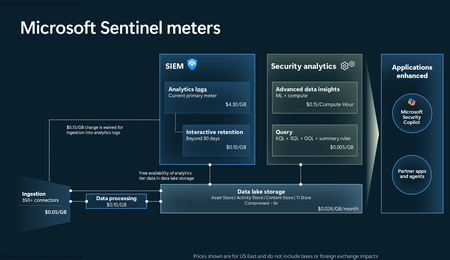
Introduction on Sentinel and its New Pricing Model Microsoft Sentinel is a cloud-native Security Information and Event Management (SIEM) and Security Orchestration, Automation, and Response (SOAR) platform that collects, analyzes, and correlates security data from across your environment to detect threats and automate response. Traditionally, Sentinel stored all ingested data in the Analytics tier (Log Analytics workspace), which is powerful but expensive for high-volume logs. To reduce cost and enable customers to retain all security data without compromise, Microsoft introduced a new dual-tier pricing model consisting of the Analytics tier and the Data Lake tier. The Analytics tier continues to support fast, real-time querying and analytics for core security scenarios, while the new Data Lake tier provides very low-cost storage for long-term retention and high-volume datasets. Customers can now choose where each data type lands—analytics for high-value detections and investigations, and data lake for large or archival types—allowing organizations to significantly lower cost while still retaining all their security data for analytics, compliance, and hunting. Please flow diagram depicts new sentinel pricing model: Now let's understand this new pricing model with below scenarios: Scenario 1A (PAY GO) Scenario 1B (Usage Commitment) Scenario 2 (Data Lake Tier Only) Scenario 1A (PAY GO) Requirement Suppose you need to ingest 10 GB of data per day, and you must retain that data for 2 years. However, you will only frequently use, query, and analyze the data for the first 6 months. Solution To optimize cost, you can ingest the data into the Analytics tier and retain it there for the first 6 months, where active querying and investigation happen. After that period, the remaining 18 months of retention can be shifted to the Data Lake tier, which provides low-cost storage for compliance and auditing needs. But you will be charged separately for data lake tier querying and analytics which depicted as Compute (D) in pricing flow diagram. Pricing Flow / Notes The first 10 GB/day ingested into the Analytics tier is free for 31 days under the Analytics logs plan. All data ingested into the Analytics tier is automatically mirrored to the Data Lake tier at no additional ingestion or retention cost. For the first 6 months, you pay only for Analytics tier ingestion and retention, excluding any free capacity. For the next 18 months, you pay only for Data Lake tier retention, which is significantly cheaper. Azure Pricing Calculator Equivalent Assuming no data is queried or analyzed during the 18-month Data Lake tier retention period: Although the Analytics tier retention is set to 6 months, the first 3 months of retention fall under the free retention limit, so retention charges apply only for the remaining 3 months of the analytics retention window. Azure pricing calculator will adjust accordingly. Scenario 1B (Usage Commitment) Now, suppose you are ingesting 100 GB per day. If you follow the same pay-as-you-go pricing model described above, your estimated cost would be approximately $15,204 per month. However, you can reduce this cost by choosing a Commitment Tier, where Analytics tier ingestion is billed at a discounted rate. Note that the discount applies only to Analytics tier ingestion—it does not apply to Analytics tier retention costs or to any Data Lake tier–related charges. Please refer to the pricing flow and the equivalent pricing calculator results shown below. Monthly cost savings: $15,204 – $11,184 = $4,020 per month Now the question is: What happens if your usage reaches 150 GB per day? Will the additional 50 GB be billed at the Pay-As-You-Go rate? No. The entire 150 GB/day will still be billed at the discounted rate associated with the 100 GB/day commitment tier bucket. Azure Pricing Calculator Equivalent (100 GB/ Day) Azure Pricing Calculator Equivalent (150 GB/ Day) Scenario 2 (Data Lake Tier Only) Requirement Suppose you need to store certain audit or compliance logs amounting to 10 GB per day. These logs are not used for querying, analytics, or investigations on a regular basis, but must be retained for 2 years as per your organization’s compliance or forensic policies. Solution Since these logs are not actively analyzed, you should avoid ingesting them into the Analytics tier, which is more expensive and optimized for active querying. Instead, send them directly to the Data Lake tier, where they can be retained cost-effectively for future audit, compliance, or forensic needs. Pricing Flow Because the data is ingested directly into the Data Lake tier, you pay both ingestion and retention costs there for the entire 2-year period. If, at any point in the future, you need to perform advanced analytics, querying, or search, you will incur additional compute charges, based on actual usage. Even with occasional compute charges, the cost remains significantly lower than storing the same data in the Analytics tier. Realized Savings Scenario Cost per Month Scenario 1: 10 GB/day in Analytics tier $1,520.40 Scenario 2: 10 GB/day directly into Data Lake tier $202.20 (without compute) $257.20 (with sample compute price) Savings with no compute activity: $1,520.40 – $202.20 = $1,318.20 per month Savings with some compute activity (sample value): $1,520.40 – $257.20 = $1,263.20 per month Azure calculator equivalent without compute Azure calculator equivalent with Sample Compute Conclusion The combination of the Analytics tier and the Data Lake tier in Microsoft Sentinel enables organizations to optimize cost based on how their security data is used. High-value logs that require frequent querying, real-time analytics, and investigation can be stored in the Analytics tier, which provides powerful search performance and built-in detection capabilities. At the same time, large-volume or infrequently accessed logs—such as audit, compliance, or long-term retention data—can be directed to the Data Lake tier, which offers dramatically lower storage and ingestion costs. Because all Analytics tier data is automatically mirrored to the Data Lake tier at no extra cost, customers can use the Analytics tier only for the period they actively query data, and rely on the Data Lake tier for the remaining retention. This tiered model allows different scenarios—active investigation, archival storage, compliance retention, or large-scale telemetry ingestion—to be handled at the most cost-effective layer, ultimately delivering substantial savings without sacrificing visibility, retention, or future analytical capabilities.Solved3.9KViews2likes6Comments
Issue when ingesting Defender XDR table in Sentinel
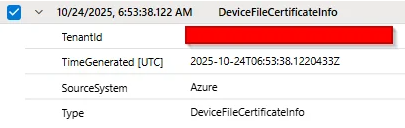
Hello, We are migrating our on-premises SIEM solution to Microsoft Sentinel since we have E5 licences for all our users. The integration between Defender XDR and Sentinel convinced us to make the move. We have a limited budget for Sentinel, and we found out that the Auxiliary/Data Lake feature is sufficient for verbose log sources such as network logs. We would like to retain Defender XDR data for more than 30 days (the default retention period). We implemented the solution described in this blog post: https://jeffreyappel.nl/how-to-store-defender-xdr-data-for-years-in-sentinel-data-lake-without-expensive-ingestion-cost/ However, we are facing an issue with 2 tables: DeviceImageLoadEvents and DeviceFileCertificateInfo. The table forwarded by Defender to Sentinel are empty like this row: We created a support ticket but so far, we haven't received any solution. If anyone has experienced this issue, we would appreciate your feedback. Lucas407Views0likes1CommentDefender Entity Page w/ Sentinel Events Tab
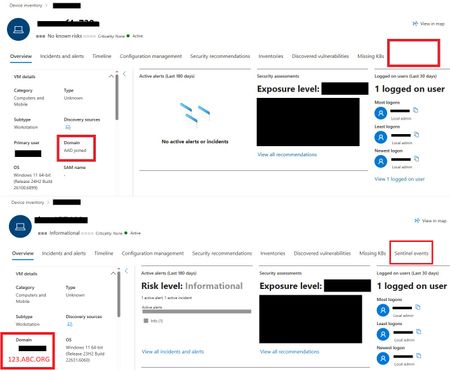
One device is displaying the Sentinel Events Tab, while the other is not. The only difference observed is that one device is Azure AD (AAD) joined and the other is Domain Joined. Could this difference account for the missing Sentinel events data? Any insight would be appreciated!478Views0likes2Comments
Device Tables are not ingesting tables for an orgs workspace
Device Tables are not ingesting tables for an orgs workspace. I can confirm that all devices are enrolled and onboarded to MDE (Microsoft defender for endpoint) I had placed an EICAR file on one of the machine which bought an alert through to sentinel,however this did not invoke any of the device related tables . Workspace i am targeting Workspace from another org with tables enabled and ingesting data Microsoft Defender XDR connector shows as connected however the tables do not seem to be ingesting data; I run the following; DeviceEvents | where TimeGenerated > ago(15m) | top 20 by TimeGenerated DeviceProcessEvents | where TimeGenerated > ago(15m) | top 20 by TimeGenerated I receive no results; No results found from the specified time range Try selecting another time range Please assist As I cannot think where this is failing213Views1like1Comment
Microsoft 365 defender alerts not capturing fields (entities) in azure sentinel
We got an alert from 365 defenders to azure sentinel ( A potentially malicious URL click was detected). To investigate this alert we have to check in the 365 defender portal. We noticed that entities are not capturing (user, host, IP). How can we resolve this issue? Note: This is not a custom rule.2.8KViews1like3Comments