inspektor gadget
7 TopicsFour open source projects to explore at Microsoft Build
Open source is where developers experiment, collaborate, and turn new ideas into tools that others can build on. At Microsoft Build, we’re creating a dedicated space for that energy: the Open Source Zone. This year, the Open Source Zone will bring together maintainers, contributors, and developers working on some of the most interesting open source projects in AI. Whether you’re building agents, experimenting with local models, exploring prompt workflows, or looking for practical ways to bring AI into your development process, this is a place to meet the people behind the projects and see what they’re building. The Open Source Zone is inspired by similar community spaces we’ve hosted at GitHub Universe: hands-on, conversation-driven, and centered on the people and projects moving open source forward. Meet the projects OpenClaw OpenClaw, originally Clawbot, formerly Clawdbot and briefly Moltbot,before landing on its current name (because naming is hard), is a personal AI assistant project built for developers who want more control over how AI agents run across tools, devices, and workflows. Its repository describes it as “your own personal AI assistant” across operating systems and platforms, with support for agent workspaces, skills, and device nodes. It has also become one of the fastest-growing open source projects on GitHub, with over 370,000 stars to date. At the Open Source Zone, attendees can learn how OpenClaw approaches personal agents, extensibility, and local-first experimentation. AutoGPT AutoGPT is one of the best-known open source projects in the autonomous agent space. The project’s mission is to make AI accessible for everyone to use and build on, with tools for building, testing, and delegating work to agents. Visit AutoGPT in the Open Source Zone to learn how the project is evolving agent development, benchmarking, frontend experiences, and practical workflows for building agent-powered applications. Come for the autonomous agents; stay for the very human maintainers. AutoGPT is also a member of GitHub’s Secure Open Source Fund, with a goal of enhancing AI security across the open source ecosystem. Open WebUI Open WebUI is a self-hosted, extensible AI platform for working with large language models. The project supports Ollama and OpenAI-compatible APIs and includes built-in RAG capabilities, making it a strong option for developers and organizations exploring local, private, or provider-flexible AI experiences. At Build, the Open WebUI team will show how developers can run, customize, and extend AI interfaces for their own environments. prompts.chat prompts.chat, formerly Awesome ChatGPT Prompts, is a curated collection of prompt examples for AI chat models. The project is designed to help people discover, share, and build better prompts for modern AI assistants. Created by Fatih Kadir Akın, a GitHub Star from Istanbul, prompts.chat reflects his work at the intersection of open source, developer education, and AI-assisted development. Fatih leads Developer Relations at Teknasyon, has authored books on JavaScript and prompt engineering, and is active in the community as a speaker, organizer, and contributor. Stop by to explore prompt libraries, prompt engineering resources, self-hosting options, and ways the community is making prompting more reusable and collaborative. Register for Microsoft Build Microsoft Build takes place June 2–3, 2026, in San Francisco and online. In-person passes are available, and online registration is free for livestreamed keynote and select session access. Register for Microsoft Build and come visit the Open Source Zone to meet the teams behind OpenClaw, AutoGPT, Open WebUI, and prompts.chat. We’ll see you there. <3101Views0likes0CommentsInspektor Gadget Completes Its First Independent Security Audit
Inspektor Gadget, the CNCF eBPF tool for Kubernetes and Linux observability, has completed its first independent security audit, conducted by Shielder and coordinated by OSTIF and CNCF. The audit found two Medium and one Low-severity issue, now patched in release v0.50.1. Learn what the auditors discovered, the hardening recommendations the maintainers are acting on, and why this milestone matters for the open source community.203Views0likes0Comments
Project Pavilion Presence at KubeCon EU 2026
KubeCon + CloudNativeCon Europe 2026 took place from 23 to 26 March at RAI Amsterdam, and it was a strong one. The themes running through the week reflected where the cloud native community is right now: AI moving from experimentation into production, platform engineering continuing to mature, and security and sovereignty top of mind for organizations across Europe. Microsoft was there throughout, and once again supported a range of open source projects in the Project Pavilion. The Project Pavilion is a dedicated, vendor-neutral space on the show floor reserved for CNCF projects. It is where the work gets talked about honestly. Maintainers and contributors meet directly with end users, share what they are building, get real feedback on what is and is not working, and have the kinds of technical conversations that are hard to have anywhere else. For open source communities, it is one of the most valuable parts of the event. Why Our Presence Matters Microsoft's products and services are built on and alongside many of the technologies represented in the pavilion, and the health of these communities matters to us directly. Showing up means our teams hear firsthand what is working, what is missing, and where these projects need to go next. It also means we get to contribute as community members, not just as a company name on a sponsor board. That distinction matters to us, and to the communities we are part of. Microsoft-Supported Pavilion Projects Confidential Containers Representative: Jeremi Piotrowski The Confidential Containers booth gave attendees a chance to learn more about the project and its approach to protecting workloads using hardware-based trusted execution environments. Jeremi was on hand throughout the kiosk hours, fielding questions from interested users and developers exploring confidential computing in Kubernetes environments. Conversations touched on use cases around data privacy, regulated workloads, and the role Confidential Containers plays in the broader cloud-native security landscape. Drasi Representative: Daniel Gerlag and Nandita Valsan The Drasi team had a busy time in the pavilion, engaging around 40 attendees across two kiosk shifts in focused technical conversations. Most visitors were developers and platform engineers curious about change-driven architectures and real-time data processing. There was strong positive feedback on the newly introduced Drasi Server modes and embeddable library, which complement Drasi for Kubernetes. The team came away with useful validation of current design decisions and good input for the roadmap ahead. Envoy Representative: Mikhail Krinkin The Envoy booth was staffed for the full duration of KubeCon EU by maintainers from Microsoft, Google, Isovalent, and Tetrate, reflecting the broad and healthy contributor base behind the project. The biggest topic at the booth was migration from ingress-nginx to Gateway API implementations. The archival of ingress-nginx pushed a lot of users into making changes they were not quite ready for, and questions ranged from technical specifics like HTTP default differences between Envoy and Nginx, to more foundational questions about what Envoy and Gateway API actually are. The team had anticipated this and invested in the ingress2gateway project to give users a clear migration path. Extensibility was another frequent conversation topic, with dynamic modules increasingly becoming the go-to answer for user-specific requirements. Starting with the 1.38 release of Envoy, dynamic modules will have a backward compatible ABI, a sign of real production readiness for that feature. Flatcar Representative: Thilo Fromm and Mathieu Tortuyaux The Flatcar booth had great energy, with maintainers from Microsoft, STACKIT, and CloudBase joining for conversations throughout the pavilion hours. Operational sovereignty came up again and again as a theme, with users and consulting partners sharing how they are building their Kubernetes offerings on Flatcar because of how reliable and secure it is. There were a lot of meaningful conversations. Lambda.ai currently runs Flatcar on their control plane and is looking at extending it to worker and customer clusters, with interest in contributing to the project. ReeVo has built their hosted Kubernetes distro on Flatcar across multi-cloud and bare metal environments and is planning to move hundreds of customer clusters over soon. Users from ClearScore, Avassa, Recorded Future, and several other organizations also stopped by with positive feedback on the project's robustness and security. STACKIT uses Flatcar as the default OS for their hosted Kubernetes offering and sponsors a full-time maintainer for the project. The team also connected with TAG Infrastructure to talk through Flatcar's CNCF graduation progress. Headlamp Representatives: René Dudfield and Santhosh Nagaraj S The Headlamp booth was a busy one, with users, contributors, and partner projects all stopping by throughout the pavilion hours. Conversations covered real-world deployments, federation challenges, multi-tenant namespace visibility, and feature requests like multi-CR data aggregation. There was notable interest from consultancies deploying Headlamp across hundreds of customer clusters, as well as from companies already running it at cloud scale. Several CNCF projects expressed interest in building UIs for their own projects inside Headlamp, with a few even getting started right there at the conference. The team also heard from users getting budget approved to migrate from the deprecated Kubernetes Dashboard, which is a good sign for the project's growing momentum. Demand for air-gapped AI agent support and deeper Azure and AKS integrations for internal developer platforms came up as clear areas to watch. Hyperlight Representative: Ralph Squillace The Hyperlight booth ran as a half-day session on Tuesday, in line with the project's current Sandbox status, but the corner location in the project area made a real difference in visibility. Ralph was fielding questions from the moment the doors opened, with a steady stream of visitors right up until the shift ended. Live and recorded demos were central to the conversations, helping attendees quickly grasp what Hyperlight does and how it fits into their environments. One standout visit came from an engineer at SAP who spent nearly an hour at the booth, pushing the conversation from fundamentals and embedding examples all the way through to agentic protection scenarios in Kubernetes. That conversation continued beyond KubeCon and turned into a scheduled meeting to explore a proof of concept, a good example of the kind of follow-on engagement the pavilion can generate. Inspektor Gadget Representative: Michael Friese and Qasim Sarfraz The Inspektor Gadget booth had a lot of great energy, drawing in contributors, new users, and people just discovering the project for the first time. There was genuine excitement around Inspektor Gadget Desktop and its visual troubleshooting experience for Kubernetes and Linux environments. The integration with HolmesGPT, which was also featured in the keynote, came up frequently and was one of the main talking points throughout the event. A theme that surfaced consistently in conversations with platform engineers was multi-tenancy, with teams looking for ways to safely give developers ad-hoc access to troubleshoot issues independently while keeping overall control at the platform level. It was a good set of conversations that reflected both the project's maturity and the growing demand for a flexible observability framework. Istio Representative: Mitch Connors, Mikhail Krinkin, Jackie Maertens and Mike Morris The Istio booth had steady traffic throughout the conference, with a noticeable shift in who was stopping by. More visitors came from teams with existing sidecar-based production deployments looking for guidance on moving to ambient mode, which is a change from previous years when ambient interest was mostly coming from greenfield users. The motivation to make the move was often tied to cost optimization and performance, with teams having read case studies and feeling more confident about the direction. That said, the increased interest also surfaced some real gaps, including requests for clearer migration guidance, more clarity around architectural differences like mTLS egress workflows, and better support for VM-based workloads. The team is planning to prioritize migration guidance over the coming months. The updated Istio Day format, with a half day of sessions at the Cloud Native Theater stage, also drew a strong crowd with standing room only throughout. Notary Project Representative: Toddy Mladenov and Flora Taagen The Notary Project kiosk drew a wide range of visitors, from people learning about container image signing for the first time to experienced engineers asking detailed questions about what is coming next on the roadmap. A major highlight of the week was the project's conference talk on per-layer dm-verity signing, which drew a packed room and over 660 online sign-ups, one of the stronger turnouts for a project-level session at the event. The talk walked through how the new capability moves container security beyond pull-time verification to continuous runtime protection, backed by dm-verity, which generated a lengthy Q&A and a lot of enthusiasm from the audience. The team also sees a real opportunity ahead as AI workloads push organizations to think harder about the integrity of models, datasets, and container images, and the interest at the booth reinforced that Notary Project is well positioned to play a big role in securing those workflows. ORAS Representative: Toddy Mladenov The ORAS kiosk was staffed by maintainers from Microsoft, NVIDIA, and Red Hat, a good reflection of the healthy multi-vendor community the project has built. Attendees engaged with maintainers on ORAS use cases and adoption, with conversations ranging from how artifacts are tagged and packaged to how ORAS fits into broader multi-cloud workflows. One practical takeaway from maintainer conversations was around leveraging the ORAS SDK more often as a substitute for CLI operations when working with container registries, which helps teams build simpler and more robust tooling. Radius Representative: Sylvain Niles and Will Tsai The Radius booth, supported by the Microsoft Azure Incubations team, attracted a good mix of enterprise platform teams, prospective adopters, and fellow open source maintainers throughout the pavilion hours. There was strong interest in the extensible Radius Resource Types feature and how it helps teams abstract infrastructure complexity and move workloads across different environments. Conversations also surfaced useful feedback on where the project should focus next, including agent-driven infrastructure workflows and using the Radius application graph to improve observability and operational visibility for cloud-native applications. Conclusion KubeCon EU 2026 was a good reminder of why this community continues to grow. The conversations in the Project Pavilion were substantive, the feedback was honest, and the connections made there will carry forward into the work. Microsoft will be back for KubeCon NA in Salt Lake City this November, and we are already looking forward to it. If you are interested in getting involved with any of these projects, the best starting point is each project's community directly. You are also welcome to reach out to Lexi Nadolski at lexinadolski@microsoft.com with any questions.76Views0likes0CommentsBuilding Bridges: Microsoft’s Participation in the Fedora Linux Community
At Microsoft, we believe that meaningful open source participation is driven by people, not corporations. But companies can - and should - create the conditions that empower individuals to contribute. Over the past year, our Community Linux Engineering team has been doing just that, focusing on Fedora Linux and working closely with the community to improve infrastructure, tooling, and collaboration. This post shares some of the highlights of that work and outlines where we’re headed next. Modernizing Fedora Cloud Image Delivery One of our most impactful contributions this year has been expanding the availability of Fedora Cloud images across major cloud platforms. We introduced support for publishing images to both the Azure Community Gallery and Google Cloud Platform—capabilities that didn’t exist before. At the same time, we modernized the existing AWS image publishing process by migrating it to a new, OpenShift-hosted automation framework. This new system, developed by our team and led by engineer Jeremy Cline, streamlines image delivery across all three platforms and positions the project to scale and adapt more easily in the future. We partnered with Adam Williamson in Fedora QE to extend this tooling to support container image uploads, replacing fragile shell scripts with a robust, maintainable system. Nightly Fedora builds are now uploaded to Azure, with one periodically promoted to “latest” after manual validation and basic functionality testing. This ensures cloud users get up-to-date, ready-to-run images - critical for workloads that demand fast boot times and minimal setup. As you’ll see , we have ideas for improving this testing. Enabling Secure Boot on ARM with Sigul Secure Boot is essential for trusted cloud workloads across architectures. Our current focus includes enabling it on ARM-based systems. Fedora currently signs most artifacts with Sigul, but UEFI applications are handled separately via a dedicated x86_64 builder with a smart card. We’re working to enable Sigul-based signing for UEFI applications across architectures, but Sigul is a complex project with unmaintained dependencies. We’ve stepped in to help modernize Sigul, starting with a Rust-based client and a roadmap to re-architect the code and structure for easier maintenance and improved performance. This work is about more than just Microsoft’s needs - it’s about enabling Secure Boot support out of the box, like what users expect on x86_64 systems. Bringing Inspektor Gadget to Fedora Inspektor Gadget is an eBPF-based toolkit for kernel instrumentation, enabling powerful observability use cases like performance profiling and syscall tracing. The Community Linux Engineering team consulted with the Inspektor Gadget maintainers at Microsoft about putting the project in Fedora. This led to the maintainers natively packaging it for Fedora and assuming ongoing maintenance of the package. We are encouraging teams to become active Fedora participants, to maintain their own packages, and to engage directly with the community. We believe in bi-directional feedback: upstream contributions should benefit both the project and the contributors. Azure VM Utils: Simplifying Cloud Enablement To streamline Fedora’s compatibility with Azure, we’ve introduced a package called azure-vm-utils. It consolidates Udev rules and low-level utilities that make Fedora work better on Azure infrastructure, particularly with NVMe devices. This package is a step toward greater transparency and maintainability and could serve as a model for other cloud providers. Fedora WSL: A Layer 9 Success Fedora is now officially available in the Windows Subsystem for Linux (WSL) catalog - a milestone that required both technical and organizational effort. While the engineering work was substantial, the real challenge was navigating the legal and governance landscape. This success reflects deep collaboration between Fedora leadership, Red Hat, and Microsoft. Looking Ahead: Strategic Participation and Testing We’re not stopping here. Our roadmap includes: Replacing Sigul with a modern, maintainable signing infrastructure. Expanding participation in Fedora SIGs (Cloud, Go, Rust) where Microsoft has relevant expertise. Improving automated testing using Microsoft’s open source LISA framework to validate Fedora images at cloud scale. Enhancing the Fedora-on-Azure experience, including exploring mirrors within Azure and expanding agent/extension support. We’re also working closely with the Azure Linux team, which is aligning its development model with Fedora - much like RHEL does. while Azure Linux has used some Fedora sources in the past, their upcoming 4.0 release is intended to align much more closely with Fedora as an upstream A Call for Collaboration While contributing patches is a good start, we intend to do much more. We aim to be a deeply involved member of the Fedora community - participating in SIGs, maintaining packages, and listening to feedback. If you have ideas for where Microsoft can make strategic investments that benefit Fedora, we want to hear them. You’ll find us alongside you in Fedora meetings, forums, and at conferences like Flock. Open source thrives when contributors bring their whole selves to the table. At Microsoft, we’re working to ensure our engineers can do just that - by aligning company goals with community value. (This post is based on a talk delivered at Flock to Fedora 2025.)1.9KViews3likes0CommentsProject Pavilion Presence at KubeCon NA 2025
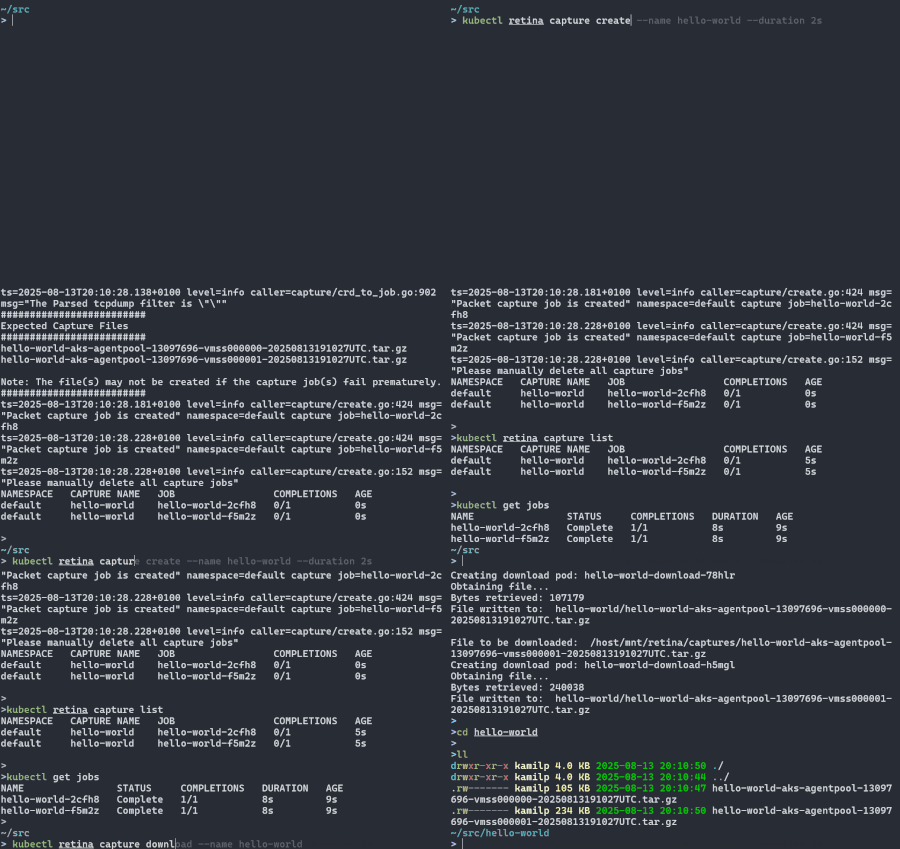
KubeCon + CloudNativeCon NA took place in Atlanta, Georgia, from 10-13 November, and continued to highlight the ongoing growth of the open source, cloud-native community. Microsoft participated throughout the event and supported several open source projects in the Project Pavilion. Microsoft’s involvement reflected our commitment to upstream collaboration, open governance, and enabling developers to build secure, scalable and portable applications across the ecosystem. The Project Pavilion serves as a dedicated, vendor-neutral space on the KubeCon show floor reserved for CNCF projects. Unlike the corporate booths, it focuses entirely on open source collaboration. It brings maintainers and contributors together with end users for hands-on demos, technical discussions, and roadmap insights. This space helps attendees discover emerging technologies and understand how different projects fit into the cloud-native ecosystem. It plays a critical role for idea exchanges, resolving challenges and strengthening collaboration across CNCF approved technologies. Why Our Presence Matters KubeCon NA remains one of the most influential gatherings for developers and organizations shaping the future of cloud-native computing. For Microsoft, participating in the Project Pavilion helps advance our goals of: Open governance and community-driven innovation Scaling vital cloud-native technologies Secure and sustainable operations Learning from practitioners and adopters Enabling developers across clouds and platforms Many of Microsoft’s products and cloud services are built on or aligned with CNCF and open-source technologies. Being active within these communities ensures that we are contributing back to the ecosystem we depend on and designing by collaborating with the community, not just for it. Microsoft-Supported Pavilion Projects containerd Representative: Wei Fu The containerd team engaged with project maintainers and ecosystem partners to explore solutions for improving AI model workflows. A key focus was the challenge of handling large OCI artifacts (often 500+ GiB) used in AI training workloads. Current image-pulling flows require containerd to fetch and fully unpack blobs, which significantly delays pod startup for large models. Collaborators from Docker, NTT, and ModelPack discussed a non-unpacking workflow that would allow training workloads to consume model data directly. The team plans to prototype this behavior as an experimental feature in containerd. Additional discussions included updates related to nerdbox and next steps for the erofs snapshotter. Copacetic Representative: Joshua Duffney The Copa booth attracted roughly 75 attendees, with strong representation from federal agencies and financial institutions, a sign of growing adoption in regulated industries. A lightning talk delivered at the conference significantly boosted traffic and engagement. Key feedback and insights included: High interest in customizable package update sources Demand for application-level patching beyond OS-level updates Need for clearer CI/CD integration patterns Expectations around in-cluster image patching Questions about runtime support, including Podman The conversations revealed several documentation gaps and feature opportunities that will inform Copa’s roadmap and future enablement efforts. Drasi Representative: Nandita Valsan KubeCon NA 2025 marked Drasi’s first in-person presence since its launch in October 2024 and its entry into the CNCF Sandbox in early 2025. With multiple kiosk slots, the team interacted with ~70 visitors across shifts. Engagement highlights included: New community members joining the Drasi Discord and starring GitHub repositories Meaningful discussions with observability and incident management vendors interested in change-driven architectures Positive reception to Aman Singh’s conference talk, which led attendees back to the booth for deeper technical conversations Post-event follow-ups are underway with several sponsors and partners to explore collaboration opportunities. Flatcar Container Linux Representatives: Sudhanva Huruli and Vamsi Kavuru The Flatcar project had some fantastic conversations at the pavilion. Attendees were eager to learn about bare metal provisioning, GPU support for AI workloads, and how Flatcar’s fully automated build and test process keeps things simple and developer friendly. Questions around Talos vs. Flatcar and CoreOS sparked lively discussions, with the team emphasizing Flatcar’s usability and independence from an OS-level API. Interest came from government agencies and financial institutions, and the preview of Flatcar on AKS opened the door to deeper conversations about real-world adoption. The Project Pavilion proved to be the perfect venue for authentic, technical exchanges. Flux Representatives: Dipti Pai The Flux booth was active throughout all three days of the Project Pavilion, where Microsoft joined other maintainers to highlight new capabilities in Flux 2.7, including improved multi-tenancy, enhanced observability, and streamlined cloud-native integrations. Visitors shared real-world GitOps experiences, both successes and challenges, which provided valuable insights for the project’s ongoing development. Microsoft’s involvement reinforced strong collaboration within the Flux community and continued commitment to advancing GitOps practices. Headlamp Representatives: Joaquim Rocha, Will Case, and Oleksandr Dubenko Headlamp had a booth for all three days of the conference, engaging with both longstanding users and first-time attendees. The increased visibility from becoming a Kubernetes sub-project was evident, with many attendees sharing their usage patterns across large tech organizations and smaller industrial teams. The booth enabled maintainers to: Gather insights into how teams use Headlamp in different environments Introduce Headlamp to new users discovering it via talks or hallway conversations Build stronger connections with the community and understand evolving needs Inspektor Gadget Representatives: Jose Blanquicet and Mauricio Vásquez Bernal Hosting a half-day kiosk session, Inspektor Gadget welcomed approximately 25 visitors. Attendees included newcomers interested in learning the basics and existing users looking for updates. The team showcased new capabilities, including the tcpdump gadget and Prometheus metrics export, and invited visitors to the upcoming contribfest to encourage participation. Istio Representatives: Keith Mattix, Jackie Maertens, Steven Jin Xuan, Niranjan Shankar, and Mike Morris The Istio booth continued to attract a mix of experienced adopters and newcomers seeking guidance. Technical discussions focused on: Enhancements to multicluster support in ambient mode Migration paths from sidecars to ambient Improvements in Gateway API availability and usage Performance and operational benefits for large-scale deployments Users, including several Azure customers, expressed appreciation for Microsoft’s sustained investment in Istio as part of their service mesh infrastructure. Notary Project Representative: Feynman Zhou and Toddy Mladenov The Notary Project booth saw significant interest from practitioners concerned with software supply chain security. Attendees discussed signing, verification workflows, and integrations with Azure services and Kubernetes clusters. The conversations will influence upcoming improvements across Notary Project and Ratify, reinforcing Microsoft’s commitment to secure artifacts and verifiable software distribution. Open Policy Agent (OPA) - Gatekeeper Representative: Jaydip Gabani The OPA/Gatekeeper booth enabled maintainers to connect with both new and existing users to explore use cases around policy enforcement, Rego/CEL authoring, and managing large policy sets. Many conversations surfaced opportunities around simplifying best practices and reducing management complexity. The team also promoted participation in an ongoing Gatekeeper/OPA survey to guide future improvements. ORAS Representative: Feynman Zhou and Toddy Mladenov ORAS engaged developers interested in OCI artifacts beyond container images which includes AI/ML models, metadata, backups, and multi-cloud artifact workflows. Attendees appreciated ORAS’s ecosystem integrations and found the booth examples useful for understanding how artifacts are tagged, packaged, and distributed. Many users shared how they leverage ORAS with Azure Container Registry and other OCI-compatible registries. Radius Representative: Zach Casper The Radius booth attracted the attention of platform engineers looking for ways to simplify their developer's experience while being able to enforce enterprise-grade infrastructure and security best practices. Attendees saw demos on deploying a database to Kubernetes and using managed databases from AWS and Azure without modifying the application deployment logic. They also saw a preview of Radius integration with GitHub Copilot enabling AI coding agents to autonomously deploy and test applications in the cloud. Conclusion KubeCon + CloudNativeCon North America 2025 reinforced the essential role of open source communities in driving innovation across cloud native technologies. Through the Project Pavilion, Microsoft teams were able to exchange knowledge with other maintainers, gather user feedback, and support projects that form foundational components of modern cloud infrastructure. Microsoft remains committed to building alongside the community and strengthening the ecosystem that powers so much of today’s cloud-native development. For anyone interested in exploring or contributing to these open source efforts, please reach out directly to each project’s community to get involved, or contact Lexi Nadolski at lexinadolski@microsoft.com for more information.290Views1like0Comments
Enhancing Observability with Inspektor Gadget
Thorough observability is essential to a pain free cloud experience. Azure provides many general-purpose observability tools, but you may want to create custom tooling . Inspektor Gadget is an open-source framework that makes customizable data collection easy. Microsoft recently contributed new features to Inspektor Gadget that further enhance its modular framework, making it even easier to meet your specific systems inspection needs. Of course, we also made it easy for Azure Kubernetes Service (AKS) users to use.1.2KViews0likes0Comments