hybrid integration
38 TopicsLogic Apps Aviators Newsletter - September 2026
In this issue: Ace Aviator of the Month News from our product group News from our community Ace Aviator of the Month September 2026's Ace Aviator: Parth Talaviya What's your role and title? What are your responsibilities? AI-Powered Azure/.NET Solution Architect I work as an Azure/.NET Solution Architect, combining technical leadership with building a Microsoft-focused boutique company. My work mainly revolves around application modernization and migration, cloud architecture, integrations, and team leadership. I also stay hands-on with development, architecture reviews, production troubleshooting, and mentoring developers. Can you give us some insights into your day-to-day activities and what a typical day in your role looks like? My day usually starts with thinking about how we can add more value to our clients' businesses. It includes reviewing project priorities, solving technical challenges, discussing architecture, supporting developers, and collaborating with stakeholders. I mainly work across .NET, Azure, APIs, integrations, DevOps, and AI automation, so every day brings something new to learn and solve. What motivates and inspires you to be an active member of the Aviators/Microsoft community? What really motivates me is how active and supportive the Microsoft community is. People are genuinely willing to help each other, share experiences, and solve problems together. Being able to use my own experience to help someone overcome a challenge genuinely makes my day, while learning from others keeps me motivated to continuously improve. Looking back, what advice do you wish you had been given earlier that you'd now share with those looking to get into STEM/technology? You don’t have to do everything alone. In technology, especially when you are stuck on a very specific problem, it can sometimes feel that way. Asking questions, learning from the community, and collaborating with others can make a huge difference. I would also say: embrace AI early, but use it wisely. Don’t use AI only to generate code. Use it to understand concepts, challenge your thinking, explore better approaches, review your work, and become a better problem-solver. What has helped you grow professionally? Continuous learning and solving real-world challenges have helped me grow the most. Working on legacy modernization, cloud architecture, large-scale data systems, automation, and AI has taught me to think beyond writing code and understand the broader business impact. Being part of a strong technical community has also helped significantly. Whenever you are stuck, there is often someone who has faced a similar challenge and is willing to share their experience. If you had a magic wand that could create a feature in Logic Apps, what would it be and why? I would create an AI-powered Copilot troubleshooting and self-healing assistant for Logic Apps. It could analyze failed workflows, understand the execution context, identify the likely root cause, suggest a fix, and provide safe recovery options. For complex integrations, this could save significant troubleshooting time and allow developers to focus more on building solutions rather than spending hours finding where something went wrong. News from our product group Use connectors with Managed Identity in the Logic Apps Standard extension Managed Identity is Azure's built-in way to authenticate to Microsoft Entra-protected resources without storing credentials, secrets, or connection strings. Deployed Logic Apps have supported it for some time, and this post explains connector support in the Logic Apps Standard extension. Introducing dependency telemetry in Application Insights for Azure API Management policies Running API platforms at scale requires both handling load and understanding where inefficiencies occur. This post introduces dependency telemetry in Application Insights for Azure API Management policies to help teams identify performance bottlenecks. Power Azure SRE Agent with the tools it needs Azure SRE Agent is an AI-powered service designed to reduce operational toil. Teams can use it to investigate incidents, identify probable causes, and automate health-related operational work using connected tools. Give your Copilot agents real tools, without hand-wiring MCP GitHub Copilot coding agents can work independently on branches, but some tasks require access to external systems. This post shows how to equip agents with real tools without manually wiring Model Context Protocol integrations. Zonal redundancy in API management Standard v2 APIs power modern mobile experiences, microservices, AI-driven applications, and business-critical integrations. This post explains zonal redundancy in Azure API Management Standard v2 for improving resilience as customers modernize their API platforms. BizTalk Server 2020 End-of-Sale Announcement Microsoft announces that BizTalk Server 2020 and Host Integration Server 2020 sales are expected to end on March 31, 2027. Existing licensed deployments can continue to be used, while mainstream support for BizTalk Server 2020 is scheduled through April 12, 2028. An optional paid extended-mainstream support offering is planned for eligible customers through April 10, 2030, with final terms to be published later. The post recommends beginning migration planning now, evaluating Azure Logic Apps Standard or Azure Logic Apps Hybrid, inventorying dependencies, and using the Logic Apps Migration Agent to assess and convert supported workloads. Logic App Storage Inspector Logic App Storage Inspector is a read-only Kudu site extension for examining storage used by an Azure Logic App Standard application. It supports searching workflow action and trigger history by workflow, date, or text, with results exportable as CSV or JSON. Users can browse and compare workflow-definition versions, review table and queue information, and monitor health indicators and refresh status. The extension isolates access to the current Logic App site, uses asynchronous paged operations for large storage accounts, and can be installed from Kudu Site Extensions. News from our community Azure Logic Apps Automation – A Practical Infrastructure Lab with Agentic Remediation Post by João Paulo Costa João Paulo Costa tests Azure Logic Apps Automation through an after-hours virtual-machine remediation lab. The workflow uses an agent to inspect VM metadata, tags, and runtime state, then apply guardrails before deciding whether to deallocate the resource, leave it unchanged, or request review. The article contrasts agentic decision-making with deterministic workflows, documents tool and connector choices, and examines preview limitations such as runtime-state retrieval and managed-identity support. It also emphasizes constrained permissions, explicit policies, verification after actions, and negative testing for production, exemptions, missing ownership, and disabled remediation. Agentic Integration: Non-Deterministic Experience, Solid Core Post by Massimo Crippa Massimo Crippa examines whether agentic capabilities make enterprise integration non-deterministic. He separates an agent’s variable decision-making from the predictable integration layer that executes selected capabilities. The article highlights durable messaging, reliable contracts, idempotency, transactional boundaries, retries, compensation, governance, and observability as continuing requirements. It presents tools as the boundary between reasoning and execution: agents determine what should happen, while integration platforms control how operations are performed safely. Azure Logic Apps is positioned as both a deterministic integration foundation and a platform that can expose governed capabilities to emerging agentic experiences. Build AI Agents in Azure Logic Apps (Conversational + Autonomous) Video by Rafsan Huseynov Rafsan Huseynov presents a video on building conversational and autonomous AI agents with Azure Logic Apps. The session describes Logic Apps as more than a background integration layer, covering orchestration, managed identities, agent loops, and the use of workflows as MCP tools. Demonstrations explore connections with Document Intelligence, Blob Storage, Microsoft Foundry, and Copilot Studio workflows, alongside conversational and autonomous agent patterns. The video also introduces a separate low-code automation experience with scoped permissions, while noting that the demonstrations use synthetic data and that the experience remains in preview. BizTalk to Logic Apps migration (three things, everyone gets wrong) Post by Brajesh Sinha Brajesh Sinha explains why simple counts of BizTalk orchestrations and maps produce unreliable Logic Apps migration estimates. One orchestration can fan out into several Azure resources, supposedly simple maps may hide substantial transformation complexity, and operational requirements are often omitted from statements of work. The article highlights the architecture, mapping, and production-readiness effort that teams frequently underestimate. It encourages migration planners to assess actual behavior and dependencies rather than relying on inventory totals, helping create more realistic timelines, scope, and delivery expectations. Hybrid Logic Apps on RKE2: a self-managed cluster with MetalLB Post by Sonny Gillissen Sonny Gillissen demonstrates how to run Azure Logic Apps Hybrid on a self-managed RKE2 Kubernetes cluster. Because RKE2 does not include a native load balancer, the walkthrough uses MetalLB to assign the ingress IP required by the deployment. It covers creating the cluster, configuring networking, connecting the environment to Azure Arc, and handling the platform-specific details needed for Logic Apps. The article provides a practical alternative for teams evaluating hybrid integration workloads outside managed Kubernetes services, extending earlier guidance for OpenShift environments. An Introduction to Logic Apps Standard SDK Video by Marcel Medina Marcel Medina shares a Coding Night ANZ recording introducing the Logic Apps Standard SDK. The session shows how the SDK brings a modern, code-first .NET development experience to Azure Logic Apps while retaining the platform’s connectors, triggers, monitoring, and managed runtime. It is aimed at developers who want familiar tooling and stronger source-driven workflow development without giving up managed integration capabilities. The post also thanks the community for its questions and participation and provides the complete session recording for anyone who missed the live event. Managed Identity in Logic Apps Standard: A Zero Trust Read Post by Steef-Jan Wiggers Steef-Jan Wiggers examines new Managed Identity support for connectors in the Logic Apps Standard local development experience. Developers can now use a consistent authentication model from development through production instead of swapping connection strings before deployment, removing a common source of unmanaged secrets. The article frames this improvement through Zero Trust while stressing that authentication alone does not replace disciplined RBAC. A working azd sample demonstrates the setup and highlights a critical application setting whose absence causes the otherwise correctly configured connection, access policy, and role assignment to fail.548Views0likes0CommentsModernize Any Integration Platform to Azure Logic Apps Standard with the Logic Apps Migration Agent
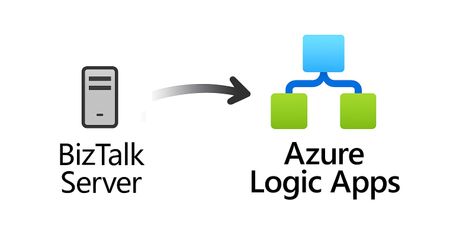
Explore the open-source Logic Apps Migration Agent Enterprise integration is entering a new era Enterprise integration platforms have powered business-critical processes for decades. They connect applications, data, partners, devices, and industries, often carrying transactions that an organization cannot afford to interrupt. Expectations have changed. Organizations want cloud-native architectures, AI-assisted automation, stronger governance, improved developer productivity, and faster response to business change. Yet many integration estates contain years of accumulated dependencies, custom code, transformations, operational procedures, and platform-specific knowledge. The challenge is not simply moving an orchestration or flow from one runtime to another. This is not lift and shift. It is a refactoring exercise that preserves business intent and expected behavior while translating source-platform constructs into cloud-ready workflows, connectors, code, operational patterns, and deployment practices for Azure Logic Apps Standard. That is why we created the Logic Apps Migration Agent. Introducing the Logic Apps Migration Agent: An Open-source project to provide an AI End-to-End Modernization Experience The Logic Apps Migration Agent is an open-source Visual Studio Code extension that provides an AI-assisted, end-to-end modernization experience. It uses GitHub Copilot and the Visual Studio Code Language Model API to guide teams through a structured five-stage workflow, while keeping people in control at every stage. Rather than treating modernization as a single conversion step, the agent helps teams discover what they have, understand dependencies, design an appropriate target, generate baseline implementation artifacts, validate expected behavior, and prepare the solution for deployment to Azure Logic Apps Standard. Refactor the implementation, preserve the business intent Lift and shift attempts to reproduce the source platform as closely as possible in a new environment. That approach can carry forward legacy topology, operational assumptions, platform-specific patterns, and technical debt. The Migration Agent supports a different outcome. It uses the source implementation as evidence of the required business behavior, then helps teams design and generate an appropriate Logic Apps Standard implementation. Some components may map directly, while others require restructuring, consolidation, decomposition, replacement, or custom implementation. The objective is functional and semantic continuity, not structural duplication. A successful migration should preserve contracts, transformations, routing rules, ordering requirements, error behavior, and essential business outcomes while allowing the target solution to adopt Azure-native identity, connectivity, observability, resiliency, deployment, and operating practices. Preserve what the integration must do. Refactor how it does it. Start by understanding what you have For many organizations, discovery is one of the most difficult parts of modernization. Documentation may be incomplete, original developers may no longer be available, and relationships between applications, endpoints, schemas, maps, pipelines, and custom components may be difficult to reconstruct. The Migration Agent scans the source project, catalogs supported artifacts, organizes related components into flow groups, and identifies dependencies and migration gaps. It can also generate architecture and message-flow visualizations for review before conversion begins. This discovery output becomes the foundation for migration sequencing, refactoring decisions, effort discussions, and risk management. Use AI to accelerate the work, not remove accountability The Migration Agent uses specialized GitHub Copilot agents for analysis, planning, and conversion. AI helps interpret source artifacts, propose mappings, create task plans, and generate baseline Logic Apps artifacts. Enterprise integration, however, requires more than plausible code generation. Human-in-the-loop checkpoints let teams review discovered flows, resolve missing dependencies, reshape the proposed architecture, approve conversion plans, and validate generated behavior before progressing. This combines the speed of AI assistance with the governance and technical review required for mission-critical integration. Modernize incrementally and reduce migration risk Large integration estates do not need a single big-bang program. The Migration Agent organizes work into logical flow groups so teams can refactor one business capability or integration path at a time. Prioritize workloads by business value, risk, complexity, or platform urgency. Validate target architecture and operating patterns with a representative first migration. Run phased cutovers and coexistence strategies when required. Apply reusable refactoring patterns, templates, and engineering standards to subsequent waves. A phased approach helps teams build experience with Azure Logic Apps while reducing migration risk and preserving delivery momentum. Bring your own tests and validate continuously Migration confidence depends on behavior, not structural similarity. The agent supports validation using source specifications, sample files, test cases, and customer-provided black-box tests. This helps compare expected inputs and outputs and identify semantic differences earlier. Generated artifacts are a baseline. Domain-specific transformations, error-handling behavior, performance characteristics, security controls, and edge cases still require customer and partner expertise. Built for BizTalk today and extensible for other platforms BizTalk Server 2016 and BizTalk Server 2020 are the first fully implemented source platforms. MuleSoft Anypoint support is represented as an in-progress built-in parser. The architecture is open and extensible so contributors can add parsers and platform-specific migration capabilities for other integration technologies. That extensibility is central to the vision. A common modernization workflow can help teams apply consistent governance, target patterns, refactoring practices, and validation across mixed integration estates. Why Azure Logic Apps Standard? Azure Logic Apps Standard provides a modern destination with a local project structure, Visual Studio Code development experience, source-control alignment, CI/CD support, stateful and stateless workflows, enterprise connectivity, and Azure and hybrid deployment options. Modernization is not about reproducing a legacy topology component by component. The target design should be optimized for Logic Apps Standard rather than constrained by the source architecture. The migration preserves valuable business logic while refactoring the implementation around modern practices for identity, networking, observability, reliability, deployment, and operations. What your team should still own The Migration Agent accelerates repeatable work, but it does not replace the decisions that define a production-ready integration platform. Responsibility Refactoring focus Target architecture Refactor application and workflow boundaries for Logic Apps Standard. Select reliability, networking, deployment, and supporting Azure patterns rather than copying the source topology. Semantic equivalence Validate contracts, mappings, transformations, business rules, error behavior, ordering, retries, and edge cases. Capability gaps Redesign source capabilities without direct equivalents using connectors, custom code, local functions, API Management, Service Bus, or other appropriate Azure patterns. Production hardening Implement identity, secrets management, security policies, monitoring, cost controls, performance testing, resiliency, and operational ownership. Cutover and coexistence Plan backlog reconciliation, dual-run periods, data consistency, partner coordination, rollback, and decommissioning. More mission critical features for Logic Apps Standard and Hybrid We are weeks away from shipping the following features, aimed at any customers in the Enterprise Application Integration space: HL7 In-App operations in general availability. MLLP Receive/Send In-App connector in Public Preview. Rules Engine In-App operation for XML facts in Public Preview. MSMQ In-App connector in Public Preview. Oracle DB In-App connector in Public Preview. Flat File generation In-App operations in Public Preview. Integration accounts support (Hybrid On premises). NMS In-App connector in Public Preview. Improvements to our EDI capabilities. BizTalk Mapper to Data Mapper Migration path What about other integration platforms? Yes—the Logic Apps Migration Agent is designed to be customizable so you can migrate from any integration platform to Logic Apps (not just BizTalk). The open architecture lets you plug in new discovery, analysis, and conversion skills for the source product you’re modernizing, while keeping the same stage-gated workflow and human-in-the-loop checkpoints. We provide guidance and examples to help you extend the agent for other platforms than BizTalk —so you can tailor mappings, transformation rules, and validation to your customer’s standards and target patterns in Logic Apps. Benefits Faster time to value with a guided process: A structured discovery→planning→conversion workflow reduces uncertainty and helps teams move from assessment to execution with clear checkpoints. Higher confidence migrations: Human-in-the-loop validation, artifacts generation, and black-box testing support mission‑critical correctness and governance. Customizable for your source platform and standards: Extend the agent with product-specific discovery and conversion steps, tailor mappings and transformation rules, and align outputs with your target Logic Apps patterns and engineering conventions. Open-source transparency and control: Review how the tool works end-to-end, validate what it produces, and adopt changes at your pace without waiting for a closed release cycle. Community-driven innovation: Benefit from contributions across Microsoft, partners, and customers—new adapters, mapping packs, and best practices can be shared and reused. Lower total migration cost: Automating repeatable tasks reduces manual effort while preserving the ability to invest partner expertise where it matters most (architecture, governance, reliability, and operations). Reusable accelerators for partners: Partners can create differentiated offerings by packaging templates, validation suites, CI/CD pipelines, and domain-specific patterns on top of the agent. An accelerator for customers and partners For customers, the Migration Agent provides a practical starting point and a consistent process for moving from assessment to a refactored implementation. For professional services organizations and system integrators, the agent augments delivery rather than replacing it. Automating inventory, analysis, baseline generation, and validation scaffolding allows experts to focus on architecture, governance, security, reliability, domain-specific transformation, DevOps, performance, cutover, and operating-model change. Because the project is open source, partners can contribute parsers or package reusable templates, mapping packs, test suites, CI/CD assets, and industry-specific modernization patterns. Review our public documentation here: https://learn.microsoft.com/en-us/azure/logic-apps/migration/migration-agent-overview How to get started Download VSCode and install the Logic Apps Migration Agent extension. Organize source projects and dependencies in a clear directory structure. Include project files, bindings, schemas, maps, pipelines, orchestrations, custom code, configuration, certificates or certificate references, and available documentation. Once you have all your artifacts ready, point the Migration Agent to the directory with all the artifacts. Review every migration stage. Confirm the discovered architecture, resolve missing dependencies, and refine the target design before authorizing conversion. Prepare a representative test environment. The workstation running Visual Studio Code must be able to reach the systems needed for local or end-to-end validation. Bring known inputs, expected outputs, specifications, and existing test cases whenever possible. These materials improve validation and reduce ambiguity. Treat the first migration as a reusable foundation. Capture architecture patterns, naming standards, deployment templates, observability practices, and lessons that can accelerate subsequent waves. Use Claude Opus 4.8 or higher. Make sure you increase the Maximum number of requests for the Copilot Chat as follows (we recommend changing the value from 60 to 1000) Check the following video for a demonstration on how the Agent works and let us know if you have any questions in the comments.2.1KViews1like0CommentsMicrosoft BizTalk Server Product Lifecycle Update
For more than 25 years, Microsoft BizTalk Server has supported mission-critical integration workloads for organizations around the world. From business process automation and B2B messaging to connectivity across industries such as financial services, healthcare, manufacturing, and government, BizTalk Server has played a foundational role in enterprise integration strategies. To help customers plan confidently for the future, Microsoft is sharing an update to the BizTalk Server product lifecycle and long-term support timelines. BizTalk Server 2020 will be the final version of BizTalk Server. Guidance to support long-term planning for mission-critical workloads This announcement does not change existing support commitments. Customers can continue to rely on BizTalk Server for many years ahead, with a clear and predictable runway to plan modernization at a pace that aligns with their business and regulatory needs. Lifecycle Phase End Date What’s Included Mainstream Support April 11, 2028 Security + non-security updates and Customer Service & Support (CSS) support Extended Support April 9, 2030 CSS support, Security updates, and paid support for fixes (*) End of Support April 10, 2030 No further updates or support (*) Paid Extended Support will be available for BizTalk Server 2020 between April 2028 and April 2030 for customers requiring hotfixes for non-security updates. CSS will continue providing their typical support. BizTalk Server 2016 is already out of mainstream support, and we recommend those customers evaluate a direct modernization path to Azure Logic Apps. Continued Commitment to Enterprise Integration Microsoft remains fully committed to supporting mission-critical integration, including hybrid connectivity, future-ready orchestration, and B2B/EDI modernization. Azure Logic Apps, part of Azure Integration Services — which includes API Management, Service Bus, and Event Grid — delivers the comprehensive integration platform for the next decade of enterprise connectivity. Host Integration Server: Continued Support for Mainframe Workloads Host Integration Server (HIS) has long provided essential connectivity for organizations with mainframe and midrange systems. To ensure continued support for those workloads, Host Integration Server 2028 will ship as a standalone product with its own lifecycle, decoupled from BizTalk Server. This provides customers with more flexibility and a longer planning horizon. Recognizing Mainframe modernization customers might be looking to integrate with their mainframes from Azure, Microsoft provides Logic Apps connectors for mainframe and midrange systems, and we are keen on adding more connectors in this space. Let us know about your HIS plans, and if you require specific features for Mainframe and midranges integration from Logic Apps at: https://aka.ms/lamainframe Azure Logic Apps: The Successor to BizTalk Server Azure Logic Apps, part of Azure Integration Services, is the modern integration platform that carries forward what customers value in BizTalk while unlocking new innovation, scale, and intelligence. With 1,400+ out-of-box connectors supporting enterprise, SaaS, legacy, and mainframe systems, organizations can reuse existing BizTalk maps, schemas, rules, and custom code to accelerate modernization while preserving prior investments including B2B/EDI and healthcare transactions. Logic Apps delivers elastic scalability, enterprise-grade security and compliance, and built-in cost efficiency without the overhead of managing infrastructure. Modern DevOps tooling, Visual Studio Code support, and infrastructure-as-code (ARM/Bicep) ensure consistent, governed deployments with end-to-end observability using Azure Monitor and OpenTelemetry. Modernizing Logic Apps also unlocks agentic business processes, enabling AI-driven routing, predictive insights, and context-aware automation without redesigning existing integrations. Logic Apps adapts to business and regulatory needs, running fully managed in Azure, hybrid via Arc-enabled Kubernetes, or evaluated for air-gapped environments. Throughout this lifecycle transition, customers can continue to rely on the BizTalk investments they have made while moving toward a platform ready for the next decade of integration and AI-driven business. Charting Your Modernization Path Microsoft remains fully committed to supporting customers through this transition. We recognize that BizTalk systems support highly customized and mission-critical business operations. Modernization requires time, planning, and precision. We hope to provide: Proven guidance and recommended design patterns A growing ecosystem of tooling supporting artifact reuse Unified Support engagements for deep migration assistance A strong partner ecosystem specializing in BizTalk modernization Potential incentive programs to help facilitate migration for eligible customers (details forthcoming) Customers can take a phased approach — starting with new workloads while incrementally modernizing existing BizTalk deployments. We’re Here to Help Migration resources are available today: Overview: https://aka.ms/btmig Best practices: https://aka.ms/BizTalkServerMigrationResources Video series: https://aka.ms/btmigvideo Feature request survey: https://aka.ms/logicappsneeds Reactor session: Modernizing BizTalk: Accelerate Migration with Logic Apps - YouTube Migration Agent (Complete refactoring from BizTalk to Logic Apps): Bringing all your Integration workloads to Logic Apps Standard | Microsoft Community Hub We encourage customers to engage their Microsoft accounts team early to assess readiness, identify modernization opportunities, and explore assistance programs. Your Modernization Journey Starts Now BizTalk Server has played a foundational role in enterprise integration success for more than two decades. As you plan ahead, Microsoft is here to partner with you every step of the way, ensuring operational continuity today while unlocking innovation tomorrow. To begin your transition, please contact your Microsoft account team or visit our migration hub. Thank you for your continued trust in Microsoft and BizTalk Server. We look forward to partnering closely with you as you plan the future of your integration platforms. Frequently Asked Questions Do I need to migrate now? No. BizTalk Server 2020 is fully supported through April 11, 2028, with paid Extended Support available through April 9, 2030, for non-security hotfixes. CSS will continue providing their typical support. You have a long and predictable runway to plan your transition. Will there be a new BizTalk Server version? No. BizTalk Server 2020 is the final version of the product. What happens after April 9, 2030? BizTalk Server will reach End of Support, and security updates or technical assistance will no longer be provided. Workloads will continue running but without Microsoft servicing. Is paid support available past 2028? Yes. Paid extended support will be available through April 2030 for BizTalk Server 2020 customers looking for non-security hotfixes. CSS will continue to provide the typical support. What is the end of sale date for BizTalk Server? We will announce an end of sale date for BizTalk Server on July 2026. What about BizTalk Server 2016 or earlier versions? Those versions are already out of mainstream support. We strongly encourage moving directly to Logic Apps rather than upgrading to BizTalk Server 2020. Will Host Integration Server continue? Yes. Host Integration Server (HIS) 2028 will be released as a standalone product with its own lifecycle and support commitments. Can I reuse BizTalk Server artifacts in Logic Apps? Yes. Most of BizTalk maps, schemas, rules, assemblies, and custom code can be reused with minimal effort using Microsoft and partner migration tooling. We welcome feature requests here: https://aka.ms/logicappsneeds Does modernization require moving fully to the cloud? No. Logic Apps supports hybrid deployments for scenarios requiring local processing or regulatory compliance, and fully disconnected environments are under evaluation. More information of the Hybrid deployment model here: https://aka.ms/lahybrid. Does modernization unlock AI capabilities? Yes. Logic Apps enables AI-driven automations through Agent Loop, improving routing, decisioning, and operational intelligence. Where do I get planning support? Your Microsoft account team can assist with assessment and planning. Migration resources are also linked in this announcement to help you get started. Microsoft Corporation7.6KViews3likes1Comment
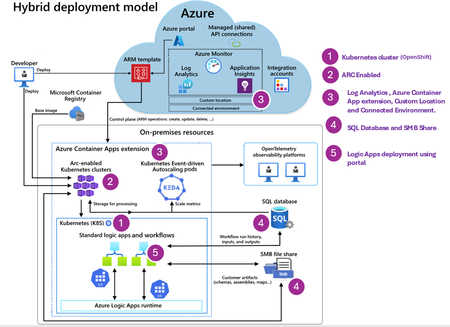
Hybrid Logic Apps Deployment on Red Hat OpenShift
What makes OpenShift different? If you've done this on K3s or AKS, most of the flow is identical as mentioned in Set up your own infrastructure for Standard logic app workflows - Azure Logic Apps | Microsoft Learn. Two OpenShift specifics are worth flagging up front. First, SCCs: the default restricted-v2 policy blocks the elevated permissions the runtime and CSI driver need, so you grant the right SCCs before installing (Step 2). Second, DNS: OpenShift runs DNS through the openshift-dns operator rather than the kube-system/coredns you'd find on AKS, so the DNS setup targets that instead (Step 7). Prerequisites Requirement Notes Azure subscription With rights to create Arc resources, custom locations, and connected environments. Azure CLI Latest, with the connectedk8s, k8s-extension, customlocation, and containerapp extensions. OpenShift cluster Self-managed OpenShift (bare metal, datacenter, or Single-Node OpenShift), or ARO. oc logged in as a cluster-admin. Newer OCP is better (some storage options are GA only on 4.18+). Don't have one yet? See the install links under References section below A SMB file share a SMB file share discoverable from the cluster to store workflow artifacts Ingress / load balancer On self-managed OpenShift you provide the ingress IP yourself: an in-cluster LB (MetalLB or similar) or an external L4 LB in front of a NodePort. See Choose your ingress path below. (ARO provides it automatically.) Install/confirm the CLI extensions: az extension add --name connectedk8s az extension add --name k8s-extension az extension add --name customlocation az extension add --name containerapp Choose your ingress path (self-managed) Every app is reached through one shared Envoy ingress, and that ingress needs an IP clients can hit. A self-managed cluster has no cloud load balancer to hand one out, so this is the piece you provide. Two options work well; pick whichever fits your environment: Option How it works You set up Best when In-cluster load balancer A bare-metal LoadBalancer controller gives the envoy LoadBalancer service an IP from a pool on your node subnet. MetalLB is the common pick; kube-vip, Cilium, and OpenELB work the same way Install the controller + an address pool; envoy.serviceType=LoadBalancer You have a spare IP range on the node network and want a self-contained cluster External LB + NodePort Any external L4 load balancer forwards to a NodePort on every node. That can be an appliance (F5, NetScaler, HAProxy, a hardware VIP…) or an Azure Standard Load Balancer when your nodes are Azure VMs in the same region envoy.serviceType=NodePort; wire your LB → NodePort You already run a datacenter load balancer, or your cluster runs on Azure VMs Your choice affects exactly two later steps: the envoy.serviceType value in Step 4, and which IP you pass to --static-ip in Step 6. Nothing else changes. On ARO you can skip this section. Leave envoy.serviceType=LoadBalancer and the cloud controller assigns the EXTERNAL-IP for you; the rest of the guide is unchanged. Step 1: Connect your OpenShift cluster to Azure Arc Log in to OpenShift and confirm you're cluster-admin: oc login <api-url> -u kubeadmin oc whoami # should be able to run cluster-admin actions Connect the cluster to Arc: az connectedk8s connect --name <cluster> --resource-group <rg> Step 2: Install the SMB CSI driver helm repo add csi-driver-smb https://raw.githubusercontent.com/kubernetes-csi/csi-driver-smb/master/charts helm repo update helm install csi-driver-smb csi-driver-smb/csi-driver-smb \ --namespace kube-system --version v1.16.0 \ --set image.smb.repository=mcr.microsoft.com/oss/kubernetes-csi/csi-driver-smb Step 3: Grant the required SCCs (OpenShift-specific) The extension installs with Helm --atomic, so if any pod is denied byrestricted-v2 the entire install rolls back. Grant the SCCs to the install namespace's service accounts before installing: oc create namespace logicapps-aca-ns oc adm policy add-scc-to-group anyuid system:serviceaccounts:logicapps-aca-ns oc adm policy add-scc-to-group privileged system:serviceaccounts:logicapps-aca-ns oc adm policy add-scc-to-group hostnetwork system:serviceaccounts:logicapps-aca-ns Step 4: Install the Container Apps extension Now install the extension that turns the cluster into a Logic Apps host. The command is the same for every cluster; the only line that depends on your ingress choice is the last one, envoy.serviceType: az k8s-extension create \ --resource-group <rg> --cluster-name <cluster> \ --cluster-type connectedClusters --name logicapps-aca-extension \ --extension-type Microsoft.App.Environment \ --release-train stable --auto-upgrade-minor-version true --scope cluster \ --release-namespace logicapps-aca-ns \ --configuration-settings "Microsoft.CustomLocation.ServiceAccount=default" \ --configuration-settings "appsNamespace=logicapps-aca-ns" \ --configuration-settings "clusterName=<env-name>" \ --configuration-settings "keda.enabled=true" \ --configuration-settings "keda.logicAppsScaler.enabled=true" \ --configuration-settings "keda.logicAppsScaler.replicaCount=1" \ --configuration-settings "containerAppController.api.functionsServerEnabled=true" \ --configuration-settings "functionsProxyApiConfig.enabled=true" \ --configuration-settings "Azure.Cluster.Distribution=openshift" \ --configuration-settings "coreDNSVersion=1.8.6" \ --configuration-settings "envoy.serviceType=LoadBalancer" The two OpenShift-specific settings: Setting Why Azure.Cluster.Distribution=openshift Renders the chart's OpenShift branch with the privileged security contexts OpenShift requires. coreDNSVersion=1.8.6 Makes the DNS config the setup generates compatible with OpenShift's resolver so app hostnames resolve. Keep this value. Ingress setting, per your path: In-cluster LB (e.g. MetalLB) → envoy.serviceType=LoadBalancer (as above); the LB controller assigns the EXTERNAL-IP from your pool. External LB (on-prem) → envoy.serviceType=NodePort plus envoy.nodeHttpsPort=30443 and envoy.nodeHttpPort=30080, then point your external L4 LB at those NodePorts. ARO → leave envoy.serviceType=LoadBalancer; Azure assigns the EXTERNAL-IP automatically. Wait for the extension and read the ingress IP: az k8s-extension show -g <rg> --cluster-name <cluster> \ --cluster-type connectedClusters --name logicapps-aca-extension \ --query provisioningState -o tsv # -> Succeeded oc get svc microsoft-app-environment-k8se-envoy -n logicapps-aca-ns # LoadBalancer: EXTERNAL-IP | NodePort: 80:30080, 443:30443 (EXTERNAL-IP stays <none>) Step 5: Create a custom location EXT_ID=$(az k8s-extension show -g <rg> --cluster-name <cluster> \ --cluster-type connectedClusters --name logicapps-aca-extension --query id -o tsv) CC_ID=$(az connectedk8s show -g <rg> -n <cluster> --query id -o tsv) az customlocation create \ --resource-group <rg> --name <custom-location> \ --location <arc-region> --host-resource-id $CC_ID \ --namespace logicapps-aca-ns --cluster-extension-ids $EXT_ID Step 6: Create the connected environment The connected environment is the Logic Apps environment your apps live in. Whether you set --static-ip depends on your ingress: External LB + NodePort: pass --static-ip <your LB VIP>. The envoy service is a NodePort with no EXTERNAL-IP, so the platform can't discover the ingress IP on its own; you give it the LB VIP explicitly. In-cluster LB (MetalLB) or ARO: you can omit --static-ip. The platform uses the EXTERNAL-IP already assigned to the envoy LoadBalancer service. CL_ID=$(az customlocation show -g <rg> -n <custom-location> --query id -o tsv) az containerapp connected-env create \ --resource-group <rg> --name <env-name> \ --location <arc-region> --custom-location $CL_ID \ --static-ip <your-lb-vip> # external LB + NodePort; omit for in-cluster LB / ARO When you do set --static-ip, it's create-only. You can't patch it later; to change it you delete and recreate the environment. Step 7: Configure cluster DNS So that app hostnames resolve to the Envoy ingress inside the cluster, run the DNS setup with the OpenShift flag: az containerapp arc setup-core-dns --distro=openshift --verbose This creates a small coredns-custom service and adds a zone-scoped forward in OpenShift's DNS Operator that covers only the environment's domain. Every other name (internet, *.svc.cluster.local, your own domains) is left alone. Step 8: Create and deploy a Logic App You can now target the connected environment from the portal or CLI, exactly like any Logic App Standard. In the portal, choose Logic App (Standard) → Hybrid, pick your connected environment, point storage at your SMB share, and create. Once the logic app is ready, you are now ready to author and test workflows hosted in your openshift cluster. Troubleshooting common issues Symptom Cause & fix Extension install fails and rolls back with SCC/PodSecurity denials SCCs not granted before install. Grant anyuid + privileged + hostnetwork to the install namespace (Step 2), then retry. UnauthorizedNamespaceError / 401 during onboarding Custom-locations RBAC incomplete. Re-run enable-features … --custom-locations-oid <oid>; ensure the caller has Contributor/Azure Arc Kubernetes Cluster Admin. App pods stuck ContainerCreating, PVC Pending SMB driver missing/misregistered. Confirm a smb.csi.k8s.io CSIDriver exists and its pods are Running. Install one driver only. Envoy has no EXTERNAL-IP on bare metal No LoadBalancer provider. Install an in-cluster LB (MetalLB or similar) or front NodePort with an external LB (ARO does this automatically). References Setting up an OpenShift cluster Install OpenShift on bare metal Install Single-Node OpenShift (SNO) Create an Azure Red Hat OpenShift (ARO) cluster OpenShift Local (run a cluster on your laptop) Logic Apps Hybrid Set up Logic Apps Hybrid deployment396Views0likes0CommentsLogic Apps Newsletter - May 2026
In this issue: Ace Aviator of the Month News from our product group News from our community Ace Aviator of the Month May 2026's Ace Aviator: Yahya Ajwad What's your role and title? What are your responsibilities? I work as Chief Architect and AI Lead at Epical. My role is centered around technical leadership, architecture, and advisory mostly within cloud adoption and transformation programs. I help customers design and implement integration platforms. I also support customers in navigating the AI landscape, with a focus on how integration platforms impact AI readiness and how AI can be used to create value in the platforms we build. Internally at Epical, I lead our Microsoft and Azure cloud integration offering, as well as our CoreAI team and AI initiatives. Can you give us some insights into your day-to-day activities? One moment it is about how we can utilize AI to deliver things cheaper and faster without compromising security, governance and quality. Next, a customer contacts us with an undocumented BizTalk environment asking us what to do next (that's where the fun begins). Usually followed up by the question about how much does their future integration platform in Azure will cost down to the last cent (good luck answering that 😜 hint: the right answer is always: "less than BizTalk"). And hey, public cloud might not be good enough for their security, so thank God for private connectivity. I also spend time helping customers identify the best cloud integration strategies and patterns and for their business needs, choosing the right platforms and components for specific use cases, and ensuring that the platforms we design are as secure, scalable, maintainable, and cost-efficient as possible. Increasingly, this also includes sprinkling AI so bosses are happy (joking I'm a true AI believer myself). Internally, I support Epical with technical business development and help ensure that we stay relevant. What motivates and inspires you to be an active member of the Aviators/Microsoft community? I honestly believe that IT in general would never have been the same without communities and the willingness to share knowledge and support one another. The Logic Apps and Azure Integration community is especially unique because it is both practical and open. People share real experiences which makes it incredibly valuable when trying to solve real-world challenges. What motivates me is the opportunity to learn by sharing, receive feedback, and be part of a community where everyone contributes to each other’s growth. Between us, I'm here for the stickers ;) Looking back, what advice do you wish you had been given earlier? Be kind, stay curious and be helpful. Share what you know, even if it feels small or irrelevant. Those small insights often help others more than you think and that will definitely help you grow. Also, focus on learning the fundamentals. Tools and platforms change quickly, and what is popular today might not matter in a few weeks. Strong basics will always stay relevant. Keep learning and try new things all the time. What has helped you grow professionally? Being around kind, skilled, and generous people both in the community and at work who are willing to teach, challenge my thinking, and share their knowledge. Also, finding mentors who are open to mentor me, listen to all my questions even the silly ones, and who are willing to guide me and correct me when I’m hallucinating. If you had a magic wand that could create a feature in Logic Apps, what would it be? I don’t need to wish for one, you guys (Shout-out to Harold, Dyvia and the team) have already created it: Logic Apps Migration Assistant Agents. That stuff is definitely magic. News from our product group Network Connectivity Check APIs for Logic App Standard This post introduces built-in network troubleshooting APIs for Logic App Standard when integrated with a virtual network. Three endpoints—connectivityCheck, dnsCheck, and tcpPingCheck—let you validate end‑to‑end connectivity to services such as Azure SQL, Key Vault, Storage, Service Bus, and Event Hubs, perform DNS resolution, and test TCP reachability from the actual worker hosting your workflows. It covers supported provider types, credential options including Managed Identity and app settings, example payloads, and known limitations (e.g., SMB port 445 cannot be tested). Step-by-step guidance shows how to call the APIs via Azure API Playground or CLI to quickly isolate network issues. Service Bus SBMP Retirement: What BizTalk Server 2020 Customers Need to Know Azure Service Bus will retire the Service Bus Messaging Protocol (SBMP) on September 30, 2026, impacting BizTalk Server 2020 customers using the SB‑Messaging adapter. Microsoft has released a hotfix that adds Advanced Message Queuing Protocol (AMQP) support to the adapter for CU6 and CU7. With the hotfix, AMQP becomes the default transport while SBMP remains an opt‑in fallback; an updated hotfix based on the new Service Bus SDK is expected in June. Guidance includes migrating configurations to AMQP, installing and validating the hotfix in non‑production, and testing large message/file scenarios. The hotfix can be requested via support (KB5091375). Migrate Data Ingestion from Data Collector to Log Ingestion With the HTTP Data Collector API for Log Analytics deprecated and heading out of support in September 2026, this guide shows Logic Apps users how to move to the Log Ingestion API. It explains impacts—such as 403 errors for new Data Collector connections and missing data in newly created custom log tables—and provides a migration path using the HTTP action. Steps include creating a Data Collection Endpoint (DCE) and Data Collection Rule (DCR), deriving the full ingestion URL, mapping sample data to define schema, assigning the Monitoring Metrics Publisher role to the Logic App’s managed identity, and verifying success (HTTP 204). Introducing AI Skill Assessment in Azure API Center Azure API Center now includes automated AI skill assessment, providing governance and quality scoring for skills at scale using an “LLM‑as‑a‑judge” approach. The system evaluates outputs against defined criteria and ships with four default dimensions—Documentation Clarity, Help Completeness, Discoverability, and Safe Usage—each scored 1–5 with configurable thresholds. Developers get detailed reports showing pass/fail, per‑dimension scores, structural checks, and schema validation, helping them decide which skills are production‑ready. Platform administrators can extend or customize criteria to match organizational standards. The feature centralizes oversight and reduces manual review effort, improving confidence when adopting AI skills across integration solutions. Introducing the plugin marketplace for Azure API Center Azure API Center adds a plugin marketplace endpoint (public preview) that exposes a version‑controlled catalog of organizational AI plugins—such as MCP servers and skills—directly from your API Center data plane. Developers can discover and install plugins from familiar tools like Claude Code and GitHub Copilot CLI using simple marketplace commands. The endpoint inherits the API Center portal’s authentication model, ensuring governance and security while platform teams control publication. The article explains the problem it addresses, the marketplace.git URL format, quick start commands, and documentation to enable the feature—streamlining how teams curate, manage, and consume AI plugins in enterprise environments. News from our community Control the Initial State of Logic Apps Standard Workflows Post by Sandro Pereira This tip explains how to prevent Logic Apps Standard workflows from auto-starting after deployment, a risky default in production. Unlike Consumption, Standard doesn’t expose a state property in ARM. Instead, each workflow’s initial state is controlled via App Service application settings using the pattern “Workflows.<WorkflowName>.FlowState=Disabled.” The post shows how to define these keys in local.settings.json (or pipelines/Bicep), deploy with workflows disabled, and enable them when ready. It also notes acceptable values (Disabled/disabled) and clarifies that omitting the keys leaves workflows enabled by default—reducing unwanted executions and noisy alerts. 10 Azure Function App Limitations for Enterprise Integration Post by Tarun Garg The post outlines ten reasons Azure Function Apps may be a poor fit for enterprise integration workloads. Issues include cold-start latency, limited orchestration and state management, operational complexity at scale, and the need to hand-roll observability. It also highlights security and network isolation challenges, cost variability under heavy throughput, strong dependence on custom code, risks around versioning and breaking changes, and insufficient governance controls for integration use cases. The takeaway: Function Apps excel at granular compute, but integration programs often benefit from managed orchestration layers and patterns better aligned to enterprise requirements. Logic Apps Standard: how accidentally blocking access from Edge results in CORS errors Post by Şahin Özdemir Şahin Özdemir explains a troubleshooting case where Logic Apps Standard action inputs/outputs stopped loading in the Azure portal, appearing like a CORS issue. The root cause was a blocked “Local Network Access” permission in Microsoft Edge, not misconfigured CORS. The article advises checking Edge’s site permissions and re-enabling local network access before diving into CORS diagnostics. By validating browser settings first, engineers can avoid unnecessary changes to integration apps and resolve portal rendering failures quickly—saving time and reducing confusion when workflow views suddenly fail to load. Logic apps – Handling AND OR conditions Post by Anitha Eswaran Anitha Eswaran explains how to correctly implement combined AND/OR logic in Azure Logic Apps when the designer view becomes confusing. Using a real example—validating item numbers—she shows how to check for empty values or specific suffixes (W/WN) and when to terminate processing. The article demonstrates building expressions to explicitly control evaluation order and outcomes, avoiding unintended behavior from default AND logic. Practical screenshots and expression snippets help readers structure conditions, handle arrays from trigger data, and create maintainable workflows that reflect real business rules. Why Enterprises Are Migrating from Logic Apps (Consumption) to Logic Apps (Standard): Practical Insights from the Field Post by Kunal Saha Kunal Saha outlines why organizations reach an inflection point where Logic Apps Standard becomes a better fit than Consumption. Drawing from field experience, he highlights drivers like consolidated app-level management, richer local development workflows, environment isolation, and cost predictability for sustained workloads. The piece discusses when per-execution billing ceases to be efficient, how Standard’s hosting model supports enterprise governance, and migration considerations around triggers, connectors, and stateful patterns. The article encourages teams to evaluate workload characteristics and operational needs to determine the right time to modernize to Standard. Event Debouncing with Logic Apps and Azure Table Storage Post by Daniel Jonathan This article presents an event debouncing pattern for webhook-heavy systems using three Logic Apps and a single Azure Table Storage table. Incoming events are buffered by upserting rows keyed by entity ID, ensuring only the latest state is retained. A timer-driven workflow processes pending rows after a cooldown window, fetches fresh state from the source, and calls downstream APIs, deleting entries on success or resetting on failure. Benefits include implicit deduplication, reduced downstream load, and operational transparency in Storage Explorer. The pattern suits moderate scale without Service Bus, with caveats for strict ordering or very high throughput scenarios. XML to JSON in Logic Apps: Fixing the “Object vs Array” Trap Post by Prashant Singh Prashant Singh explains a common pitfall when converting XML to JSON in Logic Apps: json(xml(...)) yields an array when multiple nodes exist, but a single object when only one node is present—breaking For each loops. He outlines three remedies: debatch directly with xpath() to always return a node set; wrap the target node with array() to normalize object/array differences; or use coalesce() with array() to safely handle missing nodes. With clear examples and expressions, the post helps engineers avoid brittle assumptions and build resilient workflows that handle single, multiple, or absent records cleanly. DevUP Talks 02 - 2026 Q1 Reflections with Ahmed Bayoumy, Sebastian Meyer and Andrew Wilson Video by Mattias Lögdberg This 12‑minute panel discussion surveys how AI and automation are changing day‑to‑day engineering work. Mattias Lögdberg hosts Ahmed Bayoumy, Sebastian Meyer, and Andrew Wilson to share early field perspectives: the shift from experimentation to production, emerging testing responsibilities around AI‑assisted code, and how integration teams are adapting operating models and skills. The conversation favors practical observations over hype, offering a snapshot of what practitioners are seeing at the start of 2026. It’s a compact watch for leaders tracking real impacts rather than theoretical roadmaps. How low can you code? From ‘drag-and-drop’ dreams to try–catch reality Post by Sonny Gillissen Sonny Gillissen argues that early low‑code promised simplicity but often obscured complexity with visual designers and limited tooling. He suggests AI can shift low‑code from diagramming boxes to describing intent—letting teams express business behavior in natural terms, with systems generating implementations. The piece calls for focusing on domain clarity, robust data/APIs, and guardrails over chasing more drag‑and‑drop. For integration engineers, it frames a path where Logic Apps and related platforms become orchestration shells around AI‑assisted specifications, improving maintainability without hiding the hard parts. Legacy Integration to Azure: 40% Cost Savings and Faster Delivery Post by Adaptiv (post by Simon Clendon) This piece outlines lessons from migrating legacy integration platforms to Microsoft Azure. It details the discovery work needed to untangle historical integrations, the diplomacy required with stakeholders, and the engineering patterns that de-risk cutovers. Highlights include modernizing HR workflows, establishing clear migration decision trees, and treating AI as a force multiplier rather than a silver bullet. The article emphasizes measurable outcomes—around 40% cost savings and faster delivery—while cautioning against underestimating analysis, testing, and organizational change, and recommending experienced partners to accelerate the journey. Using the Right Tool Is Not Over‑Engineering Post by Marcelo Gomes Marcelo Gomes argues that many integration failures stem from tool misalignment rather than flawed logic. Using a market‑stall analogy, he outlines when to rely on API Management for exposure and control, where Logic Apps should orchestrate rather than absorb all work, and why Azure Storage underpins durable, production‑ready designs. The piece encourages architects to map responsibilities explicitly—governance at the edge, orchestration in workflows, compute where it belongs—so systems scale cleanly without masking complexity under a single service. Choosing fit‑for‑purpose components, he suggests, is discipline—not over‑engineering. Using Event Grid to detect deleted files and trigger Logic App Post by Sandro Pereira (author: Luis Rigueira) This walkthrough shows how to capture Azure Storage blob deletion events with Event Grid and invoke a Logic App for downstream actions like audit, recovery, or notifications. It explains why native Blob triggers don’t fire on delete, then sets up a System Topic on the storage account, configures a Logic App with the “When a resource event occurs” trigger for Microsoft.Storage.BlobDeleted, and parses the event payload for container, file name, content‑type, and timestamp. The post provides expressions and screenshots to build the flow end‑to‑end, enabling reliable reactions to file deletions without custom functions.Logic Apps Aviators Newsletter - January 2026
In this issue: Ace Aviator of the Month News from our product group Community Playbook News from our community Ace Aviator of the Month January's Ace Aviator: Sagar Sharma What's your role and title? What are your responsibilities? I’m a cross-domain Business Solution Architect specializing in delivering new business capabilities to customers. I design end-to-end architectures specially on Azure platforms and also in the Integration domain using azure integration services. My role involves marking architectural decisions, defining standards, ensuring platform reliability, guiding teams, and helping organizations transition from legacy integration systems to modern cloud-native patterns. Can you give us some insights into your day-to-day activities and what a typical day in your role looks like? My day usually blends architecture work with hands-on collaboration. I review integration designs, refine patterns, help teams troubleshoot integration flows, and ensure deployments run smoothly through DevOps pipelines. A good part of my time is spent translating business needs into integration patterns and making sure the overall platform stays secure, scalable, and maintainable. What motivates and inspires you to be an active member of the Aviators/Microsoft community? The community has shaped a big part of my career. Many of my early breakthroughs came from blogs, samples, and talks shared by others. Contributing back feels like closing the loop. I enjoy sharing real-world lessons, learning from peers, and helping others adopt integration patterns with confidence. The energy of the community and the conversations it creates keep me inspired. Looking back, what advice do you wish you had been given earlier that you'd now share with those looking to get into STEM/technology? Focus on core concepts—messaging, APIs, security, and distributed systems—because tools evolve, but fundamentals stay relevant. Share your learning early, even if it feels small. Be curious about the “why” behind patterns. Build side projects, not just follow tutorials. And don’t fear a nonlinear career path—diverse experience is an asset in technology. What has helped you grow professionally? Hands-on customer work, strong mentors, and consistent learning habits have been key. Community involvement—writing, speaking, and collaborating—has pushed me to structure my knowledge and stay current. And working in environments that encourage experimentation has helped me develop faster and with more confidence. If you had a magic wand that could create a feature in Logic Apps, what would it be and why? I’d love to see a unified, out-of-the-box business transaction tracing experience across Logic Apps, Service Bus, APIM, Functions, and downstream services. Something that automatically correlates events, visualizes the full journey of a transaction, and simplifies root-cause analysis. This would make operational troubleshooting dramatically easier in enterprise environments. News from our product group Microsoft BizTalk Server Product Lifecycle Update BizTalk Server 2020 will be the final release, with support extending through 2030. Microsoft encourages a gradual transition to Azure Logic Apps, offering migration tooling, hybrid deployment options, and reuse of existing BizTalk artifacts. Customers can modernize at their own pace while maintaining operational continuity. Data Mapper Test Executor: A New Addition to Logic Apps Standard Test Framework The Data Mapper Test Executor adds native support for testing XSLT and Data Mapper transformations directly within the Logic Apps Standard test framework. It streamlines validation, improves feedback cycles, and integrates with the latest SDK to enable reliable, automated testing of map generation and execution. Announcing General Availability of AI & RAG Connectors in Logic Apps (Standard) Logic Apps Standard AI and RAG connectors are now GA333, enabling native document processing, semantic search, embeddings, and agentic workflows. These capabilities let teams build intelligent, context‑aware automations using their own data, reducing complexity and enhancing decisioning across enterprise integrations. Logic Apps Labs The Logic Apps Labs, which introduces Azure Logic Apps agentic workflows learning path, offering guided modules on building conversational and autonomous agents, extending capabilities with MCP tools, and orchestrating multi‑agent workflows. It serves as a starting point for hands‑on labs covering design, deployment, and advanced patterns for intelligent automation. News from our community Handling Empty SQL Query Results in Azure Logic Apps Post by Anitha Eswaran If a SQL stored procedure returns no rows, you can detect the empty result set in Logic Apps by checking whether the output’s ResultSets object is {}. When empty, the workflow can be cleanly terminated or used to trigger alerts, ensuring predictable behavior and more resilient integrations. Azure Logic Apps MCP Server Post by Laveesh Bansal Our own Laveesh Bansal spent some time creating an Azure Logic Apps MCP Server that enables natural‑language debugging, workflow inspection, and updates without using the portal. It supports both Standard and Consumption apps, integrates with AI clients like Copilot and Claude, and offers tools for local or cloud‑hosted setups, testing, and workflow lifecycle operations. Azure Logic Apps: Change Detection in JSON Objects and Arrays Post by Suraj Somani Logic Apps offers native functions to detect changes in JSON objects and arrays without worrying about field or item order. Using equals() for objects and intersection() for arrays, you can determine when data has truly changed and trigger workflows only when updates occur, improving efficiency and reducing unnecessary processing. Logic Apps Standard: A clever hack to use JSON schemas in your Artifacts folder for JSON message validation (Part 1) Post by Şahin Özdemir Şahin outlines a workaround for using JSON schemas stored in the Artifacts folder to validate messages in Logic Apps Standard. It revisits integration needs from BizTalk migrations and shows how to bring structured validation into modern workflows without relying on Integration Accounts. This is a two part series and you can find part two here. Let's integrate SAP with Microsoft Video by Sebastian Meyer Sebastian has a new video out, and in this episode he and Martin Pankraz break down SAP GROW and RISE for Microsoft integration developers, covering key differences and integration options across IDoc, RFC, BAPI, SOAP, HTTPS, and OData, giving a concise overview of today’s SAP landscape and what it means for building integrations on Azure. Logic Apps Initialize variables action has a max limit of 20 variables Post by Sandro Pereira Logic Apps allows only 20 variables per Initialize variables action, and exceeding it triggers a validation error. This limit applies per action, not per workflow. Using objects, parameters, or Compose actions often reduces the need for many scalars and leads to cleaner, more maintainable workflows. Did you know that? It is a Friday Fact!Logic Apps Aviators Newsletter - December 2025
In this issue: Ace Aviator of the Month News from our product group Community Playbook News from our community Ace Aviator of the Month December’s Ace Aviator: Daniel Jonathan What's your role and title? What are your responsibilities? I’m an Azure Integration Architect at Cnext, helping organizations modernize and migrate their integrations to Azure Integration Services. I design and build solutions using Logic Apps, Azure Functions, Service Bus, and API Management. I also work on AI solutions using Semantic Kernel and LangChain to bring intelligence into business processes. Can you give us some insights into your day-to-day activities and what a typical day in your role looks like? My day usually begins by attending customer requests and handling recent deployments. Most of my time goes into designing integration patterns, building Logic Apps, mentoring the team, and helping customers with technical solutions. Lately, I’ve also been integrating AI capabilities into workflows. What motivates and inspires you to be an active member of the Aviators/Microsoft community? The community is open, friendly, and full of knowledge. I enjoy sharing ideas, writing posts, and helping others solve real-world challenges. It’s great to learn and grow together. Looking back, what advice do you wish you had been given earlier that you'd now share with those looking to get into STEM/technology? Start small and stay consistent. Learn the basics well—like messaging, retries, and error handling—before diving into complex tools. Keep learning and share what you know. What has helped you grow professionally? Hands-on experience, teamwork, and continuous learning. Working across different projects taught me how to design reliable and scalable systems. Exploring AI with Semantic Kernel and LangChain has also helped me think beyond traditional integrations. If you had a magic wand that could create a feature in Logic Apps, what would it be and why? I’d add an “Overview Page” in Logic Apps containing the HTTP URLs for each workflow, so developers can quickly access to test from one place. It would save time and make working with multiple workflows much easier. News from our product group Logic Apps Community Day 2025 Playlist Did you miss or want to catch up on individual sessions from Logic Apps Community Day 2025? Here is the full playlist – choose your favorite sessions and have fun! The future of integration is here and it's agentic Missed Kent Weare and Divya Swarnkar session at Ignite? It is here for you to watch on demand. Enterprise integration is being reimagined. It’s no longer just about connecting systems, but about enabling adaptive, agentic workflows that unify apps, data, and systems. In this session, discover how to modernize integration, migrate from BizTalk, and adopt AI-driven patterns that deliver agility and intelligence. Through customer stories and live demos, see how to bring these workflows to life with Agent Loop in Azure Logic Apps. Public Preview: Azure Logic Apps Connectors as MCP Tools in Microsoft Foundry Unlock secure enterprise connectivity with Azure Logic Apps connectors as MCP tools in Microsoft Foundry. Agents can now use hundreds of connectors natively—no custom code required. Learn how to configure and register MCP servers for seamless integration. Announcing AI Foundry Agent Service Connector v2 (Preview) AI Foundry Agent Service Connector v2 (Preview) is here! Azure Logic Apps can now securely invoke Foundry agents, enabling low-code AI integration, multi-agent workflows, and faster time-to-value. Explore new operations for orchestration and monitoring. Announcing the General Availability of the XML Parse and Compose Actions in Azure Logic Apps XML Parse and Compose Actions are now GA in Azure Logic Apps! Easily handle XML with XSD schemas, streamline workflows, and support internationalization. Learn best practices for arrays, encoding, and safe transport of content. Clone a Consumption Logic App to a Standard Workflow Clone your Consumption Logic Apps into Standard workflows with ease! This new feature accelerates migration, preserves design, and unlocks advanced capabilities for modern integration solutions. Announcing the HL7 connector for Azure Logic Apps Standard and Hybrid (Public Preview) Connect healthcare systems effortlessly! The new HL7 connector for Azure Logic Apps (Standard & Hybrid) enables secure, standardized data exchange and automation using HL7 protocols—now in Public Preview. Announcing Foundry Control Plane support for Logic Apps Agent Loop (Preview) Foundry Control Plane now supports Logic Apps Agent Loop (Preview)! Manage, govern, and observe agents at scale with built-in integration—no extra steps required. Ensure trust, compliance, and scalability in the agentic era. Announcing General Availability of Agent Loop in Azure Logic Apps Agent Loop transforms Logic Apps into a multi-agent automation platform, enabling AI agents to collaborate with workflows and humans. Build secure, enterprise-ready agentic solutions for business automation at scale. Agent Loop Ignite Update - New Set of AI Features Arrive in Public Preview We are releasing a broad set of Agent Loop new and powerful AI-first capabilities in Public Preview that dramatically expand what developers can build: run agents in the Consumption SKU ,bring your own models through APIM AI Gateway, call any tool through MCP, deploy agents directly into Teams, secure RAG with document-level permissions, onboard with Okta, and build in a completely redesigned workflow designer. Announcing MCP Server Support for Logic Apps Agent Loop Agent Loop in Azure Logic Apps now supports Model Context Protocol (MCP), enabling secure, standardized tool integration. Bring your own MCP connector, use Azure-managed servers, or build custom connectors for enterprise workflows. Enabling API Key Authentication for Logic Apps MCP Servers Logic Apps MCP Servers now support API Key authentication alongside OAuth2 and Anonymous options. Configure keys via host.json or Azure APIs, retrieve and regenerate keys easily, and connect MCP clients securely for agentic workflows. Announcing Public Preview of Agent Loop in Azure Logic Apps Consumption Agent Loop now brings AI-powered automation to Logic Apps Consumption with a frictionless, pay-as-you-go model. Build autonomous and conversational agents using 1,400+ connectors—no dedicated infrastructure required. Ideal for rapid prototyping and enterprise workflows. Moving the Logic Apps Designer Forward Major redesign of Azure Logic Apps designer enters Public Preview for Standard workflows. Phase I focuses on faster onboarding, unified views, draft mode with auto-save, improved search, and enhanced debugging. Feedback will shape future phases for a seamless development experience. Announcing the General Availability of the RabbitMQ Connector RabbitMQ Connector for Azure Logic Apps is now generally available, enabling reliable message exchange for Standard and Hybrid workflows. It supports triggers, publishing, and advanced routing, with global rollout underway for robust, scalable integration scenarios. Duplicate Detection in Logic App Trigger Prevent duplicate processing in Logic Apps triggers with a REST API-based solution. It checks recent runs using clientTrackingId to avoid reprocessing items caused by edits or webhook updates. Works with Logic App Standard and adaptable for Consumption or Power Automate. Announcing the BizTalk Server 2020 Cumulative Update 7 BizTalk Server 2020 Cumulative Update 7 is out, adding support for Visual Studio 2022, Windows Server 2022, SQL Server 2022, and Windows 11. Includes all prior fixes. Upgrade from older versions or consider migrating to Azure Logic Apps for modernization. News from our community Logic Apps Local Development Series Post by Daniel Jonathan Last month I shared an article from Daniel about debugging XSLT in VS Code. This month, I bumped into not one, but five articles in a series about Build, Test and Run Logic Apps Standard locally – definitely worth the read! Working with sessions in Agentic Workflows Post by Simon Stender Build AI-powered chat experiences with session-based agentic workflows in Azure Logic Apps. Learn how they enable dynamic, stateful interactions, integrate with APIs and apps, and avoid common pitfalls like workflows stuck in “running” forever. Integration Love Story with Mimmi Gullberg Video by Ahmed Bayoumy and Robin Wilde Meet Mimmi Gullberg, Green Cargo’s new integration architect driving smarter, sustainable rail logistics. With experience from BizTalk to Azure, she blends tech and business insight to create real value. Her mantra: understand the problem first, then choose the right tools—Logic Apps, Functions, or AI. Integration Love Story with Jenny Andersson Video by Ahmed Bayoumy and Robin Wilde Discover Jenny Andesson’s inspiring journey from skepticism to creativity in tech. In this episode, she shares insights on life as an integration architect, tackling system challenges, listening to customers, and how AI is shaping the future of integration. You Can Get an XPath value in Logic Apps without returning an array Post by Luis Rigueira Working with XML in Azure Logic Apps? The xpath() function always returns an array—even for a single node. Or does it? Found how to return just the values you want on this Friday Fact from Luis Rigueira. Set up Azure Standard Logic App Connectors as MCP Server Video by Srikanth Gunnala Expose your Azure Logic Apps integrations as secure tools for AI assistants. Learn how to turn connectors like SAP, SQL, and Jira into MCP tools, protect them with Entra ID/OAuth, and test in GitHub Copilot Chat for safe, action-ready AI workflows. Making Logic Apps Speak Business Post by Al Ghoniem Stop forcing Logic Apps to look like business diagrams. With Business Process Tracking, you can keep workflows technically sound while giving business users clear, stage-based visibility into processes—decoupled, visual, and KPI-driven.616Views0likes0CommentsAnnouncing the General Availability of the RabbitMQ Connector
We are pleased to announce the general availability of the RabbitMQ Connector in Logic Apps (Standard) which allows you to both send and receive messages between Logic Apps and RabbitMQ. RabbitMQ is a robust, open-source message broker widely used for building reliable, scalable, and flexible messaging solutions. It is trusted across industries such as financial services, e-commerce, IoT, telecommunications, and cloud-native microservices. Our RabbitMQ connector allows messaging scenarios on-premises using Logic Apps hybrid. Benefits of Using RabbitMQ Reliability: RabbitMQ ensures message delivery with strong durability and acknowledgment mechanisms. Flexible Routing: Supports complex routing logic via exchanges (direct, topic, fanout, headers). Clustering & High Availability: Offers clustering and mirrored queues for fault tolerance. Management & Monitoring: Provides a user-friendly management UI and extensive monitoring capabilities. Extensibility: Supports plugins for authentication, federation, and more. Our current connector offering supports both triggers (receive) and sending (publish) within Logic Apps. Receiving Messages To enable a trigger, we need to search for the RabbitMQ connector within our designer. We will discover an operation called When the queue has messages from RabbitMQ show up as a built-in connector. We also have a peek lock operation for non-destructive reads. Search for Trigger and click on this operation to add the trigger to your design surface. Configure the trigger by providing the Queue Name. You can use the payload from your trigger in downstream actions. For example, you might place the payload within a Compose action for further processing. Publishing Messages To send a message, search for the RabbitMQ connector in your design experience. You’ll find an operation called Send a message. Add this operation to your design surface and Provide the following: Queue Name Message Body Exchange Name (if routing is required) Routing Key Once configured, you can run messages through your solution. To see this in action, refer to the demonstration video below. Completing Messages To Complete messages, in scenarios using peek-lock, search for the RabbitMQ connector within the Logic Apps designer. You’ll find an operation called Complete message as a built-in connector. Search for the action and click on this operation to add the action to your design surface. Provide: Delivery tag Consumer tag Acknowledgment (Complete or Reject) You can use the payload from your trigger in downstream actions. For example, you might place the payload within a Compose action for further processing. You can also create queues as well, with the Create a queue action. Please see the following video with further details on the configuration of this connector: Supported Regions We are rolling out this connector worldwide, with some regions receiving it before others.284Views1like0CommentsLogic Apps Aviators Newsletter - November 2025
In this issue: Ace Aviator of the Month News from our product group News from our community Ace Aviator of the Month Novembers’s Ace Aviator: Al Ghoniem What's your role and title? What are your responsibilities? As a Senior Integration Consultant, I design and deliver enterprise-grade integration on Microsoft Azure, primarily using Logic Apps Standard, API Management, Service Bus, Event Grid and Azure Functions. My remit covers reference architectures, “golden” templates, governance and FinOps guardrails, CI/CD automation (Bicep and YAML), and production-ready patterns for reliability, observability and cost efficiency. Alongside my technical work, I lead teams of consultants and engineers, helping them adopt standardised delivery models, mentor through code reviews and architectural walkthroughs, and ensure we deliver consistent, high-quality outcomes across projects. I also help teams apply decisioning patterns (embedded versus external rules) and integrate AI responsibly within enterprise workflows. Can you give us some insights into your day-to-day activities and what a typical day in your role looks like? Architecture and patterns: refining solution designs, sequence diagrams and rules models for new and existing integrations. Build and automation: evolving reusable Logic App Standard templates, Bicep modules and pipelines, embedding monitoring, alerts and identity-first security. Problem-solving: addressing performance tuning, transient fault handling, poison/DLQ flows and “design for reprocessing.” Leadership and enablement: mentoring consultants, facilitating technical discussions, and ensuring knowledge is shared across teams. Community and writing: publishing articles and examples to demystify real-world integration trade-offs. What motivates and inspires you to be an active member of the Aviators/Microsoft community? The community continuously turns hard-won lessons into reusable practices. Sharing patterns (and anti-patterns) saves others time and incidents, while learning from peers strengthens my own work. Microsoft’s product teams also listen closely, and seeing customer feedback directly shape the platform is genuinely rewarding. Looking back, what advice do you wish you had been given earlier that you'd now share with those looking to get into STEM/technology? Optimise for learning speed, not titles. Choose problems that stretch you and deliver in small, measurable increments. Master the fundamentals. Naming, idempotency, retries and observability are not glamorous but make systems dependable. Document everything. Diagrams, runbooks and ADRs multiply your impact. Understand trade-offs. Every decision buys something and costs something; acknowledge both sides clearly. Value collaboration over heroics. Ask questions, share knowledge and give credit freely. What has helped you grow professionally? Reusable scaffolding: creating golden templates and reference repositories that capture best practice once and reuse it everywhere. Feedback loops: leveraging telemetry, post-incident reviews and peer critique to improve. Teaching and mentoring: explaining concepts to others brings clarity and strengthens leadership. Cross-disciplinary curiosity: combining architecture, DevOps, FinOps and AI to address problems holistically. If you had a magic wand that could create a feature in Logic Apps, what would it be and why? "Stateful Sessions and Decisions” as a first-class capability: Built-in session state across multiple workflows, durable correlation and resumable orchestrations without external storage. A native decisioning activity with versioned decision tables and rule auditing (“why this rule fired”). A local-first developer experience with fast testing and contract validation for confident iteration. This would simplify complex, human-in-the-loop and event-driven scenarios, reduce custom plumbing, and make advanced orchestration patterns accessible to a wider audience. News from our product group Logic Apps Community Day 2025 Did you miss or want to catch up again on your favorite Logic Apps Community Day videos – jump back into action on this four hours long learning session, with 10 sessions from our Community Experts. And stay tuned for individual sessions being shared throughout the week. Announcing Parse & Chunk with Metadata in Logic Apps: Build Context-Aware RAG Agents New Parse & Chunk actions add metadata like page numbers and sentence completeness—perfect for context-aware document Q&A using Azure AI Search and Agent Loop. Introducing the RabbitMQ Connector (Public Preview) The new connector (Public Preview) lets you send and receive messages with RabbitMQ in Logic Apps Standard and Hybrid—ideal for scalable, reliable messaging across industries. News from our community EventGrid And Entra Auth In Logic Apps Standard Post by Riccardo Viglianisi Learn how to use Entra Auth for webhook authentication, ditch SAS tokens, and configure private endpoints with public access rules—perfect for secure, scalable integrations. Debugging XSLT Made Easy in VS Code: .NET-Based Debugging for Logic Apps Post by Daniel Jonathan A new .NET-based extension brings real debugging to XSLT for Logic Apps. Set breakpoints, step through transformations, and inspect variables—making XSLT development clear and productive. This is the 3 rd post in a 5 part series, so worth checking out the other posts too. Modifying the Logic App Azure Workbook: Custom Views for Multi Workflow Monitoring Post by Jeff Wessling Learn how to tailor dashboards with KQL, multi-workflow views, and context panes—boosting visibility, troubleshooting speed, and operational efficiency across your integrations. Azure AI Agents in Logic Apps: A Guide to Automate Decisions Post by Imashi Kinigama Discover how GPT-powered agents, created using Logic Apps Agent Loop, automate decisions, extract data, and adapt in real time. Build intelligent workflows with minimal effort—no hardcoding, just instructions and tools. How to Turn Logic App Connectors into MCP Servers (Step-by-Step Guide) Post by Stephen W. Thomas Learn how to expose connectors like Google Drive or Salesforce as MCP endpoints using Azure API Center—giving AI agents secure, real-time access to 1,400+ services directly from VS Code. Custom SAP MCP Server with Logic Apps Post by Sebastian Meyer Learn how to turn Logic Apps into AI-accessible tools using MCP. From workflow descriptions to Easy Auth setup and VS Code integration—this guide unlocks SAP automation with Copilot. How Azure Logic Apps as MCP Servers Accelerate AI Agent Development Post by Monisha S Turn 1,400+ connectors into AI tools with Logic Apps Standard. Build agents fast, integrate with legacy systems, and scale intelligent workflows across your organization. Designing Business Rules in Azure Logic Apps: When to Go Embedded vs External Post by Al Ghoniem Learn when to use Logic Apps' native Rules Engine or offload to Azure Functions with NRules or JSON RulesEngine. Discover hybrid patterns for scalable, testable decision automation. Syncing SharePoint with Azure Blob Storage using Logic Apps & Azure Functions for Azure AI Search Post by Daniel Jonathan Solve folder delete issues by tagging blobs with SharePoint metadata. Use Logic Apps and a custom Azure Function to clean up orphaned files and keep Azure AI Search in sync. Step-by-Step Guide: Building a Conversational Agent in Azure Logic Apps Post by Stephen W. Thomas Use Azure AI Foundry and Logic Apps Standard to create chatbots that shuffle cards, answer questions, and embed into websites—no code required, just smart workflows and EasyAuth. You can hide sensitive data from the Logic App run history Post by Francisco Leal Learn how to protect sensitive data like authentication tokens, credentials, and personal information in Logic App, so this data don’t appear in the run history, which could pose security and privacy risks.2.1KViews0likes0CommentsLogic Apps Aviators Newsletter - October 25
In this issue: Ace Aviator of the Month News from our product group News from our community Ace Aviator of the Month October Ace Aviator: Robin Wilde Business and Marketing Manager @Contica What's your role and title? What are your responsibilities? My role is Business and Marketing Manager at Contica. My main responsibility is helping our customers translate business challenges into technical solutions. I come from a technical background as a BizTalk and Azure developer and architect, so I have one foot in the technical world and the other in the business side. Can you give us some insights into your day-to-day activities and what a typical day in your role looks like? On any given day, I’m improving our customer offerings, diving into project challenges with colleagues, and exploring new technologies with Ahmed Bayoumy to find better ways of working. If I’m lucky, we’re recording a new episode of Integration Love Story with a community member/friend and learning from their life and tech experience. What motivates and inspires you to be an active member of the Aviators/Microsoft community? The community itself. Since I started working with integration, I’ve always felt that people genuinely want to share their knowledge and experience. The people behind the blog posts that helped me grow as a junior integration developer have turned out to be some of the most humble and generous individuals I’ve met. Everyone is open to sharing their experiences in a kind and respectful way, and that’s incredibly motivating. Looking back, what advice do you wish you had been given earlier that you'd now share with those looking to get into STEM/technology? Everyone has been a beginner. Don’t be afraid to reach out, ask for help and most importantly, stay curious and lean into new technology. “The more you know, the more you realize you don’t know.” And that’s the beauty of it! What has helped you grow professionally? Curiosity and the drive to keep learning. I've been something of a "Yes man" when it comes to new challenges. And being in an environment where the people around you accept you for who you are, every day, that’s a recipe for real growth. If you had a magic wand that could create a feature in Logic Apps, what would it be and why? A built-in AI-powered "next action suggestion” in your Logic App workflow based on other designs in your resource group or predefined business process in the same logic app standard that you are working one. A feature that would help me be more productivity! News from our product group Logic Apps Live September 2025 Missed Logic Apps Live in September? You can watch it here. We shared our latest updates in AI, including the latest refresh on Agent Loop and the introduction of Logic Apps MCP support. Logic Apps Community Day 2025 We are bringing Logic Apps Community Day again this year, on October 30, 2025 (Pacific Time) and we want you to join us as we host a full day of learning where you will be the star! Check the agenda register for this must watch event. Logic Apps - MCP Demos Explore how Azure Logic Apps and API Center simplify building MCP servers to integrate with Salesforce, Dataverse, SharePoint, ServiceNow, and even Copilot Studio. Introducing Logic Apps MCP servers (Public Preview) Microsoft has launched public preview support for building MCP servers using Azure Logic Apps (Standard). This enables developers to turn connectors into modular, reusable tools for scalable agent creation. Two approaches are supported: streamlined setup via Azure API Center and custom configuration for advanced control. Both methods simplify integration across enterprise systems. Announcement! Python Code Interpreter in Logic Apps is now in Public Preview Logic Apps now support Python code execution via Azure Container Apps, enabling users to analyze data, generate insights, and automate tasks using natural language. This feature empowers business users to explore data without writing code, streamlining workflows across sales, finance, and operations. Azure Logic Apps: Ushering in the Era of Multi-Agentic Business Process Automation Microsoft has transformed Azure Logic Apps into a multi-agentic automation platform, introducing features like Agent Loop for AI-driven workflows, Python Code Interpreter for custom logic, and Foundry Agent Service for model integration. These enhancements enable intelligent, collaborative automation with conversational agents, advanced orchestration, and enterprise-grade security and observability. Calling Logic Apps MCP Server from Copilot Studio Microsoft’s Azure Logic Apps now supports MCP Server integration with Copilot Studio, enabling secure and scalable access to enterprise data assets. Using API Center and Logic Apps Standard, developers can expose workflows and connectors as MCP tools, authenticated via Entra ID and Managed Identity. This setup allows conversational agents in Copilot Studio to interact with enterprise systems efficiently and securely. News from our community What Every Developer Needs to Know about AI! Post by Stephen W. Thomas AI is rapidly transforming integration development, and this guide offers a practical roadmap for developers to stay relevant. It emphasizes three focus areas: building foundational AI knowledge, boosting productivity with tools like GitHub Copilot, and mastering enterprise-ready skills through APIs, Microsoft tools, MCP, and agents. With curated resources and expert recommendations, developers can confidently navigate the evolving AI landscape and apply it effectively in business scenarios. BizTalk to Logic Apps with Harold Campos: Standard or Hybrid, what changes & what maps Video by Ahmed Bayoumy Migrating from BizTalk to Azure? In this conversation with Harold Campos, Principal PM - Azure Logic Apps at Microsoft, Ahmed unpacks Logic Apps Hybrid and Logic apps options. What it is, when to use it, and how it helps teams modernize without losing on-prem control. Determinism vs Nondeterminism Post by Håkan Åkerblom Determinism or nondeterminism, two concepts that shape everything from science to philosophy. But what do they mean for system integration? Track Down and Delete Unused Logic Apps in Azure Post by Dieter Gobeyn Azure Logic Apps (Consumption) charge per execution, but even inactive ones can still cost money. Triggers like polling or timers may continue to run, leading to hidden costs. Cleaning up unused Logic Apps improves governance and supports FinOps goals. Handling “When a Blob is Added or Modified” Trigger Limitation and Pick Files from Subfolders with File Extension Filters Post by Prashant Singh Learn how to overcome Logic Apps’ limitations with blob triggers in subfolders and file filters in this Post from Prashant, learn about trigger conditions and Event Grid options to make your workflows smarter and more scalable. Consume an MCP Endpoint from Azure Logic Apps — with an Agent Loop Post by Daniel Jonathan In this post, Daniel shows how to use Azure Logic Apps with an Agent Loop to discover MCP tools, select the right one, and invoke it—all in one flow. Perfect for building smart, dynamic integrations with MCP servers. Logic Apps ❤️ MCP — Expose Arithmetic Tools (Add & Subtract) Post by Daniel Jonathan And Daniel is in a roll. In this post, Daniel shows how to expose simple arithmetic operations—like add and subtract—as MCP tools using Logic Apps. With Postman support, testing these agent-ready workflows is now easier than ever. Logic Apps & MCP - Leverage Your Existing Integration Platform Post by Pim Simons and Michel Pauwels Learn how to turn existing Logic Apps into MCP servers, enabling secure access for AI agents to your APIs, workflows, and data—without changing your architecture. A smart way to future-proof your integrations. Building Approval Workflows with Logic Apps, Adaptive Cards, and Microsoft Teams Post by Saroj Kumar Learn how to build secure, reusable approval workflows using Azure Logic Apps, Adaptive Cards, and Microsoft Teams. Approvers stay in Teams, while automation handles the rest—fast, transparent, and scalable. Microsoft Introduces Logic Apps as MCP Servers in Public Preview Post by Steef-Jan Wiggers In this InfoQ article, Steef-Jan introduces the public preview support for Azure Logic Apps as MCP servers, enabling scalable, secure integration with AI agents and enterprise systems. Build reusable tools and workflows that agents can discover and invoke with ease. The 56 Resubmits Trap in Logic App Standard Post by Luis Rigueira Logic App Standard limits bulk resubmissions to 56 runs every 5 minutes. This post shows how to bypass that using callback URLs for faster, parallel recovery—ideal when dealing with thousands of failed runs. Stop Using Azure Logic Apps for Data Integration Post by Al Ghoniem Workflow tools like Azure Logic Apps aren’t built for heavy data processing. This post explains why ETL/ELT tools are better for data integration—and how to combine both for scalable, reliable pipelines. Integration Love Story with Tom Canter Video by Ahmed Bayoumy and Robin Wilde In this episode of 'Integration Love Story,' Ahmed and Robin interview the legendary Tom Cantor. He discusses his early involvement and long-standing focus on integration, dating back to 1998. Tom emphasizes the community-centric nature of the integration field, recounting personal stories that highlight the value of trust and collaboration among peers.618Views0likes0Comments