genai
4 TopicsAlphaLife Sciences powers regulatory-compliant AI workflows with PostgreSQL on Azure
by: Maxim Lukiyanov, PhD, Principal PM Manager and Sharon Chen, CEO and Founder at AlphaLife Sciences In life sciences, every document is deeply interconnected and highly regulated. Each clinical trial, regulatory submission, safety report, or protocol amendment is expected to stand up to rigorous audit. For AlphaLife Sciences, that challenge became an opportunity to rethink how AI could support expert human judgment. At Microsoft Ignite, AlphaLife Sciences CEO and Founder Sharon Chen shared how her team is building an AI-powered content authoring platform on top of Azure Database for PostgreSQL, designed specifically for the demands of regulated life sciences workflows. She also explained why the team is excited about Azure HorizonDB as a new PostgreSQL service that is built to meet the needs of modern enterprise workloads. This post explores how AlphaLife Sciences uses PostgreSQL as more than a data store. It’s a semantic foundation for compliant, auditable AI agents. Bringing AI into regulated workflows Life sciences organizations are under constant pressure. R&D pipelines are growing and patent windows are shrinking. A single clinical study report can take six months or more to complete, involving multiple teams and hundreds of source documents. Building efficiency into these processes is critical, but only if it doesn’t compromise accuracy, traceability, or compliance. That’s where many AI solutions fall short. Generating text is one thing, but generating verifiable, version-controlled, regulation-aware content is another. AlphaLife Sciences needed agents that could: Work across massive volumes of structured and unstructured data (Word, PDF, Excel, PowerPoint) Maintain full traceability from generated content back to source documents Support audits, amendments, and regulatory review Minimize hallucinations in a zero-tolerance environment Integrate naturally into the tools writers already use Bringing data, search, and AI together in one system At the core of AlphaLife Sciences’ platform is Azure Database for PostgreSQL. The team chose it for flexibility, extensibility, and for how well it supports modern AI workloads. Instead of stitching together separate systems for SQL queries, vector search, text indexing, and metadata tracking, AlphaLife Sciences consolidated everything into PostgreSQL. One of its flagship use cases is clinical trial protocol authoring, a process that typically involves: Designing trial objectives and endpoints Pulling references from previous studies Writing and revising hundreds of pages of structured content Managing multiple rounds of amendments and regulatory feedback With AI agents backed by PostgreSQL, that workflow changes dramatically. When a writer generates a protocol section, the system can automatically retrieve relevant references from a centralized document pool, using semantic search rather than manual lookup. Writers select the sources they want, apply rules or prompts, and let AI draft the section - complete with citations tied back to the original documents. Reviewers can inspect the source, adjust the output, or insert it directly into the document. For protocol amendments, the platform allows teams to upload inputs (Word or Excel), analyze which sections are affected, and generate structured suggestions. Changes are clearly highlighted, compared against previous versions, and summarized in amendment tables. AI agents that respect the rules A recurring theme in Chen’s talk was restraint. “We don’t just need AI that can write,” she said. “We need intelligent agents that understand data structures, follow regulatory laws, and manage version control.” This is where PostgreSQL-backed AI agents shine. By grounding AI behavior in structured schemas, controlled access, and auditable records, automation works hand-in-hand with human experts. AI accelerates first drafts, consistency checks, discrepancy detection, and cross-document analysis, but final accountability stays firmly with professionals. In some cases, the time to complete processes has been reduced by more than 50%. Azure Database for PostgreSQL has become more than a database for AlphaLife Sciences. It’s a semantic knowledge base that supports: Structured and unstructured data Vector similarity search Metadata-driven traceability Compliance, security, and auditability AI agents operating safely inside enterprise constraints By grounding AI agents directly in the database, reasoning, retrieval, and generation all operate against the same governed source of truth. “AI agents are not here to replace human beings,” said Chen. “They extend structured, compliant, and auditable thinking.” What’s next for AlphaLife Sciences with PostgreSQL on Azure Looking ahead, Chen shared her excitement about Azure HorizonDB and the capabilities it brings to PostgreSQL on Azure. Features like in-database AI model management, semantic operators for classification and summarization, and faster vector search with DiskANN align closely with AlphaLife Sciences’ needs as their platform continues to scale. “We’re extremely happy to see the launch of Azure HorizonDB and the more powerful tools coming with it,” Chen said. “By putting everything together in PostgreSQL, we don’t have to rely on different systems for vector search, text indexing, or SQL queries. Everything happens in one streamlined system. The code becomes cleaner, efficiency improves, and the AI agents perform much more elegantly.” Learn more AlphaLife Sciences’ journey was featured during the Microsoft Ignite session “The Blueprint for Intelligent AI Agents Backed by PostgreSQL.” Watch the session to learn more and see a demo of how Azure Database for PostgreSQL transforms the protocol and protocol amendment process. When AI is anchored in a strong PostgreSQL foundation, innovation and compliance don’t have to compete - they can reinforce each other.499Views4likes0CommentsBuild Smarter with Azure HorizonDB
By: Maxim Lukiyanov, PhD, Principal PM Manager; Abe Omorogbe, Senior Product Manager; Shreya R. Aithal, Product Manager II; Swarathmika Kakivaya, Product Manager II Today, at Microsoft Ignite, we are announcing a new PostgreSQL database service - Azure HorizonDB. You can read the announcement here, and in this blog you can learn more about HorizonDB’s AI features and development tools. Azure HorizonDB is designed for the full spectrum of modern database needs - from quickly building new AI applications, to scaling enterprise workloads to unprecedented levels of performance and availability, to managing your databases efficiently and securely. To help with building new AI applications we are introducing 3 features: DiskANN Advanced Filtering, built-in AI model management, and integration with Microsoft Foundry. To help with database management we are introducing a set of new capabilities in PostgreSQL extension for Visual Studio Code, as well as announcing General Availability of the extension. Let’s dive into AI features first. DiskANN Advanced Filtering We are excited to announce a new enhancement in the Microsoft’s state of the art vector indexing algorithm DiskANN – DiskANN Advanced Filtering. Advanced Filtering addresses a common problem in vector search – combining vector search with filtering. In real-world applications where queries often include constraints like price ranges, ratings, or categories, traditional vector search approaches, such as pgvector’s HNSW, rely on multiple step retrieval and post-filtering, which can make search extremely slow. DiskANN Advanced Filtering solves this by combining filter and search into one operation - while the graph of vectors is traversed during the vector search, each vector is also checked for filter predicate match, ensuring that only the correct vectors are retrieved. Under the hood, it works in a 3-step process: first creating a bitmap of relevant rows using indexes on attributes such as price or rating, then performing a filter-aware graph traversal against the bitmap, and finally, validating and ordering the results for accuracy. This integrated approach delivers dramatically faster and more efficient filtered vector searches. Initial benchmarks show that enabling Advanced Filtering on DiskANN reduces query latency by up to 3x, depending on filter selectivity. AI Model Management Another exciting feature of HorizonDB is AI Model Management. This feature automates Microsoft Foundry model provisioning during database deployment and instantly activates database semantic operators. This eliminates tens of setup and configuration steps and simplifies the development of new AI apps and agents. AI Model Management elevates the experience of using semantic operators within PostgreSQL. When activated, it provisions key models for embedding, semantic ranking and generation via Foundry, installs and configures the azure_ai extension to enable the operators, establishes secure connections, integrates model management, monitoring and cost management within HorizonDB. What would otherwise require significant manual effort and context-switching between Foundry and PostgreSQL for configuration, management, and monitoring is now possible with just a few clicks, all without leaving the PostgreSQL environment. You can also continue to bring your own Foundry models, with a simplified and enhanced process for registering your custom model endpoints in the azure_ai extension. Microsoft Foundry Integration Microsoft Foundry offers a comprehensive technology stack for building AI apps and agents. But building modern agents capable of reasoning, acting, and collaborating is impossible without connection to data. To facilitate that connection, we are excited to announce a new PostgreSQL connector in Microsoft Foundry. The connector is designed using a new standard in data connectivity – Model Context Protocol (MCP). It enables Foundry agents to interact with HorizonDB securely and intelligently, using natural language instead of SQL, and leveraging Microsoft Entra ID to ensure secure connection. In addition to HorizonDB this connector also supports Azure Database for PostgreSQL (ADP). This integration allows Foundry agents to perform tasks like: Exploring database schemas Retrieving records and insights Performing analytical queries Executing vector similarity searches for semantic search use cases All through natural language, without compromising enterprise security or compliance. To get started with Foundry Integration, follow these setup steps to deploy your own HorizonDB (requires participation in Private Preview) or ADP and connect it to Foundry in just a few steps. PostgreSQL extension for VS Code is Generally Available We’re excited to announce that the PostgreSQL extension for Visual Studio Code is now Generally Available. This extension garnered significant popularity within the PostgreSQL community since it’s preview in May’25 reaching more than 200K installs. It is the easiest way to connect to a PostgreSQL database from your favorite editor, manage your databases, and take advantage of built-in AI capabilities without ever leaving VS Code. The extension works with any PostgreSQL whether it's on-premises or in the cloud, and also supports unique features of Azure HorizonDB and Azure Database for PostgreSQL (ADP). One of the key new capabilities is Metrics Intelligence, which uses Copilot and real-time telemetry of HorizonDB or ADP to help you diagnose and fix performance issues in seconds. Instead of digging through logs and query plans, you can open the Performance Dashboard, see a CPU spike, and ask Copilot to investigate. The extension sends a rich prompt that tells Copilot to analyze live metrics, identify the root cause, and propose an actionable fix. For example, Copilot might find a full table scan on a large table, recommend a composite index on the filter columns, create that index, and confirm the query plan now uses it. The result is dramatic: you can investigate and resolve the CPU spike in seconds, with no manual scripting or guesswork, and with no prior PostgreSQL expertise required. The extension also makes it easier to work with graph data. HorizonDB and ADP support open-source graph extension Apache AGE. This turns these services into fully managed graph databases. You can run graph queries against HorizonDB and immediately visualize the results as an interactive graph inside VS Code. This helps you understand relationships in your data faster, whether you’re exploring customer journeys, network topologies, or knowledge graphs - all without switching tools. In Conclusion Azure HorizonDB brings together everything teams need to build, run, and manage modern, AI-powered applications on PostgreSQL. With DiskANN Advanced Filtering, you can deliver low-latency, filtered vector search at scale. With built-in AI Model Management and Microsoft Foundry integration, you can provision models, wire up semantic operators, and connect agents to your data with far fewer steps and far less complexity. And with the PostgreSQL extension for Visual Studio Code, you get an intuitive, AI-assisted experience for performance tuning and graph visualization, right inside the tools you already use. HorizonDB is now available in private preview. If you’re interested in building AI apps and agents on a fully managed, PostgreSQL-compatible service with built-in AI and rich developer tooling, sign-up for Private Preview: https://aka.ms/PreviewHorizonDB.1.6KViews4likes0CommentsUBS unlocks advanced AI techniques with PostgreSQL on Azure
This blog was authored by Jay Yang, Executive Director, and Orhun Oezbek, GenAI Architect, UBS RiskLab UBS Group AG is a multinational investment bank and world-leading asset manager that manages $5.7 trillion in assets across 15 different markets. We continue to evolve our tools to suit the needs of data scientists and to integrate the use of AI. Our UBS RiskLab data science platform helps over 1,200 UBS data scientists expedite development and deployment of their analytics and AI solutions, which support functions such as risk, compliance, and finance, as well as front-office divisions such as investment banking and wealth management. RiskLab and UBS GOTO (Group Operations and Technology Office) have a long-term AI strategy to provide a scalable and easy-to-use AI platform. This strategy aims to remove friction and pain points for users, such as developers and data scientists, by introducing DevOps automation, centralized governance and AI service simplification. These efforts have significantly democratized AI development for our business users. This blog walks through how we created two RiskLab products using Azure services. We also explain how we’re using Azure Database for PostgreSQL to power advanced Retrieval Augmented-Generation (RAG) techniques—such as new vector search algorithms, parameter tuning, hybrid search, semantic ranking, and a graphRAG approach—to further the work of our financial generative AI use cases. The RiskLab AI Common Ecosystem (AICE) provides fully governed and simplified generative AI platform services, including: Governed production data access for AI development Managed large language model (LLM) endpoints access control Tenanted RAG environments Enhanced document insight AI processing Streamlined AI agent standardization, development, registration, and deployment solutions End-to-end machine learning (ML) model continuous integration, training, deployment, and monitoring processes The AICE Vector Embedding Governance Application (VEGA) is a fully governed and multi-tenant vector store built on top of Azure Database for PostgreSQL that provides self-service vector store lifecycle management and advanced indexing and retrieval techniques for financial RAG use cases. A focus on best practices like AIOps and MLOps As generative AI gained traction in 2023, we noticed the need for a platform that simplified the process for our data scientists to build, test, and deploy generative AI applications. In this age of AI, the focus should be on data science best practices—GenAIOps and MLOps. Most of our data scientists aren’t fully trained on MLOps, GenAIOps, and setting up complex pipelines, so AICE was designed to provide automated, self-serve DevOps provisioning of the Azure resources they need, as well as simplified MLOps and AIOps pipelines libraries. This removes operational complexities from their workflows. The second reason for AICE was to make sure our data scientists were working in fully governed environments that comply with data privacy regulations from the multiple countries in which UBS operates. To meet that need, AICE provides a set of generative AI libraries that fully manages data governance and reduces complexity. Overall, AICE greatly simplifies the work for our data scientists. For instance, the platform provides managed Azure LLM endpoints, MLflow for generative AI evaluation, and AI agent deployment pipelines along with their corresponding Python libraries. Without going into the nitty gritty of setting up a new Azure subscription, managing MLFlow instances, and navigating Azure Kubernetes Service (AKS) deployments, data scientists can just write three lines of code to obtain a fully governed and secure generative AI ecosystem to manage their entire application lifecycle. And, as a governed, secure lab environment, they can also develop and prototype ML models and generative AI applications in the production tier. We found that providing production read-only datasets to build these models significantly expedites our AI development. In fact, the process for developing an ML model, building a pipeline for model training, and putting it into production has dropped from six months to just one month. Azure Database for PostgreSQL and pgvector: The best of both worlds for relational and vector databases Once AICE adoption ramped up, our next step was to develop a comprehensive, flexible vector store that would simplify vector store resource provisioning while supporting hundreds of RAG use cases and tenants across both lab and production environments. Essentially, we needed to create RAG as a Service (RaaS) so our data scientists could build custom AI solutions in a self-service manner. When we started building VEGA and this vector store, we anticipated that effective RAG would require a diverse range of search capabilities covering not only vector searches but also more traditional document searches or even relational queries. Therefore, we needed a database that could pivot easily. We were looking for a really flexible relational database and decided on Azure Database for PostgreSQL. For a while, Azure Database for PostgreSQL has been our go-to database at RiskLab for our structured data use cases because it’s like the Swiss Army Knife of databases. It’s very compact and flexible, and we have all the tools we need in a single package. Azure Database for PostgreSQL offers excellent relational queries and JSONB document search. When used in conjunction with the pgvector extension for vector search, we created some very powerful hybrid search and hierarchical search RAG functionalities for our end users. The relational nature of Azure Database for PostgreSQL also allowed us to build a highly regulated authorization and authentication mechanism that makes it easy and secure for data scientists to share their embeddings. This involved meeting very stringent access control policies so that users’ access to vector stores is on a need-to-know basis. Integrations with the Azure Graph API help us manage those identities and ensure that the environment is fully secure. Using VEGA, data scientists can just click a button to add a user or group and provide access to all their embeddings/documents. It’s very easy, but it’s also governed and highly regulated. Speeding vector store initialization from days to seconds With VEGA, the time it takes to provision a vector store has dropped from days to less than 30 seconds. Instead of waiting days on a request for new instances of Azure Database for PostgreSQL, pgvector, and Azure AI Search, data scientists can now simply write five lines of code to stand up virtual, fully governed, and secure collections. And the same is true for agentic deployment frameworks. This speed is critical for lab work that involves fast iterations and experiments. And because we built on Azure Database for PostgreSQL, a single instance of VEGA can support thousands of vector stores. It’s cost-effective and seamlessly scales. Creating a hybrid search to analyze thousands of documents Since launching VEGA, one of the top hybrid search use cases has been Augmented Indexing Search (AIR Search), allowing data scientists to comb through financial documents and pinpoint the correct sections and text. This search uses LLMs as agents that first filter based on metadata stored in JSONB columns of the Azure Database for PostgreSQL, then apply vector similarity retrieval. Our thousands of well-structured financial documents are built with hierarchical headers that act as metadata, providing a filtering mechanism for agents and allowing them to retrieve sections in our documents to find precisely what they’re looking for. Because these agents are autonomous, they can decide on the best tools to use for the situation—either metadata filtering or vector similarity search. As a hybrid search, this approach also minimizes AI hallucinations because it gives the agents more context to work with. To enable this search, we used ChatGPT and Azure OpenAI. But because most of our financial documents are saved as PDFs, the challenge was retaining hierarchical information from headers that were lost when simply dumping in text from PDFs. We also had to determine how to make sure ChatGPT understood the meaning behind aspects like tables and figures. As a solution, we created PNG images of PDF pages and told ChatGPT to semantically chunk documents by titles and headers. And if it came across a table, we asked it to provide a YAML or JSON representation of it. We also asked ChatGPT to interpret figures to extract information, which is an important step because many of our documents contain financial graphs and charts. We’re now using Azure AI Document Intelligence for layout detection and section detection as the first step, which simplified our document ingestion pipelines significantly. Forecasting economic implications with PostgreSQL Graph Extension Since creating AICE and VEGA using Azure services, we’ve significantly enhanced our data science workflows. We’ve made it faster and easier to develop generative AI applications thanks to the speed and flexibility of Azure Database for PostgreSQL. Making advanced AI features accessible to our data scientists has accelerated innovation in RiskLab and ultimately allowed UBS to deliver exceptional value to our customers. Looking ahead, we plan to use the Apache AGE graph extension in Azure Database for PostgreSQL for macroeconomics knowledge retention capabilities. Specifically, we’re considering Azure tooling such as GraphRAG to equip UBS economist and portfolio managers with advanced RAG capabilities. This will allow them to retrieve more coherent RAG search results for use cases such as economics scenario generation and impact analysis, as well as investment forecasting and decision-making. For instance, a UBS business user will be able to ask an AI agent: if a country’s interest rate increases by a certain percentage, what are the implications to my client’s investment portfolio? The agent can perform a graph search to obtain all other connected economic entity nodes that might be affected by the interest rate entity node in the graph. We anticipate the AI-assisted graph knowledge will gain significant traction in the financial industry. Learn more For a deeper dive on how we created AICE and VEGA, check out this on-demand session from Ignite. We talk through our use of Azure Database for PostgreSQL and pgvector, plus we show a demo of our GraphRAG capabilities. About Azure Database for PostgreSQL Azure Database for PostgreSQL is a fully managed, scalable, and secure relational database service that supports open-source PostgreSQL. It enables organizations to build and manage mission-critical applications with high availability, built-in security, and automated maintenance.1.3KViews1like0CommentsNew Generative AI Features in Azure Database for PostgreSQL
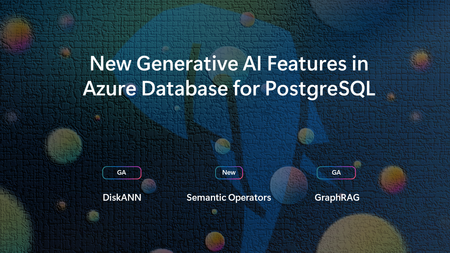
by: Maxim Lukiyanov, PhD, Principal PM Manager This week at Microsoft Build conference, we're excited to unveil a suite of new Generative AI capabilities in Azure Database for PostgreSQL flexible server. These features unlock a new class of applications powered by an intelligent database layer, expanding the horizons of what application developers can achieve. In this post, we’ll give you a brief overview of these announcements. Data is the fuel of AI. Looking back, the intelligence of Large Language Models (LLMs) can be reframed as intelligence that emerged from the vast data they were trained on. The LLMs just happened to be this technological leap necessary to extract that knowledge, but the knowledge itself was hidden in the data all along. In modern AI applications, the Retrieval-Augmented Generation (RAG) pattern applies this same principle to real-time data. RAG extracts relevant facts from data on the fly to augment an LLM’s knowledge. At Microsoft, we believe this principle will continue to transform technology. Every bit of data will be squeezed dry of every bit of knowledge it holds. And there’s no better place to find the most critical and up-to-date data than in databases. Today, we're excited to announce the next steps on our journey to make databases smarter – so they can help you capture the full potential of your data. Fast and accurate vector search with DiskANN First, we’re announcing the General Availability of DiskANN vector indexing in Azure Database for PostgreSQL. Vector search is at the heart of the RAG pattern, and it continues to be a cornerstone technology for the new generation of AI Agents - giving it contextual awareness and access to fresh knowledge hidden in data. DiskANN brings years of state-of-the-art innovation in vector indexing from Microsoft Research directly to our customers. This release introduces supports for vectors up to 16,000 dimensions — far surpassing the 2,000-dimension limit of the standard pgvector extension in PostgreSQL. This enables the development of highly accurate applications using high-dimensional embeddings. We’ve also accelerated index creation with enhanced memory management, parallel index building, and other optimizations – delivering up to 3x faster index builds while reducing disk I/O. Additionally, we're excited to announce the Public Preview of Product Quantization – a cutting-edge vector compression technique that delivers exceptional compression while maintaining high accuracy. DiskANN Product Quantization enables efficient storage of large vector volumes, making it ideal for production workloads where both performance and cost matter. With Product Quantization enabled, DiskANN offers up to 10x faster performance and 4x cost savings compared to pgvector HNSW. You can learn more about DiskANN in a dedicated blog post. Semantic operators in the database Next, we’re announcing the Public Preview of Semantic Operators in Azure Database for PostgreSQL – bringing a new intelligence layer to relational algebra, integrated directly into the SQL query engine. While vector search is foundational to the Generative AI (GenAI) apps and agents, it only scratches the surface of what’s possible. Semantic relationships between elements of the enterprise data are not visible to the vector search. This knowledge exists within the data but is lost at the lowest level of the stack – vector search – and this loss propagates upward, limiting the agent’s ability to reason about the data. This is where new Semantic Operators come in. Semantic Operators leverage LLMs to add semantic understanding of operational data. Today, we’re introducing four operators: generate() – a versatile generation operator capable of ChatGPT-style responses. is_true() – a semantic filtering operator that evaluates filter conditions and joins in natural language. extract() – a knowledge extraction operator that extracts hidden semantic relationships and other knowledge from your data, bringing a new level of intelligence to your GenAI apps and agents. rank() - a highly accurate semantic ranking operator, offering two types of state-of-the-art re-ranking models: Cohere Rank-v3.5 or OpenAI gpt-4.1 models from Azure AI Foundry Model Catalog. You can learn more about Semantic Operators in a dedicated blog post. Graph database and GraphRAG knowledge graph support Finally, we’re announcing the General Availability of GraphRAG support and the General Availability of the Apache AGE extension in Azure Database for PostgreSQL. Apache AGE extension on Azure Database for PostgreSQL offers a cost-effective, managed graph database service powered by PostgreSQL engine – and serves as the foundation for building GraphRAG applications. The semantic relationships in the data once extracted can be stored in various ways within the database. While relational tables with referential integrity can represent some relationships, this approach is suboptimal for knowledge graphs. Semantic relationships are dynamic; many aren’t known ahead of time and can’t be effectively modeled by a fixed schema. Graph databases provide a much more flexible structure, enabling knowledge graphs to be expressed naturally. Apache AGE supports openCypher, the emerging standard for querying graph data. OpenCypher offers an expressive, intuitive language well-suited for knowledge graph queries. We believe that combining semantic operators with graph support in Azure Database for PostgreSQL creates a compelling data platform for the next generation of AI agents — capable of effectively extracting, storing, and retrieving semantic relationships in your data. You can learn more about graph support in a separate blog post. Resources to help you get started We’re also happy to announce availability of the new resources and tools for application developers: Model Context Protocol (MCP) is an emerging open protocol designed to integrate AI models with external data sources and services. We have integrated MCP server for Azure Database for PostgreSQL into the Azure MCP Server, making it easy to connect your agentic apps not only to Azure Database for PostgreSQL, but to other Azure services as well through one unified interface. To learn more, refer to this blog post. New Solution Accelerator which showcases all of the capabilities we have announced today working together in one solution solving real world problems of ecommerce retail reimagined for agentic era. New PostgreSQL extension for VSCode for application developers and database administrators alike, bringing new generation of query editing and Copilot experiences to the world of PostgreSQL. And read about New enterprise features making Azure Database for PostgreSQL faster and more secure in the accompanying post. Begin your journey Generative AI innovation continues its advancement, bringing new opportunities every month. We’re excited for what is to come and look forward to sharing this journey of discovery with our customers. With today’s announcements - DiskANN vector indexing, Semantic Operators, and GraphRAG - Azure Database for PostgreSQL is ready to help you explore new boundaries of what’s possible. We invite you to begin your Generative AI journey today by exploring our new Solution Accelerator.2.1KViews3likes0Comments