gcc
92 Topics
Securing AI Adoption in the Defense Industrial Base — Part 3: Governing AI and a 90-Day Plan
Part 3 of 3 | November 2026 By Michael Crane, Principal Cloud Solution Architect (Security); Kelly Lunghamer, Senior Solution Engineer (Security); Brooke Robinson, Security Specialist; and Sarah Vyzas, Security Specialist, Microsoft Welcome to the final installment of our three-part series on securing AI adoption in the Defense Industrial Base (DIB). In Part 1, we laid out the AI risk landscape facing DIB organizations and the evidence foundation security teams need to manage it. Part 2 described Microsoft's approach, extending Zero Trust to AI, the six pillars of agent governance, and the shared responsibility model, and then walked through how to Discover & Observe and Secure AI across identity, data, workload, and operations in GCC High. Part 3 completes the series with Govern, the discipline that keeps those controls effective over time, and a practical 30/60/90-day plan for putting it all into action. Govern Key Considerations Security controls hold only as long as someone maintains them. Agents gain new connectors after approval, owners move to other roles, and exceptions granted for a pilot quietly become permanent. Governance is what keeps a secure environment secured as it changes, turning the controls in the previous section into repeatable decisions with names attached to them. For DIB organizations, these are auditable obligations, not administrative activities: Who approved an agent? What data and systems can it access? When was that access last reviewed? What actions did it take? Governance requires a standing decision-making body rather than a one-time approval process. An AI security council, or an existing architecture review board given the appropriate remit, should determine which use cases are permitted, what data they may access, which connectors or third parties are approved, and when exceptions expire. Every agent should also have both a designated owner and sponsor. The owner is responsible for day-to-day operation, access, and lifecycle management. The sponsor provides business accountability and validates that the agent continues to serve a legitimate organizational purpose. Together, they help prevent orphaned automation as personnel and priorities change. Governance should scale with risk. A personal productivity agent and an agent embedded in a mission-critical business process should not follow the same approval path. Higher-risk agents require greater scrutiny based on data sensitivity, system access, autonomy, and business impact, while lower-risk agents may inherit existing controls and governance baselines. Industry frameworks provide useful structure for institutionalizing these governance practices. ISO/IEC 42001 emphasizes policies, accountability, performance evaluation, and continual improvement through a Plan-Do-Check-Act cycle.[1] For DIB organizations, it complements existing requirements such as NIST SP 800-171 and CMMC by helping ensure governance remains repeatable, evidence-based, and sustainable. The RAISE framework offers a practical model for governing AI identities and agents.[2] These principles align closely with the discover, secure, and govern approach described throughout this series: Reveal AI identities and their access Assign accountable human ownership Interpret behavior through monitoring and context Secure autonomy through least privilege and guardrails Evaluate lifecycle changes in risk and business purpose The guidance below focuses on four governance disciplines: Lifecycle management, automated guardrails, administrative containment, and audit evidence. Working seamlessly together as one, these capabilities help organizations maintain control over AI systems as they evolve. Technical Guidance Table 6. Operationalizing AI governance: Lifecycle, guardrails, exceptions, and evidence in GCC-H Security team action GCC-H capability Next steps Manage the agent lifecycle end to end Manual registry plus Power Platform environment strategy, Managed Environments, application lifecycle management, and Entra app/SPN lifecycle for custom agents. [Future] Entra ID Governance for agents (entitlement management, access packages, lifecycle workflows, access reviews scoped to agent identities) and Agent 365 registry Define create → review → publish → recertify → retire with a named owner per agent; expire agents that miss recertification. Power Platform ALM (https://learn.microsoft.com/power-platform/alm/) · Managed Environments (https://learn.microsoft.com/power-platform/admin/managed-environment-overview) · Entra ID Governance (https://learn.microsoft.com/entra/id-governance/identity-governance-overview) Establish and enforce guardrails Power Platform DLP with connector endpoint filtering, environment creation restrictions, Copilot Studio authentication and publishing controls, Purview DLP and sensitivity labels, Conditional Access, tenant AI settings. [Future] Agent 365 guardrails for data access, tool usage, agent workflows Default-deny connectors and channels; allow-list per approved agent and workload. Power Platform DLP (https://learn.microsoft.com/power-platform/admin/wp-data-loss-prevention) · Copilot Studio security and governance (https://learn.microsoft.com/microsoft-copilot-studio/security-and-governance) Pre-authorize administrative containment Power Platform admin center and PowerShell to disable, quarantine, reassign, or delete agents and flows; M365 admin center Integrated Apps to block deployment; Entra to disable the agent identity and revoke sessions or consent. [Future] Governance and lifecycle agents for agents in the M365 admin center Pre-authorize containment levers and document who can pull each; test disable-and-revoke end to end. Power Platform admin (https://learn.microsoft.com/power-platform/admin/) · Manage Copilot agents / Integrated Apps (https://learn.microsoft.com/microsoft-365/admin/manage/manage-copilot-agents-integrated-apps). Measure revocation latency from detection or approval to disabling the agent identity, revoking sessions and consent, removing connectors, and withdrawing privileged access; test the process through an agent-focused incident exercise. Publish reusable policy baselines Reusable Power Platform DLP policy sets, Managed Environment rulesets, Purview label and DLP policy templates, and CoE Starter Kit patterns as the template library. [Future] Built-in agent policy templates for Entra Identity Protection and Purview Risky Agents Publish a small set of tiered baselines (low / moderate / CUI) and require every new agent to inherit one. CoE Starter Kit (https://learn.microsoft.com/power-platform/guidance/coe/starter-kit) · Monitoring agents with IRM (https://learn.microsoft.com/purview/insider-risk-management-monitoring-agents) · ID Protection for Agents (https://learn.microsoft.com/en-us/entra/id-protection/concept-risky-agents) Retain audit evidence and support eDiscovery Unified Audit Log for Copilot and agent interactions, Dataverse and Power Platform activity logging, Purview Audit retention policies, eDiscovery hold and collection, Communication Compliance for AI-generated content. [Future] Parity for all agent interaction types in GCC-H Extend audit retention to meet records requirements and test a Copilot/agent collection end to end. Audit retention policies (https://learn.microsoft.com/purview/audit-log-retention-policies) · eDiscovery overview (https://learn.microsoft.com/purview/ediscovery-solution-overview) A Recommended Approach Sample Execution Plan A DIB security team can begin without waiting for a large transformation program. The sequence below follows the same order as this series – establish visibility, enforce the baseline, then operationalize governance – and is designed to produce evidence early, reduce immediate exposure, and prepare the organization for expanded agent capabilities. First 30 Days: Establish Visibility Name an executive sponsor and a security owner, because every control that follows needs a decision maker and a person accountable for operating it. Publish the approved AI service list, so that shadow AI is defined by exception rather than by assumption. Validate and confirm which AI services are in use, by whom, and from which devices. Stand up the agent registry with a named owner for every agent. Turn on the telemetry you already own. Onboard priority endpoints to Defender for Endpoint and Purview – Device coverage is critical for visibility coverage. Review DSPM for AI and audit coverage to see what Copilot and connected services can reach. Identify your highest-risk repositories and the AI use cases that the business is already running. Days 31–60: Enforce the Baseline Start with the data and use cases that carry the most risk and apply labeling and DLP to priority data sets. Sanction the AI applications that meet your bar and block the ones that do not, so users get a clear path instead of an ambiguous one. Revisit Conditional Access and privileged access with AI in scope and treat agent and workload identities as first-class subjects rather than exceptions. Restrict connectors and external destinations to an allow list. Enable content safety guardrails on custom AI workloads. Complete threat models for the approved custom AI and agent use cases. Route AI signals – discovery alerts, DLP matches, anomalous retrieval, agent permission changes – into the SOC queue with a named owner and a defined response. Communicate clearly to users which AI tools are approved, which are prohibited, and why. Days 61–90: Operationalize Governance Stand up a mature AI security council with security, legal, privacy, and business teams, and give it authority to approve use cases and grant exceptions. Publish tiered policy templates, so new agents inherit a known configuration instead of being negotiated one at a time. Run an AI incident exercise , such as a prompt-injected agent exfiltrating sensitive data. Review agent and application owners , permissions, exceptions, and evidence. Commit to a quarterly control review paired with a GCC-High feature-availability check. Prioritize moving approved use cases onto platforms that preserve consistent identity, data protection, security operations, and compliance evidence. The long-term cost of AI governance is determined less by the strength of your guardrails than by how many different tools and platforms those guardrails must span. Outcome The goal is not to stop AI adoption. It is to make approved adoption easier than unmanaged adoption. A consolidated security foundation reduces policy gaps, shortens investigations, improves evidence quality, and gives DIB security teams a controlled path from copilots and custom models to a future agent estate. Ninety days in, a security team should be able to tell its executive sponsor which AI is in use, who owns it, what data it reaches, which controls are enforced, and which additional controls are needed, and to answer: “Have we enabled this?” with evidence, rather than estimation. Bringing It Together Across this series, we have followed a single progression: Discover & Observe the AI already in use, Secure it with controls across identity, data, workloads, and operations, and Govern it so those controls hold as agents, owners, and business priorities change. None of this calls for a parallel security program. AI security extends the Zero Trust practices DIB organizations already operate, applying them to new identities, new data paths, and new forms of autonomy. As you plan your next steps, engage your Microsoft account team for GCC High feature-availability reviews and roadmap briefings tailored to your environment. References [1] International Organization for Standardization (ISO). ISO/IEC 42001:2023 Information Technology — Artificial Intelligence — Management System (https://www.iso.org/standard/42001). December 2023. [2] Mastrogiacomo, Rosario. AI Identities: Governing the Next Generation of Autonomous Actors (https://www.oreilly.com/library/view/ai-identities-governing/9798868820342/html/672915_1_En_10_Chapter.xhtml). Chapter 10, “The RAISE Framework for Governing AI Identities.” O'Reilly Media, 2025.164Views0likes0CommentsCopilot for US Government delivers advanced models, app integration
Executive Summary: Microsoft is delivering Frontier Suite capabilities to U.S. Government cloud environments this month—bringing state-of-the-art reasoning and deep Office app integration to GCC, GCC-H, and DoD.879Views2likes0CommentsReady to Build the Future? Join Microsoft's Agent Bootcamp in Boulder, Colorado!
Ready to move beyond AI experimentation? Join the Microsoft Agent Bootcamp and discover how to build intelligent agents that automate work, accelerate decision-making, and drive measurable business outcomes. Through hands-on labs, expert guidance, and real-world scenarios, you'll gain the skills and confidence to turn AI potential into practical impact for your organization.214Views0likes0CommentsBuild Your First AI Agent in a Day: Join the M365 Copilot Government Roadshow in Tempe
The future of AI isn't just prompting, it's agents. Join fellow government leaders, innovators, and Microsoft experts for a hands-on Agent Bootcamp where you'll go from idea to working prototype in a single day.367Views1like0Comments
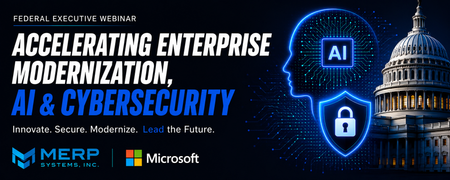
August 20 Federal Event: Accelerating Enterprise Modernization, AI & Cybersecurity
Overview Federal agencies are under increasing pressure to modernize mission systems, strengthen cybersecurity, and responsibly adopt artificial intelligence. Executive Order 14409, record federal technology investments, and Microsoft's OneGov initiative have created a unique opportunity to accelerate secure digital transformation. What Attendees Will Learn How agencies are translating AI strategy into operational outcomes. Microsoft's latest AI, cybersecurity, and modernization capabilities. How Microsoft OneGov is accelerating secure AI adoption across federal agencies. Real-world modernization strategies and success stories from CDC and USGS. Practical approaches to modernizing legacy systems while improving mission outcomes. Plus: Every attendee receives a complimentary 30-minute FY27 AI Readiness Consultation with a MERP Solutions Architect. Why Attend Join MERP Systems and Microsoft to discover the latest AI and cybersecurity innovations and hear directly from CDC and USGS as they share real-world enterprise modernization strategies and success stories. Attendees will leave with actionable insights, proven approaches, and a better understanding of how to accelerate secure AI adoption across their organizations. Event Link- https://events.teams.microsoft.com/event/b58ebc1e-e927-4e66-b73c-f25d7f43be7f@c33861f9-4a57-4bc4-bc88-d6e0c7b92c37?source=copyLinkOneEventsShareDialogJoin us at Microsoft 365 Copilot Discovery event in Huntsville, AL! - UPDATED LOCATION AND DATES!
The Microsoft 365 Copilot Discovery event in Huntsville, AL features hands-on demos, expert sessions, and real-world use cases showcasing AI-driven productivity, Microsoft Copilot capabilities, and modern workplace innovation. The event takes place on May 19th 2026 in Huntsville, AL.527Views0likes0Comments