frontier firm
17 TopicsBeyond Tokens: Rethinking AI Economics with Microsoft Foundry
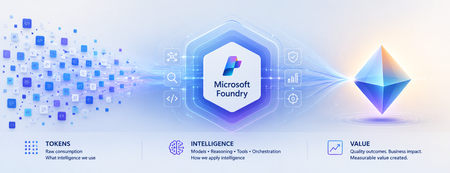
Beyond Tokens: Rethinking AI Economics with Microsoft Foundry From the cost of intelligence to the value of outcomes Enterprise AI has an accounting problem. Executives expect agentic AI to return roughly 171% on investment, according to one widely cited survey. Yet McKinsey finds only about 39% of organizations can attribute any earnings impact to AI at all. Both numbers can be true at once — because the gap between them is not a technology gap. It is a measurement gap. For the first few years of generative AI, one number dominated the economics conversation: tokens. How many tokens did a model consume? What was the cost per million tokens? Could a smaller model perform the same task? Those questions mattered when enterprises were experimenting with AI. They are no longer enough as AI moves into production. An enterprise agent doesn't simply consume tokens. It reasons, retrieves context, invokes tools, calls APIs, verifies its work, retries unsuccessful actions and sometimes escalates exceptions to humans. The model call might cost pennies. The business outcome could cost considerably more. Which leads to an increasingly important question: What is the right economic unit for intelligence? From AI experimentation to economic accountability The first wave of enterprise AI was about possibility: Can AI do this? The next wave is about production, as AI becomes embedded in software engineering, customer service, finance, healthcare and supply chains. And production changes the question: Should AI do this and at what cost? Microsoft has moved decisively onto this ground. In August 2026, the Microsoft Foundry team launched its Economics of Agent Optimization series, arguing that "tokens have become the new unit of technology spend" and that AI should be run as a managed investment system. On the latest earnings call, Satya Nadella described Microsoft's objective as "advancing the frontier on the cost-to-outcome curve, ensuring every customer can turn tokens into business results." The discipline is going mainstream too: 98% of FinOps teams now manage AI spend, up from 31% two years ago. Microsoft's series is largely about the numerator of that curve - making every request, agent and dollar more efficient. This article is about the denominator: what an outcome is, what it truly costs, and what it is worth. The evolution of Microsoft Foundry reflects the same shift. At Build 2026, Microsoft expanded the conversation beyond building agents toward tracing behavior, evaluating quality, monitoring production performance, optimizing agents and connecting their operation to ROI. Think of the progression as: Trace → Evaluate → Monitor → Optimize → ROI This is more than a technology roadmap. It represents a shift from observing AI as technology to managing AI as an economic asset. Tokens became the unit of spend. They were never the unit of value. Consider two AI agents handling the same customer-service workflow. Agent A costs $0.08 per interaction. Agent B costs $0.20. Agent A appears cheaper. But suppose Agent A successfully resolves only 55% of cases, while Agent B resolves 90%. The remainder require retries, additional reasoning or human intervention. Which agent is actually cheaper? The inexpensive interaction may produce the expensive resolution. This illustrates a fundamental problem: We often measure AI where it is consumed rather than where value is created. Tokens are a unit of consumption. Businesses operate in outcomes. A customer-service leader cares about issues resolved. An engineering leader cares about high-quality software reaching production. A finance leader cares about reconciliations completed accurately. The economic denominator needs to move closer to the business. The AI Economic Ladder I think of this evolution as an AI Economic Ladder: Tokens → Interactions → Tasks → Outcomes → Value Each step moves measurement closer to what the enterprise actually cares about. At the token level: What intelligence did we consume? At the interaction level: What did each AI run cost? At the task level: What did it cost to complete the work? At the outcome level: What did a successful result cost? At the value level: Was the outcome worth creating? An AI system can become more efficient at every technical metric while creating little economic value. Conversely, an expensive AI workflow could be extraordinarily valuable if it prevents revenue leakage, reduces operational risk or accelerates a critical business process. The objective isn't cheaper AI. It is better economics. Not every completed task is a successful outcome There is another complication. If an agent completes a workflow, should we count it as a successful outcome? Not necessarily. A meaningful outcome needs three characteristics: Completed. Quality-gated. Attributable. It must reach its intended end state, meet an explicit standard for quality, accuracy, safety or business acceptability, and be attributable to the agent or workflow that produced it. That gives us a more meaningful measure: Cost per Successful Outcome = Fully Loaded AI Workflow Cost / Completed, Quality-Gated, Attributable Outcomes The denominator becomes real only when named in business language: cost per prior authorization resolved in healthcare, per pull request triaged and tested in engineering, per disputed invoice reconciled in finance operations. If you cannot name the outcome in a sentence the process owner recognizes, you are not ready to measure it. The quality gate matters. With AI, "the system ran successfully" and "the system produced a good outcome" are not the same thing. Microsoft Foundry's tracing and evaluation capabilities become economically important for precisely this reason. Evaluation isn't merely quality control. It helps determine what gets counted as value. What does an AI outcome really cost? The true economic footprint goes far beyond inference: Model + Reasoning + Grounding + Tools + Orchestration + Infrastructure + Retries + Evaluation + Governance + Human Intervention Human intervention is particularly easy to overlook. Every time someone must review, correct, approve or recover an AI-generated outcome, the economics change. The same applies to verification. An agent reaching an acceptable result in three steps has different economics from one requiring fifteen steps and multiple retries. And verification is not a rounding error — it is the bulk of the bill. McKinsey's 2026 analysis of production agentic workflows found roughly 60% of an agentic task's cost is tied to refining answers — checking, repairing, re-verifying — not generating the initial response. Most of what you pay for is not intelligence. It is assurance. This means quality and economics are connected. The quality bar you set influences the cost you pay. The challenge isn't simply minimizing consumption. It is finding the right balance between quality, cost, speed and risk. Cost per outcome is only half the equation Now imagine two agents. Both cost $5 per successful outcome. One saves an employee ten minutes of administrative work. The other prevents $500 in revenue leakage. Their cost efficiency is identical. Their economics clearly aren't. So we need to move another step up the ladder: from Cost per Outcome to Value per Outcome. The question isn't only how cheaply AI can complete the work. It is: How much economic value does this outcome create relative to the intelligence required to produce it? Now the CIO, CFO, CAIO and business leader have a common conversation. Give every outcome an Intelligence Budget Not every problem deserves the smartest model available. Classifying an email may require relatively little intelligence. Resolving a complicated customer complaint may justify more context and reasoning. Assessing the risks in a multimillion-dollar contract may justify sophisticated reasoning, multiple validations and human review. Every business outcome therefore has an economically rational amount of intelligence worth spending on it. Call it an Intelligence Budget. This changes the architecture question from which model should we standardize on, to: What combination of model, reasoning, context, tools and human judgment does this outcome deserve? This is where Microsoft Foundry's model router becomes interesting. Individual requests can be dynamically routed so simpler work doesn't consume the same model resources as complex reasoning. If the Intelligence Budget is the economic principle, intelligent routing is one way of operationalizing it. The future enterprise AI architecture won't be about one model doing everything. It will route intelligence according to the economics, quality and risk of the outcome. Making AI economics observable None of this works without visibility. An AI system can be technically healthy and economically unhealthy — responsive and error-free while repeatedly choosing inefficient reasoning paths, invoking unnecessary tools or producing outputs requiring expensive human correction. AI economics and AI observability are becoming inseparable. Microsoft Foundry increasingly connects these disciplines. Tracing shows what an agent did. Evaluation determines whether it met required criteria. Observability helps monitor production behavior. Agent optimizer can test improvements across prompts, skills and models. Microsoft's emerging ROI capabilities take the next step by connecting operating costs with measures such as task completion, time saved and cost efficiency. Attribution is the bridge to the finance conversation. Teams place Azure API Management in front of Foundry endpoints as an AI Gateway, stream token telemetry into Application Insights, and use Entra Agent ID to give every agent run a discrete identity that maps cost to its cost center. Microsoft Agent 365 extends the discipline tenant-wide — spending policies, budget caps and departmental chargeback across Microsoft and third-party agents. Together, they create something enterprises have historically lacked: A feedback loop between how intelligence is consumed and what that intelligence accomplishes. The paradox of cheaper intelligence There is another reason AI economics will become more important as models get cheaper. The Jevons paradox suggests that when technology makes a resource cheaper and more efficient, total consumption can actually increase. AI may experience the same effect. Cheaper intelligence enables more agents, more reasoning and more workflows that were previously uneconomic. So we could see cost per unit of intelligence fall while total intelligence consumed rises. Cheaper AI may therefore produce larger AI bills. That isn't necessarily bad — provided value grows faster than consumption. The objective isn't minimum AI consumption. It is maximum economic value from AI consumption. From workload economics to portfolio economics As AI scales, economics becomes a capital-allocation question. I see three levels. Workload Economics: Is this AI system running efficiently? Outcome Economics: Is it producing quality outcomes economically? Portfolio Economics: Where should we put our next AI dollar? That final question will become increasingly important. An enterprise with hundreds of AI initiatives shouldn't assume every one deserves continued investment. Some should scale. Some need optimization. Some should be redesigned or consolidated. And some should be stopped. The ability to experiment cheaply created the first explosion of enterprise AI. The discipline to allocate capital intelligently will determine what scales. Who owns AI economics? Once an agent becomes part of how work gets done, its economics cannot remain purely an IT metric. The business understands the value of the outcome. Technology understands the architecture and optimization levers. Finance brings economic discipline and comparability. That suggests a shared model: Business owns the outcome. Technology owns the optimization levers. Finance owns the economic discipline. AI economics ultimately isn't just a technology-cost conversation. It is a business-performance and capital-allocation conversation. From abundant intelligence to intelligent economics We are entering an era where intelligence is becoming an increasingly abundant, programmable and variable-cost resource. Microsoft Foundry and the broader Microsoft AI stack are making it easier to build, evaluate, observe, optimize and govern that intelligence. But abundant intelligence does not guarantee abundant value. Enterprises still need to decide where AI belongs, how much intelligence each problem deserves, what defines a successful outcome, when humans should remain involved and which AI investments deserve more capital. The winners won't necessarily use the cheapest models. They won't consume the fewest tokens. And they won't be the organizations that build the most agents. They will become exceptionally good at moving up the AI Economic Ladder: from consumption, to outcomes, to value. Because the next era of AI won't be won by organizations that buy intelligence most cheaply. It will be won by those that convert intelligence into value most efficiently. Where to start: the first 90 days Define the denominator for your top three agents — what counts as done, what quality gate applies, who signs off. Instrument attribution — Azure API Management as an AI Gateway, token telemetry to Application Insights, Entra Agent ID on every run. Wire evaluations into the cost pipeline so only quality-gated outcomes count. Set Intelligence Budgets — model router per request, agent optimizer against your evaluators, Agent 365 policies as circuit breakers. Stand up a joint monthly review — business, technology and finance on one dashboard: outcomes delivered, cost per outcome, value per outcome. Frequently asked questions What is Cost per Successful Outcome in enterprise AI? The fully loaded cost of an AI workload divided by outputs that were completed, quality-gated and attributable - for example, cost per prior authorization resolved or per pull request triaged. It turns token metrics into the unit economics of AI-performed work. What is an Intelligence Budget? The economically rational amount of intelligence - model capability, reasoning, context, tools and human review — worth spending on a given outcome, based on its value and risk. Model router in Microsoft Foundry is one way to operationalize it. Why do AI agents cost more than single model calls? One agent task can involve planning, tool calls, retries and verification - many model calls with compounding context. Research on production agentic workflows attributes roughly 60% of task cost to refining and verifying answers, not generating the first response. Will falling model prices make AI cost management unnecessary? No. By the Jevons paradox, cheaper intelligence expands consumption, so total AI spend typically rises as unit prices fall. The discipline that matters is maximizing value per unit of intelligence. Who should own AI economics? A shared model: the business owns the outcome and its value, technology owns the optimization levers, and finance owns the economic discipline and review cadence. #MicrosoftFoundry #Agent365 #AzureAI #FinOps #AgenticAI #AIAgents #Azure #MicrosoftCostManagement #AIEconomics #Tokens References Microsoft Azure Blog: "The Economics of Agent Optimization: From pilots to measurable returns" (August 12, 2026) Microsoft FY26 Q4 earnings call (Satya Nadella, July 2026) McKinsey — "Cost versus value: managing agentic AI system performance" (July 2026) FinOps Foundation — State of FinOps 2026; Microsoft Learn — Model router for Microsoft Foundry; Agent optimizer; Foundry Control Plane cost optimization76Views0likes0CommentsScaling Seller Impact with ASPX Insights: From Data Access to AI-Driven Execution
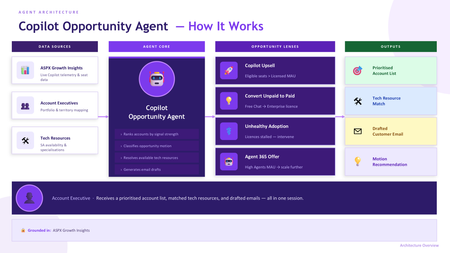
ASPX Insights in Partner Center Most sellers are not constrained by opportunity; they are constrained by time and signal. With up to 70% of effort spent on administrative work, portfolio coverage continues to expand while insight quality declines. Sellers are forced to manually interpret fragmented telemetry across multiple systems, slowing decision-making and reducing precision in where they focus. The result is missed revenue signals, delayed interventions, and inconsistent execution at scale. Productivity is not just about efficiency, it is about enabling every seller to consistently identify and act on the highest-value opportunity, in real time. To drive consistent, data-led growth across Security and AI Business Solutions, partners should connect to ASPX Insights within Partner Center. This provides direct access to adoption propensity models, customer telemetry, and actionable account-level insights across Microsoft 365 Copilot, E7, and Agent 365 scenarios. Access to ASPX Insights is only the starting point. The real value comes from how you operationalise that data and surface it directly to sellers in the flow of work. The most effective pattern is to build a lightweight “opportunity agent” that connects to ASPX data via API and translates telemetry into clear actions. This ensures your sales teams have the right conversation with the right customer at the right time - Conversations that are backed by intelligent insights to help guide your customer's on their AI and security journey. The Architecture ASPX Insights is powered by Partner Center data and exposes rich telemetry and propensity signals that can be accessed programmatically. This allows partners to move beyond dashboards and embed insights directly into seller workflows. As demonstrated in internal adoption patterns, partners can connect to ASPX via API and pull Customer-level adoption and usage telemetry Copilot, Security, and Agent usage signals Propensity scores for expansion, adoption, and conversion Licensing, whitespace, and engagement indicators The M365 Partner API – AI Business Solutions & Security Insights allows partners to ground an agent in real, actionable data rather than static pipeline assumptions. By pulling live telemetry and seat-level signals directly into the agent, the solution continuously reflects actual customer usage patterns - who is adopting, who is stalled, and where there is untapped potential. This means opportunity identification is no longer based on periodic reporting or manual interpretation, but on near real-time behavioural insight. As a result, account prioritisation, upsell motions, and intervention strategies are driven by evidence rather than instinct, enabling account teams to act with precision and focus on the highest-impact opportunities across their portfolio. The agent should act as a translation layer between raw telemetry and seller action. The goal is not to expose more data, but to remove ambiguity and tell the seller exactly where to focus. A simple architecture looks like this: Data layer Ingest ASPX Insights data via API on a daily or scheduled basis. Optionally store monthly snapshots to track trends and smooth out variability. This creates both real-time signal and historical context. With the data layer you have a couple of options. You can integrate directly into Partner Centre ASPX Insights by using the API. This is technically complex and may have a longer lead time to see results. Alternatively, to see results with less complexity, you can simply download snapshots of the data monthly from ASPX Insights in Partner Centre. This is manual but easy to achieve and offers a shorter time to value for your agent. Scoring layer Use ASPX propensity outputs directly or combine them with your own logic to rank accounts across a small set of opportunity lenses Expansion ready (Copilot scale) Conversion ready (free to paid) At risk (low adoption vs paid licenses) Transformation ready (Agent 365 and advanced AI scenarios) These align directly with the machine learning models and signals already surfaced in ASPX. Action layer Translate scores into next best actions Who to engage Why now What motion to run (sell, enable, expand, govern) This is where agents create value. Sellers should not see raw dashboards. They should see prioritised accounts and recommended actions. Internal Adoption Path The key design principle is simple: bring insight into the tools sellers already use. CRM integration Push ranked accounts and recommendations directly into CRM as opportunities, tasks, or account insights. This ensures data becomes part of pipeline management, not a separate activity. Copilot / Agent interface Expose the agent through Microsoft 365 Copilot or a custom chat interface where sellers can ask Which customers should I prioritise this week Which accounts are ready for Copilot or E7 expansion Where are my adoption risks The agent queries the ASPX-backed dataset and returns structured recommendations in seconds. Proactive notifications Trigger alerts based on signal changes Spikes in Copilot usage Drops in adoption for paid tenants New high-propensity accounts entering threshold This shifts sellers from reactive to proactive engagement. Portfolio dashboards (secondary) Maintain dashboards for leadership and planning, but not as the primary interaction model for sellers. Dashboards support strategy, agents drive execution. Extending into E7 and Agent 365 scenarios Once the agent is connected to ASPX, partners can extend the same model across broader solution plays E7 opportunities Use signals such as usage depth, licensing posture, and workload adoption to identify customers progressing toward advanced security and compliance requirements. The agent can flag these accounts as ready for E7-led conversations. Agent 365 opportunities Combine Copilot maturity with agent usage signals to identify customers moving beyond productivity into process automation. These are high-value transformation plays where partners should proactively engage. This ensures sellers are not operating in silos but are guided toward the next logical workload based on real behavior, not assumptions. Where to Next If you lead a partner sales team, connect to ASPX Insights and see how these insights can empower your sales teams to achieve more. Check out our ready made ASPX Insights agent in Github.705Views3likes5CommentsFrontier Transformation campaign in a box now available in Partner Marketing Center
AI transformation is moving beyond isolated experimentation to organization-wide initiatives and customers are looking for partners who can help them scale. Organizations scaling AI are seeing measurable gains across productivity, efficiency, and customer engagement. To support this shift, the Frontier Transformation campaign in a box provides a ready-to-launch, co-branded marketing campaign aligned to Microsoft AI solutions. This campaign is aligned with the Frontier Success framework and engages customers as they advance in their AI maturity, with messaging that connects AI capabilities to real business context while reinforcing trust, governance, and security. Available in Partner Marketing Center Pro, the Frontier Transformation campaign in a box empowers you to go market faster, support lead generation, and build pipeline. Partner Marketing Center Pro is available to partners who have purchased a partner benefits package, attained a Solutions Partner designation or are enrolled in ISV Success. Explore Frontier Transformation campaign in a box.119Views1like0CommentsDifferentiate yourself for the AI era—earn your Frontier Transformation Engineer badge
Each session of the Frontier Transformation Engineer Summit is designed for you to build the skills to advance your Frontier Engineering journey and accelerate progress toward earning your Frontier Transformation Engineer badge. With this badge, you can validate that you have the expertise to deliver agentic AI solutions at the hypervelocity that customers expect, with the breadth of the Microsoft technology stack to support you. Here’s how you can keep building your AI capability: View the summit sessions on demand. Work toward earning the Frontier Transformation Engineer badge. Join us at MCAPS Start for Partners on July 22 to refresh your go-to-market approach for the next year.321Views0likes0Comments
From insight to action: how Adobe and Microsoft are helping marketers move faster with AI
Today’s marketing leaders are under pressure to do more than ever—deliver meaningful personalization, accelerate execution, and prove measurable business impact. At the same time, teams are navigating increasing complexity: fragmented data, disconnected tools, and insights that arrive too late to act on. AI can change this—but only when it’s embedded directly into how people already work. That’s why Microsoft and Adobe are deepening our partnership: bringing customer experience intelligence, AI-powered workflows, and enterprise-grade AI directly into Microsoft 365 Copilot—so teams can move from insight to alignment to execution in one continuous workflow. The result is faster decisions, more coordinated execution, and clearer business outcomes—without breaking flow or context. Bringing customer experience intelligence into the flow of work Marketing teams don’t struggle because they lack data. They struggle because insights live in one place, collaboration in another, and execution somewhere else entirely. That disconnect slows teams down and creates unnecessary friction between analysis and action. Together, Adobe and Microsoft are changing that dynamic by connecting Adobe’s customer experience capabilities with Microsoft 365 Copilot and Copilot Cowork—so insight, collaboration, and next-best action can happen where work already happens: in Copilot Chat and in everyday apps like Teams, Word, and PowerPoint. Marketers can ask questions, explore insights, align with teammates, and take action without jumping between tools—turning intelligence into impact at the moment it matters. Adobe Marketing Agent for Microsoft 365 Copilot: now generally available A major milestone in this journey is the general availability of the Adobe Marketing Agent for Microsoft 365 Copilot, now available via Microsoft Commercial Marketplace. The Adobe Marketing Agent brings Adobe customer experience intelligence directly into Copilot, enabling marketing teams to: Accelerate time from insight to decision Move seamlessly from analysis to execution Keep humans firmly in control, with AI supporting—not replacing—decision‑making Importantly, the agent is enterprise-ready by design. IT administrators can deploy and manage the experience through the Microsoft 365 admin center, ensuring security, governance, and compliance at scale. Expanding executive experiences with Copilot Cowork Looking ahead, Adobe skills designed for customer experience orchestration will be accessible in Copilot Cowork—in a future release. This upcoming experience will enable customer experience leaders to engage with customer experience insights in a more direct, conversational way, bringing strategic visibility into the same Copilot environments where decisions are made and actions are coordinated. Built on Azure to scale securely and responsibly The technology foundation of this innovation is Azure. Adobe Experience Platform, Adobe Experience Platform Agent Orchestrator, and Adobe AI Agents are built on Azure and leverage Azure AI models, providing the scalability, security, and reliability enterprises require. By running on Azure, these agentic experiences benefit from Microsoft’s global infrastructure, enterprise‑grade security, and responsible AI commitments—supporting customer trust as organizations scale AI across their business. Designed for interoperability across agent ecosystems Modern enterprises don’t operate in a single ecosystem—and their agents shouldn’t either. Adobe agents are built to interoperate with agents created using Microsoft Azure AI Foundry or Copilot Studio, enabling customers to orchestrate richer, cross‑functional workflows across marketing, sales, service, and operations. This architecture is designed to enable organizations to compose agentic solutions that reflect how work actually happens—across systems, teams, and business processes. Moving from experimentation to execution This partnership reflects a broader shift in how organizations adopt AI—moving from experimentation to embedded, enterprise‑ready execution. By bringing the full power of Adobe Experience Platform together with Microsoft’s AI platform, cloud infrastructure, and Copilot experiences, we’re helping teams move faster with clarity, confidence, and control. This is how AI becomes not just powerful—but practical. Learn more Adobe + Microsoft partnership page Adobe Marketing Agent for Microsoft Copilot page279Views1like0CommentsBuild AI skills at Microsoft AI Skills Fest
Register now for Microsoft AI Skills Fest, a no-cost digital skilling event taking place June 8–12. Designed so partners can stay ahead in the rapidly evolving AI landscape, attendees can build in-demand AI skills, gain practical insights, and discover ways to deliver innovative solutions, deepen customer relationships, and stay competitive in a fast-changing market. Get ready to lead Frontier Transformation If you’re a solution engineer or architect building AI agents across the Frontier stack—including Microsoft 365 Copilot, Microsoft Foundry, Copilot Studio, GitHub Copilot, Fabric, and Agent 365—you can validate your expertise with the Frontier Transformation Engineer badge. Continue reading this blog on our newSkilling discussion board836Views0likes0CommentsGet ready to lead Frontier Transformation: Earn your badge and attend the summit
If you’re a solution engineer or architect building AI agents across the Frontier stack—including Microsoft Foundry, Microsoft Copilot Studio, Microsoft 365 Copilot, GitHub Copilot, Microsoft Fabric, and Agent 365—now’s the perfect time to validate your expertise with the Frontier Transformation Engineer badge. Through certifications, project-ready execution, and advanced training, this applied skilling journey hones your capabilities in designing, building, and operating production-ready agentic AI solutions—so you can lead customers from AI experimentation to secure implementation. Learn more about how to engineer a Frontier partner practice in our latest blog post. Want to fast-track your badge completion? Join us at the Frontier Transformation Engineer Summit on June 9 for a live, expert-led skilling experience where you’ll explore how to use Microsoft Agent Factory at scale, build your expertise, showcase organizational readiness, and lead Frontier Transformation for your customers.559Views1like0CommentsPartner Blog | Build Frontier Transformation capability with new engineer skilling and June events
Customers are moving quickly to Frontier Transformation, where AI and agents are embedded as a repeatable, governed operating capability. As Nicole Dezen outlines in her recent post, Accelerating Frontier Transformation with Microsoft partners, Frontier Transformation is the moment when AI becomes a repeatable, governed capability embedded into the flow of work, business processes, and customer engagement. Customers are moving from targeted pilots to operating AI at scale, grounded in identity, data protection, compliance, monitoring, and change management. This shift changes what customers look for in a partner. Customers increasingly want teams that can translate ideas into deployable solutions, then scale adoption and measurement so that AI runs reliably in production. That is why skilling matters. Skilling is how you build technical readiness and delivery confidence across sales, presales, engineering, and delivery roles. It is how you turn emerging demand into repeatable execution. It is also how you validate capability as the bar rises for governed, secure AI at scale. This post shares the latest Frontier skilling opportunities across Microsoft Partner Skilling, designed to take partners from learning to customer impact faster. For deeper context on the Frontier engineering approach, read our recent post, Engineering the Frontier partner practice. Frontier skilling starts here Partners have told us they want skilling tied to real delivery motion, not just content. These Frontier-focused updates are designed to deliver role-based learning that builds practical readiness, plus clear ways to validate skills and align your team around how Frontier Transformation is delivered at scale. New Partner Skilling discussion board A dedicated Partner Skilling discussion board is now available for partners to discover skilling resources, connect with subject matter experts, and get questions answered across solution areas. Continue reading blog here122Views0likes0CommentsPartner Blog | Leading the moment: How Azure partners are driving the Frontier shift
Something fundamental is shifting in how partners create value, and it is moving faster than many expected. That shift is creating new opportunities for those ready to lead. Across recent partner events and one-on-one conversations, we have heard a consistent message: customers are actively adopting AI and shifting toward becoming Frontier firms. They are moving AI from isolated experimentation to a core capability that drives execution, differentiation, and growth. Now customers are asking a more consequential question: how do we rewire our businesses to operate as a Frontier firm? That question can reshape how you deliver value. In this blog, we share how Microsoft is investing in the platform and programs that enable the partner-led path to becoming Frontier, so you can turn AI ambition into durable transformation. The Frontier shift partners are witnessing now Frameworks set the direction, but markets move when partners lead. In conversations with partners around the world, one point is clear: AI has moved from exploration to execution. Customers are no longer asking whether to adopt AI. They are asking how fast they can put it to work safely, at scale, and with measurable outcomes. Take TD SYNNEX, for example. TD SYNNEX is turning “AI-ready” into a repeatable channel motion by connecting devices, cloud, and security into its “Better Together” approach. Instead of letting customers buy pieces of the stack in silos, the motion guides partners to modernize endpoints, secure the foundation, and then adopt Microsoft AI with confidence, at the scale distributors can bring. Across these conversations, a clear pattern is emerging: partners are thinking beyond any single workload or product to drive end-to-end business transformation built on Azure. This is the Frontier narrative coming to life in the market. Continue reading here86Views0likes0CommentsMake this your year for Frontier Transformation: Earn your badge and join us at the summit
If you’re a solution engineer or architect building AI agents across the Frontier stack—including Microsoft Foundry, Microsoft Copilot Studio, Microsoft 365 Copilot, GitHub Copilot, Microsoft Fabric, and Microsoft Agent 365—now’s the perfect time to validate your expertise with the Frontier Transformation Engineer badgehttps://aka.ms/FrontierPartnerSkilling. Through certifications, project-ready execution, and advanced training, this applied skilling journey hones your capabilities in designing, building, and operating production-ready agentic AI solutions—so you can lead customers from AI experimentation to secure implementation. Learn more about how to engineer a Frontier partner practice in our latest blog post. Want to fast-track your badge completion? Join us at the Frontier Transformation Engineer Summit on June 9 for a live, expert-led skilling experience where you’ll explore how to use Microsoft Agent Factory at scale, build individual expertise, showcase organizational readiness, and lead Frontier Transformation for your customers. Plus, make sure you’re registered for MCAPS Start for Partners on July 22 to get the insights and playbooks to sharpen your focus and position your practice where the momentum is strongest. Register now282Views1like0Comments