devsecops
18 TopicsMCP safety & evaluation with the Agent 365 CLI & Agent Governance Toolkit
Co Author: JiteshThakur AI agents are useful because they can act. They call tools, query databases, send messages, and hand work to other agents. That same freedom creates a problem: access control can tell you which service an agent may reach, but it does not always tell you whether a particular action is sensible, safe, or permitted. MCP is how most agents now act. Two Control Points: This post examines two control points that address different parts of the MCP lifecycle. Agent 365 CLI evaluates the MCP server before an agent uses it. Agent Governance Toolkit (AGT) governs sensitive tool calls while the agent runs. One improves what the agent sees. The other governs what the agent does. The Agent 365 CLI is a cross-platform command-line tool for Agent 365 applications on Azure. Its evaluation command examines MCP tool definitions and scores their quality. AGT evaluates actions against policy and records each decision. Together, these tools support a practical model: evaluate the server first, then provide proper scaffolding for the developer to test this in a dry run. Agent 365 CLI: Score an MCP server from the command line: The Agent 365 CLI can evaluate an MCP server against research-based practices for production readiness. The result is more useful than a simple pass or fail. The evaluation gives you: A score for each tool name, description, and parameter schema; A prioritized list of improvements; An overall maturity score for the server; and Local output that you can use early in development. This report turns a vague question, "Is this MCP server ready?", into a concrete list of work. The evaluate command a365 develop-mcp evaluate --server-url <server-url> [--auth-token <auth-token>] [options] The command reads the tool schemas from the server. It then produces guidance for names, descriptions, parameters, and schema structure. A local coding-agent CLI scores the semantic checks. You can use GitHub Copilot CLI or Claude Code under your account and AI subscription. The command does not send tool-schema data to Microsoft. Prerequisites: Install the following software: Agent 365 CLI; Node.js 18 or later for GitHub Copilot CLI; and A supported coding-agent CLI for semantic scoring. For example, install GitHub Copilot CLI with this command: powershell npm install -g @github/copilot This bring-your-own-LLM model keeps the scoring step in your local development environment. It is useful when model calls must remain inside an approved deployment. How the evaluation works The command runs a five-step pipeline and logs progress as it goes. Fig 1: MCP Evaluation using Agent 365 Cli Connect to the MCP server and collect its tool schemas. Generate an evaluation checklist in the output directory. Score the semantic checks with the selected coding agent. Calculate the maturity level and action priorities. Write the JSON and HTML reports. The evaluation contains two types of checks: Deterministic checks use exact rules in the CLI. For example, a tool name cannot be empty. Semantic checks use a coding agent to score clarity and meaning. Each result includes a reason for the score. Examples Set the authentication token in an environment variable. Then evaluate an authenticated server and write the artifacts to a subfolder. powershell $env:A365_MCP_AUTH_TOKEN = "<bearer-token>" a365 develop-mcp evaluate --server-url "https://my-mcp-server.contoso.com/mcp" --output-dir "./eval" Use a specific scoring engine with the `--eval-engine` option: powershell a365 develop-mcp evaluate --server-url "http://localhost:5000/mcp" --eval-engine claude-code Scenario: Evaluate a malicious MCP server For this demonstration, we hosted a deliberately malicious MCP server at `http://127.0.0.1:8124/`. It exposes tools that demonstrate tool poisoning, credential leakage, prompt injection, schema mismatch, sandbox escape, and other attacks. The server is intentionally unsafe and is for demonstration only. Fig 2: Setting up a test MCP server for evaluation We ran the evaluation in two steps. First, we generated the checklist without automatic semantic scoring: a365 develop-mcp evaluate --server-url "http://127.0.0.1:8124/" --eval-engine none Fig 3: Agent365CLI MCP Evaluation The command wrote the checklist and a semantic-evaluation prompt to the output directory. It also displayed the next steps. Second, we gave the prompt and checklist to a coding agent. The agent completed each unscored semantic check with a Boolean score and a short reason. After we saved the completed checklist, we ran the command again to generate the report: a365 develop-mcp evaluate --server-url "http://127.0.0.1:8124/" --output-dir "C:\temp\MaliciousMCP" Fig 4: Creating the report with Agent365 CLI MCP Evaluate command Understanding the evaluation report Open `<server-name>_eval_report.html` from the output directory. The report contains: The overall score from 0 to 100; The maturity level from 0 to 4; Scores for each tool and quality category; and A prioritized action list for the next maturity level. Fig 5: MCP Evaluation Report In our demonstration, the server scored 86.0 and reached Level 3: Optimized for AI. That strong overall score did not mean that every tool was safe or clear. The report found 58 action items, including one critical item and 33 high-priority items. That contrast matters. A server can have valid schemas and consistent names while still exposing misleading or dangerous tools. Fig 6: MCP Evaluation Report - Tool-By-Tool Detail What to look for Read the per-tool results before the overall score. A single weak tool can create more risk than the server average suggests. Focus on these report sections: Tool names: Can an agent select the correct tool from its name? Tool descriptions: Does each description explain the purpose and correct use? Parameter names: Do the names identify the data that the tool requires? Parameter descriptions: Do they explain the format, type, and constraints? Schema structure: Are the schemas valid and processable? Action items: Which changes have the highest effect on tool selection and use? The command processes static tool schemas from `tools/list`. It does not process runtime payloads, end-user data, or personal data. The command keeps the `--auth-token` value in memory. It sends the value only in the HTTP `Authorization` header. It does not write the token to disk or give it to the coding agent. AGT: Put governance in the execution path: Microsoft's open-source Agent Governance Toolkit (AGT) evaluates an action before execution. It adds identity and policy context, records the decision, and can send risky work for approval. This can be used by developers during the build time for dynamic evaluation of the MCP server. AGT lets developers put part of that intent into the execution path. Remote tools still need secure implementations, sandboxes need hard boundaries, and audit records need appropriate storage and access controls. You do not need to replace your agent framework to use it. What sits in the decision path? AGT wraps the tools that an agent already uses. You can start to govern a tool with two lines of Python: python from agentmesh.governance import govern safe_tool = govern(my_tool, policy="policy.yaml") On each call, `safe_tool` evaluates the configured policy. An allowed action reaches the original tool. A denied action raises `GovernanceDenied` and creates a decision record. This wrapper model reduces the cost of adoption. Teams can add governance to an existing agent stack without rebuilding it. AGT supports Python, TypeScript, .NET, Rust, and Go. Its documented integrations include popular agent frameworks, MCP, and A2A. Teams can also adopt AGT in stages. A team can begin with policy checks and audit records. It can add identity, approvals, sandboxing, and operational controls as risk increases. Each control answers a different question: Policy: Is this action allowed? Identity and trust: Which agent made the request? Runtime controls: What limits apply to execution? Audit evidence: Why did AGT allow or deny the action? A low-risk assistant can need only a deny rule and basic logging. An agent that moves money or changes production systems needs stronger controls. Fig 7: AGT Architecture Scenario: Govern the same malicious MCP server For this scenario demonstration, we used AGT Python packages as an MCP gateway. The gateway sat between an agent and the same malicious server from the earlier evaluation. This setup let us examine both control points against one target. The Agent 365 CLI examined the server's static tool definitions. The AGT gateway examined real requests and responses for the developer during its testing. Fig 8: AGT findings at runtime In the policy interface, a developer can edit runtime limits and detection rules. The developer can also validate the policy against sample tool metadata, save a revision, and activate it with a recorded reason. Fig 9: AGT control coverage The control-coverage view shows which AGT capabilities are active in the gateway. It also links each capability to package checks and end-to-end evidence. In our demonstration, we included the following controls: Tool metadata poisoning detection; Tool change and rug-pull detection; Dangerous argument blocking; Tool-response content scanning; Per-client tool-call budgets; and A redacted decision audit trail. You can build your detection & input security by reading more about it here. The gateway detected malicious content. For one blocked `tools/list` request, it recorded the findings. The important result was not only that AGT blocked the request. It also preserved the matched evidence, affected tool locations, policy modes, and request context. Fig 10: Example detection via AGT The dashboard then summarized block-mode findings, leading risk drivers, and tools that required review. This evidence can help a team prioritize policy changes and investigate repeated attacks. Fig 11: Sample AGT metrics AGT does not require this UI, gateway, or architecture. Its structured decisions can feed an admin console, SIEM, incident workflow, or approval queue. AGT also includes an Agent Compliance package with mappings for OWASP and other controls. These mappings give developers and governance teams a common record of applied controls. Teams do not need to reconstruct the agent's behavior after an incident. Check Compliance - Agent Governance Toolkit for more information. Conclusion: MCP safety needs controls before and during execution. The Agent 365 CLI improves the MCP interface before deployment. It exposes unclear tool definitions, scores server maturity, and turns quality gaps into prioritized work. While AGT is implemented at the build phase, it provides developers the ability to test policy, identity, execution context & preserve evidence for allowed or denied decisions. Neither tool replaces secure server code, strong sandbox boundaries, or protected audit storage. Instead, they make those controls easier to evaluate and explain. Start with one MCP server and one consequential tool call. Evaluate the server with the Agent 365 CLI. Then put an AGT policy around the action that carries the most risk. While these controls help secure the build phase of an agent, once agents move into production, runtime controls become essential. Agent365 provides those controls at runtime. With thanks to Ashik Kuppil for his inputs and collaboration on this post.
Microsoft Leads a New Era of Software Supply Chain Transparency
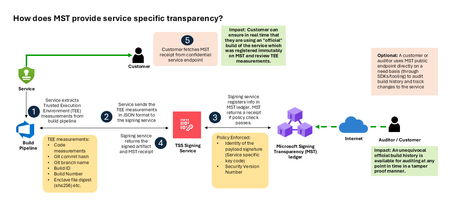
Today, Microsoft announces the general availability of Microsoft’s Signing Transparency (MST) – a first-of-its-kind capability that brings unprecedented visibility and trust to our software supply chain. With this release, Microsoft is leading the industry by recording the build of critical cloud services into a publicly readable and verifiable SCITT standard (Supply Chain Integrity, Transparency, and Trust) compliant blockchain ledger. This means every production software build for in scope services like Azure Attestation and Azure Managed HSM (Hardware Security Module), Azure confidential ledger, Microsoft Signing Transparency itself (and others over time) – is now logged in an immutable, tamper-evident record. Only builds that are in the MST ledger are deployed to production; this gives customers confidence that the supply chain for these critical services can be audited at anytime. Notably, the MST ledger is fully open source and built to align with the emerging IETF SCITT standard. By embracing SCITT’s principles and open protocols, Microsoft ensures that MST not only secures our own ecosystem but also contributes to a broader industry movement toward standardized supply chain transparency. The open-source MST ledger serves as a verifiable trust anchor that any organization or researcher can inspect, audit, or even integrate with their own tooling. MST itself meets the highest levels of transparency, backed by a tamper-proof confidential ledger, open-source, and independently verified. Specifically, we are making the foundation of our trust model transparent and accessible to everyone – reinforcing that trust must be earned through proof, not just promises. This launch marks a major milestone in our commitment to Zero Trust principles, extending “never trust, always verify” all the way into the build itself. Building on a public preview introduced late last year, MST’s general availability delivers verifiable transparency at the software level. It transforms traditional code signing with an additive trust layer that is accessible via an open verification model. Every new software update is accompanied by a publicly auditable proof of integrity, enabling security teams to proactively confirm that each update is authentic and unaltered. To help organizations get the most out of this capability, we are also introducing a free tool to explore the contents – Ledger Explorer – an offline tool that allows security teams to examine MST ledger entries, verify cryptographic proofs, and even validate the ledger’s integrity independently. This tool, combined with MST’s open design, ensures that every Microsoft customer – and the broader community – can hold us accountable in real time for the software we run on their behalf. Key Benefits of Microsoft’s Signing Transparency (MST) Verified Code Integrity – Every software release is cryptographically logged in MST’s ledgers. This makes each build tamper-evident and traceable. If an attacker attempts to inject malicious code or sign an unauthorized update, it will be evident through the well-defined validation step built into the SCITT standard. Organizations gain the assurance that code integrity can be independently confirmed at any time. Independent Verification & Zero Trust – MST enables customers and auditors to verify software authenticity on their own, without having to solely rely on vendor attestations. For each update, Microsoft provides a transparency “receipt” (proof of logging) that you can use to prove the update was officially published and unaltered. This fosters a “don’t just trust, verify” approach, empowering security teams to double-check everything running in their environment aligns with what Microsoft intended. Audit-Trail & Compliance – The transparency ledger creates a permanent, auditable timeline of code deployments. Every entry is a record of what was released and when, backed by cryptographic proofs. This simplifies compliance reporting and accelerates forensic analysis. In the event of an incident, you can quickly audit the ledger to see if any unexpected code was introduced. For highly regulated industries, MST offers concrete evidence of software integrity and policy compliance over time. Leadership & Open Standards – We are delivering real transparency now, encouraging a future where all critical software is released with verifiable integrity. MST’s open source implementation and SCITT-compliant design exemplify our commitment to openness and collaboration. We believe widespread adoption of these standards will strengthen supply chain security for everyone, making trust verification a universal practice. Next Steps Microsoft’s Signing Transparency is more than a new security feature and shapes the advances in trust technology. As threats grow more sophisticated, we must evolve the way we assure our customers about the software they depend on. With MST now generally available, we are leading by example: proving that it is possible to open up the traditionally opaque process of software deployment and turn it into a source of strength and trust, i.e., empowering each person with verifiable transparency. We invite the industry to join us on this journey and get started by reading the documentation and exploring Ledger Explorer today! Together, by embracing transparency and open standards, we can turn “trust but verify” from a slogan into an everyday reality for digital infrastructure.2.7KViews2likes3CommentsExtracting and Auditing Azure DevOps Permissions at Scale with PowerShell
Managing access in Azure DevOps is easy at small scale — and increasingly opaque as organizations grow. This post introduces ADO Permissions Output, an open-source PowerShell toolset that queries Azure DevOps REST APIs across 30+ security namespaces, decodes bitmask permissions, resolves cryptic GUIDs and tokens into readable names, and produces structured JSON/CSV output ready for Power BI. It also surfaces "ghost" members — users who appear in ADO through nested Entra groups but hold no active entitlement — which the standard Graph API alone cannot detect. Whether you're preparing for a compliance review or just want to know who actually has access to what, this tool closes the gap between the ADO portal and a complete audit picture.Why UK Enterprise Cybersecurity Is Failing in 2026 (And What Leaders Must Change)
Enterprise cybersecurity in large organisations has always been an asymmetric game. But with the rise of AI‑enabled cyber attacks, that imbalance has widened dramatically - particularly for UK and EMEA enterprises operating complex cloud, SaaS, and identity‑driven environments. Microsoft Threat Intelligence and Microsoft Defender Security Research have publicly reported a clear shift in how attackers operate: AI is now embedded across the entire attack lifecycle. Threat actors use AI to accelerate reconnaissance, generate highly targeted phishing at scale, automate infrastructure, and adapt tactics in real time - dramatically reducing the time required to move from initial access to business impact. In recent months, Microsoft has documented AI‑enabled phishing campaigns abusing legitimate authentication mechanisms, including OAuth and device‑code flows, to compromise enterprise accounts at scale. These attacks rely on automation, dynamic code generation, and highly personalised lures - not on exploiting traditional vulnerabilities or stealing passwords. The Reality Gap: Adaptive Attackers vs. Static Enterprise Defences Meanwhile, many UK enterprises still rely on legacy cybersecurity controls designed for a very different threat model - one rooted in a far more predictable world. This creates a dangerous "Resilience Gap." Here is why your current stack is failing- and the C-Suite strategy required to fix it. 1. The Failure of Traditional Antivirus in the AI Era Traditional antivirus (AV) relies on static signatures and hashes. It assumes malicious code remains identical across different targets. AI has rendered this assumption obsolete. Modern malware now uses automated mutation to generate unique code variants at execution time, and adapts behaviour based on its environment. Microsoft Threat Intelligence has observed threat actors using AI‑assisted tooling to rapidly rewrite payload components, ensuring that every deployment looks subtly different. In this model, there is no reliable signature to detect. By the time a pattern exists, the attacker has already moved on. Signature‑based detection is not just slow - it is structurally misaligned with AI‑driven attacks. The Risk: If your security relies on "recognising" a threat, you are already breached. By the time a signature exists, the attacker has evolved. The C-Suite Pivot: Shift investment from artifact detection to EDR/XDR (Extended Detection and Response). We must prioritise behavioural analytics and machine learning models that identify intent rather than file names. 2. Why Perimeter Firewalls Fail in a Cloud-First World Many UK enterprise still rely on firewalls enforcing static allow/deny rules based on IP addresses and ports. This model worked when applications were predictable and networks clearly segmented. Today, enterprise traffic is encrypted, cloud‑hosted, API‑driven, and deeply integrated with SaaS and identity services. AI‑assisted phishing campaigns abusing OAuth and device‑code flows demonstrate this clearly. From a network perspective, everything looks legitimate: HTTPS traffic to trusted identity providers. No suspicious port. No malicious domain. Yet the attacker successfully compromises identity. The Risk: Traditional firewalls are "blind" to identity-based breaches in cloud environments. The C-Suite Pivot: Move to Identity-First Security. Treat Identity as the new Control Plane, integrating signals like user risk, device health, and geolocation into every access decision. 3. The Critical Weakness of Single-Factor Authentication Despite clear NCSC guidance, single-factor passwords remain a common vulnerability in legacy applications and VPNs. AI-driven credential abuse has changed the economics of these attacks. Threat actors now deploy adaptive phishing campaigns that evolve in real-time. Microsoft has observed attackers using AI to hyper-target high-value UK identities- specifically CEOs, Finance Directors, and Procurement leads. The Risk: Static passwords are now the primary weak link in UK supply chain security. The C-Suite Pivot: Mandate Phishing‑resistant MFA (Passkeys or hardware security keys). Implement Conditional Access policies that evaluate risk dynamically at the moment of access, not just at login. Legacy Security vs. AI‑Era Reality 4. The Inherent Risk of VPN-Centric Security VPNs were built on a flawed assumption: that anyone "inside" the network is trustworthy. In 2026, this logic is a liability. AI-assisted attackers now use automation to map internal networks and identify escalation paths the moment they gain VPN access. Furthermore, Microsoft has tracked nation-state actors using AI to create synthetic employee identities- complete with fake resumes and deepfake communication. In these scenarios, VPN access isn't "hacked"; it is legally granted to a fraudster. The Risk: A compromised VPN gives an attacker the "keys to the kingdom." The C-Suite Pivot: Transition to Zero Trust Architecture (ZTA). Access must be explicit, scoped to the specific application, and continuously re‑evaluated using behavioural signals. 5. Data: The High-Velocity Target Sensitive data sitting unencrypted in legacy databases or backups is a ticking time bomb. In the AI era, data discovery is no longer a slow, manual process for a hacker. Attackers now use AI to instantly analyse your directory structures, classify your files, and prioritise high-value data for theft. Unencrypted data significantly increases your "blast radius," turning a containable incident into a catastrophic board-level crisis. The Risk: Beyond the technical breach, unencrypted data leads to massive UK GDPR fines and irreparable brand damage. The C-Suite Pivot: Adopt Data-Centric Security. Implement encryption by default, classify data while adding sensitivity labels and start board-level discussions regarding post‑quantum cryptography (PQC) to future-proof your most sensitive assets. 6. The Failure of Static IDS Traditional Intrusion Detection Systems (IDS) rely on known indicators of compromise - assuming attackers reuse the same tools and techniques. AI‑driven attacks deliberately avoid that assumption. Threat actors are now using Large Language Models (LLMs) to weaponize newly disclosed vulnerabilities within hours. While your team waits for a "known pattern" to be updated in your system, the attacker is already using a custom, AI-generated exploit. The Risk: Your team is defending against yesterday's news while the attacker is moving at machine speed. The C-Suite Pivot: Invest in Adaptive Threat Detection. Move toward Graph‑based XDR platforms that correlate signals across email, endpoint, and cloud to automate investigation and response before the damage spreads. From Static Security to Continuous Security Closing Thought: Security Is a Journey, Not a Destination For UK enterprises, the shift toward adaptive cybersecurity is no longer optional - it is increasingly driven by regulatory expectation, board oversight, and accountability for operational resilience. Recent UK cyber resilience reforms and evolving regulatory frameworks signal a clear direction of travel: cybersecurity is now a board‑level responsibility, not a back‑office technical concern. Directors and executive leaders are expected to demonstrate effective governance, risk ownership, and preparedness for cyber disruption - particularly as AI reshapes the threat landscape. AI is not a future cybersecurity problem. It is a current force multiplier for attackers, exposing the limits of legacy enterprise security architectures faster than many organisations are willing to admit. The uncomfortable truth for boards in 2026 is that no enterprise is 100% secure. Intrusions are inevitable. Credentials will be compromised. Controls will be tested. The difference between a resilient enterprise and a vulnerable one is not the absence of incidents, but how risk is managed when they occur. In mature organisations, this means assuming breach and designing for containment: Access controls that limit blast radius Least privilege and conditional access restricting attackers to the smallest possible scope if an identity is compromised Data‑centric security using automated classification and encryption, ensuring that even when access is misused, sensitive data cannot be freely exfiltrated As a Senior Enterprise Cybersecurity Architect, I see this moment as a unique opportunity. AI adoption does not have to repeat the mistakes of earlier technology waves, where innovation moved fast and security followed years later. We now have a rare chance to embed security from day one - designing identity controls, data boundaries, automated monitoring, and governance before AI systems become business‑critical. When security is built in upfront, enterprises don’t just reduce risk - they gain the confidence to move faster and unlock AI’s value safely. Security is no longer a “department”. In the age of AI, it is a continuous business function - essential to preserving trust and maintaining operational continuity as attackers move at machine speed. References: Inside an AI‑enabled device code phishing campaign | Microsoft Security Blog AI as tradecraft: How threat actors operationalize AI | Microsoft Security Blog Detecting and analyzing prompt abuse in AI tools | Microsoft Security Blog Post-Quantum Cryptography | CSRC Microsoft Digital Defense Report 2025 | Microsoft https://www.ncsc.gov.uk/news/government-adopt-passkey-technology-digital-servicesDriving DevSecOps Standards: NIST’s Live Guidelines for Secure Software Development, Security, and Operations Practices
Microsoft appreciates the opportunity to participate in the National Institute of Standards and Technology’s (NIST) effort to evolve the Live Guidelines for Secure Software Development, Security, and Operations (DevSecOps) Practices, building on the original NIST SP 1800-44 publication. This living guidance reflects ongoing, collaborative work to document practical approaches for securing the software development lifecycle, addressing challenges such as open-source risk, software supply chain integrity, Software Bill of Materials (SBOM), insider threats, and Zero Trust principles. This project is led by the National Cybersecurity Center of Excellence (NCCoE) through the National Cybersecurity Excellence Partnership (NCEP) consortium, with contributions from government, industry, and academia. The resulting guidance is intended to help organizations apply standards-based DevSecOps practices using reference implementations developed under NCCoE leadership. Our team at Microsoft was honored to share frameworks, tools, and expertise to help deploy and configure secure Azure DevOps and GitHub environments. These efforts were complemented by open-source tooling and partner solutions, resulting in CI/CD examples that reflect industry's best practices. Some of the contributions from Microsoft included: OpenSSF Secure Supply Chain Consumption Framework (S2C2F) – this is a framework of requirements, organized into a maturity model that is hyper-focused on how to securely consume open-source dependencies into the developer’s workflow. Microsoft SBOM tool – General purpose, cross-platform, open source SBOM generator that produces SPDX SBOMs at build time. GitHub Advanced Security – suite of tools available on GitHub and Azure DevOps that perform static code analysis scans, software composition analysis, automated dependency updates, and more. Defender for Cloud DevOps security – provides a centralized console to empower security teams to protect applications and resources from code to cloud across multi-pipeline environments, including Azure DevOps, GitHub, and GitLab. Note: These tools are referenced solely as examples used in the NCCoE reference implementations. NIST and NCCoE do not evaluate, recommend, or endorse any commercial product or service. The Live Guidelines for DevSecOps Practices also explore how AI can automate requirements management, code generation, vulnerability analysis, and risk mitigation across the software development lifecycle. These AI-assisted capabilities, embedded within a Zero Trust framework, enforce least privilege and continuous validation. With human oversight, transparency, and audit trails, this approach aims to support secure, compliant automation—reflecting our ongoing commitment to trustworthy DevSecOps. These examples are intended to inform discussion and public feedback as the guidance evolves, rather than prescribe specific implementations. This project is a collaborative effort led by the National Cybersecurity Center of Excellence (NCCoE) through the National Cybersecurity Excellence Partnership (NCEP) consortium, with NIST guiding the work. We are one of many contributors, and we value the broader industry partnership that makes this work possible. The National Cybersecurity Center of Excellence (NCCoE), a part of the National Institute of Standards and Technology (NIST), is a collaborative hub where industry organizations, government agencies, and academic institutions work together to address businesses’ most pressing cybersecurity challenges. Through this collaboration, the NCCoE develops modular, adaptable example cybersecurity solutions demonstrating how to apply standards and best practices using commercially available technology. Information is available at: https://nccoe.nist.gov. Why NIST’s Live Guidelines for Secure Software Development, Security, and Operations (DevSecOps) Practices Matters The Live Guidelines for DevSecOps Practices provide a practical blueprint for secure development that organizations can adopt with confidence. Many small and medium-sized businesses struggle to understand what a secure DevOps configuration should look like, or how the DevSecOps lifecycle differs from DevOps. The work in the Live Guidelines for DevSecOps Practices addresses this challenge by describing the industry best practices for the components and activities in each lifecycle phase, mapping them to NIST SP 800-218 Secure Software Development Framework (SSDF) and noting where AI integrates with activities. This work was validated against two reference builds—one exercising Microsoft’s entire developer stack, and a similar industry stack, deployed on the Azure platform—ensuring NIST guidance reflects real-world, proven practices. The Live Guidelines also explore how AI-assisted capabilities may support activities such as requirements management, code analysis, vulnerability identification, and risk mitigation across the software development lifecycle. When applied within a Zero Trust framework, these capabilities emphasize least-privileged access, continuous validation, transparency, and auditability, with appropriate human oversight. As the Live Guidelines for DevSecOps Practices enters its public comment phase, we encourage the community to participate and help shape its future direction. Microsoft’s Contributions As part of the NCEP consortium, Microsoft is one of many contributors supporting the development of reference implementations used to validate the Live Guidelines for DevSecOps Practices. Contributors shared engineering experience, architectural patterns, and example configurations to help ensure the guidance reflects real-world deployment considerations across the software development lifecycle. Through participation in the NCEP consortium’s work with NCCoE, we have shared solutions that can be adopted across sectors, supporting the nation’s critical infrastructure by fostering innovation and collaboration among stakeholders. Key contributions include: Contributing engineering expertise and implementation experience to one of the reference builds developed under NCCoE leadership for NIST’s Live Guidelines for Secure Software Development, Security, and Operations (DevSecOps) Practices Supporting the elevation of the SSDF to national and international standards Sharing practical insights from our engineering practices to ensure guidance is actionable and scalable Providing real-world examples of tools and configurations to achieve end-to-end supply chain security, fused with DevSecOps, and extended through deployment into the operational phase in Azure We see our role as both solution builder and platform provider, and we strive to support standards that matter most to customers and regulators. Connecting DevSecOps, Zero Trust, and the Secure Future Initiative While DevSecOps is the focus, for Microsoft it is built on foundational principles: Zero Trust Architecture (ZTA): The security model underpinning modern DevSecOps. Secure Future Initiative (SFI): Microsoft’s implementation of Zero Trust, now mapped to NIST Cybersecurity Framework (CSF) for global alignment. This integration ensures that DevSecOps guidance is secure-by-design and consistent with widely recognized frameworks—boosting customer confidence worldwide. Looking Ahead This is just the beginning. NIST SP1800-44 DevSecOps Practices started the journey, and the updates in the Live Guidelines for DevSecOps Practices continue the momentum, with more resources to follow. As future resources roll out, Microsoft will continue to share tools, insights, and best practices to help organizations adopt secure development at scale. By partnering with government institutions and industry participants, we’re shaping the future of cybersecurity—together. Next Steps Engage in the public comment phase for the Live Guidelines for Secure Software Development, Security, and Operations (DevSecOps) Practices document and help define the next generation of secure software development. Learn more about Microsoft Security solutions here.1.2KViews2likes0Comments
Building Secure, Enterprise Ready AI Agents with Purview SDK and Agent Framework
At Microsoft Ignite, we announced the public preview of Purview integration with the Agent Framework SDK—making it easier to build AI agents that are secure, compliant, and enterprise‑ready from day one. AI agents are quickly moving from demos to production. They reason over enterprise data, collaborate with other agents, and take real actions. As that happens, one thing becomes non‑negotiable: Governance has to be built in. That’s where Purview SDK comes in. Agentic AI Changes the Security Model Traditional apps expose risks at the UI or API layer. AI agents are different. Agents can: Process sensitive enterprise data in prompts and responses Collaborate with other agents across workflows Act autonomously on behalf of users Without built‑in controls, even a well‑designed agent can create compliance gaps. Purview SDK brings Microsoft’s enterprise data security and compliance directly into the agent runtime, so governance travels with the agent—not after it. What You Get with Purview SDK + Agent Framework This integration delivers a few key things developers and enterprises care about most: Inline Data Protection Evaluate prompts and responses against Data Loss Prevention (DLP) policies in real time. Content can be allowed or blocked automatically. Built‑In Governance Send AI interactions to Purview for audit, eDiscovery, communication compliance, and lifecycle management—without custom plumbing. Enterprise‑Ready by Design Ship agents that meet enterprise security expectations from the start, not as a follow‑up project. All of this is done natively through Agent Framework middleware, so governance feels like part of the platform—not an add‑on. How Enforcement Works (Quickly) When an agent runs: Prompts and responses flow through the Agent Framework pipeline Purview SDK evaluates content against configured policies A decision is returned: allow, redact, or block Governance signals are logged for audit and compliance This same model works for: User‑to‑agent interactions Agent‑to‑agent communication Multi‑agent workflows Try It: Add Purview SDK in Minutes Here’s a minimal Python example using Agent Framework: That’s it! From that point on: Prompts and responses are evaluated against Purview policies setup within the enterprise tenant Sensitive data can be automatically blocked Interactions are logged for governance and audit Designed for Real Agent Systems Most production AI apps aren’t single‑agent systems. Purview SDK supports: Agent‑level enforcement for fine‑grained control Workflow‑level enforcement across orchestration steps Agent‑to‑agent governance to protect data as agents collaborate This makes it a natural fit for enterprise‑scale, multi‑agent architectures. Get Started Today You can start experimenting right away: Try the Purview SDK with Agent Framework Follow the Microsoft Learn docs to configure Purview SDK with Agent Framework. Explore the GitHub samples See examples of policy‑enforced agents in Python and .NET. Secure AI, Without Slowing It Down AI agents are quickly becoming production systems—not experiments. By integrating Purview SDK directly into the Agent Framework, Microsoft is making governance a default capability, not a deployment blocker. Build intelligent agents. Protect sensitive data. Scale with confidence.Driving DevSecOps Standards: Microsoft’s Role in Shaping NIST SP 1800-44 Volume B
We are grateful for the opportunity to contribute to the National Institute of Standards and Technology’s (NIST) SP 1800-44 Volume B – DevSecOps Architecture. This publication represents a significant step forward in defining a reference architecture for secure software development, and we appreciate the collaborative efforts of all involved. Security is woven throughout the development lifecycle, addressing challenges such as open-source risk, software supply chain integrity, Software Bill of Materials (SBOM) requirements, insider threats, and Zero Trust principles. Our team at Microsoft was honored to share frameworks, tools, and expertise to help deploy and configure secure Azure DevOps and GitHub environments. These efforts were complemented by open-source tooling and partner solutions, resulting in CI/CD examples that reflect industry's best practices. Some of the contributions from Microsoft included: OpenSSF Secure Supply Chain Consumption Framework (S2C2F) – this is a framework of requirements, organized into a maturity model that is hyper-focused on how to securely consume open-source dependencies into the developer’s workflow. Microsoft SBOM tool – General purpose, cross-platform, open source SBOM generator that produces SPDX SBOMs at build time. Copacetic – Open-source tool that automates patching containers at build time. GitHub Advanced Security – suite of tools available on GitHub and Azure DevOps that perform static code analysis scans, software composition analysis, automated dependency updates, and more. Defender for Cloud DevOps security – provides a centralized console to empower security teams to protect applications and resources from code to cloud across multi-pipeline environments, including Azure DevOps, GitHub, and GitLab. Volume B also explores how AI can automate requirements management, code generation, vulnerability analysis, and risk mitigation across the software development lifecycle. These AI-assisted capabilities, embedded within a Zero Trust framework, enforce least privilege and continuous validation. With human oversight, transparency, and audit trails, this approach aims to support secure, compliant automation—reflecting our ongoing commitment to trustworthy DevSecOps. This project is a collaborative effort led by the National Cybersecurity Center of Excellence (NCCoE) through the National Cybersecurity Excellence Partnership (NCEP) consortium, with NIST guiding the work. We are one of many contributors, and we value the broader industry partnership that makes this work possible. The NCCoE brings together government, industry, and academia to address critical cybersecurity challenges and develop practical, standards-based solutions. Why NIST’s SP 1800-44 Volume B Matters Volume B provides a practical blueprint for secure development that organizations can adopt with confidence. Many small and medium-sized businesses struggle to understand what a secure DevOps configuration should look like, or how the DevSecOps lifecycle differs from DevOps. The work in Volume B addresses this challenge by describing the industry best practices for the components and activities in each lifecycle phase, mapping them to NIST SP 800-218 Secure Software Development Framework (SSDF) and noting where AI integrates with activities. This work was validated against two reference builds—one exercising Microsoft’s entire developer stack, and a similar industry stack, deployed on the Azure platform—ensuring NIST guidance reflects real-world, proven practices. As Volume B enters its public comment phase, we encourage the community to participate and help shape its future direction. Microsoft’s Contributions Through participation in the NCEP consortium’s work with NCCoE, we have shared solutions that can be adopted across sectors, supporting the nation’s critical infrastructure by fostering innovation and collaboration among stakeholders. Key contributions include: Helping develop the first reference build for NIST’s SP 1800-44 Volume B Supporting the elevation of the SSDF to national and international standards Sharing practical insights from our engineering practices to ensure guidance is actionable and scalable Providing real-world examples of tools and configurations to achieve end-to-end supply chain security, fused with DevSecOps, and extended through deployment into the operational phase in Azure We see our role as both solution builder and platform provider, and we strive to support standards that matter most to customers and regulators. Connecting DevSecOps, Zero Trust, and the Secure Future Initiative While DevSecOps is the focus, for Microsoft it is built on foundational principles: Zero Trust Architecture (ZTA): The security model underpinning modern DevSecOps. Secure Future Initiative (SFI): Microsoft’s implementation of Zero Trust, now mapped to NIST CSF for global alignment. This integration ensures that DevSecOps guidance is secure-by-design and consistent with widely recognized frameworks—boosting customer confidence worldwide. Looking Ahead This is just the beginning. Volume A started the journey, and Volume B continues the momentum, with more volumes to follow. As future volumes roll out, Microsoft will continue to share tools, insights, and best practices to help organizations adopt secure development at scale. By partnering with government institutions and industry participants, we’re shaping the future of cybersecurity—together. Call to Action Engage in the public comment phase for SP 1800-44 Volume B and help define the next generation of secure software development. Learn more about Microsoft Security solutions
Artificial Intelligence & Security
Understanding Artificial Intelligence Artificial intelligence (AI) is a computational system that perform human‑intelligence tasks, learning, reasoning, problem‑solving, perception, and language understanding by leveraging algorithmic and statistical methods to analyse data and make informed decisions. Artificial Intelligence (AI) can also be abbreviated as is the simulation of human intelligence through machines programmed to learn, reason, and act. It blends statistics, machine learning, and robotics to deliver following outcomes: Prediction: The application of statistical modelling and machine learning techniques to anticipate future outcomes, such as detecting fraudulent transactions. Automation: The utilisation of robotics and artificial intelligence to streamline and execute routine processes, exemplified by automated invoice processing. Augmentation: The enhancement of human decision-making and operational capabilities through AI-driven tools, for instance, AI-assisted sales enablement. Artificial Intelligence: Core Capabilities and Market Outlook Key capabilities of AI include: Data-driven decision-making: Analysing large datasets to generate actionable insights and optimise outcomes. Anomaly detection: Identifying irregular patterns or deviations in data for risk mitigation and quality assurance. Visual interpretation: Processing and understanding visual inputs such as images and videos for applications like computer vision. Natural language understanding: Comprehending and interpreting human language to enable accurate information extraction and contextual responses. Conversational engagement: Facilitating human-like interactions through chatbots, virtual assistants, and dialogue systems. With the exponential growth of data, ML learning models and computing power. AI is advancing much faster and as According to industry analyst reports breakthroughs in deep learning and neural network architectures have enabled highly sophisticated applications across diverse sectors, including healthcare, finance, manufacturing, and retail. The global AI market is on a trajectory of significant expansion, projected to increase nearly 5X by 2030, from $391 billion in 2025 to $1.81 trillion. This growth corresponds to a compound annual growth rate (CAGR) of 35.9% during the forecast period. These projections are estimates and subject to change as per rapid growth and advancement in the AI Era. AI and Cloud Synergy AI, and cloud computing form a powerful technological mixture. Digital assistants are offering scalable, cloud-powered intelligence. Cloud platforms such as Azure provide pre-trained models and services, enabling businesses to deploy AI solutions efficiently. Core AI Workloads Capabilities Machine Learning Machine learning (ML) underpins most AI systems by enabling models to learn from historical and real-time data to make predictions, classifications, and recommendations. These models adapt over time as they are exposed to new data, improving accuracy and robustness. Example use cases: Credit risk scoring in banking, demand forecasting in retail, and predictive maintenance in manufacturing. Anomaly Detection Anomaly detection techniques identify deviations from expected patterns in data, systems, or processes. This capability is critical for risk management and operational resilience, as it enables early detection of fraud, security breaches, or equipment failures. Example use cases: Fraud detection in financial transactions, network intrusion monitoring in cybersecurity, and quality control in industrial production. Natural Language Processing (NLP) NLP focuses on enabling machines to understand, interpret, and generate human language in both text and speech formats. This capability powers a wide range of applications that require contextual comprehension and semantic accuracy. Example use cases: Sentiment analysis for customer feedback, document summarisation for legal and compliance teams, and multilingual translation for global operations. Principles of Responsible AI To ensure ethical and trustworthy AI, organisations must embrace: Reliability & Safety Privacy & Security Inclusiveness Fairness Transparency Accountability These principles are embedded in frameworks like the Responsible-AI-Standard and reinforced by governance models such as Microsoft AI Governance Framework. Responsible AI Principles and Approach | Microsoft AI AI and Security AI introduces both opportunities and risks. A responsible approach to AI security involves three dimensions: Risk Mitigation: It Is addressing threats from immature or malicious AI applications. Security Applications: These are used to enhance AI security and public safety. Governance Systems: Establishing frameworks to manage AI risks and ensure safe development. Security Risks and Opportunities Due to AI Transformation AI’s transformative nature brings new challenges: Cybersecurity: This brings the opportunities and advancement to track, detect and act against Vulnerabilities in infrastructure and learning models. Data Security: This helps the tool and solutions such as Microsoft Purview to prevent data security by performing assessments, creating Data loss prevention policies applying sensitivity labels. Information Security: The biggest risk is securing the information and due to the AI era of transformation securing IS using various AI security frameworks. These concerns are echoed in The Crucial Role of Data Security Posture Management in the AI Era, which highlights insider threats, generative AI risks, and the need for robust data governance. AI in Security Applications AI’s capabilities in data analysis and decision-making enable innovative security solutions: Network Protection: applications include use of AI algorithms for intrusion detection, malware detection, security situational awareness, and threat early warning, etc. Data Management: applications refer to the use of AI technologies to achieve data protection objectives such as hierarchical classification, leak prevention, and leak traceability. Intelligent Security: applications refer to the use of AI technology to upgrade the security field from passive defence toward the intelligent direction, developing of active judgment and timely early warning. Financial Risk Control: applications use AI technology to improve the efficiency and accuracy of credit assessment, risk management, etc., and assisting governments in the regulation of financial transactions. AI Security Management Effective AI security requires: Regulations & Policies: Establish and safety management laws specifically designed to for governance by regulatory authorities and management policies for key application domains of AI and prominent security risks. Standards & Specifications: Industry-wide benchmarks, along with international and domestic standards can be used to support AI safety. Technological Methods: Early detection with Modern set of tools such as Defender for AI can be used to support to detect and mitigate and remediate AI threats. Security Assessments: Organization should use proper tools and platforms for evaluating AI risks and perform assessments regularly using automated tools approach Conclusion AI is transforming how organizations operate, innovate, and secure their environments. As AI capabilities evolve, integrating security and governance considerations from the outset remains critical. By combining responsible AI principles, effective governance, and appropriate security measures, organizations can work toward deploying AI technologies in a manner that supports both innovation and trust. Industry projections suggest continued growth in AI‑related security investments over the coming years, reflecting increased focus on managing AI risks alongside its benefits. These estimates are subject to change and should be interpreted in the context of evolving technologies and regulatory developments. Disclaimer References to Microsoft products and frameworks are for informational purposes only and do not imply endorsement, guarantee, or contractual commitment. Market projections referenced are based on publicly available industry analyses and are subject to change.Microsoft Ignite 2025: Top Security Innovations You Need to Know
🤖 Security & AI -The Big Story This Year 2025 marks a turning point for cybersecurity. Rapid adoption of AI across enterprises has unlocked innovation but introduced new risks. AI agents are now part of everyday workflows-automating tasks and interacting with sensitive data—creating new attack surfaces that traditional security models cannot fully address. Threat actors are leveraging AI to accelerate attacks, making speed and automation critical for defense. Organizations need solutions that deliver visibility, governance, and proactive risk management for both human and machine identities. Microsoft Ignite 2025 reflects this shift with announcements focused on securing AI at scale, extending Zero Trust principles to AI agents, and embedding intelligent automation into security operations. As a Senior Cybersecurity Solution Architect, I’ve curated the top security announcements from Microsoft Ignite 2025 to help you stay ahead of evolving threats and understand the latest innovations in enterprise security. Agent 365: Control Plane for AI Agents Agent 365 is a centralized platform that gives organizations full visibility, governance, and risk management over AI agents across Microsoft and third-party ecosystems. Why it matters: Unmanaged AI agents can introduce compliance gaps and security risks. Agent 365 ensures full lifecycle control. Key Features: Complete agent registry and discovery Access control and conditional policies Visualization of agent interactions and risk posture Built-in integration with Defender, Entra, and Purview Available via the Frontier Program Microsoft Agent 365: The control plane for AI agents Deep dive blog on Agent 365 Entra Agent ID: Zero Trust for AI Identities Microsoft Entra is the identity and access management suite (covering Azure AD, permissions, and secure access). Entra Agent ID extends Zero Trust identity principles to AI agents, ensuring they are governed like human identities. Why it matters: Unmanaged or over-privileged AI agents can create major security gaps. Agent ID enforces identity governance on AI agents and reduces automation risks. Key Features: Provides unique identities for AI agents Lifecycle governance and sponsorship for agents Conditional access policies applied to agent activity Integrated with open SDKs/APIs for third‑party platforms Microsoft Entra Agent ID Overview Entra Ignite 2025 announcements Public Preview details Security Copilot Expansion Security Copilot is Microsoft’s AI assistant for security teams, now expanded to automate threat hunting, phishing triage, identity risk remediation, and compliance tasks. Why it matters: Security teams face alert fatigue and resource constraints. Copilot accelerates response and reduces manual effort. Key Features: 12 new Microsoft-built agents across Defender, Entra, Intune, and Purview. 30+ partner-built agents available in the Microsoft Security Store. Automates threat hunting, phishing triage, identity risk remediation, and compliance tasks. Included for Microsoft 365 E5 customers at no extra cost. Security Copilot inclusion in Microsoft 365 E5 Security Copilot Ignite blog Security Dashboard for AI A unified dashboard for CISOs and risk leaders to monitor AI risks, aggregate signals from Microsoft security services, and assign tasks via Security Copilot - included at no extra cost. Why it matters: Provides a single pane of glass for AI risk management, improving visibility and decision-making. Key Features: Aggregates signals from Entra, Defender, and Purview Supports natural language queries for risk insights Enables task assignment via Security Copilot Ignite Session: Securing AI at Scale Microsoft Security Blog Microsoft Defender Innovations Microsoft Defender serves as Microsoft’s CNAPP solution, offering comprehensive, AI-driven threat protection that spans endpoints, email, cloud workloads, and SIEM/SOAR integrations. Why It Matters Modern attacks target multi-cloud environments and software supply chains. These innovations provide proactive defense, reduce breach risks before exploitation, and extend protection beyond Microsoft ecosystems-helping organizations secure endpoints, identities, and workloads at scale. Key Features: Predictive Shielding: Proactively hardens attack paths before adversaries pivot. Automatic Attack Disruption: Extended to AWS, Okta, and Proofpoint via Sentinel. Supply Chain Security: Defender for Cloud now integrates with GitHub Advanced Security. What’s new in Microsoft Defender at Ignite Defender for Cloud innovations Global Secure Access & AI Gateway Part of Microsoft Entra’s secure access portfolio, providing secure connectivity and inspection for web and AI traffic. Why it matters: Protects against lateral movement and AI-specific threats while maintaining secure connectivity. Key Features: TLS inspection, URL/file filtering AI Prompt Injection protection Private access for domain controllers to prevent lateral movement attacks. Learn about Secure Web and AI Gateway for agents Microsoft Entra: What’s new in secure access on the AI frontier Purview Enhancements Microsoft Purview is the data governance and compliance platform, ensuring sensitive data is classified, protected, and monitored. Why it matters: Ensures sensitive data remains protected and compliant in AI-driven environments. Key Features: AI Observability: Monitor agent activities and prevent sensitive data leakage. Compliance Guardrails: Communication compliance for AI interactions. Expanded DSPM: Data Security Posture Management for AI workloads. Announcing new Microsoft Purview capabilities to protect GenAI agents Intune Updates Microsoft Intune is a cloud-based endpoint device management solution that secures apps, devices, and data across platforms. It simplifies endpoint security management and accelerates response to device risks using AI. Why it matters: Endpoint security is critical as organizations manage diverse devices in hybrid environments. These updates reduce complexity, speed up remediation, and leverage AI-driven automation-helping security teams stay ahead of evolving threats. Key Features: Security Copilot agents automate policy reviews, device offboarding, and risk-based remediation. Enhanced remote management for Windows Recovery Environment (WinRE). Policy Configuration Agent in Intune lets IT admins create and validate policies with natural language What’s new in Microsoft Intune at Ignite Your guide to Intune at Ignite Closing Thoughts Microsoft Ignite 2025 signals the start of an AI-driven security era. From visibility and governance for AI agents to Zero Trust for machine identities, automation in security operations, and stronger compliance for AI workloads-these innovations empower organizations to anticipate threats, simplify governance, and accelerate secure AI adoption without compromising compliance or control. 📘 Full Coverage: Microsoft Ignite 2025 Book of News3.3KViews2likes0Comments
Transforming Security Analysis into a Repeatable, Auditable, and Agentic Workflow
Author(s): Animesh Jain, Vinay Yadav Shaped by investigations into the strategic question of what it takes for Windows to achieve world-leading security—and the practical engineering needed to explore agentic workflows at scale and their interfaces. Our work in Windows Servicing & Delivery (WSD) is shaped by two guiding prompts from leadership: "what does it take for Windows to achieve world-leading security", and "how do we responsibly integrate AI into systems as large and high-churn as Windows?". Reasoning models open new possibilities on both fronts. As we continue experimenting, one issue repeatedly surfaces as the bottleneck for scalable security assurance: variant vulnerabilities. They are subtle, recurring, and easy to miss—making them an ideal proving ground for the enterprise-grade workflow we present here. Security Analysis at Windows Scale Security analysis shouldn’t be an afterthought—it should be a continuous, auditable, and intelligence-driven process built directly into the engineering workflow. This work introduces an agentic security analysis pipeline that uses reasoning models and tool-based agents to detect variant vulnerabilities across large, fast-changing codebases. By combining automation with explainability, it transforms security validation from a manual, point-in-time task into a repeatable and trustworthy part of every build. Why are variants the hard part? Security flaws rarely occur in isolation. Once a vulnerability is fixed, its logical or structural pattern often reappears elsewhere in the codebase—hidden behind different variables, layers, or call paths. These recurring patterns are variants—the quiet echoes of known issues that can persist across millions of lines of code. Finding them manually is slow, repetitive, and incomplete. As engineering velocity increases, so does the likelihood of variant drift—the same vulnerability class re-emerging in a slightly altered form. Each missed variant carries a downstream cost: regression, re-servicing, or, in the worst cases, re-exploitation. Modern large systems like Windows are too large, too interconnected, and ship too frequently for manual vulnerability discovery to keep pace. Traditional static analyzers and deterministic class-based scanners struggle to generalize these patterns or create too much noise, while targeted fuzzing campaigns often fail to trigger the nuanced runtime conditions that expose them. To stay ahead, automation must evolve. We need systems that reason—not just scan—systems capable of understanding relationships between code regions and applying logical analogies instead of brute-force enumeration. Reasoning Models: A Turning Point in Security Research Recent advances in AI reasoning have demonstrated that large language models can uncover vulnerabilities previously missed by deterministic tools. For example, Google’s Big Sleep agent surfaced an exploitable SQLite flaw (CVE-2025-6965) that bypassed traditional fuzzers due to configuration-sensitive logic. Similarly, an o-series reasoning model helped identify a critical Linux SMB logoff use-after-free (CVE-2025-37899), proving that reasoning-driven automation can detect complex, context-dependent flaws in mature kernel code. These breakthroughs show what’s possible when systems can form, test, and refine hypotheses about software behavior. The challenge now is scaling that intelligence into repeatable, auditable, enterprise-grade workflows—where every result is traceable, reviewable, and integrated into the developer’s daily workflow. A Framework for Agentic Security Analysis To address this challenge, we’ve developed an agentic security analysis framework that applies reasoning models within structured, enterprise grade workflow pattern. It combines large language model agents, specialized analysis tools, and structured artifact generation to make vulnerability discovery continuous, explainable, and auditable. It is interfaced as a first-class Azure DevOps (ADO) pipeline and can be integrated natively into enterprise CI/CD processes. For security analysis, it continuously reasons over large, evolving codebases to identify and validate variant vulnerabilities earlier in the release cycle. Together, these components form a repeatable workflow that helps surface variant patterns with greater consistency and clarity. Core Technical Pillars Scale – Autonomous Code Reasoning Long-context models extend analysis across massive, evolving codebases. They infer analogies, relationships, and behavioral patterns between code regions, enabling scalable reasoning that adapts as systems grow. Tool–Agent Collaboration Specialized agents coordinate to perform semantic search, graph traversal, and both static and dynamic interpretation. This distributed reasoning approach ensures resilience and precision across diverse enterprise environments. Structured Artifact Generation Every step produces versioned, auditable artifacts that document the reasoning process. These artifacts help provide reproducibility, compliance, and transparency—critical for enterprise governance and regulated industries. Together, these pillars enable scalable, explainable, and repeatable vulnerability discovery across large software ecosystems such as Windows. Every stage—from reasoning to validation—is logged and traceable, designed to make each discovery reproducible and reviewable. Inside the framework Agent-Led, Human-Reviewed The system is agent-led from start to finish and human-reviewed only at decision boundaries. Agents form hypotheses from recent fixes or vulnerability classes, test them against context, perform validation passes, and generate evidence-backed reports for reviewer confirmation. The workflow mirrors how seasoned security engineers operate—only faster and continuously. n tasks based on templatized prompts. Tool Specialists as Agents Each analytical tool functions as a domain-specific agent—performing semantic search, file inspection, or function-graph traversal. These agents collaborate through structured orchestration, maintaining specialization without sacrificing coherence. Agentic Patterns and Orchestration The framework employs reusable reasoning patterns—reflective reasoning, actor–validator loops, and parallel tool dialogues—for accuracy and scale. A central conductor agent governs task coordination, context flow, and artifact persistence across runs. Auditability Through Artifacts Every investigation yields a transparent chain of artifacts: Analysis Notes – summarize candidate issues Critique Notes – document reasoning and counter-evidence Synthesis Reports – provide developer-ready summaries, diffs, call graphs, and exploitability insights Agentic Conversation Logs - provides conversation logs so developers can backtrack on reasoning and get more context This structure makes each discovery fully traceable and auditable. CI/CD-Native Integration The interface operates as a first-class Azure DevOps pipeline, attachable to pull requests, nightly builds, or release triggers. Each run publishes versioned artifacts and validation notes directly into the developer workflow—making reasoning-driven security a seamless part of software delivery. What It Can Do Today Seeded Variant Hunts: Start from a recent fix or known pattern to enumerate analogous cases, analyze helper functions, and test reachability. Evidence-First Reporting: Every finding includes reproducible evidence—code snippets, diffs, and caller graphs—delivered within the PR or work item. Scalable Coverage: Runs across servicing branches, producing consistent and auditable validation artifacts. Improved Precision: A reasoning-based validation pass has significantly reduced false positives in internal testing. Case Study: CVE-2025-55325 During a sweep of “*_DEFAULTS” deserializers, the agentic pipeline independently identified GetPoolDefaults trusting a user-controlled size field and copying that many bytes from a caller buffer. The missing runtime bounds check—guarded only by an assertion in debug builds—enabled a potential read access violation and information disclosure. The mitigation mirrored a hardened sibling helper: enforcing runtime bounds on Size versus BytesAvailable/Version before allocation and copy. The finding was later validated by the servicing teams, confirming it matched an issue already under active investigation—illustrating how the automated reasoning process can independently surface real-world vulnerabilities that align with expert analysis. Beyond Variant Analysis The underlying architecture of this framework extends naturally beyond variant detection: Net-new vulnerability discovery through cross-binary pattern matching Model-assisted fuzzing & static analysis orchestrated through CI/CD integration Regression detection via historical code comparisons Security Development Lifecycle (SDL) enforcement and reproducibility checks The agentic patterns and tooling can support net-new vulnerability discovery through cross-binary pattern matching, regression detection using historical code comparisons, reproducibility checks aligned with SDL requirements, and model-assisted fuzzing orchestrated through CI/CD processes. These capabilities open the door to applying reasoning-driven workflows across a broader range of security & validation tasks. The Road Ahead Looking ahead, this trajectory naturally leads toward autonomous cybersecurity pipelines powered by reasoning agents that apply reflective analysis, validation loops, and structured tool interactions to complex codebases. By structuring each step as an auditable artifact, the approach supports security & validation analysis that is both explainable and repeatable. These agents could help validate security posture, analyze historical and real-time signals, and detect anomalous patterns early in the lifecycle. References Google Cloud Blog – Big Sleep and AI-Assisted Vulnerability Discovery “A summer of security: empowering cyber defenders with AI.” https://blog.google/technology/safety-security/cybersecurity-updates-summer-2025 The Hacker News – Google AI ‘Big Sleep’ Stops Exploitation of Critical SQLite Flaw https://thehackernews.com/2025/07/google-ai-big-sleep-stops-exploitation.html NIST National Vulnerability Database – CVE-2025-6965 (SQLite) https://nvd.nist.gov/vuln/detail/CVE-2025-6965 Sean Heelan – “Reasoning Models and the ksmbd Use-After-Free” https://simonwillison.net/2025/May/24/sean-heelan The Cyber Express – AI Finds CVE-2025-37899 Zero-Day in Linux SMB Kernel https://thecyberexpress.com/cve-2025-37899-zero-day-in-linux-smb-kernel NIST National Vulnerability Database – CVE-2025-37899 (Linux SMB Use-After-Free) https://nvd.nist.gov/vuln/detail/CVE-2025-37899 NIST National Vulnerability Database – CVE-2025-55325 (Windows Storage Management Provider Buffer Over-read) https://nvd.nist.gov/vuln/detail/CVE-2025-55325 NVD Microsoft Security Response Center – Vulnerability Details for CVE-2025-55325 https://msrc.microsoft.com/update-guide/vulnerability/CVE-2025-55325