dashboards
38 TopicsSentinel Foundry - MCP Server (Github Community Release)
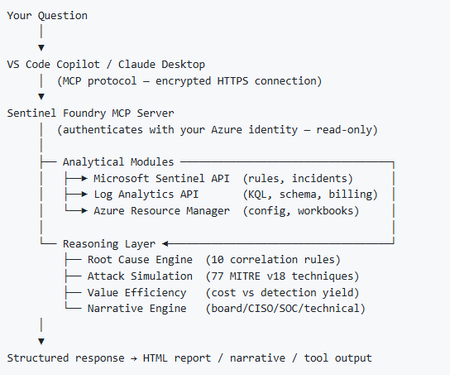
I’ve been cooking something that a lot of people in SOC have been struggling with — especially on the engineering side of Microsoft Sentinel. Thanks to the Microsoft Security team for shaping the capabilities of Sentinel even better with Sentinel Data Lake & Modern SecOps. Today’s the day I can finally share it. Note: This is not an official Microsoft product, but it is designed to make the Sentinel Build even better (complement) with much more intelligence. 🚀 Sentinel Foundry is now in public preview with 43 tools. (Sentinel Foundry - MCP Server) It’s an MCP server built to act like the brain of a strong Sentinel engineer — helping make building, improving, and operating Sentinel far more practical, faster, and honestly more enjoyable. For a lot of teams, the challenge is not understanding what Sentinel can do. The hard part is the engineering work around it: -> Deciding what data should actually be ingested -> Building a clean, scalable Sentinel foundation -> Writing useful detections instead of noisy ones -> Balancing security value with cost -> Turning ideas into deployable engineering outputs That is exactly why I built Sentinel Foundry to help communities grow stronger. It helps with the real engineering tasks behind Sentinel — from architecture thinking to detection design, deployment planning, ingestion strategy, automation ideas, and many of the workflows outlined in the GitHub project. How does it work? Here’s one of the flagship prompts I ran with it: “Give me a complete security posture report for our workspace. Score each pillar and tell me what to prioritise.” And within seconds, it produced a structured engineering blueprint that would normally take a lot longer to pull together manually. You can see the example prompts here in what it can do: https://github.com/prabhukiranveesam/Sentinel-Foundry#what-can-it-do I want building Sentinel to feel less like repetitive engineering overhead — and more like real security engineering that is fast, creative, and enjoyable. If you work with Sentinel as a SOC L2 analyst, engineer, detection engineer, consultant, or architect, I’d genuinely love for you to try it and tell me what you think. 🔗 Public Preview: https://github.com/prabhukiranveesam/Sentinel-Foundry This is just the start of an AI era — and I’m excited to keep shaping it with more powerful features over the coming days. This is very easy to set up and will be available to all of you at no cost during this month as part of the public preview, and your feedback is extremely valuable to shape this as a powerful solution.1KViews0likes2CommentsSentinel - Defender XDR KQL Queries Library
Hello all, I’ve been building something over the past few weeks that I think the security community might find useful. https://goxdr.fyi is a searchable KQL query library for Microsoft Sentinel and Defender XDR. The name comes from a nickname my colleagues gave me (GoX) combined with XDR. I also picked up https://goxdr.fyi as a short and easy to remember domain for it. You can check it out here: https://goxdr.fyi The idea came from my own day to day work as someone working in IAM and SOC operations. I constantly find myself writing and refining KQL queries for threat hunting, detection engineering and incident investigation. Over time I realized I had a growing collection of queries that I kept going back to and I thought why not make these available to others? It currently has 117 queries covering identity security, BEC/AiTM detection, NTLM and LDAP attack hunting, OAuth governance, AI/Copilot security, Sentinel alert trending, SOC performance metrics and more. Some of these queries are ones I wrote from scratch based on real scenarios I encountered in production environments. Others are community queries I tested and validated in my own setup. Only the ones I found genuinely useful and that actually worked against real data made it in. Each query comes with a description explaining what it detects and why it matters, along with severity levels, platform tags (Sentinel, XDR or both) and a copy button so you can paste it directly into Advanced Hunting or use it as the basis for an Analytics Rule. The site is open source, hosted on GitHub Pages and licensed under CC BY 4.0. No sign-up, no paywall, no tracking. The source is available. I’ll keep adding queries as new scenarios come up. If there’s enough interest I’m also considering adding Cortex XQL queries for Palo Alto environments. Suggestions, feedback or ideas for new detections are always welcome. Feel free to reach out. Thanks198Views0likes0Comments
XdrLogRaider Defender XDR portal telemetry
A Microsoft Sentinel custom data connector that ingests Microsoft Defender XDR portal-only telemetry — configuration, compliance, drift, exposure, governance — that public Microsoft APIs (Graph Security, Microsoft 365 Defender, MDE) don't expose. https://github.com/akefallonitis/xdrlograider— Defender XDR portal telemetry Happy Hunting 🥳 🎉337Views0likes2Comments
Sentinel Data Connector: Google Workspace (G Suite) (using Azure Functions)
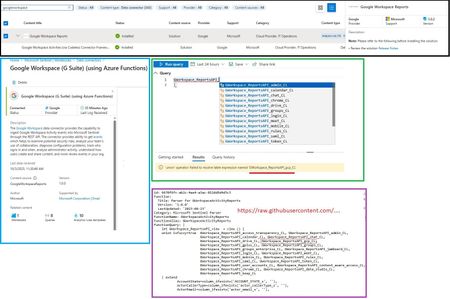
I'm encountering a problem when attempting to run the GWorkspace_Report workbook in Azure Sentinel. The query is throwing this error related to the union operator: 'union' operator: Failed to resolve table expression named 'GWorkspace_ReportsAPI_gcp_CL' I've double-checked, and the GoogleWorkspaceReports connector is installed and updated to version 3.0.2. Has anyone seen this or know what might be causing the table GWorkspace_ReportsAPI_gcp_CL to be unresolved? Thanks!502Views1like2CommentsSecurityIncident access from Sentinel tenants
Hello, My company's business model follows the Sentinel MSP with visibility to Customer Sentinel via Lighthouse. All the incidents from across the Customer Sentinels are located on the Sentinel MSP (since the detection rules reside on the Sentinel MSP). Although it might not be the usual MSP model (hosting incidents in the MSP Sentinel), we want to provide visibility to our Customers regarding their Incidents (with all updates) in a dashboard. Is there a possibility we can have a solution for this?Solved432Views0likes5Comments
Sentinel Data Connector for Azure Virtual Desktop
Hello, I have a customer planning to deploy Azure Virtual Desktop (AVD). They are currently using Microsoft Sentinel for their SecOps. However, there is no AVD Data Connector available. The customer is not interested in building a custom data connector. Does anyone know if there are plans to add a data connector for AVD in the near future? Thanks.272Views0likes1Comment
Workbook with multiple visualizations using lowest number of queries
Coming from Splunk world and didn't found answer to this in the workbook documentation. Is it possible to chains searches, like in Splunk, explained here: https://docs.splunk.com/Documentation/Splunk/9.3.1/DashStudio/dsChain Trying to explain in KQL terms: suppose there are 3 very similar queries, like same base search | condition 1 same base search | condition 2 same base search | condition 3 feeding 3 vizualizations. Goal is to execute the "same base search" part only once in the workbook. Defining a new function for "same base search" still means 3 executions, I guess. Your response is appreciated. Thank you.282Views0likes1Comment
Cross-workspace incident management
Hello Techcommunity, We are looking for a solution to manage incidents in several Sentinel workspaces within the same tenant. 1. We reviewed Azure Lighthouse and it seems to be working only for cross-tenant management 2. We saw the option to mark the workspaces we want to monitor and click on "View incidents" 3. We also considered building the dashboard in a Workbook Could you please say if there is any other option to have a unified dashboard for managing incidents from several Sentinels within the same tenant?310Views0likes0Comments
KQL extend command does not seems to work in workbook
Hi all, I have an issue with the extend command in a custom workboook. The following KQL query parses Palo Alto Logs and to extract specific field (like PanOSSourceUserName, etc) and creating new column (same name). CommonSecurityLog | where DeviceProduct == "PAN-OS" | where DeviceEventClassID == "GLOBALPROTECT" | extend PanOSSourceUserName=extract("PanOSSourceUserName=([A-Z,a-z.]+@+[A-Z,a-z.]+)",0,AdditionalExtensions) | extend PanOSSourceRegion=extract("PanOSSourceRegion=([A-Z,a-z.]+)",0,AdditionalExtensions) | extend PanOSPublicIPv4=extract("PanOSPublicIPv4=([0-9.]+)",0,AdditionalExtensions) | project-away ExtID, LogSeverity, Activity When I run this KQL query again the log (Sentinel Dashboard-> General -> Logs), I got the expected result. If I edit a Workbook (then Add query), and run the same KQL query, the new column (like PanOSSourceUserName, etc) are not created ! Is it normal ?? Any idea ? Regards, HASolved826Views0likes2Comments