cybersecurity
35 TopicsUnderstanding Compliance Between Commercial, Government, DoD & Secret Offerings - May 2026 Update
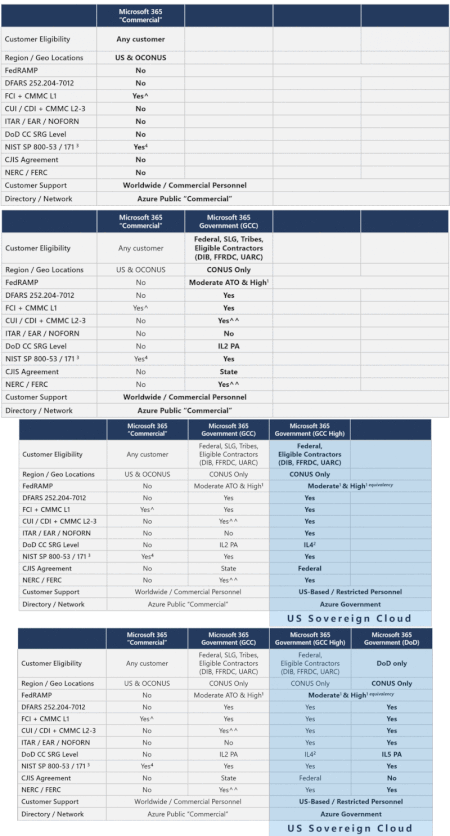
Understanding compliance between Commercial, Government, DoD & Secret Offerings: There remains much confusion as to what service supports what standards best. If you have CMMC, DFARS, ITAR, FedRAMP, CJIS, IRS and other regulatory requirements and you are trying to understand what service is the best fit for your organization then you should read this article.79KViews5likes8CommentsFrom Fragmentation to Resilience: Why Next Gen “Whole of State” Is Future of Pub Sec Cybersecurity
Each year at the Billington State and Local Cybersecurity Summit, one message comes through clearly: the cyber threat landscape facing state and local governments is accelerating faster than traditional models of defense can keep up. Cyber risk is no longer confined to a single agency, system, or jurisdiction. It spans emergency management, education, healthcare, critical infrastructure, and the workforce itself. At the same time, public sector leaders are being asked to modernize services, adopt AI responsibly, and do more with constrained resources. These pressures are not isolated—and neither can the response be. That is why Microsoft is focused on a Next Gen Whole of State approach: a state-wide, coordinated model that brings together cyber defense, risk management, and workforce development into a unified strategy—designed for scale, resilience, and trust. Why “Whole of State” Matters Now Many states have invested significantly in cybersecurity over the past decade. Yet most efforts remain fragmented—with agencies operating independently, duplicating tools, and competing for scarce talent. Internal Microsoft analysis and field experience show that this model creates three persistent challenges: Limited visibility across agencies and jurisdictions Inconsistent security posture and response capability Ongoing workforce shortages that slow modernization efforts A Next Gen Whole of State program is designed to address these challenges holistically. It is a state-wide shared services model that improves efficiency, strengthens critical infrastructure defense, and accelerates AI and cyber talent development—while respecting the autonomy of individual agencies. This is not about centralizing control. It is about coordinating outcomes. Cybersecurity as Critical Infrastructure At Billington, state and local leaders consistently emphasize that cybersecurity must be treated as critical infrastructure protection, not simply an IT function. Next Gen Whole of State reflects that reality by enabling: Shared cyber services across agencies and local governments Proactive identification of vulnerabilities and “slow-burn” risks Streamlined collaboration during incident response and emergencies By aligning technology platforms, processes, and partners, states can move toward a more collective defense posture—reducing duplication while improving resilience across the entire ecosystem. This approach supports more consistent policy enforcement, better situational awareness, and more efficient use of limited funding—priorities that resonate strongly across the state and local community. Workforce Development Is a Security Imperative Another theme that consistently surfaces at Billington is the workforce challenge. Technology alone does not secure a state. People do. Next Gen Whole of State explicitly integrates workforce and economic development into the security strategy. Through hands-on skilling, apprenticeships, and industry-recognized certifications, states can help build sustainable pipelines of AI and cyber talent using real-world platforms and tools. This model supports: Career-ready training aligned to actual state and local needs Opportunities for students, veterans, and career changers Long-term reduction in dependency on external resources By investing locally, states strengthen both their security posture and their communities—an outcome public sector leaders increasingly view as inseparable. Microsoft’s Role: Thought Leadership at Scale Microsoft’s contribution to Next Gen Whole of State is grounded in three principles reflected across our public sector work: Unified platforms that span identity, security, compliance, and AI Cross-sector collaboration, connecting government, education, and partners Responsible innovation, aligned with Zero Trust and secure-by-design practices This enables states to move beyond isolated pilots toward enduring, state-wide programs—while positioning themselves to adapt as threats and technologies evolve. Importantly, Whole of State also creates a framework for consistent executive engagement, allowing leaders to align strategy, funding, and outcomes around a shared vision. Looking Ahead The conversations happening at Billington reflect a broader shift underway across the public sector. States that lead in the next decade will be those that: Treat cybersecurity as a shared responsibility Align technology, policy, and workforce strategy Build trust through resilience, transparency, and scale Next Gen Whole of State is not a single product or program. It is a strategic approach to how states protect critical infrastructure, modernize services, and prepare their workforce for an AI-driven future. And it is increasingly clear that this approach is no longer optional—it is foundational. Join the Conversation Microsoft continues to work with state and local leaders, educators, and partners to advance Next Gen Whole of State initiatives across the country. To learn more or engage with the Microsoft Security community, visit the Microsoft Tech Community and continue the conversation.201Views1like0CommentsA CISO's Guide to Securing AI - Securing AI for Federal, DIB, and DoW Entities
Artificial Intelligence (AI) is rapidly reshaping federal missions, defense operations, and critical infrastructure. From intelligence analysis to logistics and cyber defense, AI’s transformative power is undeniable. Yet, with great power comes great responsibility and risk.1.2KViews0likes0CommentsJoin Microsoft at IACP 2025: Empower public safety operations with trusted AI
The International Association of Chiefs of Police (IACP) Annual Conference and Exposition is the premier global event for law enforcement leaders, bringing together more than 16,000 public safety professionals. This year, IACP 2025 takes place October 18–22 at the Colorado Convention Center in Denver, and Microsoft is proud to be part of the conversation. As your trusted partner in public safety innovation, we invite you to connect with us at booth #362 to discover how Microsoft and our ecosystem of partners are helping agencies modernize operations, improve decision-making, and build safer communities through trusted AI. Microsoft’s presence at IACP 2025 centers around three key pillars that reflect the evolving needs of law enforcement and public safety agencies: Empower the government workforce Streamline workflows with secure AI copilots, enhance collaboration across departments, and boost efficiency with intuitive digital tools. Enable AI-driven decision making Accelerate officer workflows with real-time insights and unify data to support faster, more informed decisions. Transform emergency response Modernize communications, integrate systems for real-time situational awareness, and automate operations to improve coordination and outcomes. Experience Innovation Firsthand At booth #362, attendees can explore hands-on demos of Microsoft solutions including Microsoft 365 Copilot, Researcher and Analyst agents, and Copilot Studio agents tailored for first responders. These tools are designed to help agencies work smarter, respond faster, and serve communities more effectively. You’ll also have the opportunity to connect with our partners, Altia, DisasterTech, Insight, Pimloc, Remark, Revelen.AI, Triangula, and Zencos who are showcasing their solutions that support officer workflows, evidence management, reporting, and analytics. Don’t miss the Emergency Response Platform vehicle demo, supported by Darley, Dejero, and 3AM which highlights how AI and real-time data can transform field operations and emergency response at the tactical edge. Attend Our Thought Leadership Session Join us for a featured education session in the Leadership Track: Is "Technology Sharing" the Key to Law Enforcement Innovation? 📅 Saturday, October 18 🕤 9:30 – 10:30 AM MT 📍 Room 505/506 This session explores how collaborative platforms and shared technology models can reduce costs, accelerate deployment, and improve outcomes across jurisdictions, offering a blueprint for scalable innovation. Let’s Connect We’d love to meet with you one-on-one to discuss your agency’s goals and challenges. Request a meeting with a Microsoft expert to explore how AI and cloud technologies can support your mission. Visit Microsoft at booth #362 to explore AI-powered public safety solutions and skilling opportunities. Together, we can build safer, more resilient communities through innovation.213Views0likes0CommentsDIB Embraces Cloud PCs: Streamlined Compliance, Risk Mitigation, and Cost Savings
Aerospace and Defense Distributor Embraces Cloud PCs: Streamlined Compliance, Risk Mitigation, and Cost Savings Jaco Aerospace holds a pivotal role in the aerospace and defense industry. As a distributor, they serve a remarkably diverse clientele, including the Defense Industrial Base, airlines, Maintenance, Repair, and Overhaul (MRO) operations, general aviation, space exploration, rocketry, satellites, supersonic aircraft, lunar landers, Air-Taxi initiatives, and Defense Technology companies. This diversity brings heightened responsibilities, especially in meeting stringent compliance requirements. Beyond the standard distributor regulations, they have to adhere to rigorous standards such as the Federal Aviation Administration (FAA), the Department of Defense (DoD), AS9120, and the DoD’s Cybersecurity Maturity Model Certification (CMMC). For a detailed breakdown of these requirements, check out their whitepaper here. Early Adoption of Cloud PCs Jaco Aerospace was an early adopter of cloud technology, transitioning their operations to Cloud PCs in February 2022. They recognized the transformative potential of cloud computing for IT infrastructure and firmly believe traditional PCs will soon become a thing of the past. By integrating Cloud PCs, they enhanced their AS9120-certified quality system, prioritizing risk reduction. The decision to migrate to the cloud in a post-COVID-19 world has unlocked numerous benefits, including: Enhanced Compliance Their operating environment meets the requirements of CMMC Level 1 (self-attestation). The straightforward in-house implementation enabled them to achieve and maintain compliance with ease. Robust Cybersecurity Cloud PCs help mitigate cybersecurity risks by enabling granular control over user permissions through conditional access policies. For example, they restrict most users' access to Microsoft apps on mobile devices, ensuring sensitive data remains secure. Consistent User Experience With Cloud PCs, they deliver a uniform user experience across the organization, improving productivity and streamlining workflows for all team members. Cost Savings The reduced need for IT-related user interactions and minimal hardware changes translate to significant cost savings in both the short and long term. Increased Connectivity Employees benefit from breakneck internet speeds when connecting to Cloud PCs, ensuring smooth and uninterrupted workflows. Furthermore, as they use Microsoft Teams for all phone communication, this speed results in high-quality calls not always found in their legacy VOIP solutions. Scalable Resources Cloud PCs allow them to dynamically scale memory and RAM based on individual user requirements, providing flexibility and operational efficiency. Simplified Scalability for Growth As their business grows, onboarding new employees is seamless. In rare employee departures, they can quickly offboard them and repurpose their equipment, ensuring a smooth transition. Risk Mitigation in Action The benefits of risk mitigation are often challenging to quantify, but recent events provided a clear example of its value. Their Valencia headquarters was in an evacuation zone during the Southern California wildfires. Thanks to their cloud infrastructure, employees swiftly transitioned to working from home by taking their thin client devices. Jaco Aerospace was required to maintain uninterrupted operations as a critical part of the Defense Industrial Base during COVID-19. At that time, the absence of a cloud-based system posed significant IT challenges. In contrast, during the wildfire evacuation, their team experienced just a one-hour disruption before resuming full operations—a stark difference that underscores the agility enabled by Cloud PCs. Looking Ahead At Jaco Aerospace, they see Cloud PCs (Windows 365) as a cornerstone of their future, enabling them to stay agile, secure, and ready to tackle any challenges that come their way. Whether it’s meeting stringent compliance requirements or ensuring seamless business continuity during unexpected events, their transition to the cloud has proven to be an invaluable asset. With the upcoming release of Microsoft’s Windows 365 Link, companies shifting to a Cloud PC environment will benefit from its affordability and the streamlined process of embracing this forward-looking technology. As the industry evolves, they remain dedicated to adopting innovative solutions that enhance operational efficiency and deliver unparalleled value to their customers.449Views2likes0Comments