cvm
30 TopicsAdvancing confidential computing with Intel TDX: more performance, more resiliency
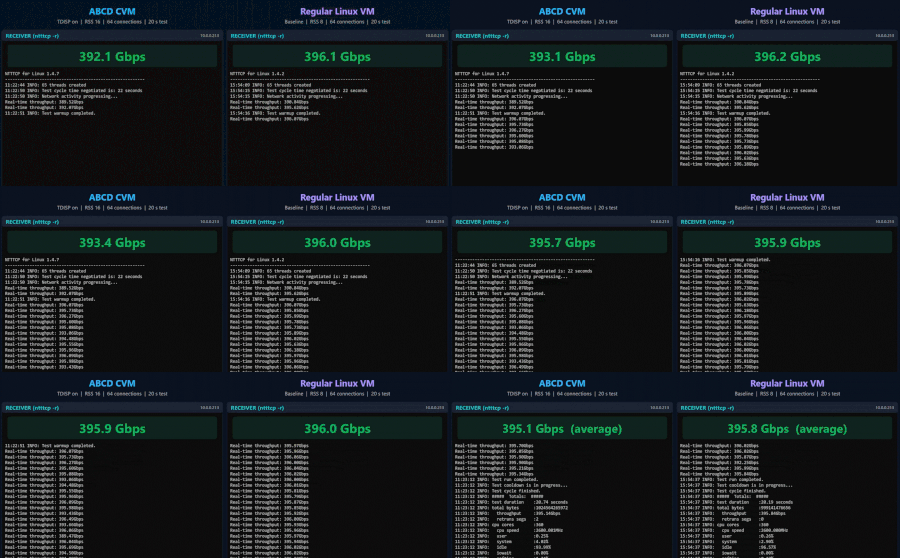
Today at Ignite, we presented an industry-first demonstration of TEE Device Interface Security Protocol (TDISP) with Azure Boost, showcasing up to 400 Gbps of network bandwidth. We also released improvements across our Intel-based portfolio to help enterprises strengthen workload resiliency and improve total cost of ownership for mission-critical workloads.Shrinking the trusted computing base for sensitive cloud workloads
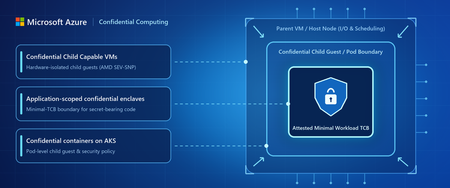
Azure confidential computing is investing across three connected layers to help shrink the workload trusted computing base (TCB): next-generation Confidential Child Capable VMs, confidential enclaves for application-scoped isolation, and support for these next-generation VMs in confidential containers on Azure Kubernetes Service (AKS).
Closing the Azure Confidential VM Performance Gap with Intel® TDX
The question every customer asks When organizations evaluate confidential computing, the conversation usually starts with security: how memory is protected, how attestation works, and who controls the root of trust. But it rarely ends there. The next question is almost always performance. Customers want to know what stronger confidentiality means for workload and application throughput, latency, and infrastructure efficiency. They want to understand whether protecting data in use creates a meaningful performance tradeoff and whether that tradeoff is changing over time. Recent Intel performance publications, together with internal Azure engineering data on local NVMe and Accelerated Networking, provide a more useful way to frame the discussion. Rather than asking for one universal “confidential computing overhead” number, we can examine how workload behavior and platform capabilities affect end-to-end performance on Confidential VMs with Intel TDX. How close is a Confidential VM with Intel TDX to a matched general-purpose VM? How do local NVMe and Accelerated Networking improve end-to-end I/O performance? Those questions are related, but they are not interchangeable. Keeping them separate is essential to interpreting the data correctly. The right comparison: confidential versus general purpose A same-generation comparison estimates the end-to-end performance difference associated with choosing the confidential VM configuration. The Intel data discussed below compares DCeds_v6 confidential VMs with Dds_v6 general-purpose VMs on the same 5th Generation Intel Xeon Scalable processor platform. This comparison is the appropriate basis for discussing the measured performance retained by the Confidential VM with Intel TDX in the tested workloads. The Azure confidential VM families in scope This post focuses on the Azure Intel TDX VM families used in the published performance comparison. The catalog context matters because processor generation, network and storage configuration, VM size, and workload placement all influence the measured result. Processor Generation Confidential VM series Largest General Purpose DC (Confidential) Largest memory optimized EC (Confidential) 5th Gen Intel ® Xeon Platinum 8573C (Emerald Rapids), TDX DCesv6 / DCedsv6, ECesv6 / ECedsv6 128 vCPU, 512 GiB 64 vCPU, 512 GiB Table 1. Confidential VM with Intel TDX series. Specifications from Microsoft Learn VM size documentation. The Intel picture: same-generation performance Intel’s published comparison uses Azure DCeds_v6 confidential VMs and Dds_v6 general-purpose VMs on 5th Generation Intel Xeon Scalable processors. The evaluation matched 16-vCPU, 64-GB configurations with local NVMe backing, Windows Server 2025 and Ubuntu 24.04, and three runs per test. The confidential VM retained 97% to 99% of general-purpose performance across the reported SPEC CPU 2017 rate-suite summaries. The NGINX-WordPress workload retained 97%, while PostgreSQL driven by HammerDB retained 86%. Figure 1. Relative performance of Azure DCeds_v6 confidential VMs compared with same-generation Dds_v6 general-purpose VMs on 5th Gen Intel Xeon Scalable processors. SPEC CPU 2017 results are geometric means; web and database results are throughput ratios. Source: Intel Corporation, document 926026, August 2026. Chart created from the reported benchmark results. The range reinforces why workload-level characterization matters. The reported CPU rate suites and web stack were close to the matched baseline, while the PostgreSQL-HammerDB workload showed a larger difference. The published chart establishes the measured difference, but customers should avoid treating one database result as representative of every transactional application or storage configuration. Intel plans to reevaluate PostgreSQL-HammerDB performance once Accelerated Networking through MANA is available for this Intel TDX configuration, enabling the workload to be assessed with the optimized network path. Optimizing I/O performance for Confidential VMs with Intel TDX The published Intel results establish a compute and multi-tier application performance baseline for the TDX configuration, but they do not capture the broader impact of platform co-optimization. Two capabilities available on the Intel confidential VM platform illustrate how coordinated hardware and software enablement can improve end-to-end workload performance: local NVMe for storage and Azure Accelerated Networking through Microsoft Azure Network Adapter (MANA) for networking, which is currently available in preview for the Confidential VM with Intel TDX configuration discussed in this post. Local NVMe: a shorter storage pathlength In the earlier virtualized-SCSI design, a request traverses the guest SCSI stack and VMBus into OpenHCL, where it is translated before reaching the underlying NVMe device. The local-NVMe path presents an NVMe interface to the guest through vPCI, removing the virtual-SCSI protocol conversion and VMBus transport from the I/O path. In the measured storage data, local NVMe delivered nearly 5 times the IOPs of the single-thread virtualized-SCSI baseline and reduced average I/O latency by approximately 16%. At higher concurrency, the same internal engineering data shows near-parity in local-NVMe performance between matched general-purpose and confidential VM configurations. At both 32 and 64 threads, the confidential VM delivers comparable IOPS and average I/O latency, demonstrating general-purpose-class local-NVMe performance for the tested workload. Figure 3. Local NVMe IOPS and average-latency comparison at 32 and 64 threads. Windows confidential VM and matched general-purpose VM, 8 KB random reads, queue depth 16. Source: Microsoft Azure internal engineering data. These results demonstrate how new platform capabilities enabled through hardware and software co-optimization can substantially improve confidential VM performance. With local NVMe, the tested confidential VM achieved throughput and average latency comparable to the matched general-purpose VM at 32 and 64 threads. Accelerated Networking: removing the synthetic throughput ceiling With the synthetic NIC path, packets traverse the guest-facing synthetic interface and host networking path. Accelerated Networking exposes a MANA SR-IOV virtual function to the guest, bypassing the host virtual switch for the fast datapath while network policy remains enforced in adapter hardware. The measured networking data shows a throughput benefit from MANA at low thread counts: approximately 3.20 times the synthetic-NIC throughput at one thread, 2.00 times at two threads, and 1.22 times at four threads. Average latency was approximately 24% lower than the synthetic path. Figure 4. Accelerated Networking throughput and average-latency improvement over the synthetic NIC. Source: Microsoft Azure internal engineering data. Note: Accelerate Networking with MANA for the Intel TDX configuration discussed here is currently in preview and is not yet generally available. At higher concurrency, MANA enables confidential VM network throughput to match the general-purpose baseline. In the 128 KB NTTTCP sweep at 32 threads, the confidential VM with MANA achieved 100% of the matched general-purpose VM’s throughput, compared with approximately 74.1% for the confidential VM using a synthetic NIC. In this tested configuration, Accelerated Networking increased throughput by 35% over the synthetic path and delivered throughput parity with the matched general-purpose VM. Figure 5. NTTTCP throughput at 32 threads with a 128 KB buffer: matched general-purpose MANA, confidential synthetic NIC, and confidential MANA configurations. Source: Microsoft Azure internal engineering data. Bandwidth parity does not mean every remaining performance difference has disappeared. The internal analysis shows a larger throughput gap at low thread counts, along with CPU-efficiency and latency differences even when throughput converges at higher concurrency. MANA restores bandwidth scalability, while efficiency and latency remain dependent on the workload and concurrency level. A broader definition of platform progress The evolution of confidential VM performance is not only a processor story. Processor capabilities establish the compute and memory baseline, while platform capabilities enabled through Intel and Azure hardware and software co-optimization improve overall performance, efficiency, and scalability. Local NVMe and Accelerated Networking illustrate this broader progress by reducing storage-path overhead and removing the synthetic-network throughput ceiling. Emerging platform innovations such as Azure Boost Confidential Device and standards-based technologies like TDISP further advance this model by offloading infrastructure functions and enabling more efficient, secure device interactions within confidential computing environments. Together, these advances preserve the confidential trust boundary while bringing more general-purpose-class performance capabilities into the Confidential VM with Intel TDX environment. The practical question is therefore not, “What is the confidential computing penalty?” It is, “How much performance does my workload retain on the current Confidential VM with Intel TDX configuration compared with the right baseline?” Answering that question requires workload-level measurement, a controlled baseline, and a clear separation between compute behavior, platform-capability gains, and confidentiality-specific cost. For customers evaluating Confidential VMs with Intel TDX, the data points to a clear approach: compare against a matched same-generation baseline, characterize the actual workload, and include the I/O capabilities that shape end-to-end performance. The result is a more accurate view of the security-performance tradeoff than any single universal overhead number can provide. Sources and further reading Azure confidential VM overview DCesv6 size series DCedsv6 size series Intel: Performance of Confidential VMs with Intel TDX on Microsoft Azure Azure Boost - Virtual Machines Intel AMD Performance | Microsoft Azure Azure Boost Confidential DeviceAdvancing Performance in AMD-Powered Azure Confidential VMs
Performance through the customer lens Security is the reason organizations turn to confidential computing. They need assurance that data remains protected while it is being processed, supported by attestation and a clearly defined root of trust. Once that foundation is understood, attention quickly shifts to a second consideration: how the protected environment performs. For customers, performance is not an abstract benchmark. It affects application throughput, response time, capacity planning, and ultimately the efficiency of the infrastructure they operate. The practical concern is whether stronger data-in-use protection changes those outcomes, and whether newer platforms are narrowing any difference. Performance data for Azure Confidential VMs powered by AMD EPYC TM processors helps answer that concern from two complementary angles. The useful story is not a single percentage labeled as confidential-computing overhead. It is how the platform has advanced across generations and how the current confidential offering performs against an appropriately matched general-purpose baseline. What does a customer gain by moving from the previous AMD confidential VM generation to the current one? Within the current processor generation, how much of the matched general-purpose VM performance does the confidential VM preserve? Each comparison answers a different customer question. Treating them separately prevents processor-generation improvements from being mistaken for the cost of confidentiality. Reading the data through two lenses Lens 1: progress across confidential VM generations The first lens tracks how the confidential platform itself has advanced. For AMD-powered Azure Confidential VMs, which use the SEV-SNP variant of AMD Secure Encrypted Virtualization (SEV, AMD's umbrella term for its VM memory encryption and isolation technology), it compares DCas_v6, based on 4th Generation AMD EPYC TM processors, with DCas_v5 from the prior processor generation, using independent results from Prowess Consulting. It also previews the next step, comparing DCas_v7 on 5th Generation AMD EPYC TM processors with DCas_v6, based on Microsoft internal testing ahead of the DCas_v7 preview. Because both sides of each comparison use confidential VMs, the result reflects the combined benefit of the newer processor and platform. It is a measure of generational progress, not an isolated measurement of confidentiality overhead. Lens 2: performance against a matched general-purpose VM The second lens holds the processor generation constant. Here, DCas_v6 confidential VMs are compared with Das_v6 general-purpose VMs on the same 4th Generation AMD EPYC TM platform. This is the relevant comparison for understanding how much performance the confidential configuration retained in the tested workloads. The result should not be extended to other processor generations, VM families, or benchmark methods. AMD-powered Azure VM families covered here The results in this post are tied to specific Azure VM families. That scope is important: processor generation, VM size, workload placement, and application behavior can all influence the outcome of a performance study. Processor generation Confidential VM series Largest general-purpose DC (confidential) Largest memory-optimized EC (confidential) 3rd Gen AMD EPYC TM 7763v (“Milan”), SEV-SNP DCasv5 / DCadsv5, ECasv5 / ECadsv5 96 vCPU, 384 GiB 96 vCPU, 672 GiB 4th Gen AMD EPYC TM 9004 (“Genoa”), SEV-SNP DCasv6 / DCadsv6, ECasv6 / ECadsv6 96 vCPU, 384 GiB 96 vCPU, 672 GiB 5 th Gen AMD EPYC TM 9005 (“Turin”), SEV-SNP DCasv7 / DCadsv7, ECasv7 / ECadsv7 (gated preview) 160 vCPU, 640 GiB 160 vCPU, 1020 GiB Table 1. AMD confidential VM series by processor generation. Specifications from Microsoft Learn VM size documentation. Note: 5 th Gen AMD EPYC TM 9005 (Turin), SEV-SNP based VMs discussed here is currently in preview and is not yet generally available. What changed across AMD confidential VM generations DCas_v5 to DCas_v6: independent results In October 2025, Prowess Consulting published Microsoft-commissioned research comparing DCas_v6 confidential VMs on 4th Generation AMD EPYC TM processors with DCas_v5 confidential VMs on the preceding generation. At the benchmark-family level, DCas_v6 delivered 77% higher memory bandwidth in AMD STREAM, 34% higher Redis throughput, and 30% higher SPEC CPU 2017 performance. Figure 1. Generation-over-generation performance of Azure confidential VMs with SEV-SNP enabled: DCas_v6 on 4th Gen AMD EPYC TM processors versus DCas_v5 on 3rd Gen AMD EPYC TM processors. Results show the geometric mean for each benchmark. Source: Prowess Consulting, Performance and Cost Advantages When Running Latest-Generation VMs, commissioned by Microsoft, October 2025. Viewed together, these results show broad platform advancement rather than an isolated gain in one test. Organizations moving to the newer AMD confidential VM generation can benefit from stronger performance across compute, memory, and data-service workloads while continuing to use SEV-SNP-based isolation. Preview: DCas_v6 to DCas_v7 DCas_v7 confidential VMs, built on 5th Generation AMD EPYC TM Turin processors, are being introduced in preview at Microsoft Ignite 2026. To give an early view of what the next generation brings, Microsoft measured DCas_v7 against DCas_v6 at the same vCPU count, with AMD SEV-SNP enabled on both sides. The tests covered Linux and Windows guests at 8 and 32 vCPUs across CPU, cryptography, and web-application workloads. Across all 22 throughput and score results, DCas_v7 delivered between 12% and 56% higher performance than DCas_v6. Cryptographic hashing showed the largest gains, with SHA-512 throughput up 42% to 56%, while CoreMark and Geekbench 6 multi-core scores rose 27% to 43%. ASP.NET requests per second increased 43% on Linux and 24% on Windows, and SPECrate 2017 integer performance improved 16% to 18% across both operating systems and VM sizes. Figure 2. Preview of generation-over-generation performance of Azure confidential VMs with SEV-SNP enabled: DCas_v7 on 5th Gen AMD EPYC TM processors versus DCas_v6 on 4th Gen AMD EPYC TM processors at equal vCPU count, for Linux and Windows guests. Results show throughput and score metrics, where higher is better. Source: Microsoft internal testing, October 2026. Preview results; final results may vary. As with the move from DCas_v5 to DCas_v6, the gains span compute, cryptography, and application workloads rather than a single test. These are preview measurements from Microsoft internal testing rather than an independent study, and they cover a defined set of VM sizes and benchmarks. Customers evaluating DCas_v7 during the preview should validate their own workloads before drawing capacity or sizing conclusions. How much performance is retained on DCas_v6? Prowess also evaluated DCas_v6 confidential VMs against Das_v6 general-purpose VMs on the same 4th Generation AMD EPYC TM platform. The confidential configuration delivered 98% of the general-purpose result for AMD STREAM and 92% for both Redis and SPEC CPU 2017. Stated as measured differences, the gaps were 2% for the memory-bandwidth benchmark and 8% for the Redis and CPU benchmark families. Figure 3. Relative performance of Azure confidential VMs (DCas_v6) compared with same-generation general-purpose VMs (Das_v6) on 4th Gen AMD EPYC TM processors, and the resulting overhead. Results show the geometric mean for each benchmark. Source: Prowess Consulting, Performance and Cost Advantages When Running Latest-Generation VMs, commissioned by Microsoft, October 2025. These percentages describe the VM configurations and benchmarks included in the study, not a universal overhead for every confidential workload. Application design, VM size, operating system, and workload behavior can change the result. Within the evaluated set, the confidential VM preserved between 92% and 98% of the matched general-purpose VM performance. What the results mean for platform decisions AMD confidential VM progress comes from more than a faster processor. Processor improvements raise the compute and memory baseline, while continued evolution in platform architecture, virtualization, and cloud infrastructure shapes the end-to-end experience. The results capture both effects: substantial improvement over the prior confidential generation, continued gains in the DCas_v7 preview, and strong performance retention relative to a same-generation general-purpose VM. This changes the most useful question for customers. Instead of asking for one universal "confidential computing penalty," ask how the intended workload performs on the current confidential VM against the correct baseline. A defensible answer requires controlled testing at the workload level and a clear distinction between gains from a new generation and differences associated with the confidential configuration. For AMD-powered Azure Confidential VMs, the data supports three conclusions. First, moving to a newer confidential VM generation can provide meaningful gains over the previous platform, as the Prowess results for DCas_v6 show. Second, early internal results indicate that this progress continues with DCas_v7, which delivered 12% to 56% higher throughput than DCas_v6 in preview testing. Third, the tested DCas_v6 workloads retained a high share of performance when compared with matched Das_v6 general-purpose VMs. Considering those findings together gives customers a clearer basis for evaluating platform progress than a single generalized overhead figure. Sources and further reading Azure confidential VM overview DCasv6 size series Prowess Consulting: Performance and Cost Advantages When Running Latest-Generation VMs Azure Boost - Virtual Machines Intel AMD Performance | Microsoft Azure Azure Boost Confidential DeviceAnnouncing gated preview of next-gen Azure confidential VMs with 5th Generation AMD EPYC™ processor
Today, we’re announcing the gated preview of Azure’s next generation v7 confidential virtual machines (CVMs), powered by 5 th Generation AMD EPYC™ (“Turin”) processor with Secure Encrypted Virtualization (SEV). The gated preview includes six new VM series spanning general-purpose and memory-optimized configurations, with options both with and without local disks. These CVMs are designed for organizations running data-sensitive, regulatory and digital sovereignty workloads. The AMD EPYC “Turin” processor’s Zen 5 cores provide higher memory bandwidth and improved instructions per clock compared with the previous generation, supporting compute-intensive work such as AI and machine learning, scientific simulations, and financial analytics. AMD EPYC “Turin” CVMs introduce Secure AVIC (Advanced Virtual Interrupt Controller) which helps in securing interrupt injection from a malicious hypervisor and better performance for APIC (Advanced Programmable Interrupt Controller) accesses in SEV with Secure Nested Paging (SNP) guests. The new CVMs incorporate the latest Azure Boost technology for improved performance and security, use the Microsoft Azure Network Adapter (MANA) for next-generation network interface that provides stable, forward-compatible drivers on Windows and Linux with accelerated networking, and support the NVMe protocol for both local and remote disks. DCasv7 DCadsv7 DCalsv7 DCaldsv7 ECasv7 ECadsv7 vCPU 2-160 2-160 2-160 2-160 2-160 2-160 Memory 8-640 8-640 4-320 4-320 16-1020 16-1020 Memory to vCPU ratio 4:1 4:1 2:1 2:1 8:1 8:1 Note: Memory to vCPU ratio varies for 160-vCPU EC-series VM. Windows Server 2025 Datacenter (G2), 2025 Datacenter G2 Azure, Windows Server 2025 Azure Edition, Windows Server 2025 Azure Edition Core, Windows Server 2025 Server Core (Core G2), Ubuntu 22.04 LTS and Ubuntu 24.04 LTS are supported guest operating systems with more OS support planned in phases. Performance improvements for demanding workloads Compared with equivalent-sized, previous-generation confidential VMs: Up to 45% higher memory bandwidth and 64% lower memory latency under load at 8 vCPU, and 43% higher bandwidth with 71% lower latency under load at 32 vCPU on Windows CVM. Up to 43% higher CPU benchmark performance, measured with CoreMark on an 8-vCPU Windows VM. Up to 42% higher Java benchmark throughput, measured with SPECjbb critical-IOPS on an 8-vCPU Windows VM. Up to 56% higher SHA-512 hashing throughput, measured with OpenSSL on an 8-vCPU Linux VM. Up to 43% more web requests per second and 47.2% lower average response latency, measured with ASP.NET Core on a 32-vCPU Linux VM. Note: These are preliminary performance data and may vary depending on VM configuration and workload parameters. In partnership with AMD “AMD and Microsoft have worked together for years to advance confidential computing in Azure, and this next generation represents another important step forward. By combining 5th Gen AMD EPYC processors with AMD Secure Encrypted Virtualization and Azure’s latest infrastructure innovation, we’re delivering the security, performance, and scale customers need for their most sensitive workloads.” Steve Berg, Corporate Vice President & General Manager, Cloud Business Group, AMD Early customer feedback “Azure customers don’t have to wait to put the latest confidential computing hardware to work. Anjuna Seaglass now runs on Azure’s new v7 confidential VMs, powered by 5th Gen AMD EPYC processors with AMD SEV-SNP, so teams can protect their workloads on the newest infrastructure from day one. Through our early access partnership with Microsoft, we’ve already validated the security and performance of Seaglass on AMD processors, giving Azure customers the confidence to adopt it immediately.” Ofir Azoulay-Rozanes, Director of Product Management, Anjuna Security "Early access to Microsoft’s latest Turin v7 Confidential VMs enables us to offer customers accelerated computing performance, enhanced security, and greater efficiency. With EscrowAI, customers can seamlessly leverage these next-generation Confidential VMs without modifying their existing algorithms. This allows them to benefit from the latest advancements in confidential computing while EscrowAI handles the underlying infrastructure complexity." Sudish Mogli, VP of Engineering, BeeKeeper AI Get started with the gated preview The gated preview is available in South Central US and UK South, with Central US availability planned for December 2026. To request access, please fill out the gated preview sign-up form.Confidential AI at rack scale: Introducing Azure’s Vera Rubin NVL72 technology preview
Microsoft is excited to announce a technology preview of Azure Confidential Computing on NVIDIA Vera Rubin NVL72, advancing our joint engineering work with NVIDIA toward future confidential AI offerings. We are starting with Confidential Bare Metal Instances (C-BMI), a first step that brings together customer control of the software stack and hardware-rooted protection for AI data and models while they are in use. AI becomes more valuable when it can work with information that is not on the public internet: a patient’s history, a bank’s proprietary risk model, a citizen’s case file, or the business context an AI agent carries across systems. Using that information should not mean surrendering control of it. In healthcare, private records can inform clinical workflows. In financial services, AI can detect financial-crime patterns while protecting customer data and proprietary models. Government assistants can help citizens navigate taxes and benefits using their own case context. Model developers need to safeguard weights and fine-tuning data as intellectual property. These uses call for protection on both sides of the interaction: the customer’s sensitive content and the model provider’s valuable assets. Protecting sensitive AI without giving up control Across these workloads, the challenge is not only where information is stored, but who can access it while AI uses it. Confidential computing adds hardware-backed protection for data and models during execution, reducing the trust customers must place in privileged infrastructure operators. Protection during execution complements policies such as zero data retention, which govern what a service keeps after processing. Attestation provides signed evidence of the execution environment’s identity and measured security state. Combined with policies that release keys only to approved configurations, it gives data and model owners greater control over where their assets become usable. With carefully designed application and access policies, model providers can also use these protections to isolate their own operators from customer workload data. That isolation requires an end-to-end design; confidential hardware alone does not exclude authorized applications or tenant administrators. For sovereign AI, these capabilities extend control beyond the location of a datacenter. Governments building national models or delivering public services need to determine who controls the keys, which environments may process sensitive information, and how those environments are verified. Confidential computing supports those requirements alongside residency, jurisdiction, and operational governance. NVIDIA accelerated computing is essential for AI workloads, and the protections offered by confidential computing need to extend across these processors and interconnects. That is the foundation of our work with NVIDIA on Vera Rubin NVL72 and NVIDIA Confidential Computing. A bare-metal foundation for rack-scale AI Large models distribute computation across accelerators, making the interconnect part of the security architecture. NVIDIA describes Vera Rubin NVL72 as a rack-scale confidential domain spanning 72 NVIDIA Rubin GPUs, 36 NVIDIA Vera CPUs, and their interconnects, including NVIDIA NVLink and NVLink-C2C. Hardware-rooted device attestation provides evidence about those components. This platform architecture is the foundation for our work; the product demonstration at Microsoft Ignite has a narrower, single-node scope. Confidential Bare Metal Instances (C-BMI) put the tenant’s host operating system, runtime and workload inside the trusted computing base (TCB), while placing the infrastructure operator outside that trust boundary. The tenant controls the software stack and must secure it accordingly. This differs from treating the host OS as untrusted: in this bare-metal model, the host kernel is part of what must be measured and trusted. The C-BMI architecture combines CPU and GPU memory protection with encrypted physical links, including C2C, PCIe IDE, and NVLink. A dynamic root of trust for measurement (DRTM) reduces the tenant host’s TCB by keeping UEFI outside it. The host OS and workload remain trusted, so platform evidence and tenant software measurements must be evaluated together. Figure 1 brings these trust boundaries and protected connections together. The tenant host is trusted; UEFI and the BMC sit outside its TCB. The demo uses local verification, not the remote service shown. From platform evidence to a 397-billion-parameter model The Ignite demonstration is designed around a single Vera Rubin NVL72 node with four Rubin GPUs. It begins by collecting CPU and GPU attestation evidence: a platform token carries platform firmware measurements, a tenant token carries host kernel measurements, and each of the four GPUs supplies firmware and configuration measurements. The signed evidence is rooted in a trusted NVIDIA root certificate. Together, these measurements describe the platform and tenant TCB underlying the AI workload, rather than merely reporting that a GPU is present. A minimal local verifier checks signatures, challenges, and the binding between the platform and tenant tokens. It compares GPU measurements with NVIDIA known-good values and confirms that all four GPUs are in Confidential Bare Metal mode. The workload sequence then loads a 397-billion-parameter model using vLLM with four-way tensor parallelism. One worker runs on each GPU. The planned flow checks that the model endpoint is healthy, shows the four workers and GPU memory usage, and submits an inference request that generates a response. The sequence links a measured confidential environment with a near-400-billion-parameter workload on four GPUs. One foundation, more ways to build Confidential BMI is the starting point for a broader deployment vision. Future work will enable Vera Rubin NVL72 support for confidential virtual machines, confidential containers through Azure Kubernetes Service (AKS) and Kata Containers with Confidential Containers (CoCo), and Microsoft Foundry. These are areas of development beyond the Confidential BMI technology preview, extending the design toward different levels of infrastructure control and application integration. Across these operating models, the goal is to preserve control of sensitive assets from encrypted storage through computation, combining a verifiable environment with the data owner’s key policies and governance. AI should be able to work with the information organizations most need to protect. Our work with NVIDIA on Vera Rubin NVL72 is a step toward that future. Learn more Learn more about Azure Confidential Computing and its approach to protecting data in use.Secure Sensitive AI on Azure Confidential Computing with NVIDIA and Protopia
Your most valuable AI use cases often involve your most sensitive information: customer records, claims, clinical notes, and transaction histories. Dedicated infrastructure can offer control, but it can also limit access to flexible cloud capacity. The opportunity is to expand where that work can run without treating data protection as an afterthought. For a team exploring claims review or clinical-note analysis, the question is not simply whether a model can run in the cloud. It is where sensitive information could be exposed along the journey from application to model and back. Enterprises want to run their highest-value inference on the same scalable cloud they already run everything else on. The catch is that the highest-value inference is usually the most sensitive: customer records, claims and underwriting packets, clinical notes, transaction histories. Data policy keeps that work off shared, multi-tenant capacity and pins it to dedicated, single-tenant deployments. That is the isolation tax: the most valuable, most token-heavy workloads are exactly the ones kept off the infrastructure built to run them, so dedicated capacity sits underused and costs more than it should. Microsoft Foundry already gives this work an enterprise platform: a model catalog that now includes NVIDIA Nemotron, managed and serverless endpoints, and the governance regulated industries require. What has been missing is a way to run sensitive agentic workflows on that shared capacity while reducing the risk of data exposure. The trust dilemma on public cloud Azure Confidential Computing (ACC) addresses a fundamental trust challenge for AI workloads in multi-tenant cloud environments: the model, infrastructure, and data may each be owned or controlled by different parties. Model owners need to protect proprietary weights and intellectual property, and data owners need safeguards for sensitive information throughout processing. ACC provides the trusted foundation for addressing these requirements by helping protect models and their execution from unauthorized host access while enabling additional safeguards across the inference data path. The reference architecture brings together Azure Confidential Computing with NVIDIA H100 GPU capabilities and Protopia AI’s Stained Glass Transform to provide layered protection for sensitive AI workloads running at Azure scale. Confidential Computing: securing the model with NVIDIA Confidential Computing is designed to protect data and AI models while they are in use inside the enclave. The NVIDIA Hopper architecture introduced GPU-based confidential computing, extending the hardware trusted execution environment from the CPU to the GPU so that model weights, activations, and execution state remain within an attested boundary and are designed to be inaccessible to the host operating system, hypervisor, and infrastructure operator. NVIDIA device attestation provides cryptographic evidence about the GPU’s identity and security state before keys are released. For a model owner, these controls are designed to restrict access to model IP while the model runs. Enterprises should not have to choose between protecting their models and running them where compute is available and most convenient. NVIDIA has designed Confidential Computing to keep a model’s weights and execution within the GPU’s trusted execution environment, helping proprietary models run on shared infrastructure while limiting access to their IP. Combined with Protopia’s inference data protection on Azure, customers have a path designed to support sensitive AI workloads in the cloud they already trust. Bring confidential inference to Azure Azure brings confidential inference to production scale, surrounding the confidential GPU with the platform an enterprise needs to operate AI. The Azure NCCads H100 v5 series combines 4th-generation AMD EPYC confidential VMs with NVIDIA H100 Tensor Core GPUs to support confidential AI workloads. The trusted execution environment spans the AMD SEV-SNP CPU and the attached H100 in confidential mode, isolating GPU memory and the channel between CPU and GPU. When enabled and properly configured, Confidential Computing is designed to help limit access to unencrypted customer data within that boundary, including the cloud operator. Azure provides tools to help verify and operate the boundary: Microsoft Azure Attestation (MAA) can assess the confidential VM, while Azure Key Vault Managed HSM can be configured to release decryption keys after successful attestation. "Azure was the first cloud to bring Confidential Computing to NVIDIA H100 GPUs, so customers can protect their data in use, even from the cloud operator, while getting the performance they need for AI. Paired with Protopia’s Stained Glass Transform, this reference architecture protects data across the full inference path, helping regulated organizations bring their most sensitive agentic workloads to Azure.“ - Vikas Bhatia, Head of Product, Azure Confidential Computing, Microsoft Protecting the inference data path Confidential execution does not, by itself, cover every component of a managed inference service. Gateways, logs, traces, caches, and scheduler metadata can sit outside the trusted execution environment. Protopia AI’s Stained Glass Transform (SGT) converts sensitive inputs into protected representations inside the data owner’s trust boundary. The architecture is designed for downstream components to receive those representations, not the original inputs. An SGT-enabled model reasons over them directly, without a host-side decoder. Security teams should inspect the serving layer to verify that this pattern is implemented as intended. This distinction matters when reviewing a service: an attested GPU does not establish how a gateway or cache handles requests. Start with a map of the data flow, then check the controls at each boundary. “Sensitive AI should not automatically mean having to operate every part of the infrastructure yourself. Applying Stained Glass Transform inside the data owner's trust boundary, or within confidential execution on Azure, offers a way to securely deploy to the cloud without exposing sensitive data to the model hosting environment (other tenants or operator), and retaining the data owner's control over their sensitive enterprise data.” - Eiman Ebrahimi, Co-Founder and CEO, Protopia AI From customer boundary to confidential inference At the data owner’s trust boundary, the Stained Glass Proxy, an OpenAI-compatible sidecar, applies the Stained Glass Transform to the prompt and its context, with no changes to the upstream stack. In transit to Azure, the architecture sends the protected representation beyond the customer’s trust boundary rather than the original plaintext input, reducing the likelihood that sensitive plaintext is captured in downstream logs, caches, or interception points. In-transit encryption is used as standard. On Azure NCCads H100 v5 confidential VMs, the request reaches an SGT-enabled model endpoint. Configure and verify confidential execution, attestation, and key-release policies for the chosen serving stack. Across the serving path, verify that components outside the execution boundary handle protected representations rather than original sensitive inputs, including logs, caches, and traces. On return, the client receives a result intended to be interpretable within the data owner’s environment. Expand your options for sensitive AI For enterprises, the value comes down to expanding where sensitive AI workloads can run while maintaining strong protections for models and data. Azure Confidential Computing provides a trusted foundation for running sensitive AI workloads on Azure, helping protect models and data while in use and enabling organizations to take advantage of Azure’s scalable GPU infrastructure. Depending on the workload and deployment configuration, this approach may provide greater infrastructure flexibility and utilization while helping organizations manage performance, model quality, and cost. Learn more Azure Confidential GPU OptionsAnnouncing general availability of Azure Intel® TDX confidential VMs
We’re excited to announce the general availability of Azure’s next generation of confidential virtual machines, powered by 5th Gen Intel® Xeon® processors with Intel® Trust Domain Extensions (Intel® TDX). These new confidential VMs make it easier than ever for organizations to move their most sensitive workloads to the cloud—without requiring any application code changes. Available today for production deployments across both general-purpose (DCesv6, DCedsv6) and memory-optimized (ECesv6, ECedsv6) VM series, this release delivers a powerful combination of performance, scalability, and hardware-enforced security, enabling customers to innovate with confidence on Azure. By combining hardware-enforced isolation, cryptographic attestation, and built-in support for Intel® Advanced Matrix Extensions (Intel® AMX), Intel® TDX confidential VMs allow Azure customers to accelerate confidential AI scenarios, protect models and weights, and even collaborate across organizations without exposing confidential data. For Azure customers, this generation of Intel-based confidential VMs provides additional assurance for one of the last major barriers to cloud adoption for sensitive and high-value workloads. It allows organizations to take advantage of Azure’s global scale, elasticity, and rich ecosystem while helping to prevent unauthorized access to data in-use, even from the cloud operator. By combining hardware-enforced isolation and cryptographic attestation, customers can deploy sensitive and/or regulated workloads, protect intellectual property, and run confidential AI pipelines with greater assurance and fewer architectural compromises. The result is faster cloud adoption, simpler compliance, and accelerated innovation —without sacrificing control or security. With Azure Intel® TDX confidential VMs, customers can: Protect data and models while in use with hardware-enforced isolation Achieve significantly lower latency and higher throughput with NVMe local storage Deploy existing applications without code changes Verify integrity and workload integrity through cryptographic attestation and open infrastructure components Run confidential AI workloads efficiently with Intel® AMX acceleration As a first for Azure’s confidential VM offerings, we are adding support for local NVMe SSDs for our DCedsv6-series and ECedsv6-series. These sizes are suited for storage workloads that need a balance of SSD capacity, compute, and memory. With NVMe we can achieve nearly 5× more throughput while reducing latency by about 16% compared to the previous SCSI generation. Overall, we see lower IO latency by ~27 microseconds across block size and thread count. This figure shows NVMe vs SCSI local disk performance ratio for IOPS to latency for random reads with 8K block size, queue depth of 1, and 1 thread. This figure shows NVMe vs SCSI local disk performance for random reads with 8K block size and queue depth of 8 across various thread counts. Additionally, these TDX confidential VMs are Azure confidential compute's first offering to utilize our open-source paravisor, OpenHCL. This innovation allows us to increase transparency and verifiability for our customers, reinforcing our commitment to the trust-but-verify principle for confidential computing. These VMs also support Azure Boost, enabling up to 205k IOPS and 4 GB/s throughput of remote storage along with 40 Gbps VM network bandwidth. Customers are excited to use TDX based Confidential VMs “At Bosch Trustworthy Collaboration Services, we’ve enrolled our collaboration platform on Azure’s latest Confidential VMs powered by Intel® 5th Generation Xeon® processors with TDX support. That means better transparency, stronger performance, and more robust verification: the foundation we need for cross-company teamwork. These improvements reinforce our capability to deliver best-in-class secure collaboration capabilities to our customers with our Trusted Collaboration Spaces.” - Dr. Sven Trieflinger, CTO Bosch Trustworthy Collaboration Services “Ensuring data security across its entire lifecycle has always been a key priority for me. Until recently, encryption for data-in-use was the missing link, preventing true end-to-end protection managed by the customer. Through collaboration with Microsoft and Intel®, we have established a comprehensive ecosystem, called End-to-End Data Encryption. This ecosystem seamlessly unites data protection at rest, in transit, and now in use, thanks to the integration of Intel® TDX technology. The root of trust remains Thales CipherTrust Data Security Platform, enabling us to manage and safeguard our data with confidence. Of course, leveraging that technology for our own use significantly strengthens our cyber defenses. I would like to thank Microsoft for bringing this innovation to fruition.” - Didier Espinet, Chief Information Security Officer for Thales Cyber & Digital Identity "In the public sector and other regulated industries, trust and fairness are paramount. By integrating Microsoft Azure confidential virtual machines with Intel® TDX and AMX technologies, Nuuday delivers a secure and compliant Confidential AI environment that upholds strict data sovereignty and privacy standards. These capabilities ensure sensitive information can be processed with verifiable confidentiality and integrity – while unlocking new opportunities for digital innovation." - John Henriksen, CEO, TDC Erhverv. “Arqit is delighted to partner with Microsoft and Intel® on the launch of Azure’s latest Intel® TDX-enabled Confidential VMs. Together we have demonstrated a combination of security-enhancing technologies to deliver provable protection of sensitive AI workloads processed across multi-region public cloud. This partnership underlines our shared commitment to giving customers full sovereign control over their data even outside of their own networks, in turn accelerating AI adoption and digital transformation.” - Jonathan Pope, VP Sales & Partnerships Offerings The DCesv6-series and DCedsv6-series VMs are designed to offer a balance of memory to vCPU ratio, with up to 128 vCPUs, and up to 512 GiB of memory. The ECesv6-series and ECedsv6-series VMs are designed to offer an even higher memory to vCPU ratio, with up to 64 vCPUs, and 512 GiB of memory. Availability The DCesv6, DCedsv6, ECesv6 and ECedsv6 VMs with Intel® TDX are now generally available in West US, West US 3, West Europe, East US and South Central US. Customers can access these VMs through Azure Portal, Azure CLI, or Azure Powershell. We support Windows Server 2025, Ubuntu 22.04, 24.04 and RedHat guest OS versions.3.6KViews6likes0CommentsPreview of multiparty analytics with Azure Confidential Clean Rooms
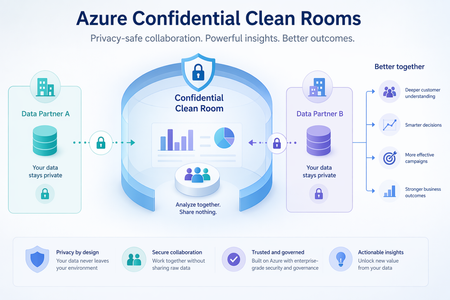
Today, we are excited to announce the preview of multiparty analytics feature of Azure Confidential Clean Rooms, a fully managed service that allows customers and their partners to securely analyze privacy-sensitive datasets from multiple parties. It uses confidential compute enabled Apache Spark-based big-data analytics (Spark SQL) which helps protect their raw data from other collaborators and from the Azure operator by performing computations in a Trusted Execution Environment (TEE). Privacy-sensitive datasets include personally identifiable information (PII), protected health information (PHI) and cryptographic secrets. Organizations across industries are increasingly looking to supplement their data with data from business partners, to build a complete view of their business. For example, brands, publishers, and their partners need to collaborate using datasets containing Intellectual Property (IP) to improve the relevance of their campaigns. Confidential data clean rooms help solve this challenge by enabling organizations to share and analyze granular datasets in a secure environment that helps prevent raw data exfiltration—protecting intellectual property, preserving customer privacy, and addressing concerns around regulatory compliance. You can sign up for the preview here Key Features Fully Managed: Azure takes care of the infrastructure provisioning and scaling with no user intervention. This significantly reduces your onboarding effort allowing you to focus on the queries and insights, not on infra management. Confidential Spark SQL: Spark SQL allows you to query large datasets and run complex queries in a distributed computing environment. In the confidential computing enabled version, the Spark driver and executors are fully attested policy-governed enclaves running as virtual nodes on confidential Azure Container Instances (ACI) which helps prevent exfiltration of collaborators’ data during query execution. Governance: Helps manage membership to cleanrooms, enables and verifies approval for queries from relevant collaborators before executing them and verifies consent to access sensitive collaborator data. It also helps generate tamper-resistant audit trails containing salient clean room events. This is made possible with the help of an implementation of the Confidential Consortium Framework (CCF). Telemetry: Throughout every clean-room run, detailed logs are streamed out in real time to monitor performance, troubleshoot issues, and keep the analytics healthy — all without ever exposing the collaborators’ data at any time. Verifiable trust: Cryptographic remote attestation viz. full attestation based on confidential hardware reports allows independent verification of the TEE along with along with all components that are part of it, without just trusting the cloud provider, before sensitive data and decryption keys are made available to the TEE Open-source containers: All Microsoft provided cleanroom containers and sidecars are open-sourced here and can be verified for provenance and integrity guarantees using GitHub artifact attestation Use Cases Multi-party confidential big-data analytics unlocks value in scenarios where data sensitivity, regulatory pressure, or competitive concerns previously blocked collaboration. These are some early scenarios that can benefit from this. Media & Advertising Collaboration of advertiser CRM data with publisher data for audience targeting and segment activation. Collaboration of audience data with measurement partners for measurement and attribution. Banking & Finance Collaboration between banks and insurance firms to upsell relevant products to existing bank customers without sharing raw data from either side Collaboration with retailers to generate customized offers for bank customers, without exposing either party’s underlying data. Government & Public Sector Secure collaboration of data across government departments to deliver better citizen welfare outcomes. Secure collaboration between government and private enterprises on shared-interest workloads such as traffic monitoring and weather systems. Healthcare Enable healthcare firms — including biopharma organizations — to combine their data with third-party institutions to accelerate clinical development, like identifying eligible participants for a clinical trial, without exposing underlying patient data. Combine patient datasets across hospitals to study disease patterns or outcomes without exposing sensitive protected health information. "A higher standard for protecting user privacy and trust, the phase-out of third-party cookies, and global regulations demand more sophisticated data collaboration tools to support advertising marketplaces. Azure Confidential Cleanrooms (ACCR) provides a secure, feature-rich, and flexible foundation to implement privacy-preserving functions and enable insights without sharing privacy-sensitive data outside of organization boundaries. Built on the Azure Confidential Compute (ACC) platform and offering cohesion with Azure's diverse set of services, ACCR offers the attestation, audit, fine-grained access control, and verifiable trust tools required for secure and privacy-safe data collaboration in today's world." — Andrei Mackenzie, Engineering Manager, Microsoft AI "Azure Confidential Clean Rooms enabled our team to evaluate how clean room capabilities can support secure, governed data collaboration at scale. Through the Proof-of-Concept (PoC), we explored how privacy-preserving workflows, trusted access controls, and scalable compute can create a stronger foundation for responsibly leveraging first-party data. This helps reduce operational friction while supporting business growth, improving customer engagement, and enabling more relevant customer experiences." — Nic Dregne, Director, Microsoft AdTech Engineering Beyond Spark SQL Realizing other multi-party scenarios like custom analytics, ML training and inferencing on Azure Confidential Clean Rooms is in our roadmap. If you have such a scenario to be realized, you can fill in and submit the preview signup form with the details of your scenario and we’ll get back to you. Learn More · Signup for the preview of Azure Confidential Clean Rooms for Analytics · Confidential Consortium Framework (CCF) · Virtual Nodes on Azure Container InstancesGA: DCasv6 and ECasv6 confidential VMs based on 4th Generation AMD EPYC™ processors
Today, Azure has expanded its confidential computing offerings with the general availability of the DCasv6 and ECasv6 confidential VMs. Regional availability June 03 2026: Australia Central, Australia Central 2, Australia Southeast, Austria East, Belgium Central, Brazil South, Brazil Southeast, Central India, Central US, Chile Central, Denmark East, East Asia, East US, East US 2, France Central, India South Central, Indonesia Central, Israel Central, Japan East, Japan West, Korea South, Malaysia West, Mexico Central, New Zealand North, North Central US, North Europe, Poland Central, South Africa West, South Central US, South India, Southeast Asia, Spain Central, Sweden Central, Sweden South, Switzerland West, Taiwan North, UAE Central, UK West, West US 2 April 13 2026: West Europe Jan 30 2026: Canada Central, Canada East, Norway East, Norway West, Italy North, Germany North, France South, Australia East, West US, West US 3, Germany West Central Sep 16 2025: Korea Central, South Africa North, Switzerland North, UAE North, UK South, West Central US These VMs are powered by 4th generation AMD EPYC™ processors and feature advanced Secure Encrypted Virtualization-Secure Nested Paging (SEV-SNP) technology. These confidential VMs offer: Hardware-rooted attestation Memory encryption in multi-tenant environments Enhanced data confidentiality Protection against cloud operators, administrators, and insider threats You can get started today by creating confidential VMs in the Azure portal as explained here. Highlights: 4th generation AMD EPYC processors with SEV-SNP 25% performance improvement over previous generation Ability to rotate keys online AES-256 memory encryption enabled by default Up to 96 vCPUs and 672 GiB RAM for demanding workloads Streamlined Security Organizations in certain regulated industries and sovereign customers migrating to Microsoft Azure need strict security and compliance across all layers of the stack. With Azure Confidential VMs, organizations can ensure the integrity of the boot sequence and the OS kernel while helping administrators safeguard sensitive data against advanced and persistent threats. The DCasv6 and ECasv6 family of confidential VMs support online key rotation to give organizations the ability to dynamically adapt their defenses to rapidly evolving threats. Additionally, these new VMs include AES-256 memory encryption as a default feature. Customers have the option to use Virtualization-Based Security (VBS) in Windows, which is currently in preview to protect private keys from exfiltration via the Guest OS or applications. With VBS enabled, keys are isolated within a secure process, allowing key operations to be carried out without exposing them outside this environment. Faster Performance In addition to the newly announced security upgrades, the new DCasv6 and ECasv6 family of confidential VMs have demonstrated up to 25% improvement in various benchmarks compared to our previous generation of confidential VMs powered by AMD. Organizations that need to run complex workflows like combining multiple private data sets to perform joint analysis, medical research or Confidential AI services can use these new VMs to accelerate their sensitive workload faster than ever before. "While we began our journey with v5 confidential VMs, now we’re seeing noticeable performance improvements with the new v6 confidential VMs based on 4th Gen AMD EPYC “Genoa” processors. These latest confidential VMs are being rolled out across many Azure regions worldwide, including the UAE. So as v6 becomes available in more regions, we can deploy AMD based confidential computing wherever we need, with the same consistency and higher performance." — Mohammed Retmi, Vice President - Sovereign Public Cloud, at Core42, a G42 company. "KT is leveraging Azure confidential computing to secure sensitive and regulated data from its telco business in the cloud. With new V6 CVM offerings in Korea Central Region, KT extends its use to help Korean customers with enhanced security requirements, including regulated industries, benefit from the highest data protection as well as the fastest performance by the latest AMD SEV-SNP technology through its Secure Public Cloud built with Azure confidential computing." — Woojin Jung, EVP, KT Corporation Kubernetes support Deploy resilient, globally available applications on confidential VMs with our managed Kubernetes experience - Azure Kubernetes Service (AKS). AKS now supports the new DCasv6 and ECasv6 family of confidential VMs, enabling organizations to easily deploy, scale and manage confidential Kubernetes clusters on Azure, streamlining developer workflows and reducing manual tasks with integrated continuous integration and continuous delivery (CI/CD) pipelines. AKS brings integrated monitoring and logging to confidential VM node pools with in-depth performance and health insights, the clusters and containerized applications. Azure Linux 3.0 and Ubuntu 24.04 support are now in preview. AKS integration in this generation of confidential VMs also brings support for Azure Linux 3.0, that contains the most essential packages to be resource efficient and contains a secure, hardened Linux kernel specifically tuned for Azure cloud deployments. Ubuntu 24.04 clusters are also supported in addition to Azure Linux 3.0. Organizations wanting to ease the orchestration issues associated with deploying, scaling and managing hundreds of confidential VM node pools can now choose from either of these two for their node pools. General purpose & Memory-intensive workloads Featuring general purpose optimized memory-to-vCPU ratios and support for up to 96 vCPUs and 384 GiB RAM, the DCasv6-series delivers enterprise-grade performance. The DCasv6-series enables organizations to run sensitive workloads with hardware-based security guarantees, making them ideal for applications processing regulated or confidential data. For more memory demanding workloads that exceed even the capabilities of the DCasv6 series, the new ECasv6-series offer high memory-to-vCPU ratios with increased scalability up to 96 vCPUs and 672 GiB of RAM, nearly doubling the memory capacity of DCasv6. You can get started today by creating confidential VMs in the Azure portal as explained here. Additional Resources: Quickstart: Create confidential VM with Azure portal Quickstart: Create confidential VM with ARM template Azure confidential virtual machines FAQ