conference
6 TopicsLast Call: Join Live the PostgreSQL Community at POSETTE: An Event for Postgres 2026 (T‑1 week)
In just one week, the PostgreSQL community gathers again for one of the most anticipated global moments of the year: POSETTE: An Event for Postgres 2026. From June 16–18, this free and fully virtual event brings together PostgreSQL contributors, engineers, architects, and practitioners across 4 livestreams, 44 talks, and 50 speakers. But you might be wondering, why should I participate in POSETTE during the livestreams? Why join it live? Explore the schedule and choose your livestreams on the official site: Join POSETTE: An Event for Postgres 2026 Why joining live makes all the difference Yes, every talk will be available afterward. But the real value of POSETTE: An Event for Postgres 2026 happens while it is unfolding live. Be part of the virtual hallway track Participating live gives you access to the #posetteconf Discord channel, where attendees and speakers interact in real time, asking questions, sharing perspectives, and comparing approaches. This is where conversations extend beyond the talks and where ideas are challenged and refined collectively. Learn and validate your thinking in real time POSETTE is not just about listening. It is about sharpening how you think about PostgreSQL: Are you partitioning effectively? Are you approaching replication with the right mental model? Are your performance strategies aligned with how PostgreSQL actually behaves? Joining live means you can test those ideas immediately with people who build and run PostgreSQL systems at scale. Connect with practitioners solving the same problems A recurring insight from POSETTE participants is how often they discover others facing the same challenges, whether around scaling, performance, or operability. That shared experience often leads to the most valuable takeaways: not just what works, but why. What makes this year’s speakers worth your time POSETTE: An Event for Postgres 2026 brings together a diverse set of voices: PostgreSQL core contributors Engineers and architects working on production systems Specialists in performance, replication, and security Developers shaping how PostgreSQL is used in modern applications Azure Database for PostgreSQL and Azure HorizonDB engineers and experts These are practitioners who have built, debugged, and scaled real systems, and who are ready to share what they learned. Learn directly from the POSETTE speakers who are shaping PostgreSQL Bruce Momjian: understanding PostgreSQL from the inside out Read Bruce Momjian’s interview Bruce Momjian, a co-founder and core member of the PostgreSQL Global Development Group, has spent decades helping people understand how PostgreSQL really works. His session on the write-ahead log (WAL) reflects that same focus: taking something fundamental but often misunderstood and making it approachable. If you want to move beyond “using” PostgreSQL and start truly understanding its internals, how durability, recovery, and replication actually function, this is a rare opportunity to learn directly from someone who has helped build the system. Chris Ellis: making PostgreSQL practical for developers Read Chris Ellis’s interview Chris Ellis focuses on how to turn PostgreSQL’s extensive feature set into practical design choices. His session on design patterns highlights a reality many developers face: PostgreSQL offers powerful primitives, but knowing how to combine them effectively is what makes the difference. His work consistently centers on simplifying application architecture by using the database well, rather than pushing complexity into application code. Chun Lin Goh: understanding performance in real environments Read Chun Lin Goh’s interview Chun Lin Goh brings a cloud architecture and observability perspective to PostgreSQL performance. His session on performance degradation in burstable environments shows how the database behaves under real-world infrastructure constraints. This is especially relevant if you run PostgreSQL in cloud environments, where system behaviour, not just query design,can have a major impact. Derk van Veen: lessons from real-world partitioning Read Derk van Veen’s interview Derk van Veen’s work is grounded in hands-on experience operating PostgreSQL at scale. His partitioning session focuses not just on how to do things right, but also on what can go wrong,and why. Partitioning decisions often look simple early on but have long-term consequences. Learning from real mistakes and trade-offs is what makes these sessions so valuable. Hari Kiran: thinking deeply about replication Read Hari Kiran’s interview Hari Kiran’s session explores logical decoding and replication, two foundational aspects of how PostgreSQL systems scale and integrate with other systems. If your work involves distributed systems, data pipelines, or event-driven architectures, understanding these mechanics is essential. Jimmy Angelakos: uncovering subtle behavior Read Jimmy Angelakos’s interview Jimmy Angelakos focuses on practical, often overlooked aspects of PostgreSQL behavior. His session on NOTIFY highlights how features that seem simple on the surface can introduce complexity in real systems. These are exactly the kinds of nuances that can save hours or days of debugging in production. Sakshi Nasha: securing PostgreSQL for production Read Sakshi Nasha’s interview Sakshi Nasha’s work emphasizes security and production readiness. Her session on securing PostgreSQL reflects a broader shift: as PostgreSQL becomes central to more systems, security needs to be built in from the start. Her perspective is especially relevant for teams moving from development environments into production systems. Taiob Ali: connecting community and real-world usage Read Taiob Ali’s interview Taiob Ali brings a strong community-driven perspective to PostgreSQL, shaped by experience as both a practitioner and an advocate. Sessions like his often help bridge the gap between concepts and how PostgreSQL is actually used across different teams and environments. Xuneng Zhou: an independent perspective from the ecosystem Read Xuneng Zhou’s interview As an independent PostgreSQL hacker, Xuneng Zhou represents a perspective deeply rooted in the open source ecosystem itself. That viewpoint often brings a focus on fundamentals, experimentation, and how PostgreSQL evolves over time, valuable context for anyone who wants to understand not just where PostgreSQL is today, but where it is heading. This is more than a conference POSETTE: An Event for Postgres 2026 is a shared moment for the PostgreSQL community. It is an opportunity to: Learn from practitioners and contributors Challenge assumptions and refine your thinking Understand where PostgreSQL is heading next Stepping into the livestream is not just about attending talks, it is about participating in that moment. Your next step: join live If PostgreSQL is part of your work, or becoming central to it, the best way to experience POSETTE: An Event for Postgres 2026 is live. Pick the sessions that matter to you. Add the livestreams to your calendar. Join the discussion as it happens. Start here: Check out the POSETTE schedule to figure out which livestreams & which talks are for you. For any other answer you may still have, don't forget to take a look at the Ultimate Guide to POSETTE: An Event for Postgres 2026 See you live at POSETTE Whether you are exploring PostgreSQL internals, building modern applications, or scaling production systems, POSETTE: An Event for Postgres 2026 is where those conversations come together. See you at POSETTE on 16-18 June 2026.145Views1like0CommentsUltimate Guide to POSETTE: An Event for Postgres, 2026 edition
POSETTE: An Event for Postgres 2026 is back for its 5th year: free, virtual, and unapologetically all about Postgres. No travel budget required and no jet lag involved. Just your laptop, a decent internet connection, and curiosity. This year the POSETTE 2026 schedule has 4 livestreams (16-18 June) with 44 talks at ~25 minutes each—covering everything from query performance and partitioning to Postgres 19 features, extensions, and use cases. Which is awesome but also a bit of work to figure out which talks are for you. Hence this ultimate guide post. Every talk will land on YouTube afterward (un-gated, of course) so if you miss anything you care about, you can watch it later. But if you can catch a livestream in June, do it. That’s when the “virtual hallway track” happens on Discord—where you can ask the POSETTE speakers questions and compare notes with other attendees. Meeting other attendees who have the same weird Postgres problems you do can be reassuring somehow. And yes, there will be swag. This guide is your cheat sheet: I’ve categorized and tagged all 44 talks so you don’t have to read 44 abstracts back-to-back. In this post you'll get: “By the numbers” summary Map of the 44 talks 2 Keynote sessions 23 Postgres core talks 11 Postgres ecosystem talks 8 Azure Database talks Why participate on the virtual hallway track on Discord A big thank you to our amazing speakers Join us for POSETTE 2026 & mark your calendars Official POSETTE 2026 Trailer “By the numbers” summary for POSETTE 2026 Here’s a quick snapshot of what you need to know about POSETTE this year: 3 days 16-18 June 2026 4 livestreams In Americas & EMEA time zones but of course you can watch from anywhere 44 talks All free, all virtual 2 invited keynotes Driving Postgres forward at Microsoft (Livestream 1), and Postgres 19 Hackers Panel: What’s In, What’s Out, & What’s Next (Livestream 2) 25 minutes Average length per talk ~1100 minutes Total minutes in POSETTE 2026 talks 50 speakers POSETTE 2026 speakers include PostgreSQL hackers and contributors, users, application developers, PG community members, Azure engineers, & Azure customers 6 keynote speakers Affan Dar & Charles Feddersen (Livestream 1); and Álvaro Herrera, Heikki Linnakangas, Melanie Plageman, & Thomas Munro (Livestream 2) 19 countries Speakers reside in 19 different countries 23 companies Speakers hail from 23 different companies 17.6% CFP acceptance rate 42 talks selected from 238 submisssions 75% general Postgres talks 33 talks are not cloud-specific at all, they’re about the Postgres technology & ecosystem 25% Azure-related talks 11 of 44 talks feature Azure Database for PostgreSQL or Azure HorizonDB 1 organizing company Organized by the Postgres team at Microsoft, in partnership with AMD 17 languages Published talk videos will have captions available in 17 languages, including English, Czech, Dutch, French, German, Hindi, Italian, Japanese, Korean, Polish, Portuguese, Russian, Spanish, Turkish, Ukrainian, and Chinese Simplified & Chinese Traditional Map of the 44 talks To help you quickly navigate all 44 talks, here’s a map of the high-level categories and detailed topics. : A map of the POSETTE 2026 talks—high-level categories and detailed tags to help you find what you care about 2 Keynote sessions Affan Dar and Charles Feddersen lead the PostgreSQL engineering and product teams at Microsoft, In this keynote, they’ll walk through how Microsoft is contributing to Postgres, both upstream in the open source project and in the cloud database service they build on top of it. Driving Postgres forward at Microsoft, by Affan Dar & Charles Feddersen (Azure Database for PostgreSQL, Azure HorizonDB, VS Code, Dev tools, community, Postgres hacking, open source, PosetteConf, livestream-1) Want to understand how Postgres features get decided? This keynote panel with 4 PostgreSQL committers & hackers will peel back the curtain. You’ll hear what made it into Postgres 19, what didn’t (and why), and get a sneak peek into a few of the things in the oven for Postgres 20. Postgres 19 Hackers Panel: What’s In, What’s Out, & What’s Next, by Álvaro Herrera, Heikki Linnakangas, Melanie Plageman, & Thomas Munro (Postgres 19, Postgres hacking, panel, open source, collaboration, multithreading, livestream-2) 23 Postgres core talks Data Modeling JSON in PostgreSQL - evil data type or just needs to be tamed?, by Boriss Mejias (JSON, performance, data modeling, livestream-1) PostgreSQL Design Patterns, by Chris Ellis (data modeling, SQL, PG use cases, livestream-1) Graph Data Exploring property graphs with SQL/PGQ in PostgreSQL, by Ashutosh Bapat (SQL/PGQ, graph data, data modeling, Postgres 19, livestream-4) LISTEN/NOTIFY LISTEN Carefully: How NOTIFY Can Trip Up Your Database, by Jimmy Angelakos (LISTEN/NOTIFY, PG use cases, triggers, livestream-4) Performance Maintaining Large Tables in PostgreSQL, by Sarat Balijepalli (WAL, performance, scaling Postgres, vacuum, autovacuum, statistics, partitioning, monitoring, livestream-3) My Postgres partitioning cookbook, by Derk van Veen (partitioning, PG use cases, data modeling, performance, livestream-4) PostgreSQL 17 vs 18: Side‑by‑Side Performance Wins in Real‑World Queries, by Divya Bhargov (performance, PG use cases, livestream-3) Vacuuming Enhancements in PostgreSQL 18: Faster, Smarter, More Predictable, by Shashikant Shakya (vacuum, async IO, monitoring, performance, livestream-4) PG Internals Linux and PostgreSQL in the Multiverse of Connections, by Josef Machytka (Linux, PG internals, connection pooling, livestream-2) pg_stats: How Postgres Internal Stats Work, by Richard Yen (statistics, pg_stats, PG internals, query planner, livestream-2) Postgres isn’t slow, your storage is, by Sai Srirampur (storage, IO, performance, livestream-3) PostgreSQL queues done right with PgQ, by Alexander Kukushkin (queues, PG internals, extensions, livestream-2) random_page_cost in Postgres - why the default is 4.0 and should you lower it?, by Tomas Vondra (PG internals, IO, performance, livestream-1) The Wonderful World of WAL, by Bruce Momjian (WAL, PG internals, replication, livestream-3) What's new with constraints in Postgres 18, by Gülçin Yıldırım Jelínek (constraints, data modeling, livestream-2) Postgres Hacking Fuzzing PostgreSQL, by Adam Wolk (PG internals, testing, Dev tools, libpq, security, livestream-1) Journey of developing a performance optimization feature in PostgreSQL, by Rahila Syed (Postgres hacking, PG internals, performance, WAL, replication, livestream-4) The Hitchhiker’s Guide to PostgreSQL Hacking: Don’t Panic, Just Start Small, by Xuneng Zhou (Postgres hacking, PG internals, community, livestream-2) Replication Past, Present, and Future: Logical Decoding and Replication in PostgreSQL, by Hari Kiran (replication, logical decoding, PG internals, livestream-4) Where Does My INSERT Go? A Logical Replication Story, by Hamid Akhtar (replication, PG internals, WAL, livestream-4) Security From Dev to Prod: Securing Postgres the Right Way, by Sakshi Nasha (security, roles, PG use cases, extensions, monitoring, livestream-4) From trust to Tokens: A Short History of PostgreSQL Authentication, by Murat Tuncer (authentication, security, livestream-2) PostgreSQL vs. SQL Server: Security Model Differences, by Taiob Ali (security, authentication, SQL Server, roles, livestream-1) 11 Postgres ecosystem talks Analytics pg_lake: Postgres as a lakehouse, by Marco Slot (pg_lake, extensions, OLAP, data warehouse, Iceberg, DuckDB, analytics, livestream-2) Apache AGE Querying & Visualizing Graphs in Postgres with Apache AGE, by Christian Miles (Apache AGE, graph data, data visualization, SQL/PGQ, Azure HorizonDB, livestream-1) Autotuning Building safety tooling for risk-free AI tuning of Postgres: Fast cars need fast brakes, by Mohsin Ejaz (autotuning, AI, performance, monitoring, livestream-2) Change Data Capture Building Event-Driven Systems with PostgreSQL Logical Replication and Drasi, by Diaa Radwan (Drasi, replication, WAL, CDC, livestream-3) Citus Move Less, Move Faster: Speeding Up Citus Cluster Scaling, by Muhammad Usama (Citus, extensions, performance, scaling Postgres, livestream-4) Dev Tools An MCP for your Postgres DB, by Pamela Fox (MCP, AI, Python, Dev tools, livestream-1) pgcov: Bringing Real Test Coverage to PostgreSQL Code, by Pavlo Golub (testing, Postgres hacking, Dev tools, extensions, CI/CD, livestream-3) PostgreSQL Tooling Across AI Editors and Agents, by Matt McFarland (Dev tools, VS Code, Cursor, AI, data visualization, Apache AGE, graph data, Azure, MCP, Copilot, livestream-1) Django PostgreSQL Generated Columns by Example, by Paolo Melchiorre (app dev, Django, generated columns, livestream-2) Kubernetes Quorum-Based Consistency for Cluster Changes with CloudNativePG Operator, by Jeremy Schneider & Leonardo Cecchi (CloudNativePG, Kubernetes, PG use cases, livestream-3) Performance Modelling Postgres Performance Degradation on Burstable Cloud Instances, by Chun Lin Goh (performance, burstable, compute, QA, livestream-4) 8 Azure Database for PostgreSQL & Azure HorizonDB talks AI-related talks From Queries to Agents: The Next Era of Data Retrieval on PostgreSQL, by Abe Omorogbe (AI, MCP, Azure Database for PostgreSQL, graph data, Apache AGE, Azure HorizonDB, livestream-3) Production RAG at Scale with Azure Database for PostgreSQL, by Julia Schröder Langhaeuser & Paula Santamaría (Azure Database for PostgreSQL, AI, RAG, PG use cases, livestream-3) AMD Choose the Right Azure Infrastructure to Improve Postgres Performance by Over 60%, by Andrew Ruffin (AMD, performance, Azure, compute, Azure Database for PostgreSQL, livestream-1) Azure HorizonDB Why we built Azure HorizonDB for PostgreSQL, by Dingding Lu (Azure HorizonDB, scaling Postgres, livestream-3) Flexible Server pg_duckdb in Action: Accelerating Analytics on Azure Database for PostgreSQL, by Nitin Jadhav (DuckDB, Azure Database for PostgreSQL, extensions, OLAP, analytics, performance, livestream-4) The Rise of PostgreSQL as the Everything Database, by Varun Dhawan (Postgres history, extensions, graph data, Apache AGE, Azure Database for PostgreSQL, DuckDB, Citus, livestream-3) What I’ve Learned Teaching Postgres to 200+ field engineers at Microsoft, by Paula Berenguel (training, Azure, Postgres skilling, livestream-1) Oracle to Postgres Migrating VLDBs from Oracle to Azure Database for PostgreSQL, by Adithya Kumaranchath (migration, Azure Database for PostgreSQL, Oracle to Postgres, livestream-2) Why participate in the virtual hallway track on Discord If you’ve checked out the schedule and plan to watch some of the talks, you might still be wondering: why join live—and why bother with the virtual hallway track on Discord? Here’s how a few of last year’s attendees described the experience: “Very impressed by all the speakers and content I am absolutely shattered as there was so much great content in all the talks over the past 3 days but I have probably learnt more in these sessions than I could have in months of reading up.” “Want to let y’all know how much I got from this onine conference, the speakers were excellent, well-prepared and well-presented. The hosts were informative, engaging, & amusing. The discord hallway channel made me feel connected. I learned a lot and found some new inspiration. I’ll be back next year!” “I have no idea how I’m going to summarise all the interesting stuff for coworkers.” The common thread: the live, shared experience—being able to ask questions, compare notes, and learn alongside other people in real time. How to join the virtual hallway track Head to the #posetteconf channel on Discord (on the Microsoft Open Source Discord) That’s where speakers and attendees hang out during the livestreams—it’s where you can ask questions, share reactions, and just say hi Big thank you to our amazing speakers Every great event starts with great talks—and great talks start with great speakers. Want to learn more about the people behind these talks? Visit the POSETTE 2026 Speaker page Click a speaker’s bio to see their written interview (if available) If a speaker has been a guest on the Talking Postgres podcast in the past, then you’ll find a link to their episode there, too Join us for POSETTE 2026! Mark your calendars I hope you join us for POSETTE 2026. Consider yourself officially invited. As part of the talk selection team, I’m definitely biased—but I truly believe these speakers and talks are worth your time. I’ll be hosting Livestream 1 and you’ll find me in the #posetteconf Discord chat. I hope to see you there. And please: tell your Postgres friends, so they don’t miss out! 🗓️ Add the livestreams to your calendar Livestream 1: Tue 16 June, 8am–2pm PDT (UTC-7) [ register for updates ] and/or [ add to calendar ] Livestream 2: Wed 17 June, 8am–2pm CEST (UTC+2) [ register for updates ] and/or [ add to calendar ] Livestream 3: Wed 17 June, 8am–2pm PDT (UTC-7) [ register for updates ] and/or [ add to calendar ] Livestream 4: Thu 18 June, 8am–2pm CEST (UTC+2) [ register for updates ] and/or [ add to calendar ] Watch last year’s POSETTE 2025 talks in advance: And if you want to get ready, you can watch talks from the POSETTE 2025 playlist on YouTube anytime, anywhere. Lots of solid, useful, and evergreen Postgres talks in there. “Official Trailer” for POSETTE 2026 is on YouTube To help more developers, community members, and Postgres users discover POSETTE 2026, our team created this short video trailer. Take a peek and share it with friends as an invitation of sorts. We’re trying to make sure that people don’t miss their opportunity to be part of the livestreams and ask questions on the discord during the conference (as well as watch the talks on YouTube after the event is over.) Watch and share the trailer: Official Trailer for POSETTE: An Event for Postgres 2026 Acknowledgements & Gratitude I’ve already thanked the 50 amazing speakers above. In addition, thanks go to Silvano Coriani, Cornelia Biacsics, Aaron Wislang, and My Nguyen for reviewing parts of this post before publication. I also want to thank the team at AMD for their partnership and support of POSETTE this year! And of course, big thank you to the POSETTE 2026 organizing team and POSETTE talk selection team—without you, there would be no POSETTE! Figure 3: Visual invitation to join the virtual hallway track for POSETTE 2026 on the Microsoft Open Source Discord, so you can chat with the speakers & others in the Postgres community1.3KViews3likes0CommentsPostgres speakers - POSETTE 2026 CFP is closing soon!
Guidelines for submitting a proposal to the POSETTE CFP POSETTE: An Event for Postgres is back for its 5th year, and the excitement is already building. Scheduled for June 16 – June 18, 2026, this free and virtual developer event brings together the global Postgres community for three days of learning, sharing, and deep technical storytelling. Whether you're a first-time speaker or a seasoned contributor, your story matters and the Call for Proposals (CFP) closes on February 1, 2026. If you’re considering submitting a proposal (or encouraging someone else to), in this post I will walk you through everything you need to know to craft a strong, compelling submission before the deadline arrives. 1. Key Dates to Know CFP Deadline: February 1, 2026 @ 11:59 PM PST Talk Acceptance Notifications: February 11, 2026 Event Dates: June 16 – June 18, 2026 (includes four unique livestreams, live text chat, and speaker Q&A) Schedule & sessions announced: Feb 25, 2026 Pre-record all talks: Weeks of April 20 & April 27 Tip: Add a calendar reminder, this deadline arrives quickly, and no late submissions are accepted. 2. Why Submit a Talk to POSETTE? Submitting a talk for a conference can seem like a difficult task at the start, but this guide can help you come up with potential ideas that can be used to submit a talk for the conference. Share your story with the global Postgres community Your experience, whether it’s a deep dive into query planning, a migration journey, or lessons learned from scaling can help thousands of developers. Grow your professional visibility POSETTE is a high‑reach, virtual event that enables your content to live on well after the livestream. First‑time speakers are welcomed and encouraged POSETTE is not an exclusive club. If you have a story to tell, this is a supportive, welcoming place to tell it. 3. What Makes a Strong Proposal? First‑time speaker? Don’t worry. The guidelines below cover the key elements you’ll need to craft a strong, successful proposal. Make your proposal focused, not broad: Many proposals try to cover too much. The strongest ones zoom in on a specific challenge, insight, or transformation. A narrow, well‑defined topic reads more clearly and creates a stronger takeaway for attendees. Clearly identify the target audience: State who the talk is for: Beginner Postgres developers Cloud architects DBAs focusing on performance Engineers migrating from Oracle/MySQL This helps the selection team understand fit and event balance. Demonstrate real‑world value, not generic theory: Talks rooted in hands‑on experience tend to perform best. Strong abstracts answer: What problem did we face? What did we try? What worked (or didn’t)? What can you replicate in your environment? POSETTE audiences love actionable content. 4. Show how attendees will grow from your talk: Selection committees love when speakers articulate transformation. Clarify what people will gain: “Improve query execution time by…” “Avoid common replication pitfalls…” “Design HA setups more confidently…” The reviewers want talks with practical outcomes. 5. Highlight what makes your talk unique Is your approach unconventional? Did you migrate at massive scale? Did you build or extend an OSS tool? Did you learn something the hard way? Emphasize novelty POSETTE gets many submissions, so originality matters. 6. Use a storytelling angle: Human brains love stories. Strong abstracts often follow a mini narrative: Problem Tension Turning point Solution Lessons This makes your proposal memorable and relatable. 7. Keep the abstract concise and structured: Avoid long, meandering paragraphs. A clear structure like this works well: Topic summary (one sentence) Problem + context (two–three sentences) Solution or insights (two–three sentences) What attendees will learn (one–two sentences) 4. Ideas for Topics That Work Well Not every proposal needs to be a deep internal dive real‑world stories resonate. Consider topics like: Migrating to Postgres (cloud or on‑prem) Performance tuning adventures and lessons Postgres extensions and ecosystem tooling Operational best practices, HA architecture, or incident learnings Developer productivity with Postgres Novel patterns or creative uses of Postgres internals Azure Database for PostgreSQL customer stories Community‑focused topics, such as how to start a PGDay event, how to begin contributing to open source, or how to engage with the Postgres community effectively. Look at POSETTE 2024 or 2025 talk titles to calibrate tone and depth. 5. What Happens If Your Talk Is Accepted? Good news: the speaker experience is designed to be smooth and supportive. Talks are 25 minutes long and pre‑recorded, with professional production support from the POSETTE organizing team at an agreed-upon time during the weeks of April 20 & April 27 Speakers join live text chat during the session to interact with attendees No travel required the event is fully virtual All you need is a good microphone, a quiet space, and a story worth telling. 6. How to Submit Your Proposal Here are the official links you’ll want handy: 📄 CFP Page: https://posetteconf.com/2026/cfp/ ❓ FAQ: https://posetteconf.com/2026/faq/ 📝 Submit on Sessionize: https://sessionize.com/posette2026/ Submission Checklist Before hitting "submit," make sure you have: A strong, interesting title A clear and concise abstract Defined takeaways for attendees An understanding of your target audience Submission completed before Feb 1 @ 11:59 PM PST POSETTE is built by and for the Postgres community and your experience, whether small or monumental, has the potential to help others. With the CFP deadline approaching fast on February 1, now is the perfect time to refine your idea, shape your abstract, and submit your talk. This could be the year your story gets shared with thousands. Take the leap the community will be glad you did.315Views4likes0CommentsPOSETTE - What’s New with Azure Database for PostgreSQL - Flexible Server in 2025 🆕
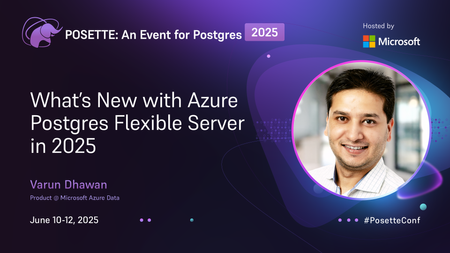
Talk Recap I had the opportunity to present at POSETTE: An Event for Postgres 2025, where I shared what’s new with Azure Database for PostgreSQL – Flexible Server. The session covers: Recent feature updates in performance, storage, and compute New AI-ready extensions like AZURE_AI, DISKANN, and PGVECTOR Improvements in high availability, GeoDR, and major version upgrades Enterprise-grade security enhancements (CMK, Entra ID) Tuning & monitoring improvements to simplify day-to-day operations 🎥 Watch the talk here: https://youtu.be/GnA8Z1Ojnk0?si=r1dbJb57JKjTGl68 Would love your feedback—and happy to answer any follow-up questions in this thread!CFP talk proposal ideas for POSETTE: An Event for Postgres 2025
Some of you have been asking for advice about what to submit to the CFP for POSETTE: An Event for Postgres 2025. So this post aims to give you ideas that might help you submit a talk proposal (or 2, or 3) before the upcoming CFP deadline. If you’re not yet familiar with this conference, POSETTE: An Event for Postgres 2025 is a free & virtual developer event now in its 4th year, organized by the Postgres team at Microsoft. I love the virtual aspect of POSETTE because the conference talks are so accessible—for both speakers and attendees. If you’re a speaker, you don’t need travel budget $$—and you don’t have to leave home. Also, the talk you’ve poured all that energy into is not limited to the people in the room, and has the potential to reach so many more people. If you’re an attendee, well, all you need is an internet connection The CFP for POSETTE: An Event for Postgres will be open until Sunday Feb 9th at 11:59pm PST. So as of the publication date of this blog post, you still have time to submit a CFP proposal (or 2, or 3, or 4)—and to remind your Postgres teammates and friends of the speaking opportunity. If you have a Postgres experience, success story, failure, best practice, “how-to”, collection of tips, lesson about something that's new, or deep dive to share—not just about the core of Postgres, but about anything in the Postgres ecosystem, including extensions, and tooling, and monitoring—maybe you should consider submitting a talk proposal to the CFP for POSETTE. If you’re not sure about whether to give a conference talk, there are a boatload of reasons why you should. And there’s also a podcast episode with Álvaro Herrera, Boriss Mejías, and Pino de Candia that makes the case for why giving conference talks matters. For inspiration, you can also take a look at the playlist of POSETTE 2024 talks. And if you’re looking for even more CFP ideas, you’ve come to the right place! Read on… Ideas for talks you might propose in the POSETTE CFP On the CFP page there is a list of possible talk titles (screenshot below) you might submit—these are good ideas, although the list is by no means exhaustive, and we welcome talk proposals that are not on this list. Figure 1: POSETTE CFP talk topics taken from the CFP page on PosetteConf.com On Telegram the other day, when answering the question “Do you have any ideas of what I should submit?”, I found myself suggesting different TYPES of talks. Not specific ideas and talk titles, but rather I framed the different categories. So I decided to share these different “types” and “classes” of talks with all of you, in the hopes this might gives you a good talk proposal idea. First you need to pick your audience: Before you think about what type of talk to give, remember that the POSETTE team is focused on serving the needs of both the USER community—as well as the Postgres contributor & hacker communities. That means first you need to decide on your audience. Are you giving a talk for PostgreSQL users, or Azure Database for PostgreSQL customers, or the PostgreSQL contributor community? All are good choices. Then you need to decide: what do you want to accomplish with your talk? Do you want to skill up the Postgres hacker community?: If you want to help skill-up the developer/contributor community, maybe pick a part of Postgres that new contributors often ask a lot of questions about, get stuck on, need help with, etc—and give a “tour” of its mechanics, starting with the basics. Do you want to help grow the Postgres community?: If you want to help grow the Postgres community of contributors and developers, you could propose a talk that would motivate tomorrow's developers/contributors to get involved in the project. Imagine you were going to a university to give a talk about "why work on Postgres"… what would you say? And how would you entice people to work on Postgres? What pain points would you challenge them with? What benefits would you share from your own Postgres experience that might inspire these developers to think seriously about Postgres as a career path? You could also shine a light on the different ways people can (and do!) contribute to the Postgres community: from mentoring to translations to organizing conferences to podcasts to speaking at conferences to publishing PostgreSQL Person of the Week. Do you want to share your expertise with Postgres users?: If you want your talk to benefit users, maybe pick an area that you are already expert in (or want an excuse to dig into and learn about?) and create a Beginners Guide for it? Or Advanced Tips for it? Or Surprising Benefits of? Or Things People Might Not Know? Especially if there is a part of Postgres you feel like people sometimes mis-use, or don't take enough advantage of.... Do you want to share your customer experiences with Azure Database for PostgreSQL, or Postgres more generally?: Maybe you have a wild success story you think others will benefit from. Or you want to share a problem you had and how you used Postgres to solve it? People love customer stories. Do you want to shine a light on the broader Postgres ecosystem?: If you want to target users with your talk, don’t limit yourself the Postgres core. There is a rich ecosystem that surrounds Postgres and people need to understand the ecosystem, too. So maybe there are tools or Postgres extensions or forks or startups that you can give a useful talk about? Do you want to help experts in other database technologies learn about Postgres?: If you have expertise in other databases as well as Postgres, maybe you can help people who who are skilled in running workloads on other databases and are looking to skill up on Postgres—by helping them understand what’s similar, and what’s different. As if you’re giving them a dictionary to translate from their familiar database to Postgres, and vice versa. There are so many more possibilities: Often I look at the schedule from previous years to look for inspiration (and to make sure that my talk proposal is not a duplicate of a talk that’s already been given.) And I think about pain points, things people get confused about, or questions that come up a lot. Another thing to keep in mind: how can you help your story to "stick"? Can you make it entertaining? How do you share your story in a way that keeps people watching (versus looking at their phone instead?) Key things to know about POSETTE: An Event for Postgres 2025 CFP deadline: The CFP for POSETTE will close on Sunday, Feb 9th 2025 @ 11:59pm Pacific Time (PST) No travel required: free & virtual developer event Length of talks: 25 minutes/session Language: All talks will be in English Talks will be pre-recorded: All talks will be pre-recorded by the POSETTE team during the weeks of Apr 28th and May 5th (with accepted speakers presenting remotely) When is the event?: Jun 10-12, 2025 Format of the virtual event: All pre-recorded talks will be livestreamed in one of 4 unique livestreams on Jun 10-12, 2025—all with parallel live text chats on Discord. Two of the livestreams will be in Americas-friendly times of day (8:00am-2:00pm PDT) and two of the livestreams will be in EMEA-friendly times of day (8:00am-2:00pm CEST). All talks will be published online after the event is over. More info about the CFP: All the details, including key dates and how to submit on Sessionize, are spelled out on the CFP page for POSETTE 2025 Code-of-conduct: You can find the Code of Conduct for POSETTE online. Please help us to provide a respectful, friendly, and professional experience for everybody involved in this virtual conference. Figure 2: The CFP is open for POSETTE: An Event for Postgres 2025 until Sunday Feb 9th at 11:59pm PST. What Postgres story do you want to share?313Views6likes0Comments