compute
176 Topics
Windows server 2022 is not updating with latest patch KB5126655
Windows server 2022 is not updating with latest patch KB5126655. However, successfully installed 2026-10 Cumulative update for .Net framework. Last successful Cumulative update for the operating system version 21H2 is 2026-06. Try to update the latest patch manually, the server is rolling back the patch.1.1KViews0likes4Comments
Profile Bloat in Azure VM and VMware VDI: A Policy-Driven Strategy for Reducing Storage Growth
OneDrive profile bloat is one of those issues that often starts as a minor desktop optimization discussion, but quickly becomes a storage, performance, and governance problem at enterprise scale. In Azure Virtual Machines and VMware VDI environments, when OneDrive is tied to the user profile, the sync cache, local file state, and stale content can accumulate over time and create unnecessary growth in profile containers, VHD/VHDX files, and backup overhead. The result is higher infrastructure cost, slower login and logoff times, and inconsistent user experience across pooled or multi-session desktops. This is not a problem that should be solved by disabling OneDrive. In most enterprise scenarios, OneDrive remains a critical collaboration workload, but it must be managed as a controlled service rather than a user-local convenience. The most effective strategy is to install OneDrive at the machine level, enforce policy by user class and device context, and use Files On-Demand and cloud content dehydration to minimize local persistence. This approach preserves user productivity while reducing the operational impact on virtualized desktop infrastructure. A policy-driven design is particularly important in multi-user environments where not all workloads should be treated the same. Developer desktops, standard business users, and restricted or consultant user groups have different productivity needs and different data-risk profiles. For example: General business users may benefit from a balanced policy with Files On-Demand enabled and moderate dehydration thresholds. Developer or QA environments may require more local flexibility while still controlling profile growth. Restricted or external-user populations should have strong sync boundaries, personal account restrictions, and minimal local persistence. To support this model, organizations should align their deployment around a few core principles: install OneDrive at the machine level in the standard image or build pipeline use group policy and loopback processing to apply user-specific policy based on OU or security group enable Files On-Demand by default configure Storage Sense and cloud content dehydration based on workload profile restrict personal Microsoft account sync in higher-risk scenarios use FSLogix compaction and profile optimization as secondary controls, not as the primary solution This model is especially relevant for organizations running Azure Virtual Desktop, Azure VM-based workloads, VMware Horizon, and other multi-user Windows desktop environments. The benefits are practical and measurable: lower local storage consumption, reduced VHD/VHDX growth, improved desktop performance, lower backup cost, and stronger governance over enterprise data movement. As IT and endpoint engineering teams continue modernizing virtual desktop environments, I would encourage us to think of OneDrive not as a user-profile feature, but as an enterprise-managed workload with policy boundaries. When implemented properly, this gives us the best balance between productivity, storage efficiency, and security. I’d be very interested in hearing how others are handling this in their environments: Are you deploying OneDrive at the machine level? Are you enforcing Files On-Demand by default? How are you segmenting policy by user class or device type? Have you measured the impact on VHD/VHDX growth or profile size after enforcement? Source document: https://github.com/RodrigoACriscuolo/criscra/blob/main/Home.Profile-Bloat165Views1like2Comments
¿Cómo comprobar que las actualizaciones se instalaron correctamente en Windows Server 2025?
Hola. Estoy usando Windows Server 2025 y quisiera saber qué pasos recomiendan para comprobar que las actualizaciones se instalaron correctamente. Después de reiniciar el servidor, ¿qué herramientas o registros puedo revisar para detectar errores y confirmar que los servicios siguen funcionando con normalidad?302Views0likes1CommentAzure Update Management Centre (Preview) - Security Intelligence Update for Microsoft Defender AV
Afternoon all, We are exploring using Update Management Centre and scheduling the update of our fleet of IaaS servers. Monthly patching is fairly easy to understand and deploy. Our dev machines are successfully patching. However, what is the implementation pattern for updating Defender AV signatures? In a WSUS deployment, this would likely be a separate job that runs hourly. However, UMC doesn't allow that level of frequency, nor does the maintenance Window accept anything less than 1 hour. Many thanks Paul666Views1like1Comment
Force a specific default lock screen and logon image
Dear, I currently have a DC deployed on Windows Server 2019. i want to configure a specific default image on lock screens on Windows 10 pro clients via group policy. Is this possible or is it only compatible with Enterprise or Education editions? Thanks in advance,2.4KViews0likes3Comments
Unable to load large delta table in azure ml studio
I am writing to report an issue that I am currently experiencing while trying to read a delta table from Azure ML. I have already created data assets to register the delta table, which is located at an ADLS location. However, when attempting to load the data, I have noticed that for large data sizes it is taking an exceedingly long time to load. I have confirmed that for small data sizes, the data is returned within few seconds, which leads me to believe that there may be an issue with the scalability of the data loading process. I would greatly appreciate it if you could investigate this issue and provide me with any recommendations or solutions to resolve this issue. I can provide additional details such as the size of the data, the steps I am taking to load the data, and any error messages if required. I'm following this document: https://learn.microsoft.com/en-us/python/api/mltable/mltable.mltable?view=azure-ml-py#mltable-mltable-from-delta-lake Using this command to read delta table using data asset URI from mltable import from_delta_lake mltable_ts = from_delta_lake(delta_table_uri=<DATA ASSET URI>, timestamp_as_of="2999-08-26T00:00:00Z", include_path_column=True)934Views0likes1CommentXXX virtual machines should enable Azure Disk Encryption or EncryptionAtHost.
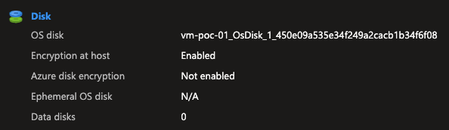
Hello everyone, I'm facing issues related to a policy: Linux virtual machines should enable Azure Disk Encryption or EncryptionAtHost. Windows virtual machines should enable Azure Disk Encryption or EncryptionAtHost. After enabling EncryptionAtHost, it appears as encrypted in the portal. However, the policy does not recognize that it is encrypted and shows it as non-compliant. The same happens when enabling Azure Disk Encryption (ADE): the policy still indicates that it is non-compliant. Has anyone else experienced this?1.4KViews0likes3CommentsCorrupted VT+ transaction files
We are a small accounting company using VT+ Transaction on a local drive synchronized with OneDrive for backup and file storage. A few days ago when we tried to open the application, we suddenly started receiving the following error messages: Run Time Error 0 and Run Time Error 440, and the program does not start. According to VT+ support the program files are corrupted and the data can only be restored up to the year 2022, as the more recent backups are also affected. Somehow the system is overriding our backups, which makes the latest ones unusable. Any advice what could cause that and how to resolve the issue. Thanks418Views0likes1CommentWindows 11 automatically restarting after install security Update — With GPO and WSUS.
Hi everyone, I’m facing a strange behavior with Windows 11 devices that receive updates through WSUS and are fully managed via Group Policy. Here’s the scenario: We have a GPO configured as follows: -Configure Automatic Updates → 4 (Auto download and schedule the install) -Scheduled installation every day at 10:00 -Install during automatic maintenance → disabled -Active Hours configured -Turn off auto-restart for updates during active hours → Enabled -Update deadlines set to 0 (to avoid any forced restart) -No other restart-related policies set in the domain Even with this configuration, after updates are installed, Windows 11 shows the following message: “Your organization manages update settings. We will restart and install this update at X minutes.” And then the device automatically restarts, even when: -a user is logged in -it is outside Active Hours -deadlines are disabled -no-auto-restart is enabled This behavior does not happen on Windows 10 — only on Windows 11.3.7KViews1like1Comment
Runtime installations on Azure Functions
We have a serverless requirement to run an ETL tool jobs from Azure Functions. The run time utility package for the ETL tool, would need to be installed on the azure functions, so it can run those utility tasks when invoked. Is there a standard way of installing a utility package every time the azure function is invoked? Note the azure function would be in python and python does not have an existing package to run informatica jobs.828Views0likes2Comments