azure us government
5 TopicsCalling API Management using Entra ID authentication and testing with PowerShell
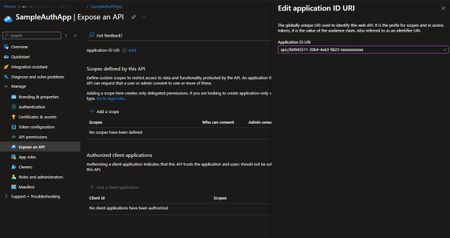
Integrating Entra ID or other compatible identity providers with Azure API Management is both easy and a great way to enhance security for your APIs. However, when you enforce authentication with the Validate JWT policy in API Management, you now have the extra step of obtaining a JWT token from your identity provider and supplying it to API Management. If you are writing code, this is fairly straight forward to achieve with the Azure Identity libraries, and there are great API testing tools such as Postman which support integrating with an identity provider and obtaining a token and presenting it for authentication. But what happens if you happen to be in a restricted environment where tools like Postman, or even VS Code, are not available and you need to test an API? The good news is that with just a few short lines of PowerShell we can achieve the same results. Setting up the App Registration The first step in enabling Entra ID authentication for your app is creating an App Registration in Entra ID. There is an excellent Learn article here describing the process of setting up an App Registration and enabling the JWT validation policy in API Management, but I'll go over the rough steps here: Open the Azure Portal Navigate to the Entra ID blade Go to App registrations and select New registration Enter a name for the app registration and click register Go to Certificates & secrets and create a new client secret Make note of the client secret, client ID, and tenant ID Click on the "Expose an API" blade Click "Add" next to "Application ID URI" Take the default URI and save the Application ID URI. The Learn article discusses setting up scopes in the Expose an API blade but we will use the default scope in the interests of simplicity. Setting up the validate-jwt policy In API Management, setup the validate-jwt policy by adding the policy expression at the appropriate scope, e.g. global, workspace, product, API or operation in the Inbound policies section. While there are many options for JWT validation, e.g using claims, for the purposes of this example we'll evaluate the issuer and audience. The validate-jwt policy will look like this: <validate-jwt header-name="Authorization" failed-validation-httpcode="401" failed-validation-error-message="Unauthorized. Access token is missing or invalid."> <openid-config url="https://login.microsoftonline.us/{your-tenant-id}/v2.0/.well-known/openid-configuration" /> <audiences> <audience>{your-client-id}</audience> </audiences> <issuers> <issuer>https://sts.windows.net/{your-tenant-id}/</issuer> </issuers> </validate-jwt> It's important to note two things here: Even though we are in Azure Government, the issuer is still sts.windows.net (that took me down a rabbit hole once upon a time). The "/" at the end of the issuer string is important. Failure to include the "/" will result in your validation to fail because the issuer does not match. After you save your policy, you can test that it's working by trying an Invoke-WebRequest to your API endpoint. You should receive a 401 Unauthorized message. Testing with PowerShell The PowerShell script essentially has two parts. The first part obtains the JWT token from Entra ID. $tenantId = "your-tenant-id" $clientId = "your-client-id" $clientSecret = "your-client-secret" $scope = "api://$clientId/.default" $subscriptionKey = "your-subscription-key" $tokenUrl = "https://login.microsoftonline.us/$tenantId/oauth2/v2.0/token" $body = @{ client_id = $clientId scope = $scope client_secret = $clientSecret grant_type = "client_credentials" } $response = Invoke-RestMethod -Method Post -Uri $tokenUrl -Body $body -ContentType "application/x-www-form-urlencoded" $token = $response.access_token The second part builds the request to include the token in the Authorization header. $headers = @{ Authorization = "Bearer $token" "Ocp-Apim-Subscription-Key" = $subscriptionKey } $outputValue = Invoke-RestMethod -Uri "https://apim.yourdomain.com/apiName/operationName" -Headers $headers -Method Get And that's it, a simple script that will allow you to grab a token and test your APIs with Entra ID or other identity provider authentication. Link to the script here.575Views0likes0CommentsDeploying Logic Apps Standard with Managed Identity and private networking
I was working with a customer who needed to implement some automation tasks to support their application. The automation tasks would be driven on data in their Azure SQL database. As most of their developers were busy tackling their backlog, I thought "What if we could use Logic Apps to do a no code solution with their operations team?" The first step was of course to deploy the Logic App. As the customer is running fully private networking for all services (Azure SQL, Storage, etc.), we would deploy Logic Apps Standard, which runs on the Azure App Service runtime similar to Function Apps. Like a Function App, the Logic App uses a storage account in the background. However, when deploying through the portal, the deployment failed with a 403 Unauthorized error. Of course! The customer had disabled shared key access to storage accounts, utilizing Entra ID exclusively. Like our post about setting up an Azure Container Instance to use Managed Identity to connect to an Azure Container Registry, we'd have to write a bit of Bicep script to utilize a User Assigned Managed Identity which has rights to Azure Storage and SQL. I created the User Assigned Managed Identity and granted it the following roles on the storage account: Storage Account Contributor Storage Blob Data Contributor Storage Queue Data Contributor Storage Table Data Contributor While that solved the access issue and allowed the deployment to complete, the Logic App was showing a runtime error in the portal, stating that it was "Unable to load the proper Managed Identity." As it turns out, we need to explicitly tell the Logic App in the App Service configuration that we are using Managed Identity as our authentication mechanism, and which Managed Identity we want to use. Once I added that to the configuration, my Managed Identity error went away, but I was still getting a runtime error. Looking in the log stream, I could see that I was getting many errors trying to talk to the storage account queue and table endpoints. Because the client is using all private networking, we needed to setup a private endpoint and associated private DNS entry for all three storage account endpoints: blob, queue and table. Once I added those private endpoints and added them to my App Service configuration, my Logic App deployed and ran successfully. I've added the Bicep code for the Logic App service here. One final "Gotcha": if you look in my Bicep, you will note that I am specifying both the User Assigned Managed Identity as well as a System Assigned Managed Identity. The reason for this is, when using a SQL connector, Managed Identity was not listed as an option for authentication. I was stumped by this at first, but then I noticed that it was an option in a portal deployed Logic App. The difference was that the portal deployment adds a System Assigned Managed Identity. Once I added this to my Bicep, the Managed Identity option showed up on the SQL connector. It appears that the connector is looking for the presence of a System Assigned Managed Identity to toggle that authentication option, but you can still use your User Assinged Managed Identity for SQL authentication.1.7KViews2likes0Comments