azure synapse analytics
9 TopicsDesigning Reliable Data Platforms: Centralized Failure Logging Framework with Azure Monitor
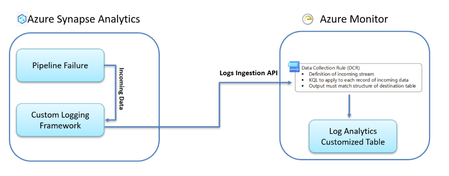
Introduction Modern data platforms are no longer just about moving and transforming data. In production, what really matters is reliability and how quickly you can understand and react when something breaks. If you’re using Azure Synapse/ADF/Microsoft Fabric, you already have built-in monitoring. You can see pipeline runs, error messages. But it doesnt show you activity level errors, Pipeline errors works well when you’re debugging a single failure. But it doesn’t scale. Once you have dozens of pipelines running across multiple environments, failures become harder to track. You find yourself jumping between pipeline runs, scanning activity outputs, and trying to piece together what actually happened. And suddenly, simple questions become difficult to answer: Which datasets are failing most often? Are failures concentrated in Bronze, Silver, or Gold? Is this a one-off issue or a recurring pattern? What changed between yesterday and today? At that point, pipeline-level monitoring is no longer enough. You need something more structured. P.S the framework can be implemented across both Synapse and Microsoft Fabric environments with minimal changes. Why we need a custom logging framework The core issue is that pipeline failures are treated as runtime events, not as data. They live inside pipeline output and are tied to a specific run. This makes them hard to query across time, aggregate across pipelines, correlate across environments, or understand which activities failed inside the pipeline or integrate into alerting and dashboards in a consistent way. Pipeline Failures are visible but activity failures are not , and they’re not operationalized, what’s missing is a central place where all failures are captured in a consistent, structured format, regardless of which pipeline or dataset produced them including Activity level logs. That’s where a custom logging framework comes in, instead of relying only on built-in monitoring, we introduce a layer that captures failures as structured events, standardizes the payload across pipelines, and sends it to Log Analytics where it can be queried using KQL. This shifts the model from checking a pipeline when it fails to treating failures as a dataset that can be analyzed, monitored, and improved over time. Once you make that shift, you can build alerts based on patterns instead of reacting to single failures, track reliability across datasets or domains, and identify recurring issues instead of dealing with incidents one by one. It also changes who can use the data, visibility is no longer limited to engineers digging into pipeline runs it becomes accessible at the platform level for leads and stakeholders. This framework doesn’t replace Synapse monitoring. It complements it by adding a proper observability layer on top. Architecture When a pipeline fails in Synapse, the failure is intercepted through a dedicated failure path. At this stage, we don’t just log the error as-is we pass it through a custom logging framework that transforms the failure into a structured payload. This payload includes key context such as pipeline name, activity, environment, dataset, layer (Bronze/Silver/Gold), error details, and correlation identifiers. The important part here is consistency every pipeline emits the same schema, regardless of its logic. Once the payload is constructed, it is sent to Azure Monitor using the Logs Ingestion API, this API acts as the entry point into the monitoring system and decouples the pipelines from the underlying storage implementation. A Data Collection Rule (DCR) sits behind the ingestion layer and defines how incoming data is handled. It acts as a contract for the payload schema and optionally applies transformations before the data is persisted. Finally, the logs are stored in a custom Log Analytics table, where they become fully query-able using KQL, at this point, failures are no longer tied to a single pipeline run they are part of a centralized dataset that can be analyzed across time, environments, and domains. Setting up Log Analytics Before integrating the logging framework with Synapse, we first need to set up the destination for our logs, this includes creating a Log Analytics workspace, defining a custom table, and configuring the ingestion path using a Data Collection Rule (DCR). The goal is to create a pipeline where structured failure events can be received, validated, and stored in a consistent format. P.S all steps mentioned in this blog can be automated with ARM templates. 1. Create a Log Analytics workspace Start by creating a Log Analytics workspace. This will act as the central store for all failure logs across your data platform. In the Azure Portal: Navigate to Azure Monitor → Log Analytics workspaces Create a new workspace in your target subscription and region Choose a meaningful name (for example: log-analytics-data-domain) This workspace becomes the single place where all pipeline failures will be collected and queried. 2. Create a custom table for pipeline failures Instead of relying on generic tables, we define a dedicated custom table to store pipeline failure events. From the Log Analytics workspace: Go to Tables → Create → Custom table (DCR-based) Define a table name such as: DataDomain_SynapsePipelineErrors_CL [it has to end with CL suffix] At this stage, you’ll define the schema that represents your logging payload. Typical fields include: TimeGenerated PipelineName PipelineRunId ActivityName ActivityType Status ErrorCode ErrorMessage Severity Environment Layer DatasetName PartitionDate WorkspaceName CorrelationId The key here is consistency, this schema will be reused across all pipelines, so take the time to define it properly. 3. Create a Data Collection Rule (DCR) The Data Collection Rule defines how incoming data is ingested into Log Analytics. It acts as both a schema contract and a routing mechanism. In Azure Portal: Go to Azure Monitor → Data Collection Rules Create a new DCR and associate it with your Log Analytics workspace Within the DCR: Define a custom stream (for example: DataDomain_SynapsePipelineErrors_CL) Map this stream to your custom table Optionally define transformations using KQL (for example, renaming fields or enforcing types) This step is critical because it decouples your pipelines from the storage layer. If the schema evolves later, you can adjust it here without changing pipeline logic. 4. Configure the Logs Ingestion endpoint Once the DCR is created, Azure generates an ingestion endpoint that will be used by your pipelines. The endpoint follows this pattern: https://<dce>.<region>.ingest.monitor.azure.com/dataCollectionRules/<dcrId>/streams/<streamName>?api-version=2023-01-01 This endpoint is what your Synapse pipeline will call using a Web Activity. At this point, you should also: Enable Managed Identity authentication Grant the Synapse workspace permission to send data to the DCR This ensures secure ingestion without using secrets. 5.RBAC for Managed Identity The Managed Identity used by Synapse or Microsoft Fabric must have the following Azure RBAC role: Monitoring Metrics Publisher This role allows the identity to send data through the Azure Monitor Logs Ingestion API. The role should be assigned on the: Data Collection Rule (DCR) resource In Azure Portal: Data Collection Rule (DCR) → Access Control (IAM) → Add Role Assignment → Monitoring Metrics Publisher → Select Synapse/Fabric Managed Identity Without this role assignment, requests to the Logs Ingestion API will fail with authorization errors such as HTTP 403. 6. Validate the setup Before integrating with pipelines, it’s a good idea to validate that ingestion works. You can send a test payload (via Postman or a simple script) and then query your table in Log Analytics: DataDomain_SynapsePipelineErrors_CL | take 10 If everything is configured correctly, you should see your test records appear. Integrating with Synapse pipelines Now that the ingestion layer is ready, the next step is connecting Synapse pipelines, so failures are logged automatically instead of sending manual test payloads. The idea is simple: whenever a pipeline activity fails, we capture the failure details, transform them into a structured payload, and send them directly to the Logs Ingestion API, this turns pipeline failures into centralized operational events. 1. Add a failure handling path Inside your Synapse pipeline, add an On Failure dependency from the activities you want to monitor. Typically, this includes critical activities such as: Copy Activities Notebook executions Stored Procedures Data Flows Web Activities Instead of allowing the pipeline to fail silently, the failure path redirects execution into a dedicated logging step , in most production environments, this is implemented as a reusable child pipeline such as: pipeline name : Customized Logs API This keeps logging logic centralized and avoids duplicating the same implementation across dozens of pipelines. 2. Pass failure metadata as parameters The logging pipeline should receive operational context from the parent pipeline. Typical parameters include: Pipeline name Pipeline run ID Activity name Activity type Error code Error message Environment Layer (Bronze/Silver/Gold) Dataset name Severity Correlation ID This metadata becomes the foundation of the structured logging payload. The more operational context you capture here, the easier troubleshooting becomes later. 3. Construct the logging payload Inside the logging pipeline [Customized Logs API], use a dynamic content expression to construct a JSON payload matching the Log Analytics schema. Example payload: concat( '[{"TimeGenerated":"', utcNow(), '","PipelineName":"POC_Test"', ',"PipelineRunId":"', pipeline().RunId, '","PipelineStatus":"Failed"', ',"ActivityName":"TestActivity"', ',"ActivityType":"Web"', ',"ActivityStatus":"Failed"', ',"ErrorCode":"TEST"', ',"ErrorMessage":"POC test"', ',"Severity":"Warning"', ',"Environment":"Test"', ',"Layer":"Bronze"', ',"ExecutionStage":"POC"', ',"DatasetName":"TestDataset"', ',"PartitionDate":"', utcNow(), '","WorkspaceName":"', pipeline().DataFactory, '","TriggerName":"Manual"', ',"TriggerTimeUtc":"', utcNow(), '","DurationMs":1000', ',"RetryCount":0', ',"Compute":"Synapse"', ',"CorrelationId":"', pipeline().RunId, '","Payload":{"source":"test","target":"loganalytics"}}]' ) The important part is schema consistency. Every pipeline should emit the same payload structure regardless of which activity failed. This makes downstream querying and dashboarding significantly easier. 4. Send logs using a Web Activity After constructing the payload, use a Web Activity to send the data to the Logs Ingestion API endpoint configured earlier. Typical configuration: URL: https://<data-collection-endpoint>.<region>.ingest.monitor.azure.com/dataCollectionRules/<dcr-id>/streams/<stream-name>?api-version=2023-01-01 Method POST Authentication Managed Identity Resource https://monitor.azure.com Headers { "Content-Type": "application/json" } Body Dynamic JSON payload generated in the previous step. I highly recommend using Managed Identity avoids storing secrets or credentials inside Synapse pipelines and keeps authentication fully managed by Azure. 5. Validate end-to-end ingestion Once the pipeline is connected, trigger a controlled failure and verify that the event appears in Log Analytics. Run: DataDomain_SynapsePipelineErrors_CL | sort by TimeGenerated desc | take 20 You should now see real pipeline failures arriving automatically from Synapse. At this point, the framework becomes fully operational. Failures are no longer isolated runtime events buried inside activity outputs they are centralized, queryable operational records that can be analyzed across the entire platform. Future Steps Now that we have a centralized logging framework in place, we can take observability one step further by building operational dashboards in Power BI or Microsoft Fabric to analyze reliability trends across the entire data platform. Instead of reacting to isolated pipeline failures, we can aggregate logs across pipelines, datasets, environments, and medallion layers to identify what is actually causing instability over time. This allows engineering teams to detect recurring error patterns, identify unstable datasets, measure platform reliability, analyze failure spikes after deployments, and understand where operational bottlenecks are concentrated. By transforming pipeline failures into structured operational telemetry, the framework evolves beyond simple logging into a true observability platform that supports proactive reliability engineering, helping teams move from reactive firefighting to data-driven operational improvements based on measurable reliability KPIs such as failure trends, MTTR, SLA compliance, severity distribution, and pipeline health scoring. Links Tutorial: Send data to Azure Monitor Logs with Logs ingestion API (Azure portal) - Azure Monitor | Microsoft Learn Medallion Architecture Understanding with Azure Synapse Analytics Example | by Satyam Gawade | Medium Feedback: Sally Dabbah | LinkedIn437Views0likes0CommentsFrom Manual Backfills to Autonomous Pipelines: Building an LLM-Powered Backfill Agent on Azure
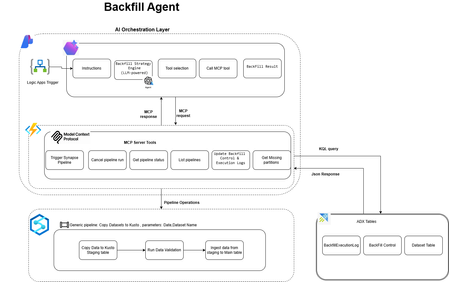
Introduction: Data backfills are a common operational requirement in modern data platforms. Missing partitions, upstream delays, or failed pipeline runs often require engineers to manually identify gaps, determine the appropriate recovery window, and trigger reprocessing. This approach does not scale well it introduces operational overhead, increases the risk of human error, and requires deep knowledge of data dependencies and pipeline behavior. In this post, I describe how to build a backfill agent using Azure AI Foundry, Model Context Protocol (MCP), Azure Functions, Synapse, and ADX. The goal is to automate the decision-making process while keeping execution controlled, observable, and governed. The design separates responsibilities across three layers: Decision layer: an LLM-based agent determines whether a backfill is required and defines the recovery scope (e.g., which dates, datasets, or layers) Execution layer: an MCP server hosted on Azure Functions exposes controlled operations such as triggering pipelines and querying system state State layer: ADX tables maintain backfill control metadata, data availability signals, and execution history This separation keeps the system flexible while ensuring that all actions are traceable, auditable, and policy-driven. Importantly, this pattern is not limited to a single dataset or pipeline. It can be applied across all datasets and across all layers of a medallion architecture Bronze, Silver, and Gold with layer-specific validation rules and backfill strategies. For example, Bronze may focus on completeness of ingestion, while Silver and Gold can enforce data quality and business logic constraints before initiating recovery. The key benefit of a backfill agent is that it shifts backfilling from a manual, reactive process to an automated, intelligent, and consistent workflow. Instead of engineers investigating incidents and triggering reruns, the agent continuously evaluates data state, identifies gaps, and initiates-controlled recovery actions. This reduces operational burden, improves reliability, and ensures faster recovery from data issues while maintaining governance, observability, and strict control over execution. Architecture Overview The solution is designed as a controlled orchestration pattern that separates decision-making, execution, and state management. This allows backfill operations to be automated without compromising governance or observability. The architecture consists of four main components. Logic Apps Trigger The workflow is initiated using a Logic App. The trigger can be scheduled or invoked on demand, depending on operational requirements. It provides the input context required for the backfill evaluation, such as dataset name, processing layer, and scope constraints (for example, maximum number of dates to process). Azure AI Foundry Agent (Decision Layer) The Azure AI Foundry agent acts as the decision layer. It evaluates the request and determines whether a backfill is required, and if so, what scope should be applied. The agent does not interact directly with data systems. Instead, it invokes predefined tools exposed through the MCP server. This ensures that decision logic is flexible, while execution remains controlled. Azure Function App – MCP Server (Execution Layer) The Azure Function App hosts the MCP server and exposes a set of operations to the agent. These operations include querying missing partitions, triggering Synapse pipelines, retrieving execution status, and updating control tables. All interactions with external systems (Synapse and ADX) are handled within this layer. It is responsible for input validation, authorization, and enforcing execution rules. This abstraction ensures that infrastructure actions are not directly performed by the agent. Synapse Pipelines (Processing Layer) Backfill execution is handled by a parameterized Synapse pipeline. The pipeline follows a consistent pattern: Data is first written to a staging table Validation is performed Data is promoted to the main table only if validation succeeds This approach ensures data quality and prevents partial or invalid data from being published. Azure Data Explorer(State and Observability Layer) ADX is used as the central state store. It maintains control and execution tables that track expected partitions, missing data, pipeline runs, and execution outcomes. This enables: Detection of missing partitions Idempotent execution (avoiding duplicate processing) Full traceability of backfill operations The agent relies on this state, accessed via the MCP server, to make decisions. End-to-End Flow The Logic App triggers the workflow and passes the request context. The Foundry agent evaluates the request. The agent invokes an MCP tool to retrieve missing partitions from ADX. Based on the result, the agent determines whether a backfill is required. If required, the agent invokes an MCP tool to trigger the Synapse pipeline. The pipeline executes the backfill using a staging and validation pattern. Execution details are written to ADX. The agent returns a summary of the operation. Analytics Layer: Azure Synapse Analytics: In the Synapse workspace, I created a generic parameterized pipeline that has three steps: 1.Copy data from upstream and ingest it to ADX staging table 2. Run Data validation 3 ingest staging data to main dataset table. the pipeline gets as a parameter dataset name, partitioning date, isbackfill flag and layer and ingest dataset into kusto table. values for layer : Bronze,Silver or Gold. Kusto: In Kusto, the solution relies on the following tables: Dataset tables for example, the Customers table in this demo [the same pattern can be extended to support multiple datasets.] BackfillControl: its the central configuration and decision input for the backfill process. It defines which dataset partitions require backfill and provides the metadata needed for the agent to make execution decisions. each row in this table represents a specific dataset partition (for example, a given date in a specific layer) and its current backfill state. BackfillExecutionLog : this table is used to track the execution of backfill operations. It provides a complete record of when backfills were triggered, their outcome, and the associated pipeline runs, while the BackfillControl table defines what should be processed, the BackfillExecutionLog captures what actually happened. Code for Creating the tables: .create table BackfillExecutionLog ( ExecutionId: string, DatasetName: string, Layer: string, PartitionDate: datetime, PipelineName: string, PipelineRunId: string, TriggeredAt: datetime, TriggeredBy: string, ExecutionStatus: string, Reason: string ) .create table BackfillControl ( DatasetName: string, Layer: string, PartitionDate: datetime, BackfillRequired: bool, Status: string, DQStatus: string, RetryCount: int, MaxRetryCount: int, Reason: string ) Output examples: In this demo, Logic Apps, Synapse, and Kusto are treated as existing systems; the focus is how to expose controlled MCP tools from an Azure Function App and connect them to Azure AI Foundry agent. Microsoft’s Azure Functions MCP extension lets a Function App expose functions as MCP tools, and Foundry can connect to the deployed MCP endpoint. Steps: Step1: Create the local Function App project in VS code, run the command: mkdir backfill-kusto-mcp cd backfill-kusto-mcp func init . --worker-runtime python --python Step2: Implement the MCP tools add requirements to requirements.txt file: azure-functions>=1.24.0 azure-identity azure-kusto-data requests python-dotenv The host.json file defines runtime-level behavior for the Azure Function App. In this implementation, it is used to configure the MCP extension, logging, and extension bundles. { "version": "2.0", "extensions": { "mcp": { "system": { "webhookAuthorizationLevel": "Anonymous" } } }, "logging": { "applicationInsights": { "samplingSettings": { "isEnabled": true, "excludedTypes": "Request" }, "enableLiveMetricsFilters": true } }, "extensionBundle": { "id": "Microsoft.Azure.Functions.ExtensionBundle.Experimental", "version": "[4.*, 5.0.0)" } } The local.settings.json file is used to define environment-specific configuration for the Azure Function App during local development. It contains application settings (environment variables) that are read by the Function App at runtime. These settings are not checked into source control and are replaced by App Settings in Azure after deployment. For example: { "IsEncrypted": false, "Values": { "AzureWebJobsStorage": "UseDevelopmentStorage=true", "FUNCTIONS_WORKER_RUNTIME": "python", "KUSTO_CLUSTER": "https://<ClusterName>.<Region>.kusto.windows.net", "KUSTO_DATABASE": "<DatabaseName>", "BACKFILL_CONTROL_TABLE": "BackfillControl", "BACKFILL_EXECUTION_LOG_TABLE": "BackfillExecutionLog", "SYNAPSE_WORKSPACE": "<SynapseWorkspaceName>", "SYNAPSE_PIPELINE": "<PipelineName>", "AUTH_MODE": "az_login", "AZURE_CLIENT_ID": "", "DEFAULT_DATASET_NAME": "Customers", "DEFAULT_LAYER": "Bronze", "MAX_DATES_DEFAULT": "5" } } For local development, AUTH_MODE is set to az_login. Before deploying to Azure Functions, change AUTH_MODE to MANAGED_IDENTITY in the Function App application settings. The function_app.py defines the main implementation of MCP server ir: Exposes MCP tools (find_backfill_candidates, trigger_backfill, run_backfill_agent, get_backfill_execution_log) Reads configuration from environment variables Authenticates using Azure CLI (local) or Managed Identity (Azure) Queries BackfillControl in Kusto to identify missing partitions Triggers Synapse pipelines for backfill Writes execution results to BackfillExecutionLog Enforces idempotency by checking if a partition was already triggered Code: import os import uuid import json import logging from datetime import datetime, timezone from urllib.parse import quote import requests import azure.functions as func from azure.identity import ManagedIdentityCredential, AzureCliCredential from azure.kusto.data import KustoClient, KustoConnectionStringBuilder app = func.FunctionApp(http_auth_level=func.AuthLevel.ANONYMOUS) logging.basicConfig(level=logging.INFO) AUTH_MODE = os.getenv("AUTH_MODE", "MANAGED_IDENTITY").lower() KUSTO_CLUSTER = os.getenv("KUSTO_CLUSTER") KUSTO_DATABASE = os.getenv("KUSTO_DATABASE") CONTROL_TABLE = os.getenv("BACKFILL_CONTROL_TABLE", "BackfillControl") EXECUTION_LOG_TABLE = os.getenv("BACKFILL_EXECUTION_LOG_TABLE", "BackfillExecutionLog") SYNAPSE_WORKSPACE = os.getenv("SYNAPSE_WORKSPACE") SYNAPSE_PIPELINE = os.getenv("SYNAPSE_PIPELINE", "Customer Dataset") DEFAULT_DATASET_NAME = os.getenv("DEFAULT_DATASET_NAME", "Customers") DEFAULT_LAYER = os.getenv("DEFAULT_LAYER", "Bronze") def utc_now() -> str: return datetime.now(timezone.utc).strftime("%Y-%m-%dT%H:%M:%SZ") def log_event(event: str, **properties): logging.info( "MCP_BACKFILL %s", json.dumps( { "event": event, "timestamp_utc": utc_now(), **properties, }, default=str, ), ) def require_setting(name: str, value: str | None): if not value: raise ValueError(f"Missing required app setting: {name}") def escape_kusto_string(value: str | None) -> str: if value is None: return "" return str(value).replace("\\", "\\\\").replace('"', '\\"') def get_credential(): if AUTH_MODE == "az_login": return AzureCliCredential() managed_identity_client_id = os.getenv("AZURE_CLIENT_ID") if managed_identity_client_id: log_event( "using_user_assigned_managed_identity", client_id=managed_identity_client_id, ) return ManagedIdentityCredential(client_id=managed_identity_client_id) log_event("using_system_assigned_managed_identity") return ManagedIdentityCredential() def get_kusto_client() -> KustoClient: require_setting("KUSTO_CLUSTER", KUSTO_CLUSTER) if AUTH_MODE == "az_login": kcsb = KustoConnectionStringBuilder.with_az_cli_authentication(KUSTO_CLUSTER) else: managed_identity_client_id = os.getenv("AZURE_CLIENT_ID") if managed_identity_client_id: kcsb = KustoConnectionStringBuilder.with_aad_managed_service_identity_authentication( KUSTO_CLUSTER, client_id=managed_identity_client_id, ) else: kcsb = KustoConnectionStringBuilder.with_aad_managed_service_identity_authentication( KUSTO_CLUSTER ) return KustoClient(kcsb) def execute_kusto_query(query: str): require_setting("KUSTO_DATABASE", KUSTO_DATABASE) client = get_kusto_client() response = client.execute(KUSTO_DATABASE, query) return response.primary_results[0] def execute_kusto_command(command: str): require_setting("KUSTO_DATABASE", KUSTO_DATABASE) client = get_kusto_client() return client.execute_mgmt(KUSTO_DATABASE, command) def find_backfill_candidates_core( dataset_name: str, layer: str, max_dates: int, ) -> list[dict]: dataset = escape_kusto_string(dataset_name) layer_name = escape_kusto_string(layer) query = f""" {CONTROL_TABLE} | where DatasetName == "{dataset}" | where Layer == "{layer_name}" | where BackfillRequired == true | where RetryCount < MaxRetryCount | where Status in ("Missing", "Failed") or DQStatus == "Failed" | top {int(max_dates)} by PartitionDate asc | project DatasetName, Layer, PartitionDate, Status, DQStatus, RetryCount, MaxRetryCount, Reason """ rows = execute_kusto_query(query) return [ { "DatasetName": row["DatasetName"], "Layer": row["Layer"], "PartitionDate": str(row["PartitionDate"])[:10], "Status": row["Status"], "DQStatus": row["DQStatus"], "RetryCount": row["RetryCount"], "MaxRetryCount": row["MaxRetryCount"], "Reason": row["Reason"], } for row in rows ] def was_backfill_already_triggered( dataset_name: str, layer: str, partition_date: str, ) -> bool: dataset = escape_kusto_string(dataset_name) layer_name = escape_kusto_string(layer) query = f""" {EXECUTION_LOG_TABLE} | where DatasetName == "{dataset}" | where Layer == "{layer_name}" | where PartitionDate == datetime({partition_date}) | where ExecutionStatus == "Triggered" | summarize Count = count() """ rows = list(execute_kusto_query(query)) return bool(rows and rows[0]["Count"] > 0) def write_execution_log( execution_id: str, dataset_name: str, layer: str, partition_date: str, pipeline_name: str, pipeline_run_id: str, execution_status: str, reason: str, ): command = f""" .set-or-append {EXECUTION_LOG_TABLE} <| print ExecutionId = "{escape_kusto_string(execution_id)}", DatasetName = "{escape_kusto_string(dataset_name)}", Layer = "{escape_kusto_string(layer)}", PartitionDate = datetime({partition_date}), PipelineName = "{escape_kusto_string(pipeline_name)}", PipelineRunId = "{escape_kusto_string(pipeline_run_id)}", TriggeredAt = datetime({utc_now()}), TriggeredBy = "FoundryMCPBackfillAgent", ExecutionStatus = "{escape_kusto_string(execution_status)}", Reason = "{escape_kusto_string(reason)}" """ execute_kusto_command(command) def trigger_synapse_pipeline( dataset_name: str, layer: str, partition_date: str, ) -> str: require_setting("SYNAPSE_WORKSPACE", SYNAPSE_WORKSPACE) require_setting("SYNAPSE_PIPELINE", SYNAPSE_PIPELINE) credential = get_credential() token = credential.get_token("https://dev.azuresynapse.net/.default").token encoded_pipeline_name = quote(SYNAPSE_PIPELINE, safe="") url = ( f"https://{SYNAPSE_WORKSPACE}.dev.azuresynapse.net" f"/pipelines/{encoded_pipeline_name}/createRun" f"?api-version=2020-12-01" ) payload = { "DatasetName": dataset_name, "Layer": layer, "PartitionDate": partition_date, "IsBackfill": True, } response = requests.post( url, headers={ "Authorization": f"Bearer {token}", "Content-Type": "application/json", }, json=payload, timeout=30, ) log_event( "synapse_create_run_response", status_code=response.status_code, body=response.text[:2000], ) response_json = {} try: response_json = response.json() except Exception: pass if "runId" in response_json: return response_json["runId"] raise Exception( f"Synapse trigger failed. " f"StatusCode={response.status_code}. " f"Body={response.text}" ) def trigger_backfill_core( dataset_name: str, layer: str, partition_date: str, ) -> dict: execution_id = str(uuid.uuid4()) log_event( "trigger_backfill_started", execution_id=execution_id, dataset_name=dataset_name, layer=layer, partition_date=partition_date, ) try: if was_backfill_already_triggered(dataset_name, layer, partition_date): return { "ExecutionId": execution_id, "DatasetName": dataset_name, "Layer": layer, "PartitionDate": partition_date, "Status": "Skipped", "Reason": "Backfill was already triggered for this partition.", } pipeline_run_id = trigger_synapse_pipeline( dataset_name=dataset_name, layer=layer, partition_date=partition_date, ) write_execution_log( execution_id=execution_id, dataset_name=dataset_name, layer=layer, partition_date=partition_date, pipeline_name=SYNAPSE_PIPELINE, pipeline_run_id=pipeline_run_id, execution_status="Triggered", reason="Triggered by Foundry MCP backfill agent", ) return { "ExecutionId": execution_id, "DatasetName": dataset_name, "Layer": layer, "PartitionDate": partition_date, "PipelineName": SYNAPSE_PIPELINE, "PipelineRunId": pipeline_run_id, "Status": "Triggered", } except Exception as ex: error_message = str(ex) log_event( "trigger_backfill_failed", execution_id=execution_id, dataset_name=dataset_name, layer=layer, partition_date=partition_date, error=error_message, ) try: write_execution_log( execution_id=execution_id, dataset_name=dataset_name, layer=layer, partition_date=partition_date, pipeline_name=SYNAPSE_PIPELINE or "", pipeline_run_id="", execution_status="FailedToTrigger", reason=error_message, ) except Exception as log_ex: log_event( "failed_to_write_execution_log", execution_id=execution_id, original_error=error_message, log_error=str(log_ex), ) return { "ExecutionId": execution_id, "DatasetName": dataset_name, "Layer": layer, "PartitionDate": partition_date, "Status": "FailedToTrigger", "Error": error_message, } def run_backfill_agent_core( dataset_name: str, layer: str, max_dates: int, ) -> list[dict]: log_event( "run_backfill_agent_started", dataset_name=dataset_name, layer=layer, max_dates=max_dates, ) candidates = find_backfill_candidates_core( dataset_name=dataset_name, layer=layer, max_dates=max_dates, ) results = [] for candidate in candidates: result = trigger_backfill_core( dataset_name=candidate["DatasetName"], layer=candidate["Layer"], partition_date=candidate["PartitionDate"], ) results.append(result) log_event( "run_backfill_agent_completed", dataset_name=dataset_name, layer=layer ) return results def get_execution_log_core( dataset_name: str, limit: int, ) -> list[dict]: dataset = escape_kusto_string(dataset_name) query = f""" {EXECUTION_LOG_TABLE} | where DatasetName == "{dataset}" | top {int(limit)} by TriggeredAt desc | project ExecutionId, DatasetName, Layer, PartitionDate, PipelineName, PipelineRunId, TriggeredAt, TriggeredBy, ExecutionStatus, Reason """ rows = execute_kusto_query(query) return [ { "ExecutionId": row["ExecutionId"], "DatasetName": row["DatasetName"], "Layer": row["Layer"], "PartitionDate": str(row["PartitionDate"])[:10], "PipelineName": row["PipelineName"], "PipelineRunId": row["PipelineRunId"], "TriggeredAt": str(row["TriggeredAt"]), "TriggeredBy": row["TriggeredBy"], "ExecutionStatus": row["ExecutionStatus"], "Reason": row["Reason"], } for row in rows ] @app.mcp_tool() @app.mcp_tool_property(arg_name="dataset_name", description="Dataset name, for example Customers.") @app.mcp_tool_property(arg_name="layer", description="Layer name, for example Bronze.") @app.mcp_tool_property(arg_name="max_dates", description="Maximum number of dates to return.") def find_backfill_candidates( dataset_name: str = DEFAULT_DATASET_NAME, layer: str = DEFAULT_LAYER, max_dates: int = 5, ) -> list[dict]: return find_backfill_candidates_core(dataset_name, layer, max_dates) @app.mcp_tool() @app.mcp_tool_property(arg_name="dataset_name", description="Dataset name, for example Customers.") @app.mcp_tool_property(arg_name="layer", description="Layer name, for example Bronze.") @app.mcp_tool_property(arg_name="partition_date", description="Partition date in yyyy-MM-dd format.") def trigger_backfill( dataset_name: str, layer: str, partition_date: str, ) -> dict: return trigger_backfill_core(dataset_name, layer, partition_date) @app.mcp_tool() @app.mcp_tool_property(arg_name="dataset_name", description="Dataset name, for example Customers.") @app.mcp_tool_property(arg_name="layer", description="Layer name, for example Bronze.") @app.mcp_tool_property(arg_name="max_dates", description="Maximum number of dates to trigger.") def run_backfill_agent( dataset_name: str = DEFAULT_DATASET_NAME, layer: str = DEFAULT_LAYER, max_dates: int = 5, ) -> list[dict]: return run_backfill_agent_core(dataset_name, layer, max_dates) @app.mcp_tool() @app.mcp_tool_property(arg_name="dataset_name", description="Dataset name, for example Customers.") @app.mcp_tool_property(arg_name="limit", description="Maximum number of execution log rows to return.") def get_backfill_execution_log( dataset_name: str = DEFAULT_DATASET_NAME, limit: int = 10, ) -> list[dict]: return get_execution_log_core(dataset_name, limit) Step3: . Run locally 1. Activate virtual environment: python -m venv .sally-env .\.sally-env\Scripts\activate 2. Install dependencies : pip install -r requirements.txt npm install -g azurite 3. Open 2 terminals, in one terminal run: azurite 4. in the second terminal: Login to Azure: az login start the function app: func start P.S make sure to change auth in local.settings.json file to "AUTH_MODE": "az_login" Step4: Create Azure resources and deploy # LOGIN az login # VARIABLES $RG="rg-backfill-kusto-mcp-demo" $LOCATION="westeurope" $STORAGE="stbackfillmcp$((Get-Random -Minimum 10000 -Maximum 99999))" $FUNCAPP="func-backfill-kusto-mcp-$((Get-Random -Minimum 10000 -Maximum 99999))" # CREATE RESOURCE GROUP az group create --name $RG --location $LOCATION # CREATE STORAGE ACCOUNT az storage account create ` --name $STORAGE ` --resource-group $RG ` --location $LOCATION ` --sku Standard_LRS # CREATE FUNCTION APP az functionapp create ` --resource-group $RG ` --consumption-plan-location $LOCATION ` --runtime python ` --runtime-version 3.11 ` --functions-version 4 ` --name $FUNCAPP ` --storage-account $STORAGE ` --os-type Linux # ENABLE MANAGED IDENTITY az functionapp identity assign ` --resource-group $RG ` --name $FUNCAPP # GET PRINCIPAL ID $FUNC_PRINCIPAL_ID = az functionapp identity show ` --resource-group $RG ` --name $FUNCAPP ` --query principalId ` --output tsv Write-Host "Function App Principal ID: $FUNC_PRINCIPAL_ID" # CONFIGURE APP SETTINGS az functionapp config appsettings set ` --resource-group $RG ` --name $FUNCAPP ` --settings ` AUTH_MODE=MANAGED_IDENTITY ` KUSTO_CLUSTER="https://<ClusterName>.<Region>.kusto.windows.net" ` KUSTO_DATABASE="<DatabaseName>" ` BACKFILL_CONTROL_TABLE="BackfillControl" ` BACKFILL_EXECUTION_LOG_TABLE="BackfillExecutionLog" ` SYNAPSE_WORKSPACE="<SynapseWorkspaceName>" ` SYNAPSE_PIPELINE="<PipelineName>" ` DEFAULT_DATASET_NAME="Customers" ` DEFAULT_LAYER="Bronze" ` MAX_DATES_DEFAULT="5" # DEPLOY FUNCTION APP (RUN FROM PROJECT FOLDER) func azure functionapp publish $FUNCAPP # GET MCP ENDPOINT $MCP_ENDPOINT="https://$FUNCAPP.azurewebsites.net/runtime/webhooks/mcp" Write-Host "MCP Endpoint: $MCP_ENDPOINT" # GET MCP KEY $MCP_KEY = az functionapp keys list ` --resource-group $RG ` --name $FUNCAPP ` --query "systemKeys.mcp_extension" ` --output tsv Write-Host "MCP Key: $MCP_KEY" # TEST MCP TOOL $body = @{ jsonrpc = "2.0" id = "1" method = "tools/call" params = @{ name = "find_backfill_candidates" arguments = @{ dataset_name = "Customers" layer = "Bronze" max_dates = 1 } } } | ConvertTo-Json -Depth 10 Invoke-RestMethod ` -Uri $MCP_ENDPOINT ` -Method POST ` -Headers @{ Accept = "application/json, text/event-stream" "x-functions-key" = $MCP_KEY } ` -ContentType "application/json" ` -Body $body After deployment, the Function App’s managed identity must be granted the appropriate permissions in both Kusto and Synapse with Function app principal id , this allows the Function App to query Kusto tables and trigger Synapse pipelines without issues. Step5: . Connect the MCP server to Azure AI Foundry Go to Azure AI Foundry portal Navigate to your Project Open your Agent Add MCP as a tool : Go to Tools Click Add Tool Select: Custom → Model Context Protocol (MCP) Configure custom MCP and click on Save MCP endpoint: https://<function-app-name>.azurewebsites.net/runtime/webhooks/mcp Step6: Define Agent instructions You are a Backfill Reliability Agent. You MUST use the backfill_agent MCP tool. Do NOT ask the user for candidate dates. When asked to run backfill: Find dataset name 1. Call find_backfill_candidates with dataset_name layer max_dates 2. Then call run_backfill_agent with dataset_name, layer= max_dates Return the PipelineRunId. Note: The instructions are very generic; you need to modify it based on your business scenario. Step7: Test prompt Now in Synapse Monitor: Search for PipelineRunId: df1b1920-09dd-415b-bbe9-d810d8505f58: Future Enhancements: The backfill agent automates recovery by detecting missing or failed data and triggering controlled reprocessing via MCP. It can scale across all datasets and medallion layers (Bronze, Silver, Gold) with layer-specific rules. The design can evolve into a multi-agent workflow for example, if backfill fails multiple times, a notification agent can automatically send emails or create incidents for upstream teams. Overall, this shift backfilling from a manual, reactive task to an automated, governed, and intelligent data operations process. Links: Tutorial: Host an MCP server on Azure Functions | Microsoft Learn Quickstart: Set up Microsoft Foundry resources - Microsoft Foundry | Microsoft Learn Quickstart: Connect Azure Data Explorer to an Azure Synapse Analytics workspace - Azure Synapse Analytics | Microsoft Learn Would love to hear your Feedback: Sally Dabbah | LinkedIn480Views0likes1CommentSmart Pipelines Orchestration: Designing Predictable Data Platforms on Shared Spark
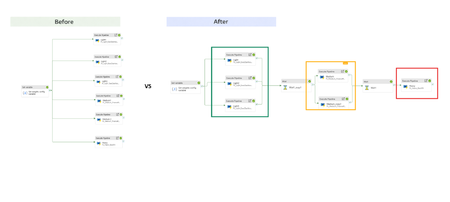
Introduction In mature data platforms, scaling compute is rarely the primary challenge. Shared, elastic Spark pools already provide sufficient processing capacity for most workloads. The harder problem is achieving predictable execution when multiple pipelines compete for the same resources. In Azure Synapse, Spark pools are commonly shared across pipelines to optimize cost and utilization. While this model is efficient, it introduces a key limitation: execution order is determined by scheduling behavior, not business priority. This post describes an orchestration pattern that makes priority explicit, allowing critical workloads to run predictably on shared Spark compute without modifying Spark code, configuration, or cluster capacity. Goal This work does not aim to optimize Spark performance. Its goal is to ensure that, when pipelines share a Spark pool: latency-sensitive workloads run first heavy backfills do not delay critical pipelines execution order is deterministic under contention All of this needed to be achieved without changes to Spark configuration, notebook logic, or cluster size. Why This Problem Occurs In a naïve orchestration model, pipelines are triggered in parallel. From Spark’s perspective: all jobs are equivalent all jobs attempt to acquire executors at the same time scheduling decisions are based on availability and timing As a result, priority is implicit and often incorrect. A heavy workload may acquire executors before a lightweight but critical one simply because it requests more resources earlier. This behavior is expected from Spark. The issue lies in orchestration, not in compute. Core Concept: Priority as Execution Ordering In shared Spark platforms, priority is enforced through execution ordering, not compute tuning. The orchestration layer controls when workloads are admitted to shared compute. Once execution begins, Spark processes each workload normally. This preserves Spark’s execution model while providing deterministic workload ordering. Step 1: Workload Classification In the demo presented in this blog, workloads are classified during configuration based on business impact: Category Description Priority example Light (critical) SLA sensitive dashboard and downstream consumers High priority , low resource weight(data volume) Medium (High) Core reporting workloads Medium priority Heavy(Best Effort) Backfills and historical computes Low priority, high resource weight(data volume) This classification is external to Spark and external to code. It represents business intent, not implementation. As a future phase, classification can be automated,for example, an agent may adjust priority based on observed failure rates or execution stability. Workload classification is expressed as orchestration metadata, for example: [ {"name":"ExecDashboard","pipeline":"PL_Light_ExecDashboard","weight":1,"tier":"Critical"}, {"name":"FinanceReporting","pipeline":"PL_Medium_FinanceReporting","weight":3,"tier":"High"}, {"name":"Backfill","pipeline":"PL_Heavy_Backfill","weight":8,"tier":"BestEffort"} ] What Runs in Each Workload Category All pipelines execute on the same shared Spark pool, but the work they perform differs in scope, data volume, and sensitivity to contention. Light workloads power SLA-sensitive dashboards and downstream consumers. Their notebooks perform targeted reads with strong filtering, limited joins, and small aggregations. Execution time is short, and overall pipeline duration is dominated by executor availability rather than computation. Medium workloads represent core reporting and analytics logic. These notebooks process larger datasets, perform joins across multiple sources, and apply aggregations that are more expensive than Light workloads but still time-bounded and business-critical. Heavy workloads are best-effort pipelines such as backfills and historical recomputation. Their notebooks scan large data volumes, apply expensive transformations, and are optimized for throughput rather than responsiveness. These workloads tolerate delay but place significant pressure on shared compute when admitted concurrently. All workloads use the same Spark pool, executor configuration, and runtime. The distinction reflects business intent and execution characteristics, not Spark tuning. Example notebooks for each category are available in the accompanying GitHub repository. Step 2: Naïve Orchestration (Baseline) The following pipeline run illustrates the baseline behavior when all workloads are triggered in parallel against a shared Spark pool. All Light, Medium, and Heavy pipelines are admitted concurrently. Executor acquisition and execution order depend on timing rather than business priority, resulting in non-deterministic behavior under contention. Although Light workloads require minimal compute, they are delayed by executor contention caused by Medium and Heavy pipelines entering the Spark pool at the same time. Step 3: Smart Orchestration (Priority-Aware) Orchestration Model The same child pipelines and notebooks are reused. The parent pipeline enforces admission order: Light (Critical) Medium (High) Heavy (Best Effort) Dependencies control admission to the Spark pool. Parallelism is preserved within a priority class. Effect on Shared Spark Light workloads enter the Spark pool without contention Medium workloads run after Light completes Heavy workloads are intentionally delayed Executor acquisition aligns with business priority Light pipelines execute first and complete before medium pipelines are admitted. Heavy workloads run last by design. No Spark configuration changes are introduced. The Spark pool, notebooks, and executor configuration are identical to the naïve run. Only the orchestration graph differs. Step 4: Impact on Light Workloads Light workloads are particularly sensitive to orchestration because their runtime is dominated by queueing time, not computation. Comparing the naïve and priority-aware runs shows that Spark execution time is unchanged, but pipeline duration improves due to earlier admission to the Spark pool and immediate executor access Naïve Execution Spark execution time: short and unchanged Pipeline duration: minutes under contention Delay caused by executor unavailability Smart Execution Spark execution time: unchanged Pipeline duration closely matches compute time Immediate access to executors The improvement comes from removing admission contention, not from increasing resources. Results and Performance Compared to naïve orchestration, priority-aware orchestration ensures that Light workloads complete in minutes rather than tens of minutes under contention, while Spark execution time itself remains unchanged. Heavy workloads no longer delay latency-sensitive pipelines, and execution order is deterministic across runs. These improvements are achieved solely by controlling admission to the shared Spark pool, without modifying Spark configuration, notebook logic, or cluster capacity. Next Steps: 1. Optimizing Heavy Workloads Once heavy workloads are isolated by priority, they can be optimized independently: retries with backoff tolerance for transient failures increased executor counts or larger pools Without admission control, these optimizations increase contention, with smart orchestration, they do not impact critical pipelines. 2. Moving Beyond Static Classification In this implementation, workload classification is static and configuration-driven, which is sufficient for stabilization. A next phase is adaptive classification: collect execution metrics and failure rates detect unstable pipelines reclassify pipelines that exceed thresholds (e.g., >20% failures in a rolling window) This prevents unstable workloads from impacting critical execution paths and makes the pipeline reliable with minimal maintenance. 3. Assisted Classification with Copilot agent At scale, priority decisions benefit from automation. A Copilot-style agent can use historical execution data to recommend classification changes, grounding decisions in observed behavior while keeping engineers in control. Example: Changing workload classification from Light to Medium Consider a pipeline initially classified as Light because it powers an SLA-sensitive dashboard and typically executes quickly with minimal resource usage. Over time, execution telemetry shows a change in behavior: The pipeline fails in 4 of the last 10 runs due to transient Spark errors Average duration has increased by 3×, even when admitted early Retry attempts amplify contention for other Light workloads Based on these signals, an automated agent flags the workload as unstable and recommends reclassifying it from Light to Medium. After reclassification: The pipeline is admitted after Light workloads but before Heavy workloads It no longer blocks latency-critical paths when retries occur Execution remains predictable, while instability is isolated from critical workloads The notebook logic and Spark configuration remain unchanged, only the workload’s admission priority is updated via orchestration metadata. This approach allows the platform to adapt to changing workload characteristics while preserving deterministic execution for critical pipelines. Conclusion Parallel execution is a default, not a strategy. In shared environments, orchestration must explicitly encode business intent rather than relying on scheduler behavior. Enforcing priority at the orchestration layer restores predictability without sacrificing efficiency and provides a foundation for adaptive, policy-driven execution as platforms evolve. Links Orchestrating data movement and transformation in Azure Data Factory - Training | Microsoft Learn How to Optimize Spark Jobs for Maximum Performance: A Complete Guide GitHub repo for notebook reference: sallydabbahmsft/Smart-pipelines-orchestration Feedback: Sally Dabbah | LinkedIn837Views2likes2CommentsArchitecting the Next-Generation Customer Tiering System
Authors Sailing Ni*, Joy Yu*, Peng Yang*, Richard Sie*, Yifei Wang* *These authors contributed equally. Affiliation Master of Science in Business Analytics (MSBA), UCLA Anderson School of Management, Los Angeles, California 90095, United States (Conducted December 2025) Acknowledgment This research was conducted as part of a Microsoft-sponsored Capstone Project, led by Juhi Singh and Bonnie Ao from the Microsoft MCAPS AI Transformation Office. Microsoft’s global B2B software business classifies customers into four tiers to guide coverage, investment, and sales strategy. However, the legacy tiering framework mixes historical rules with manual heuristics, causing several issues: Tiers do not consistently reflect customer potential or revenue importance. Statistical coherence and business KPIs (TPA, TCI, SFI) are not optimized or enforced. Tier distributions are imbalanced due to legacy ±1 movement and capacity rules. Sales coverage planning depends on a tier structure not grounded in data. To address these limitations, we, UCLA Anderson MSBA class of Dec'25, designed a next-generation KPI-driven tiering architecture. Our objective was to move from a heuristic, static system toward a scalable, transparent, and business-aligned framework. Our redesigned tiering system follows five complementary analytical layers, each addressing a specific gap in the legacy process: Natural Segmentation (Unsupervised Baseline): Identify the intrinsic structure of the customer base using clustering to understand how customers naturally group Pure KPI-Based Tiering (Upper-Bound Benchmark): Show what tiers would look like if aligned only to business KPIs, quantifying the maximum potential lift and exposing trade-offs. Hybrid KPI-Aware Segmentation (Our Contribution): Integrate clustering geometry with KPI optimization and business constraints to produce a realistic, interpretable, and deployable tiering system. Dynamic Tiering (Longitudinal Diagnostics): Analyze historical patterns to understand how companies evolve over time, separating structural tier drift from noise. Optimization & Resource Allocation (Proof of Concept): Demonstrate how the new tiers could feed into downstream coverage and whitespace prioritization through MIP- and heuristic-based approaches. Together, these components answer a core strategic question: “How should Microsoft tier its global customer base so that investment, coverage, and growth strategy directly reflect business value?” Our final architecture transforms tiering from a static classification exercise into a KPI-driven, interpretable, and operationally grounded decision framework suitable for Microsoft’s future AI and data strategy. Solution Architecture Diagram 1. Success Metrics Definition Before designing any segmentation system, the first step is to establish success metrics that define what “good” looks like. Without these metrics, models can easily produce clusters that are statistically neat but misaligned with business needs. A clear KPI framework ensures that every model—regardless of method or complexity—is evaluated consistently on both analytical quality and real business impact. We define success across two complementary dimensions: 1.1 Alignment & Segmentation Quality: These metrics evaluate whether the segmentation meaningfully separates customers based on business potential. 1.1.1 Tier Potential Alignment (TPA) Measures how well assigned tiers follow the rank order of PI_acct, our composite indicator of future growth potential. Implemented as a Spearman rank correlation, TPA tests whether higher-potential accounts systematically land in higher tiers. Step 1 - Formula for PI_acct (Potential Index per Account) Step 2 - Formula for TPA (Tier Potential Alignment) 𝜌_𝑠 = Spearman rank correlation Tier Rank = ordinal tier number (Tier A = highest → Tier D = lowest) Interpretation: TPA=1 ⇒ Perfect alignment (higher potential → higher tier) TPA=0 ⇒ No statistical relationship TPA<0 ⇒ Misalignment (tiers contradict potential) 1.1.2 Tier Compactness Index (TCI) Measures how homogeneous each tier is. Low within-tier variance on PI_acct or Revenue indicates that customers grouped together truly share similar characteristics, improving interpretability and resource planning. (1) Potential-based Compactness - TCI_PI (2) Revenue-based Compactness - TCI_REV TCI=1 ⇒ tiers are tight and well-separated TCI=0 ⇒ tiers are random or overlapping TCI<0 ⇒ within-tier variance exceeds total variance (poor grouping) 1.2 Business Impact These metrics test whether the segmentation supports strategic goals, not just statistical structure. 1.2.1 Strategic Focus Index (SFI) Quantifies how much revenue comes from the company’s most strategically important tiers. High SFI means segmentation helps focus investments—sales coverage, specialist time, programs—on the customers that matter most. Under the Tier Policy framework, the definition of “strategic” automatically adapts to the number of tiers K - for example, taking the top L tiers (e.g., top 2) or top x % of tiers ranked by mean potential or revenue. High SFI: strong emphasis on top strategic segments (potentially efficient but watch concentration risk). Moderate SFI: balanced focus across tiers. Low SFI: diffuse portfolio, limited emphasis on priority segment 2. Static Segmentation 2.1 Pure Unsupervised Clustering 2.1.1 Model Conclusions at a Glance Across all unsupervised models evaluated—Ward, Weighted Ward, K-Medoids, K-Means / K-Means++, and HDBSCAN — only the Ward model (K=4, Policy v2) provides a segmentation that is simultaneously: statistically coherent, business-aligned (high SFI), geometrically stable (clean Silhouette), and operationally interpretable. All alternative models either distort cluster geometry, collapse SFI, or produce unstable/illogical tier structures. Final Recommendation: Use Ward (K=4, Policy v2) as the natural segmentation baseline. 2.1.2 High-Level Algorithm Comparison Table 1. Algorithm Comparison Model Algorithm Summary Strengths Weaknesses Business Use Ward Variance-minimizing hierarchical merges Best balance of TPA/TCI/SFI; stable geometry Sensitive to correlated features Primary model for segmentation Weighted Ward Distance reweighted by PI + revenue Higher TPA Silhouette collapse; unstable Not recommended K-Medoids Medoid-based dissimilarity minimization Robust to outliers Cluster compression; weak SFI Diagnostic only K-Means / K-Means++ Squared-distance minimization Fast baseline SFI collapse; over-tight clusters Numeric benchmark only HDBSCAN Density-based clustering with noise Good for anomaly detection TPA collapse; noisy tiers; broken PI ordering Not suitable for tiering 2.1.3 Modeling Results Table 2. Unsupervised Clustering Model Results Metric FY26 Baseline (Legacy A+B) Ward K=4 (Policy v2) Weighted Ward2-B (α=4, β=0.8, s=0.7, K=5) Unweighted Ward (Policy v2, K=4) Unweighted Ward (Policy v2, K=3) K-Medoids B4 Behavior-only (K=3) K-means K=4 (Policy v2) K-means++ K=4 (Policy v2) HDBSCAN (baseline settings) TPA 0.260 0.260 0.860 0.260 0.300 0.520 0.310 0.310 0.040 TCI_PI 0.222 0.461 0.772 0.461 0.405 0.173 0.476 0.476 0.004 TCI_REV 0.469 0.801 0.640 0.801 0.672 0.002 0.831 0.831 0.062 SFI 0.807 0.868 0.817 0.868 0.960 0.656 0.332 0.332 0.719 Silhouette nan 0.560 0.145 0.560 0.604 0.466 0.523 0.523 0.186 Ward (K=4, Policy v2) remains the strongest performer: SFI ≈ 0.87, Silhouette ≈ 0.56, stable geometric structure. Weighted Ward raises TPA/PI slightly but Silhouette collapses (~0.15) → structural instability → not viable. K-Medoids consistently compresses clusters; TPA/TCI gain is offset by TCI_REV collapse and low SFI. K-Means / K-Means++ tighten numeric clusters but SFI drops to ~0.33 → tiers lose strategic meaning. HDBSCAN generates large noisy segments; TPA = 0.044, TCI_PI = 0.004, Silhouette = 0.186, and Tier A/B contain negative PI → fundamentally unsuitable. Conclusion: Only Ward (K=4) produces segmentation with both statistical integrity and business relevance. 2.1.4 Implications, Limitations, Next Steps Implications Our current unsupervised segmentation delivers statistically coherent and operationally usable tiers, but several structural findings emerged: Unsupervised methods reveal the data’s natural shape, not business priorities: Ward/K-means/HDBSCAN can discover separations in the feature space but cannot move clusters toward preferred PI or revenue patterns. Cluster outcomes cannot guarantee business-desired constraints. For example: If Tier A’s PI mean is too low, the model cannot raise it. If Tier C becomes too large, clustering cannot rebalance it. If the business wants stronger SFI, clustering alone cannot optimize that objective Some business-critical metrics are only evaluated after clustering, not optimized within clustering: Tier size distributions, average PI per tier, and revenue share are structurally important but not part of the unsupervised objective. Hence, Unsupervised clustering provides a statistically coherent view of the data’s natural structure, but it cannot guarantee business-preferred tier outcomes. The models cannot enforce hard constraints (e.g., desired A/B/C distribution, monotonic PI means, revenue share targets), nor can they adjust tiers when PI is too low or clusters become imbalanced. Additionally, key tier-level KPIs—such as average PI per tier, tier size stability, and revenue distribution—are only evaluated after clustering rather than optimized during it, limiting their influence on the final tier design. To overcome these structural limitations, the next stage of the system must incorporate semi-supervised guidance and policy-based optimization, where business KPIs directly shape tier boundaries and ranking. Future iterations will expand the policy beyond PI and revenue to include behavioral and market signals and bring tier-level metrics into the objective function to better align the segmentation with real-world operational priorities. 2.2 Semi-supervised KPI-Driven Learning Composite Score — KPI-Driven Objective for Tiering To guide our semi-supervised and hybrid methods, we define a Composite Score that unifies Microsoft’s key business KPIs into a single optimization target. It ensures that all modeling layers—Pure KPI-Based Tiering and Hybrid KPI-Aware Segmentation—optimize toward the same business priorities. Unsupervised clustering cannot optimize business outcomes. A composite objective is needed to consistently evaluate and improve tiering performance across: Potential uplift (TPA) Stability of tier structure (SFI) Within-tier improvement (TCI_PI) Revenue scale (TCI_REV) To align tiering with business priorities, we summarize four key KPIs—TPA, SFI, TCI_PI, and TCI_REV—into one normalized measure: Composite Score = 0.35×TPA + 0.35×SFI + 0.30×(TCI_PI + TCI_REV) This score provides a single benchmark for comparing methods and serves as the optimization target in our semi-supervised and hybrid approaches. How It Is Used Benchmarking: Compare all methods on a unified scale. Optimization: Serves as the objective in constrained local search (Method 3). Rule Learning: Guides the decision-tree logic extracted after optimization. Why It Matters The Composite Score centers the analysis around a single question: “Which tiering structure creates the strongest balance of growth potential, stability, and revenue impact?” 2.3 Pure KPI-Based Tiering 2.3.1 Model Conclusions at a Glance Pure KPI-based tiering shows what the tiers would look like if Microsoft prioritized business KPIs above all else. It achieves the largest KPI improvements, but causes major distribution shifts and violates movement rules, making it operationally unrealistic. Final takeaway: Pure KPI tiering is a valuable benchmark for understanding KPI potential, but cannot be operationalized. 2.3.2 High-Level Algorithm Summary Table 3. Methods of KPI-Based Tiering Method Algorithm Summary Strengths Weaknesses Business Use New_Tier_Direct (PI ranking only) Rank accounts by PI/KPI score and assign tiers directly Highest KPI gains; preserves overall tier distribution Moves ~20–40% companies; violates ±1 rule; disrupts continuity KPI upper-bound benchmark Tier_PI_Constrained (PI ranking + ±1 rule) Same as above but restrict movement to adjacent tiers KPI lift + respects movement constraint Still moves ~20–40%; breaks tier distribution (Tier C inflation) Diagnostic only 2.3.3 Modeling Results Table 4. Modeling Results for KPI-Based Tiering KPI FY26 Baseline New_Tier_Direct Tier_PI_Constrained Composite Score 0.5804 0.8105 0.763 TPA 0.2590 0.8300 0.721 TCI_PI 0.2220 0.5360 0.492 TCI_REV 0.4690 0.3970 0.452 SFI 0.8070 0.6860 0.650 New_Tier_Direct Composite Score: 0.5804 → 0.8105 TPA increases sharply (0.259 → 0.830) Violates ±1 rule; major reassignments (~20%–40%) Tier_PI_Constrained Respects ±1 movement KPI still improves (Composite 0.763) But tier distribution collapses (Tier C over-expands) Still ~20–40% movement → not feasible Hence: No PI-only method balances KPI lift with operational feasibility. 2.3.4 Limitations & Next Steps Pure KPI tiering cannot simultaneously: preserve tier distribution, respect ±1 movement rule, and deliver consistent KPI improvements. This creates the need for a hybrid model that combines clustering structure with KPI-aligned tier ordering. 2.4 Hybrid KPI-Aware Segmentation (Our Contribution) 2.4.1 Model Conclusions at a Glance Our hybrid method blends clustering geometry with KPI-driven optimization, achieving a practical balance between: statistical structure, business constraints, and KPI improvement. Final Recommendation: This is the segmentation framework we recommend Microsoft to adopt. ➔ It produces the most deployable segmentation by balancing KPI lift with stability and interpretability. ➔ Delivers meaningful KPI improvement while changing only ~5% of accounts, compared to Model B’s 20–40%. 2.4.2 High-Level Algorithm Summary Table 5. Algorithm Comparison Component Purpose Strengths Notes Constrained Local Search Optimize composite KPI score starting from FY26 tiers KPI uplift with strict constraints Only small movements allowed (~5%) Tier Movement Constraint (+1/–1) Ensure realistic transitions Guarantees business rules; keeps structure stable Limits improvement ceiling Decision Tree Learn interpretable rules from optimized tiers Deployable, explainable, reusable Accuracy ~80%; tunable with weighting Closed Loop Optimization Improve both rules and allocation iteratively Stable + interpretable Future extension 2.4.3 Modeling Results Table 6. Modeling Results for Hybrid Segmentation KPI FY26 Baseline New_Tier_Direct Tier_PI_Constrained ImprovedTier Composite Score 0.5804 0.8105 0.763 0.6512 TPA 0.2590 0.8300 0.721 0.2990 TCI_PI 0.2220 0.5360 0.492 0.3450 TCI_REV 0.4690 0.3970 0.452 0.5250 SFI 0.8070 0.6860 0.650 0.8160 Interpretation of Hybrid Model (Improved Tier) Composite Score: 0.5804 → 0.6512 TPA improvement (0.259 → 0.299) TCI_PI and TCI_REV both rise SFI improves compared to constrained PI method Only ~5% of companies move tiers, versus Method 2’s 20–40% This makes Method 3 the only method that simultaneously satisfies: KPI improvement original tier distribution ±1 movement rule low operational disruption interpretability (via decision tree) 2.4.4 Conclusion Model C offers a pragmatic middle ground: KPI lift close to pure PI tiering, operational impact close to clustering, and full interpretability. For Microsoft, this hybrid framework is the most realistic and sustainable segmentation approach 3. Dynamic Tier Progression 3.1 Model Conclusions at a Glance Our benchmarking shows that CatBoost and XGBoost consistently deliver the strongest overall performance, achieving the highest macro-F1 (~0.76) across all tested methods. However, despite these gains, the underlying business pattern remains dominant: tier changes are extremely rare (≈5.4%), and Microsoft’s one-step movement rule severely limits model learnability. Dynamic tiering is far more valuable as a diagnostic signal generator than a strict forecasting engine. While models cannot reliably predict future tier transitions, they can surface atypical account patterns, signals of risk, and emerging opportunities that support earlier sales intervention and more proactive account planning. 3.2 Models To predict future model upgrades and downgrades, we tested the following models: Table 7. Models Used for Dynamic Prediction Model Strengths Weaknesses When to Use MLR Simple; interpretable; fast baseline Weak on imbalanced data When transparency and explainability are needed Neural Network Captures nonlinear patterns; stronger recall than MLR Requires tuning; sensitive to imbalance data When exploring richer behavioral signals CatBoost (baseline, weighted, oversampled) Strongest overall balance; robust with categorical data; best macro-F1 Still limited by rarity of tier changes; weighted/oversampled versions risk overfitting Default diagnostic model for surfacing atypical account patterns XGBoost (baseline, weighted) High performance; scalable; production-ready Limited by structural imbalance; weighted versions increase false positives When deploying a stable scoring layer to sales teams Performance was then measured using accuracy, but more importantly, macro recall, precision, and F1, since upgrades and downgrades are much rarer and require balanced evaluation. 3.3 Model Results Across all models, overall accuracy appears high (0.95–0.97), but this metric is dominated by the fact that Tier transitions are extremely rare — only 808 of 15,000 cases (5.4%) moved tiers, while 95% stayed unchanged. According to macro metrics such as recall, precision, and F1, every model struggles to reliably detect upgrades and downgrades. CatBoost and XGBoost deliver the strongest balanced results, achieving the highest macro F1 scores (~0.76). However, even these advanced methods only capture half or fewer of the true upgrade and downgrade events. This reinforces that the challenge is not algorithmic performance, but the underlying business pattern: tier movements are infrequent, policy-driven, and weakly connected to observable account features. Table 8. Results for Dynamic Prediction Model Accuracy Macro Recall Precision F1 Score MLR 0.95 0.36 0.70 0.37 Neural Network 0.95 0.58 0.71 0.63 CatBoost 0.97 0.94 0.67 0.76 CatBoost (Weighted) 0.82 0.49 0.82 0.54 CatBoost (Oversampling) 0.69 0.42 0.75 0.42 XGBoost 0.97 0.93 0.67 0.76 XGBoost (Weighted) 0.97 0.85 0.70 0.76 3.4 Dynamic Tiering Implications Based on the results, our dynamic tiering will have the following implications to Microsoft: Tier changes are not reliably forecastable under current rules. Year-over-year stability is so dominant that even strong ML models cannot surface consistent upgrade or downgrade signals. This suggests that transitions are driven more by sales judgment and tier policy than by measurable account behavior. The dynamic model is still valuable: just not as a predictor of future tiers. Rather than serving as a forecasting engine, this pipeline should be viewed as a diagnostic tool that helps identify accounts with unusual patterns, emerging risks, or outlier behavior worth reviewing. Dynamic progression complements, rather than replaces, the core segmentation. It provides an additional layer of insight alongside clustering and KPI-optimized segmentation, helping Microsoft maintain both structural clarity (static segmentation) and forward-looking awareness (dynamic progression). 4. Optimization in Practice To understand how segmentation could support downstream coverage planning, we developed a small optimization proof-of-concept using Microsoft’s seller–tier capacity guidelines (e.g., max accounts per role × tier, geo-entity restrictions, in-person vs remote coverage rules). 4.1 What We Explored Using our final hybrid segmentation (Method 3), we tested a simplified workflow: Formulate a coverage optimization problem ○ Assign sellers to accounts under constraints such as: role × tier capacity limits, single-geo assignment, ±1 tier movement rules, domain restrictions for Tier C/D. ○ This naturally forms a mixed-integer optimization problem (MIP). Prototype with standard optimization tools ○ Linear and integer programming formulations using Gurobi, OR-Tools, and Pyomo. ○ Heuristic solvers (e.g., local search, greedy reallocation, hill climbing) as faster alternatives. Simulate coverage scenarios ○ Estimate changes in workload balance and whitespace prioritization under different seller–tier mixes. ○ Validate feasibility of the optimization with respect to Microsoft’s operational rules. 4.2 What We Learned Due to limited operational metrics (detailed whitespace values, upgrade probabilities, territory boundaries) and time constraints, we did not build a fully deployable engine. However, the PoC confirmed that: The segmentation integrates cleanly into a prescriptive segmentation → optimization → coverage pipeline. A full solver could feasibly allocate sellers under realistic business constraints. Gurobi-style MIP formulations and simulation-based heuristics are both valid paths for future development. In short: the optimization layer is technically viable and aligns naturally with our segmentation design, but its full implementation exceeds the scope of this capstone. 5. AI & LLM Integration To make segmentation accessible to a broad set of stakeholders like sales leaders, strategists, and business analysts, we built a conversational tiering assistant powered by LLM-based interpretation of strategic priorities. The assistant allows users to describe their intended segmentation direction in natural language, which the system translates into numerical weights and a refreshed set of tier assignments. 5.1 LLM Workflow Architecture The following flowchart demonstrates how the LLM work: Users communicate their goals using intuitive, high-level language (e.g. “prioritize runway growth”, “reward high-potential emerging accounts”). Front end collects the user’s tiering preference through a chat interface. The frontend sends this prompt to our cloud FastAPI service on Render. The LLM interprets the prompt and infers the relative strategic weights and which clustering method to use (KPI-based or Hybrid Approach). The server applies these weights in the tiering code to generate updated tiers based on the selected approach. The server returns a refreshed CSV with new tier assignments which can be exported through the chat interface. 5.2 Why LLMs Matter LLMs enhanced the project in three ways: Interpretation Layer: Helps business users articulate strategy in plain English and convert it to quantifiable modeling inputs. Explainability Layer: Surfaces cluster drivers, feature differences, and trade-offs across segments in natural language. Acceleration Layer: Enables real-time exploration of “what-if” tiering scenarios without engineering support. This integration transforms segmentation from a static analytical artifact into a dynamic, interactive decision-support tool, aligned with how Microsoft teams actually work. 5.3 Backend Architecture and LLM Integration Pipeline The conversational tiering system is supported by a cloud-based backend designed to translate natural-language instructions into structured model parameters. The service is deployed on Render and implemented with FastAPI, providing a lightweight, high-performance gateway for managing requests, validating inputs, and coordinating LLM interactions. FastAPI as the Orchestration Layer - User instructions are submitted through the chat interface and delivered to a FastAPI endpoint as JSON. FastAPI validates this payload using Pydantic, ensuring the request is well-formed before any processing occurs. The framework manages routing, serialization, and error handling, isolating request management from the downstream LLM and computation layers. LLM Invocation Through the OpenAI API - Once a validated prompt is received, the backend invokes the OpenAI API using a structured system prompt engineered to enforce strict JSON output. The LLM returns four normalized weights reflecting the user’s strategic intent, along with metadata used to determine whether the user explicitly prefers a KPI-based method or the default Hybrid approach. If no method is specified, the system automatically defaults to Hybrid. Low-temperature decoding is used to minimize stochastic variation and ensure repeatability across identical user prompts. All OpenAI keys are securely stored as Render environment variables. Schema Enforcement and Robust Parsing -To maintain reliability, the backend enforces strict schema validation on LLM responses. The service checks both JSON structure and numeric constraints, ensuring values fall within valid ranges and sum to one. If parsing fails or constraints are violated, the backend automatically reissues a constrained correction prompt. This design prevents malformed outputs and guards against conversational drift. Render Hosting and Operational Considerations - The backend runs in a stateless containerized environment on Render, which handles service orchestration, HTTPS termination, and environment-variable management. Data required for computation is loaded into memory at startup to reduce latency, and the lightweight tiering pipeline ensures that the system remains responsive even under shared compute resources. Response Assembly and Delivery - After LLM interpretation and schema validation, the backend applies the resulting weights and streams the recalculated results back to the user as a downloadable CSV. FastAPI’s Streaming Response enables direct transmission from memory without temporary filesystem storage, supporting rapid interactive workflows. Together, these components form a tightly integrated, cloud-native pipeline: FastAPI handles orchestration, the LLM provides semantic interpretation, Render ensures secure and reliable hosting, and the default Hybrid method ensures consistent behavior unless the user explicitly requests the KPI approach. DEMO: Microsoft x UCLA Anderson MSBA - AI-Driven KPI Segmentation Project (LLM demo) 6. Conclusion Our work delivers a strategic, KPI-driven tiering architecture that resolves the limitations of Microsoft’s legacy system and sets a scalable foundation for future segmentation and coverage strategy. Across all analyses, five differentiators stand out: Clear separation of natural structure vs. business intent: We diagnose where the legacy system diverges from true customer potential and revenue—establishing the analytical ground truth Microsoft never previously had. A precise map of strategic trade-offs: By comparing unsupervised, KPI-only, and hybrid approaches, we reveal the operational and business implications behind every tiering philosophy—making the framework decision-ready for leadership. A business-aligned segmentation ready for deployment: Our hybrid KPI-aware model uniquely satisfies KPI lift, distribution stability, ±1 movement rules, and interpretability—providing a reliable go-forward tiering backbone. A future-proof architecture that extends beyond static tiers: Dynamic progression modeling and optimization PoC show how tiering can evolve into forecasting, prioritization, whitespace planning, and resource optimization. A blueprint for Microsoft’s next-generation tiering ecosystem: The system integrates data science, business KPIs, optimization, and LLM interpretability into one cohesive workflow—positioning Microsoft for an AI-enabled tiering strategy. In essence, this work transforms customer tiering into a strategic, explainable, and scalable system—ready to support Microsoft’s growth ambitions and future AI initiatives.844Views2likes0Comments
Automating Data Vault processes on Microsoft Fabric with VaultSpeed
This Article is Authored By Jonas De Keuster from VaultSpeed and Co-authored with Michael Olschimke, co-founder and CEO at Scalefree International GmbH & Trung Ta is a senior BI consultant at Scalefree International GmbH. The Technical Review is done by Ian Clarke, Naveed Hussain – GBBs (Cloud Scale Analytics) for EMEA at Microsoft Businesses often struggle to align their understanding of processes and products across disparate systems in corporate operations. In our previous blogs in this series, we explored the advantages of Data Vault as a methodology and why it is increasingly recognized due to its automation-friendly approach to modern data warehousing. Data Vault’s modular structure, scalability, and flexibility address the challenges of integrating diverse and evolving data sources. However, the key to successfully implementing a Data Vault lies in automation. Data Vault’s pattern-based modeling - organized around hubs, links, and satellites - provides a standardized framework well-suited to integrate data from horizontally scattered operational source systems. Automation tools like VaultSpeed enhance this methodology by simplifying the generation of Data Vault structures, streamlining workflows, and enabling rapid delivery of analytics-ready data solutions. By leveraging the strengths of Data Vault and VaultSpeed’s automation capabilities, organizations can overcome inefficiencies in traditional ETL processes, enabling scalable and adaptable data integration. Examples of such operational systems include Microsoft Dynamics 365 for CRM and ERP, SAP for enterprise resource planning, or Salesforce for customer data. Attempts to harmonize this complexity historically relied on pre-built industry data models. However, these models often fell short, requiring significant customization and failing to accommodate unique business processes. Different approaches to Data Integration Industry data models offer a standardized way to structure data, providing a head start for organizations with well-aligned business processes. They work well in stable, regulated environments where consistency is key. However, for organizations dealing with diverse sources and fast-changing requirements, Data Vault offers greater flexibility. Its modular, scalable approach supports evolving data landscapes without the need to reshape existing models. Both approaches aim to streamline integration. Data Vault simply offers more adaptability when complexity and change are the norm. So it depends on the use cases when it comes to choosing the right approach. Tackling data complexity with automation Integrating data from horizontally distributed sources is one of the biggest challenges data engineers face. VaultSpeed addresses this by connecting the physical metadata from source systems with the business's conceptual data model and creating a "town plan" for building a Data Vault model. This "town plan" for Data Vault model construction serves as the bedrock for automating various data pipeline stages. By aligning data's technical and business perspectives, VaultSpeed enables the automated generation of logical and physical data models. This automation streamlines the design process and ensures consistency between the data's conceptual understanding and physical implementation. Furthermore, VaultSpeed's automation extends to the generation of transformation code. This code converts data from its source format into the structure defined by the Data Vault model. Automating this process reduces the potential for errors and accelerates the development of the data integration pipeline. In addition to data models and transformation code, VaultSpeed also automates workflow orchestration. This involves defining and managing the tasks required to extract, transform, and load data into the Data Vault. By automating this orchestration, VaultSpeed ensures that the data integration process is executed reliably and efficiently. How VaultSpeed automates integration The following section will examine the detailed steps involved in the VaultSpeed workflow. We will examine how it combines metadata-driven and data-driven modeling approaches to streamline data integration and automate various data pipeline stages. Harvest metadata: VaultSpeed collects metadata from source systems such as OneLake, AzureSQL, SAP, and Dynamics 365, capturing schema details, relationships, and dependencies. Align with conceptual models: Using a business’s conceptual data model as a guiding framework, VaultSpeed ensures that physical source metadata is mapped consistently to the target Data Vault structure. Generate logical and physical models: VaultSpeed leverages its metadata repository and automation templates to produce fully defined logical and physical Data Vault models, including hubs, links, and satellites. Automate code creation: Once the models are defined, VaultSpeed generates the necessary transformation and workflow code using templates with embedded standards and conventions for Data Vault implementation. This ensures seamless data ingestion, integration, and consistent population of the Data Vault model. By automating these steps, VaultSpeed eliminates the manual effort required for traditional data modeling and integration, reducing errors and addressing the inefficiencies of data integration using traditional ETL. Due to the model driven approach, the code is always in sync with the data model. Unified integration with Microsoft Fabric Microsoft Fabric offers a robust data ingestion, storage, and analytics ecosystem. VaultSpeed seamlessly embeds within this ecosystem to ensure an efficient and automated data pipeline. Here’s how the process works: Ingestion (Extract and Load): Tools like ADF, Fivetran, or OneLake replication bring data from various sources into Fabric. These tools handle the extraction and replication of raw data from operational systems. Microsoft Fabric also supports mirrored databases, enabling real-time data replication from sources like CosmosDB, Azure SQL, or application data into the Fabric environment. This ensures data remains synchronized across the ecosystem, providing a consistent foundation for downstream modeling and analytics. Data Repository or Platform: Microsoft Fabric is the data platform providing the infrastructure for storing, managing, and securing the ingested data. Fabric uniquely supports warehouse and lakehouse experiences, bringing them together under a unified data architecture. This means organizations can combine structured, transactional data with unstructured or semi-structured data in a single platform, eliminating silos and enabling broader analytics use cases. Modeling and Transformation: VaultSpeed takes over at this stage, leveraging its advanced automation to model and transform data into a Data Vault structure. This includes creating hubs, links, and satellites while ensuring alignment with business taxonomies. Unlike traditional ETL tools, VaultSpeed is not involved in the runtime execution of transformations. Instead, it generates code that runs within Microsoft Fabric. This approach ensures better performance, reduces vendor lock-in, and enhances security since no data flows through VaultSpeed itself. By focusing exclusively on model-driven automation, VaultSpeed enables organizations to maintain full control over their data processing while benefiting from automation efficiencies. Additionally, Fabric's VertiPaq engine manages the transformation workloads automatically, ensuring optimal performance without requiring extensive manual tuning, a key capability in a Data Vault context where performance is critical for handling large volumes of data and complex transformations. This simplifies operations for data engineers and ensures that query performance remains efficient, even as data volumes and complexity grow. Consume: The integrated data layer within Microsoft Fabric serves multiple consumption paths. While tools like Power BI enable actionable insights through analytics dashboards, the same data foundation can also drive AI use cases, such as machine learning models or intelligent applications. By connecting ingestion tools, a unified data platform, and analytics or AI solutions, VaultSpeed ensures a streamlined and integrated workflow that maximizes the value of the Microsoft Fabric ecosystem. Loading at multiple speeds: real-time Data Vaults with Fabric Loading data into a Data Vault often requires balancing traditional batch processes with the demands of real-time ingestion within a unified model. Microsoft Fabric’s event-driven tools, such as Data Activator, empower organizations to process data streams in real-time while supporting traditional batch loads. VaultSpeed complements these capabilities by ensuring that both modes of ingestion feed seamlessly into the same Data Vault model, eliminating the need for separate architectures like the Lambda pattern. Key capabilities for real time Data Vault include: Event-driven updates: Automatically trigger incremental loads into the Data Vault when changes occur in CosmosDB, OneLake, or other sources. Automated workflow orchestration: VaultSpeed’s Flow Management Control (FMC) automates the entire data ingestion, transformation, and loading workflow. This includes handling delta detection, incremental updates, and batch processes, ensuring optimal efficiency regardless of the speed of data arrival. FMC integrates natively with Azure Data Factory (ADF) for seamless orchestration within the Microsoft ecosystem. For more complex or distributed workflows, FMC also supports Apache Airflow, enabling flexibility in managing a wide range of data pipelines. Seamless integration: Maintain synchronized pipelines for historical and real-time data within the Fabric environment. The FMC intelligently manages multiple data streams, dynamically adjusting to workload demands to support high-volume batch loads and real-time event-driven updates. These capabilities ensure analytics dashboards reflect the latest data, delivering immediate value to decision-makers. Automating the gold layer and delivering data products at scale Power BI is a cornerstone of Microsoft Fabric, and VaultSpeed makes it easier for data modelers to connect the dots. By automating the creation of the gold layer, VaultSpeed enables seamless integration between Data Vaults and Power BI. Benefits for data teams: Automated gold layer: VaultSpeed automates the creation of the gold layer, including templates for star schemas, One Big Table (OBT), and other analytics-ready structures. These automated templates allow businesses to generate consistent and scalable presentation layers without manual intervention. Accelerated time to insight: By reducing manual preparation steps, VaultSpeed enables teams to deliver dashboards and reports quickly, ensuring faster access to actionable insights. Deliver data products: The ability to automate and standardize star schemas and other presentation models empowers organizations to deliver analytics-ready data products at scale, efficiently meeting the needs of multiple business domains. Improved data governance: VaultSpeed’s lineage tracking ensures compliance and transparency, providing full traceability from raw data to the presentation layer. No-code automation: Eliminate the need for custom scripting, freeing up time to focus on innovation and higher-value tasks. Conclusion Integrating VaultSpeed and Microsoft Fabric redefines how data modelers and engineers approach Data Vault 2.0. This partnership unlocks the full potential of modern data ecosystems by automating workflows, enabling real-time insights, and streamlining analytics. If you’re ready to transform your data workflows, VaultSpeed and Microsoft Fabric provide the tools you need to succeed. The following article will focus on the DataOps part of automation. Further reading Automating common understanding: Integrating different data source views into one comprehensive perspective Why Data Vault is the best model for data warehouse automation: Read the eBook The Elephant in the Fridge by John Giles: A great reference on conceptual data modeling for Data Vault About VaultSpeed VaultSpeed empowers enterprises to deliver data products at scale through advanced automation for modern data ecosystems, including data lakehouse, data mesh, and fabric architectures. The no-code platform eliminates nearly all traditional ETL tasks, delivering significant improvements in automation across areas like data modeling, engineering, testing, and deployment. With seamless integration to platforms like Microsoft Fabric or Databricks, VaultSpeed enables organizations to automate the entire software development lifecycle for data products, accelerating delivery from design to deployment. VaultSpeed addresses inefficiencies in traditional data processes, transforming how data engineers and business users collaborate to build flexible, scalable data foundations for AI and analytics. About the Authors Jonas De Keuster is VP Product at VaultSpeed. He had close to 10 years of experience as a DWH consultant in various industries like banking, insurance, healthcare, and HR services, before joining the data automation vendor. This background allows him to help understand current customer needs and engage in conversations with members of the data industry. Michael Olschimke is co-founder and CEO of Scalefree International GmbH, a European Big Data consulting firm. The firm empowers clients across all industries to use Data Vault 2.0 and similar Big Data solutions. Michael has trained thousands of industry data warehousing professionals, taught academic classes, and published regularly on these topics. Trung Ta is a senior BI consultant at Scalefree International GmbH. With over 7 years of experience in data warehousing and BI, he has advised Scalefree’s clients in different industries (banking, insurance, government, etc.) and of various sizes in establishing and maintaining their data architectures. Trung’s expertise lies within Data Vault 2.0 architecture, modeling, and implementation, specifically focusing on data automation tools. <<< Back to Blog Series Title Page1.5KViews1like0CommentsDelivering Information with Azure Synapse and Data Vault 2.0
Data Vault has been designed to integrate data from multiple data sources, creatively destruct the data into its fundamental components, and store and organize it so that any target structure can be derived quickly. This article focused on generating information models, often dimensional models, using virtual entities. They are used in the data architecture to deliver information. After all, dimensional models are easier to consume by dashboarding solutions, and business users know how to use dimensions and facts to aggregate their measures. However, PIT and bridge tables are usually needed to maintain the desired performance level. They also simplify the implementation of dimension and fact entities and, for those reasons, are frequently found in Data Vault-based data platforms. This article completes the information delivery. The following articles will focus on the automation aspects of Data Vault modeling and implementation.1KViews0likes1Comment
Creating a AI-Driven Chatbot to Inquire Insights into business data
Introduction In the fast-paced digital era, the ability to extract meaningful insights from vast datasets is paramount for businesses striving for a competitive edge. Microsoft Dynamics 365 Finance and Operations (D365 F&O) is a robust ERP platform, generating substantial business data. To unlock the full potential of this data, integrating it with advanced analytics and AI tools such as Azure OpenAI, Azure Synapse Workspace, or Fabric Workspace is essential. This blog will guide you through the process of creating a chatbot to inquire insights using Azure OpenAI with Azure Synapse Workspace or Fabric Workspace. Architecture Natural Language Processing (NLP): Enables customers to inquire about business data such as order statuses, item details, and personalized order information using natural language. Seamless Data Integration: Real-time data fetching from D365 F&O for accurate and up-to-date information. Contextual and Personalized Responses: AI provides detailed, context-rich responses to customer queries, improving engagement and satisfaction. Scalability and Efficiency: Handles multiple concurrent inquiries, reducing the burden on customer service teams and improving operational efficiency. Understanding the Components Microsoft Dynamics 365 Finance and Operations (D365 F&O) D365 F&O is a comprehensive ERP solution designed to help businesses streamline their operations, manage finances, and control supply chain activities. It generates and stores vast amounts of transactional data essential for deriving actionable insights. Dataverse Dataverse is a cloud-based data storage solution that allows you to securely store and manage data used by business applications. It provides a scalable and reliable platform for data integration and analytics, enabling businesses to derive actionable insights from their data. Azure Synapse Analytics Azure Synapse Analytics is an integrated analytics service that brings together big data and data warehousing. It allows users to query data on their terms, deploying either serverless or provisioned resources at scale. The service provides a unified experience to ingest, prepare, manage, and serve data for instant business intelligence and machine learning requirements. Fabric Workspace Fabric Workspace provides a collaborative platform for data scientists, analysts, and business users to work together on data projects. It facilitates the seamless integration of various data sources and advanced analytics tools to drive innovative solutions. Azure SQL Database Azure SQL Database is a cloud-based relational database service built on Microsoft SQL Server technologies. It offers a range of deployment options, including single databases, elastic pools, and managed instances, allowing you to choose the best fit for your application needs. Azure SQL Database provides high availability, scalability, and security features, making it an ideal choice for modern applications. Data from Dynamics 365 Finance and Operations (F&O) is copied to an Azure SQL Database using a flow that involves Azure Data Lake Storage (ADLS) and Azure Data Factory (ADF) Azure OpenAI Azure OpenAI enables developers to build and deploy intelligent applications using powerful AI models. By integrating OpenAI’s capabilities with Azure’s infrastructure, businesses can create sophisticated solutions that leverage natural language processing, machine learning, and advanced analytics. Step-by-Step Guide to Creating the Chatbot Step 1: Export Data from D365 F&O To begin, export the necessary data from your D365 F&O instance. This data will serve as the foundation for your analytics and AI operations. Ensure the exported data is in a format compatible with Azure Synapse or Fabric Workspace. Step 2: Ingest Data into Azure Synapse Workspace or Fabric Workspace Next, ingest the exported data into Azure Synapse Workspace or Fabric Workspace. Utilize the workspace’s capabilities to prepare, manage, and optimize the data for further analysis. This step involves setting up data pipelines, cleaning the data, and transforming it into a suitable format for processing. Step 3: Set Up Azure OpenAI With your data ready, set up Azure OpenAI in your environment. This involves provisioning the necessary resources, configuring the OpenAI service, and integrating it with your Azure infrastructure. Ensure you have the appropriate permissions and access controls in place. Step 4: Develop the Chatbot Develop the chatbot using Azure OpenAI’s capabilities. Design the chatbot to interact with users naturally, allowing them to inquire insights and receive valuable information based on the data from D365 F&O. Utilize natural language processing to enhance the chatbot’s ability to understand and respond to user queries effectively. Step 5: Integrate the Chatbot with Azure Synapse or Fabric Workspace Integrate the developed chatbot with Azure Synapse Workspace or Fabric Workspace. This integration will enable the chatbot to access and analyze the ingested data, providing users with real-time insights. Set up the necessary APIs and data connections to facilitate seamless communication between the chatbot and the workspace. Step 6: Test and Refine the Chatbot Thoroughly test the chatbot to ensure it functions as expected. Address any issues or bugs, and refine the chatbot’s responses and capabilities. This step is crucial to ensure the chatbot delivers accurate and valuable insights to users. Best Practices for Data Access Data Security Data security is paramount when exporting sensitive business information. Implement the following best practices: Ensure that all data transfers are encrypted using secure protocols. Use role-based access control to restrict access to the data exported. Regularly audit and monitor data export activities to detect any unauthorized access or anomalies. Data Transformation Transforming data before accessing it can enhance its usability for analysis: Use Synapse data flows to clean and normalize the data. Apply business logic to enrich the data with additional context. Aggregate and summarize data to improve query performance. Monitoring and Maintenance Regular monitoring and maintenance ensure the smooth operation of your data export solution: Set up alerts and notifications for any failures or performance issues in the data pipelines. Regularly review and optimize the data export and transformation processes. Keep your Azure Synapse environment up to date with the latest features and enhancements. Benefits of Integrating AI and Advanced Analytics Enhanced Decision-Making By leveraging AI and advanced analytics, businesses can make data-driven decisions. The chatbot provides timely insights, enabling stakeholders to act quickly and efficiently. Improved Customer Experience A chatbot enhances customer interactions by providing instant responses and personalized information. This leads to higher satisfaction and engagement levels. Operational Efficiency Integrating AI tools with business data streamlines operations, reduces manual efforts, and increases overall efficiency. Businesses can optimize processes and resource allocation effectively. Scalability It can handle multiple concurrent inquiries, scaling as the business grows without requiring proportional increases in customer service resources. Conclusion Creating a chatbot to inquire insights using Azure OpenAI with Azure Synapse Workspace or Fabric Workspace represents a significant advancement in how businesses can leverage their data. By following the steps outlined in this guide, organizations can develop sophisticated AI-driven solutions that enhance decision-making, improve customer experiences, and drive operational efficiency. Embrace the power of AI and advanced analytics to transform your business and unlock new opportunities for growth.1.5KViews1like0CommentsImplementing Business Logic using Data Vault 2.0 on Azure Fabric
This Article is Authored By Michael Olschimke, co-founder and CEO at Scalefree International GmbH and Co-authored with Kilian GrünhagenSenior BI Consultant from Scalefree The Technical Review is done by Ian Clarke and Naveed Hussain – GBBs (Cloud Scale Analytics) for EMEA at Microsoft Business logic serves an important role in the data-driven data platform. There is a business expectation of the information to be delivered. This expectation can be defined by two characteristics: the user expects the information in a certain structure (often a dimensional model) and they expect certain content, for example, all currency amounts to be in Euros. But there is a gap between these expectations and the actual data from the data sources. In the Data Vault 2.0 architecture, the Business Vault is used to bridge this gap and focuses on implementing the business logic to transform the data to meet the content expectations of the business users. Introduction The previous articles focused on modelling and implementing the Raw Data Vault, where the raw data is captured by integrating the data on shared business keys and their relationships and versioning all changes to descriptive data. In the Raw Data Vault layer, only so-called hard rules are applied. Hard rules don’t change the meaning of the content, they only change the structure of the incoming data set. The creative destruction of the data into business keys (stored in hubs), relationships between business keys (stored in links), and descriptive data (stored in satellites) is a prime example. But also the data type alignment to match the data types of the (often relational) data model is a good example: changing the data type of a whole number from a CSV string into an integer is not changing the content, but only the structure of the data. This is important to ensure auditability when the original data deliveries must be reproduced and to create multiple business perspectives when information users cannot agree on shared business logic or the definition of their concepts (“Who is a customer?”). In both cases, the unmodified raw data is required. How to Model the Business Vault The business logic to transform the raw data into useful information, for example by cleansing it, recomputing foreign currency amounts, or standardizing addresses, is implemented in the Business Vault. This sparsely modelled layer sits right between the Raw Data Vault with its unmodified raw data and the information mart where the final information in the expected structure and with the expected content is delivered to the presentation layer. “Sparsely modelled” refers to the fact that, believe it or not, some of your data is good enough for reporting. There is no need to cleanse, standardize, or otherwise transform the data because it is exactly what the information user expects. In this case, the dimensional entities in the information mart are directly derived from the Raw Data Vault entities. However, if business logic needs to be applied, it's done in the Business Vault. The entities are typically modelled in the same way as in the Raw Data Vault, so one can expect hubs, links, and many satellites in the Business Vault, including special entity types such as multi-active satellites, non-historized links, etc. For example, in the above diagram, there are the invoice hub and its two satellites originating from the CRM and ERP system. In addition to these Raw Data Vault entities, a computed (or business) satellite invoice_lroc_bsat with one calculated attribute for the invoice amount has been added. But in either case, with or without additional Business Vault entities, it also means that the final information is not done yet, as the desired target structure (e.g., a dimensional model) is not created yet. This model will be derived from the information mart. To do so, the dimensional modeler can combine (and often has to combine) entities from the Raw Data Vault and the Business Vault. Implementing Business Logic on Fabric In many cases, the business logic is relatively simple and can be implemented in SQL. In such cases, an SQL view is the preferred choice and is used to implement the Business Vault entity. If the business logic becomes too complex or the performance of the view is not as desired, an external script might be used as an alternative. For example, a Python script could retrieve data from the Raw Data Vault (but also from the Business Vault) and write the results into a table in the Business Vault. This external Python script is considered to be part of the Business Vault as long as the data platform team has it under its own version control. Keep in mind that there are other options, such as PIT tables, to improve the performance of virtualized entities in the Data Vault architecture. Note that there are actually two options to implement business logic in the Data Vault architecture: besides the discussed option in the Business Vault, it is also possible to implement business rules directly in the information marts, for example in dimension or fact entities. However, when doing so, the business logic is not re-usable. If the same business logic should be used for dimensions in multiple information marts, the business logic must be replicated. If the business logic is implemented in the Business Vault instead, the entities can be reused by multiple information marts. The Business Vault is often implemented in a cascading fashion: a Business Vault entity is not limited to a Raw Data Vault entity as its only data source. Instead, a Business Vault entity can source from multiple entities, both from the Raw Data Vault and other Business Vault entities. By doing so, the overall implementation logic is cascading across multiple Business Vault entities, which is a typical scenario. In some cases, developers try to avoid this, but end up with a Business Vault entity with complex implementation logic. From an auditing perspective, there is one more requirement: It should be possible to truncate a materialized Business Vault entity and rebuild it by applying the same, unmodified business logic to the same, unmodified source data. The results in the Business Vault entity must be the same. If this is not the case, either the source data has been modified or the business logic. Cleansing Dirty Data using Computed Satellites A typical entity type in the Business Vault is the computed satellite, also known as the business satellite. To be short: it’s just a satellite in the Business Vault. The only difference to its counterpart in the Raw Data Vault is that it contains computed results, not just raw data. This makes sense as descriptive data is stored in a satellite in the Raw Data Vault and subject to the application of business logic, for example to cleanse the data, standardize addresses and phone numbers and otherwise increase the value of the data. For example, if the Raw Data Vault satellite captures raw data from the data source, it might be erroneous (e.g. on the city name): This data is captured as it is in the Raw Data Vault of the Data Vault architecture, completely unmodified. The goal of the Raw Data Vault is to capture the good, the bad, and the ugly data, and no judgment is made about these categories. As discussed at the beginning of this article, data cleansing is part of the Business Vault, not of the Raw Data Vault. The next diagram shows the relationship between the computed satellite with the computed city attribute, the Raw Data Vault satellite, and their shared hub: The computed satellite is attached to the same hub, as it still describes the same store, just with cleansed data. In this case, the business logic is simple: data is cleansed by joining into a mapping table for the city name based on the raw data. For each city in the Raw Data Vault satellite, there is a mapping in the reference data for mapping the original city name to the cleansed city name: CREATE VIEW [dv_core].[store_address_crm_lroc_bsat] AS ( SELECT hk_store_hub ,load_datetime ,record_source ,hd_store_address_crm_lroc_sat ,address_street ,postal_code , CASE WHEN store.city != cities.CityName AND cities.ZipCode IS NOT NULL THEN cities.CityName ELSE store.city END AS city ,country FROM [dv_core].[store_address_crm_lroc0_sat] store LEFT JOIN [MS_BLOG_DWH].[dv_core].[city_ref_sat] cities on store.postal_code = cities.ZipCode); It is not uncommon for a lot of business logic to be implemented as simply as the above code. This is achieved by providing a materialized mapping table between dirty data and cleansed data as a reference hub and satellite. Once the computed satellite is deployed, the downstream developer for the information mart can now choose between the cleansed address data or the original address data to be used for the dimension entity by joining the appropriate satellite entity. Dealing with Duplicate Records Another often-used entity in the Business Vault is the Same-As-Link (SAL). The name of the SAL stems from the sentence, “This business key identifies the same business object as the other business key.” So, the link relates two business keys in a duplicate-to-master relationship. One business key identifies the master key to be used for reporting, and the other identifies the duplicate key. If the data contains multiple duplicates, multiple duplicate business keys might be mapped to the same master key. For example, the following table shows a source data set with duplicate records: There are different variations of Michael Olschimke, and because the operational system did not recognize that all of them refer to the same actual customer, the operational system assigned separate business keys to each record. The business key customer_id is captured by the hub customer_hub, while the name is captured by a satellite, not shown in the following diagram: Based on the descriptive data in the satellite, SQL Server’s SOUNDEX function (supported in Fabric Warehouse) can be used to calculate the similarity of two strings, based on the pronunciation of the text. The matches where the similarity is above a certain threshold are considered as duplicates and added to the same-as-link (SAL). That way, duplicates are marked and the mapping can be used later to retrieve a deduplicated dimension. The following code shows the virtual implementation of the same-as-link: CREATE VIEW [dv_core].[customer_sal] AS WITH crm_data AS ( SELECT crm.hk_customer_hub , crm.load_datetime , hub.record_source , hub.customer_id , crm.name , SOUNDEX(crm.name) as soundex_name , crm.email FROM dv_core.customer_hub hub LEFT JOIN dv_core.customer_crm_lroc_sat crm ON hub.hk_customer_hub = crm.hk_customer_hub AND crm.is_current = 0 ) , shop_data AS ( SELECT shop.hk_customer_hub , shop.load_datetime , hub.record_source , hub.customer_id , shop.name , SOUNDEX(shop.name) as soundex_name , shop.email FROM dv_core.customer_hub hub LEFT JOIN dv_core.customer_shop_lroc_sat shop ON hub.hk_customer_hub = shop.hk_customer_hub AND shop.is_current = 0 ) SELECT hk_customer_hub , load_datetime , record_source , hk_master , hk_duplicate FROM( SELECT crm.hk_customer_hub AS hk_customer_hub, LEAST(crm.load_datetime, shop.load_datetime) AS load_datetime, 'https://wiki.scalefree.com/business_rules/unique_customers' AS record_source, crm.hk_customer_hub AS hk_master, shop.hk_customer_hub AS hk_duplicate, DIFFERENCE(crm.name, shop.name) AS similarity_score FROM crm_data crm LEFT JOIN shop_data shop ON crm.soundex_name = shop.soundex_name )level1 WHERE level1.similarity_score = 4; Once the same-as-link is created, it can be joined with the hub to reduce the duplicates to the master record based on the SoundEx function. The actual business logic is implemented in the view - the users who query this model don’t necessarily need to know how to apply SoundEx - they just use the results by joining the link to the customer hub. Concluding the Value of the Business Vault By implementing the business logic in Business Vault entities, the business logic can be used by multiple information marts but also data scientists and other power users. The Business Vault model presents the result of the business logic, while the source code implements it in many cases. However, in other cases, the business logic could also be implemented in external scripts, such as Python. In this case, the Business Vault entity would be a physical table that is loaded from the external script. There are some cases, where it makes more sense to implement the business logic in the dimensional entity - for example in the dimension view. However, in such cases, the code will not be reused by multiple information marts. To use the same logic in multiple marts, the logic must be replicated. We will discuss the information marts and how we derive dimensional models from a Data Vault model in the next article of this series. <<< Back to Blog Series Title Page1.6KViews1like0CommentsImplementing Data Vault 2.0 on Fabric Data Warehouse
In the previous articles of this series, we have discussed how to model Data Vault on Microsoft Fabric. Our initial focus was on the basic entity types including hubs, links, and satellites; advanced entity types, such as non-historized links and multi-active satellites and the third article was modeling a more complete model, including a typical modeling process, for Microsoft Dynamics CRM data.13KViews1like1Comment