azure site recovery
88 TopicsApplying DevOps Principles on Lean Infrastructure. Lessons From Scaling to 102K Users.
Hi Azure Community, I'm a Microsoft Certified DevOps Engineer, and I want to share an unusual journey. I have been applying DevOps principles on traditional VPS infrastructure to scale to 102,000 users with 99.2% uptime. Why am I posting this in an Azure community? Because I'm planning migration to Azure in 2026, and I want to understand: What mistakes am I already making that will bite me during migration? THE CURRENT SETUP Platform: Social commerce (West Africa) Users: 102,000 active Monthly events: 2 million Uptime: 99.2% Infrastructure: Single VPS Stack: PHP/Laravel, MySQL, Redis Yes - one VPS. No cloud. No Kubernetes. No microservices. WHY I HAVEN'T USED AZURE YET Honest answer: Budget constraints in emerging market startup ecosystem. At our current scale, fully managed Azure services would significantly increase monthly burn before product-market expansion. The funding we raised needs to last through growth milestones. The trade: I manually optimize what Azure would auto-scale. I debug what Application Insights would catch. I do by hand what Azure Functions would automate. DEVOPS PRACTICES THAT KEPT US RUNNING Even on single-server infrastructure, core DevOps principles still apply: CI/CD Pipeline (GitHub Actions) • 3-5 deployments weekly • Zero-downtime deploys • Automated rollback on health check failures • Feature flags for gradual rollouts Monitoring & Observability • Custom monitoring (would love Application Insights) • Real-time alerting • Performance tracking and slow query detection • Resource usage monitoring Automation • Automated backups • Automated database optimization • Automated image compression • Automated security updates Infrastructure as Code • Configs in Git • Deployment scripts • Environment variables • Documented procedures Testing & Quality • Automated test suite • Pre-deployment health checks • Staging environment • Post-deployment verification KEY OPTIMIZATIONS Async Job Processing • Upload endpoint: 8 seconds → 340ms • 4x capacity increase Database Optimization • Feed loading: 6.4 seconds → 280ms • Strategic caching • Batch processing Image Compression • 3-8MB → 180KB (94% reduction) • Critical for mobile users Caching Strategy • Redis for hot data • Query result caching • Smart invalidation Progressive Enhancement • Server-rendered pages • 2-3 second loads on 4G WHAT I'M WORRIED ABOUT FOR AZURE MIGRATION This is where I need your help: Architecture Decisions • App Service vs Functions + managed services? • MySQL vs Azure SQL? • When does cost/benefit flip for managed services? Cost Management • How do startups manage Azure costs during growth? • Reserved instances vs pay-as-you-go? • Which Azure services are worth the premium? Migration Strategy • Lift-and-shift first, or re-architect immediately? • Zero-downtime migration with 102K active users? • Validation approach before full cutover? Monitoring & DevOps • Application Insights - worth it from day one? • Azure DevOps vs GitHub Actions for Azure deployments? • Operational burden reduction with managed services? Development Workflow • Local development against Azure services? • Cost-effective staging environments? • Testing Azure features without constant bills? MY PLANNED MIGRATION PATH Phase 1: Hybrid (Q1 2026) • Azure CDN for static assets • Azure Blob Storage for images • Application Insights trial • Keep compute on VPS Phase 2: Compute Migration (Q2 2026) • App Service for API • Azure Database for MySQL • Azure Cache for Redis • VPS for background jobs Phase 3: Full Azure (Q3 2026) • Azure Functions for processing • Full managed services • Retire VPS QUESTIONS FOR THIS COMMUNITY Question 1: Am I making migration harder by waiting? Should I have started with Azure at higher cost to avoid technical debt? Question 2: What will break when I migrate? What works on VPS but fails in cloud? What assumptions won't hold? Question 3: How do I validate before cutting over? Parallel infrastructure? Gradual traffic shift? Safe patterns? Question 4: Cost optimization from day one? What to optimize immediately vs later? Common cost mistakes? Question 5: DevOps practices that transfer? What stays the same? What needs rethinking for cloud-native? THE BIGGER QUESTION Have you migrated from self-hosted to Azure? What surprised you? I know my setup isn't best practice by Azure standards. But it's working, and I've learned optimization, monitoring, and DevOps fundamentals in practice. Will those lessons transfer? Or am I building habits that cloud will expose as problematic? Looking forward to insights from folks who've made similar migrations. --- About the Author: Microsoft Certified DevOps Engineer and Azure Developer. CTO at social commerce platform scaling in West Africa. Preparing for phased Azure migration in 2026. P.S. I got the Azure certifications to prepare for this migration. Now I need real-world wisdom from people who've actually done it!283Views0likes1Comment
Pipeline Intelligence is live and open-source real-time Azure DevOps monitoring powered by AI .
Every DevOps team I've worked with had the same problem: Slow pipelines. Zero visibility. No idea where to start. So I stopped complaining and built the solution. So I built something about it. ⚡ Pipeline Intelligence is a full-stack Azure DevOps monitoring dashboard that: ✅ Connects to your real Azure DevOps organization via REST API ✅ Detects bottlenecks across all your pipelines automatically ✅ Calculates exactly how much time your team is wasting per month ✅ Uses Gemini AI to generate prioritized fixes with ready-to-paste YAML solutions ✅ JWT-secured, Docker-ready, and fully open-source Tech Stack: → React 18 + Vite + Tailwind CSS → Node.js + Express + Azure DevOps API v7 → Google Gemini 1.5 Flash → JWT Authentication + Docker 𝗪𝗵𝗮𝘁 𝗺𝗮𝗸𝗲𝘀 𝗶𝘁 𝗱𝗶𝗳𝗳𝗲𝗿𝗲𝗻𝘁? Most tools show you generic estimates. Pipeline Intelligence reads your actual cluster config, node count, and pipeline structure and gives you recommendations specific to your infrastructure. 🎯 This year, I set myself a personal challenge: Build and open-source a series of production-grade tools exclusively focused on Azure services tools that solve real problems for real DevOps teams. This project represents weeks of research, architecture decisions, and late-night debugging sessions. I'm sharing it with the community because I believe great tooling should be accessible to everyone not locked behind enterprise paywalls. If this resonates with you, I have one simple ask: 👉 A like, a comment, or a share takes 3 seconds but it helps this reach the DevOps engineers who need it most. Your support is what keeps me building. ❤️ GitHub: https://github.com/HlaliMedAmine/pipeline-intelligence236Views0likes1CommentExcited to share my latest open-source project: KubeCost Guardian
After seeing how many DevOps teams struggle with Kubernetes cost visibility on Azure, I built a full-stack cost optimization platform from scratch. 𝗪𝗵𝗮𝘁 𝗶𝘁 𝗱𝗼𝗲𝘀: ✅ Real-time AKS cluster monitoring via Azure SDK ✅ Cost breakdown per namespace, node, and pod ✅ AI-powered recommendations generated from actual cluster state ✅ One-click optimization actions ✅ JWT-secured dashboard with full REST API 𝗧𝗲𝗰𝗵 𝗦𝘁𝗮𝗰𝗸: - React 18 + TypeScript + Vite - Tailwind CSS + shadcn/ui + Recharts - Node.js + Express + TypeScript - Azure SDK (@azure/arm-containerservice) - JWT Authentication + Azure Service Principal 𝗪𝗵𝗮𝘁 𝗺𝗮𝗸𝗲𝘀 𝗶𝘁 𝗱𝗶𝗳𝗳𝗲𝗿𝗲𝗻𝘁: Most cost tools show you generic estimates. KubeCost Guardian reads your actual VM size, node count, and cluster configuration to generate recommendations that are specific to your infrastructure not averages. For example, if your cluster has only 2 nodes with no autoscaler enabled, it immediately flags the HA risk and calculates exactly how much you'd save by switching to Spot instances based on your actual VM size. This project is fully open-source and built for the DevOps community. ⭐ GitHub: https://github.com/HlaliMedAmine/kubecost-guardian This project represents hours of hard work, and passion. I decided to make it open-source so everyone can benefit from it 🤝 ,If you find it useful, I’d really appreciate your support . Your support motivates me to keep building and sharing more powerful projects 👌. More exciting ideas are coming soon… stay tuned! 🔥.204Views0likes1Comment
Recovering our Default Azure Directory
Hello, everyone, relative newcomer to Azure here. I'm dealing with an inherited situation and, to add to the fun, I've just discovered my organization only has a Basic support plan, so no access to Azure technical support. I'm hoping some knowledgeable souls on here are in a charitable mood and will point me in the right direction. We're having problems getting to our DNS subscription because it's locked away behind an Azure directory to which we don't seem to have access, and I'm not quite sure this is completely an Azure problem. I was able to get into this directory around a year ago but I so seldomly access it that I'm not sure when this changed. We have two Azure directories. One is our "regular" directory, named for our organization, and it's linked (not sure of the terminology here) to our domain. Let's call it This.Domain.com. There are no subscriptions in this directory. The other is named "Default Directory" and it's linked to an onmicrosoft domain -- let's call it OldAdminThisDomain.onmicrosoft.com. When I try to switch to this directory I'm prompted to log in, then I'm hit with the MFA prompt. This is normally not a problem but it's like the MFA was set up for a different account with the same email address. By contrast, I can log into both the regular Azure directory and the 365 admin page with no problem -- I type in my email address (let's call it email address removed for privacy reasons), MFA comes up, and I have several authentication methods to choose from: Microsoft's MFA app, SMS, email, YubiKey, phone, etc., and all these options work. When trying to log into the Azure Default Directory, however, the MFA acknowledges only either the Microsoft Authenticator app or Use a Verification Code (which also goes through the Microsoft Authenticator app), and neither option yields any prompt on my phone. I seem to recall I effectively had two different "accounts" that somehow used the same email address but had different MFA setups, but again this was around a year and 3 phones ago so I don't have a solid memory of what was happening. I am also aware that, while this should not be permittable, there have been several cases where multiple Microsoft accounts were somehow created using the same email address. So this is where I am. Ideally we could merge the two Azure directories so that we combine the accessibility of the "regular" directory with the subscription(s?) that are in the Default Directory. Barring that I would have to somehow get the (suspected) two Microsoft accounts based on the email address removed for privacy reasons email address corrected. Any help would be greatly appreciated. Thanks to all in advance195Views0likes2Comments
Replicate workload from VMWare to Azure using Azure Site Recovery(ASR)
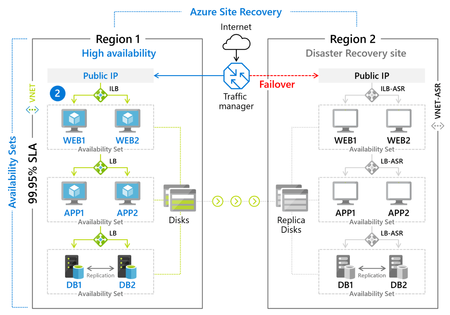
Hello, I am working on a project to replicate worklooad hosted on a VMWare to Azure Site Recovery for disaster recovery purpose. Current Environment: More than 80 VMs hosted on VMWare managed by VMWare Sphere running both Linux and Windows OS.. Databases: Oracle DB, Microsoft SQL and MySQL Requirements: seamless failover and disaster recovery requirements. scalable setup No down-time integrate identity and access mgt. integration with Microsoft Entra ID. RTO < 2 hrs and RPO > 15 minutes Backup: critical database backup every 3 hours App servers: Daily*incremental) and weekly (full) Transaction Logs: every 10 mins backup config. should be Daily Questions I have confirmed ASR supports fail back from Azure- on premise(VMWare specifically). Hence ASR(Azure site recovery) will be used for the project. However, what is the seamless method to replicate the databases(Oracle, Microsoft SQL and MySQL). https://learn.microsoft.com/en-us/azure/site-recovery/vmware-azure-failback What is the best approach to replicate the Application Servers? integrating existing on-premise 3rd party network security tool for firewall etc instead of the azure cloud native security tool. recommendation?? cost optimization techniques/recommendations Best practices for conducting non-destructive DR drills.322Views0likes2Comments
Locked out of Azure account for 5 months! Spent hours on phone, still no resolution! PLEASE HELP!!!
As per the title, back in April I somehow managed to lock myself out of my Azure portal. Typically to sign in my browser would auto-fill in the password field - for some reason that fateful day the auto-fill function didn't work. So I typed in what I believed to be the password, it wasn't. Annoyed, I typed in a few more passwords (even checked browser password manager to ensure I was typing the correct password) and finally locked myself out. Worse still, the email address that Microsoft wanted to send its verification code as a back-up contingency is no longer active (domain wasn't renewed and has since been bought). So Microsoft is sending a verification email to a dead email address... When I try to reset the password via Microsoft's questionnaire, once submitted I then get an automated email response back stating I haven't provided enough correct/relevant information, so the password can't be reset. I have long since lost any hope or faith in Microsoft rectifying this issue. Being courteous on the phone and apologising constantly is all well and good, but is only meaningful if there is a resolution. All that's happened is I've been passed around from one department to another and back again, before eventually being ghosted back in the summer. I have since opened another support ticket which is already winding its way around to ultimately leading me down another dead end. At this stage, all I want is for Microsoft to release my SQL database (my intellectual property) back to me. I am able to provide old invoices relating to my Azure account (when I was able to log in and download invoices!), as well as proof of ID to prove I am who I say I am - enough is enough! Please advise.103Views0likes1Comment
Scaling Smart with Azure: Architecture That Works
Hi Tech Community! I’m Zainab, currently based in Abu Dhabi and serving as Vice President of Finance & HR at Hoddz Trends LLC a global tech solutions company headquartered in Arkansas, USA. While I lead on strategy, people, and financials, I also roll up my sleeves when it comes to tech innovation. In this discussion, I want to explore the real-world challenges of scaling systems with Microsoft Azure. From choosing the right architecture to optimizing performance and cost, I’ll be sharing insights drawn from experience and I’d love to hear yours too. Whether you're building from scratch, migrating legacy systems, or refining deployments, let’s talk about what actually works.307Views0likes1CommentComparision on Azure Cloud Sync and Traditional Entra connect Sync.
Introduction In the evolving landscape of identity management, organizations face a critical decision when integrating their on-premises Active Directory (AD) with Microsoft Entra ID (formerly Azure AD). Two primary tools are available for this synchronization: Traditional Entra Connect Sync (formerly Azure AD Connect) Azure Cloud Sync While both serve the same fundamental purpose, bridging on-prem AD with cloud identity, they differ significantly in architecture, capabilities, and ideal use cases. Architecture & Setup Entra Connect Sync is a heavyweight solution. It installs a full synchronization engine on a Windows Server, often backed by SQL Server. This setup gives administrators deep control over sync rules, attribute flows, and filtering. Azure Cloud Sync, on the other hand, is lightweight. It uses a cloud-managed agent installed on-premises, removing the need for SQL Server or complex infrastructure. The agent communicates with Microsoft Entra ID, and most configurations are handled in the cloud portal. For organizations with complex hybrid setups (e.g., Exchange hybrid, device management), is Cloud Sync too limited?1.2KViews1like2Comments