artificial intelligence
327 TopicsContext-Aware RAG System with Azure AI Search to Cut Token Costs and Boost Accuracy
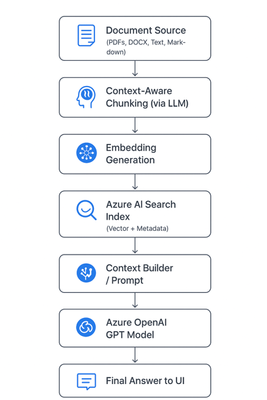
🚀 Introduction As AI copilots and assistants become integral to enterprises, one question dominates architecture discussions: “How can we make large language models (LLMs) provide accurate, source-grounded answers — without blowing up token costs?” Retrieval-Augmented Generation (RAG) is the industry’s go-to strategy for this challenge. But traditional RAG pipelines often use static document chunking, which breaks semantic context and drives inefficiencies. To address this, we built a context-aware, cost-optimized RAG pipeline using Azure AI Search and Azure OpenAI, leveraging AI-driven semantic chunking and intelligent retrieval. The result: accurate answers with up to 85% lower token consumption. Majorly in this blog we are considering: Tokenization Chunking The Problem with Naive Chunking Most RAG systems split documents by token or character count (e.g., every 1,000 tokens). This is easy to implement but introduces real-world problems: 🧩 Loss of context — sentences or concepts get split mid-idea. ⚙️ Retrieval noise — irrelevant fragments appear in top results. 💸 Higher cost — you often send 5× more text than necessary. These issues degrade both accuracy and cost efficiency. 🧠 Context-Aware Chunking: Smarter Document Segmentation Instead of breaking text arbitrarily, our system uses an LLM-powered preprocessor to identify semantic boundaries — meaning each chunk represents a complete and coherent concept. Example Naive chunking: “Azure OpenAI Service offers… [cut] …integrates with Azure AI Search for intelligent retrieval.” Context-aware chunking: “Azure OpenAI Service provides access to models like GPT-4o, enabling developers to integrate advanced natural language understanding and generation into their applications. It can be paired with Azure AI Search for efficient, context-aware information retrieval.” ✅ The chunk is self-contained and semantically meaningful. This allows the retriever to match queries with conceptually complete information rather than partial sentences — leading to precision and fewer chunks needed per query. Architecture Diagram Chunking Service: Purpose: Transforms messy enterprise data (wikis, PDFs, transcripts, repos, images) into structured, model-friendly chunks for Retrieval-Augmented Generation (RAG). ChallengeChunking FixLLM context limitsBreaks docs into smaller piecesEmbedding sizeKeeps within token boundsRetrieval accuracyGranular, relevant sections onlyNoiseRemoves irrelevant blocksTraceabilityChunk IDs for auditabilityCost/latencyRe-embed only changed chunks The Chunking Flow (End-to-End) The Chunking Service sits in the ingestion pipeline and follows this sequence: Ingestion: Raw text arrives from sources (wiki, repo, transcript, PDF, image description). Token-aware splitting: Large text is cut into manageable pre-chunks with a 100-token overlap, ensuring no semantic drift across boundaries. Semantic segmentation: Each pre-chunk is passed to an Azure OpenAI Chat model with a structured prompt. Output = JSON array of semantic chunks (sectiontitle, speaker, content). Optional overlap injection: Character-level overlap can be applied across chunks for discourse-heavy text like meeting transcripts. Embedding generation: Each chunk is passed to Azure OpenAI Embeddings API (text-embedding-3-small), producing a 1536-dimension vector. Indexing: Chunks (text + vectors) are uploaded to Azure AI Search. Retrieval: During question answering or document generation, the system pulls top-k chunks, concatenates them, and enriches the prompt for the LLM. Resilience & Traceability The service is built to handle real-world pipeline issues. It retries once on rate limits, validates JSON outputs, and fails fast on malformed data instead of silently dropping chunks. Each chunk is assigned a unique ID (chunk_<sequence>_<sourceTag>), making retrieval auditable and enabling selective re-embedding when only parts of a document change. ☁️ Why Azure AI Search Matters Here Azure AI Search (formerly Cognitive Search) is the heart of the retrieval pipeline. Key Roles: Vector Search Engine: Stores embeddings of chunks and performs semantic similarity search. Hybrid Search (Keyword + Vector): Combines lexical and semantic matching for high precision and recall. Scalability: Supports millions of chunks with blazing-fast search latency. Metadata Filtering: Enables fine-grained retrieval (e.g., by document type, author, section). Native Integration with Azure OpenAI: Allows a seamless, end-to-end RAG pipeline without third-party dependencies. In short, Azure AI Search provides the speed, scalability, and semantic intelligence to make your RAG pipeline enterprise-grade. 💡 Importance of Azure OpenAI Azure OpenAI complements Azure AI Search by providing: High-quality embeddings (text-embedding-3-large) for accurate vector search. Powerful generative reasoning (GPT-4o or GPT-4.1) to craft contextually relevant answers. Security and compliance within your organization’s Azure boundary — critical for regulated environments. Together, these two services form the retrieval (Azure AI Search) and generation (Azure OpenAI) halves of your RAG system. 💰 Token Efficiency By limiting the model’s input to only the most relevant, semantically meaningful chunks, you drastically reduce prompt size and cost. Approach Tokens per Query Typical Cost Accuracy Full-document prompt ~15,000–20,000 Very high Medium Fixed-size RAG chunks ~5,000–8,000 Moderate Medium-high Context-aware RAG (this approach) ~2,000–3,000 Low High 💰 Token Cost Reduction Analysis Let’s quantify it: Step Naive Approach (no RAG) Your Approach (Context-Aware RAG) Prompt context size Entire document (e.g., 15,000 tokens) Top 3 chunks (e.g., 2,000 tokens) Tokens per query ~16,000 (incl. user + system) ~2,500 Cost reduction — ~84% reduction in token usage Accuracy Often low (hallucinations) Higher (targeted retrieval) That’s roughly an 80–85% reduction in token usage while improving both accuracy and response speed. 🧱 Tech Stack Overview Component Service Purpose Chunking Engine Azure OpenAI (GPT models) Generate context-aware chunks Embedding Model Azure OpenAI Embedding API Create high-dimensional vectors Retriever Azure AI Search Perform hybrid and vector search Generator Azure OpenAI GPT-4o Produce final answer Orchestration Layer Python / FastAPI / .NET c# Handle RAG pipeline 🔍 The Bottom Line By adopting context-aware chunking and Azure AI Search-powered RAG, you achieve: ✅ Higher accuracy (contextually complete retrievals) 💸 Lower cost (token-efficient prompts) ⚡ Faster latency (smaller context per call) 🧩 Scalable and secure architecture (fully Azure-native) This is the same design philosophy powering Microsoft Copilot and other enterprise AI assistants today. 🧪 Real-Life Example: Context-Aware RAG in Action To bring this architecture to life, let’s walk through a simple example of how documents can be chunked, embedded, stored in Azure AI Search, and then queried to generate accurate, cost-efficient answers. Imagine you want to build an internal knowledge assistant that answers developer questions from your company’s Azure documentation. ⚙️ Step 1: Intelligent Document Chunking We’ll use a small LLM call to segment text into context-aware chunks — rather than fixed token counts //Context Aware Chunking //text can be your retrieved text from any page/ document private async Task<List<SemanticChunk>> AzureOpenAIChunk(string text) { try { string prompt = $@" Divide the following text into logical, meaningful chunks. Each chunk should represent a coherent section, topic, or idea. Return the result as a JSON array, where each object contains: - sectiontitle - speaker (if applicable, otherwise leave empty) - content Do not add any extra commentary or explanation. Only output the JSON array. Do not give content an array, try to keep all in string. TEXT: {text}" var client = GetAzureOpenAIClient(); var chatCompletionsOptions = new ChatCompletionOptions { Temperature = 0, FrequencyPenalty = 0, PresencePenalty = 0 }; var Messages = new List<OpenAI.Chat.ChatMessage> { new SystemChatMessage("You are a text processing assistant."), new UserChatMessage(prompt) }; var chatClient = client.GetChatClient( deploymentName: _appSettings.Agent.Model); var response = await chatClient.CompleteChatAsync(Messages, chatCompletionsOptions); string responseText = response.Value.Content[0].Text.ToString(); string cleaned = Regex.Replace(responseText, @"```[\s\S]*?```", match => { var match1 = match.Value.Replace("```json", "").Trim(); return match1.Replace("```", "").Trim(); }); // Try to parse the response as JSON array of chunks return CreateChunkArray(cleaned); } catch (JsonException ex) { _logger.LogError("Failed to parse GPT response: " + ex.Message); throw; } catch (Exception ex) { _logger.LogError("Error in AzureOpenAIChunk: " + ex.Message); throw; } } 🧠 Step 2: Adding Overlaps for better result We are adding overlapping between chunks for better and accurate answers. Overlapping window can be modified based on the documents. public List<SemanticChunk> AddOverlap(List<SemanticChunk> chunks, string IDText, int overlapChars = 0) { var overlappedChunks = new List<SemanticChunk>(); for (int i = 0; i < chunks.Count; i++) { var current = chunks[i]; string previousOverlap = i > 0 ? chunks[i - 1].Content[^Math.Min(overlapChars, chunks[i - 1].Content.Length)..] : ""; string combinedText = previousOverlap + "\n" + current.Content; var Id = $"chunk_{i + '_' + IDText}"; overlappedChunks.Add(new SemanticChunk { Id = Regex.Replace(Id, @"[^A-Za-z0-9_\-=]", "_"), Content = combinedText, SectionTitle = current.SectionTitle }); } return overlappedChunks; } 🧠 Step 3: Generate and Store Embeddings in Azure AI Search We convert each chunk into an embedding vector and push it to an Azure AI Search index. public async Task<List<SemanticChunk>> AddEmbeddings(List<SemanticChunk> chunks) { var client = GetAzureOpenAIClient(); var embeddingClient = client.GetEmbeddingClient("text-embedding-3-small"); foreach (var chunk in chunks) { // Generate embedding using the EmbeddingClient var embeddingResult = await embeddingClient.GenerateEmbeddingAsync(chunk.Content).ConfigureAwait(false); chunk.Embedding = embeddingResult.Value.ToFloats(); } return chunks; } public async Task UploadDocsAsync(List<SemanticChunk> chunks) { try { var indexClient = GetSearchindexClient(); var searchClient = indexClient.GetSearchClient(_indexName); var result = await searchClient.UploadDocumentsAsync(chunks); } catch (Exception ex) { _logger.LogError("Failed to upload documents: " + ex); throw; } } 🤖 Step 4: Generate the Final Answer with Azure OpenAI Now we combine the top chunks with the user query to create a cost-efficient, context-rich prompt. P.S. : Here in this example we have used semantic kernel agent , in real time any agent can be used and any prompt can be updated. var context = await _aiSearchService.GetSemanticSearchresultsAsync(UserQuery); // Gets chunks from Azure AI Search //here UserQuery is query asked by user/any question prompt which need to be answered. string questionWithContext = $@"Answer the question briefly in short relevant words based on the context provided. Context : {context}. \n\n Question : {UserQuery}?"; var _agentModel = new AgentModel() { Model = _appSettings.Agent.Model, AgentName = "Answering_Agent", Temperature = _appSettings.Agent.Temperature, TopP = _appSettings.Agent.TopP, AgentInstructions = $@"You are a cloud Migration Architect. " + "Analyze all the details from top to bottom in context based on the details provided for the Migration of APP app using Azure Services. Do not assume anything." + "There can be conflicting details for a question , please verify all details of the context. If there are any conflict please start your answer with word - **Conflict**." + "There might not be answers for all the questions, please verify all details of the context. If there are no answer for question just mention - **No Information**" }; _agentModel = await _agentService.CreateAgentAsync(_agentModel); _agentModel.QuestionWithContext = questionWithContext; var modelWithResponse = await _agentService.GetAnswerAsync(_agentModel); 🧠 Final Thoughts Context-aware RAG isn’t just a performance optimization — it’s an architectural evolution. It shifts the focus from feeding LLMs more data to feeding them the right data. By letting Azure AI Search handle intelligent retrieval and Azure OpenAI handle reasoning, you create an efficient, explainable, and scalable AI assistant. The outcome: Smarter answers, lower costs, and a pipeline that scales with your enterprise. Wiki Link: Tokenization and Chunking IP Link: AI Migration Accelerator1.2KViews4likes1CommentIntroducing Cohere Rerank 4.0 in Microsoft Foundry
These new retrieval models deliver state-of-the-art accuracy, multilingual coverage across 100+ languages, and breakthrough performance for enterprise search and retrieval-augmented generation (RAG) systems. With Rerank 4.0, customers can dramatically improve the quality of search, reduce hallucinations in RAG applications, and strengthen the reasoning capabilities of their AI agents, all with just a few lines of code. Why Rerank Models Matter for Enterprise AI Retrieval is the foundation of grounded AI systems. Whether you are building an internal assistant, a customer-facing chatbot, or a domain-specific knowledge engine, the quality of the retrieved documents determines the quality of the final answer. Traditional embeddings get you close, but reranking is what gets you the right answer. Rerank improves this step by reading both the query and document together (cross-encoding), producing highly precise semantic relevance scores. This means: More accurate search results More grounded responses in RAG pipelines Lower generative model usage , reducing cost Higher trust and quality across enterprise workloads Introducing Cohere Rerank 4.0 Fast and Rerank 4.0 Pro Microsoft Foundry now offers two versions of Rerank 4.0 to meet different enterprise needs: Rerank 4.0 Fast Best balance of speed and accuracy Same latency as Cohere Rerank 3.5, with significantly higher accuracy Ideal for high-traffic applications and real-time systems Rerank 4.0 Pro Highest accuracy across all benchmarks Excels at complex, reasoning-heavy, domain-specific retrieval Tuned for industries like finance, healthcare, manufacturing, government, and energy Multilingual & Cross-Domain Performance Rerank 4.0 delivers unmatched multilingual and cross-domain performance, supporting more than 100 languages and enabling powerful cross-lingual search across complex enterprise datasets. The models achieve state-of-the-art accuracy in 10 of the world’s most important business languages, including Arabic, Chinese, French, German, Hindi, Japanese, Korean, Portuguese, Russian, and Spanish, making them exceptionally well suited for global organizations with multilingual knowledge bases, compliance archives, or international operations. Effortless Integration: Add Rerank to Any System One of the biggest benefits of Rerank 4.0 is how easy it is to adopt. You can add reranking to: Existing enterprise search Vector DB pipelines Keyword search systems Hybrid retrieval setups RAG architectures Agent workflows No infrastructure changes required. Just a few lines of code.This makes it one of the fastest ways to meaningfully upgrade grounding, precision, and search quality in enterprise AI systems. Better RAG, Better Agents, Better Outcomes In Foundry, customers can pair Cohere Rerank 4.0 with Azure Search, vector databases, Agent Service, Azure Functions, Foundry orchestration, and any LLM—including GPT-4.1, Claude, DeepSeek, and Mistral—to deliver more grounded copilots, higher-fidelity agent actions, and better reasoning from cleaner context windows. This reduces hallucinations, lowers LLM spend, and provides a foundational upgrade for mission-critical AI systems. Built for Enterprise: Security, Observability, Governance As a direct from Azure model, Rerank 4.0 is fully integrated with: Azure role-based access control (RBAC) Virtual network isolation Customer-managed keys Logging & observability Entra ID authentication Private deployments You can run Rerank 4.0 in environments that meet the strictest enterprise security and compliance needs. Optimized for Enterprise Models & High-Value Industries Rerank 4.0 is built for sectors where accuracy matters: Finance - Delivers precise retrieval for complex disclosures, compliance documents, and regulatory filings. Healthcare- Accurately retrieves clinical notes, biomedical literature, and care protocols for safer, more reliable insights. Manufacturing- Surfaces the right engineering specs, manuals, and parts data to streamline operations and reduce downtime. Government & Public Sector - Improves access to policy documents, case archives, and citizen service information with semantic precision. Energy- Understands industrial logs, safety manuals, and technical standards to support safer and more efficient operations. Pricing Model Name Deployment Type Azure Resource Region Price /1K Search Units Availability Cohere Rerank 4.0 Pro Global Standard All regions (Check this page for region details) $2.50 Public Preview, Dec 11, 2025 Cohere Rerank 4.0 Fast Global Standard All regions (Check this page for region details) $2.00 Public Preview, Dec 11, 2025 Get Started Today Cohere Rerank 4.0 Fast and Rerank 4.0 Pro are now available in Microsoft Foundry. Rerank 4.0 is one of the simplest and highest impact upgrades you can make to your enterprise AI stack, bringing better retrieval, better agents, and more trustworthy AI to every application.1.2KViews1like0CommentsHow to Modernise a Microsoft Access Database (Forms + VBA) to Node.JS, OpenAPI and SQL Server
Microsoft Access has played a significant role in enterprise environments for over three decades. Released in November 1992, its flexibility and ease of use made it a popular choice for organizations of all sizes—from FTSE250 companies to startups and the public sector. The platform enables rapid development of graphical user interfaces (GUIs) paired with relational databases, allowing users to quickly create professional-looking applications. Developers, data architects, and power users have all leveraged Microsoft Access to address various enterprise challenges. Its integration with Microsoft Visual Basic for Applications (VBA), an object-based programming language, ensured that Access solutions often became central to business operations. Unsurprisingly, modernizing these applications is a common requirement in contemporary IT engagements as thse solutions lead to data fragmentation, lack of integration into master data systems, multiple copies of the same data replicated across each access database and so on. At first glance, upgrading a Microsoft Access application may seem simple, given its reliance on forms, VBA code, queries, and tables. However, substantial complexity often lurks beneath this straightforward exterior. Modernization efforts must consider whether to retain the familiar user interface to reduce staff retraining, how to accurately re-implement business logic, strategies for seamless data migration, and whether to introduce an API layer for data access. These factors can significantly increase the scope and effort required to deliver a modern equivalent, especially when dealing with numerous web forms, making manual rewrites a daunting task. This is where GitHub Copilot can have a transformative impact, dramatically reducing redevelopment time. By following a defined migration path, it is possible to deliver a modernized solution in as little as two weeks. In this blog post, I’ll walk you through each tier of the application and give you example prompts used at each stage. 🏛️Architecture Breakdown: The N-Tier Approach Breaking down the application architecture reveals a classic N-Tier structure, consisting of a presentation layer, business logic layer, data access layer, and data management layer. 💫First-Layer Migration: Migrating a Microsoft Access Database to SQL Server The migration process began with the database layer, which is typically the most straightforward to move from Access to another relational database management system (RDBMS). In this case, SQL Server was selected to leverage the SQL Server Migration Assistant (SSMA) for Microsoft Access—a free tool from Microsoft that streamlines database migration to SQL Server, Azure SQL Database, or Azure SQL Database Managed Instance (SQLMI). While GitHub Copilot could generate new database schemas and insert scripts, the availability of a specialized tool made the process more efficient. Using SSMA, the database was migrated to SQL Server with minimal effort. However, it is important to note that relationships in Microsoft Access may lack explicit names. In such cases, SSMA appends a GUID or uses one entirely to create unique foreign key names, which can result in confusing relationship names post-migration. Fortunately, GitHub Copilot can batch-rename these relationships in the generated SQL scripts, applying more meaningful naming conventions. By dropping and recreating the constraints, relationships become easier to understand and maintain. SSMA handles the bulk of the migration workload, allowing you to quickly obtain a fully functional SQL Server database containing all original data. In practice, renaming and recreating constraints often takes longer than the data migration itself. Prompt Used: # Context I want to refactor the #file:script.sql SQL script. Your task is to follow the below steps to analyse it and refactor it according to the specified rules. You are allowed to create / run any python scripts or terminal commands to assist in the analysis and refactoring process. # Analysis Phase Identify: Any warning comments Relations between tables Foreign key creation References to these foreign keys in 'MS_SSMA_SOURCE' metadata # Refactor Phase Refactor any SQL matching the following rules: - Create a new script file with the same name as the original but with a `.refactored.sql` extension - Rename any primary key constraints to follow the format PK_{table_name}_{column_name} - Rename any foreign key constraints like [TableName]${GUID} to FK_{child_table}_{parent_table} - Rename any indexes like [TableName]${GUID} to IDX_{table_name}_{column_name} - Ensure any updated foreign keys are updated elsewhere in the script - Identify which warnings flagged by the migration assistant need addressed # Summary Phase Create a summary file in markdown format with the following sections: - Summary of changes made - List of warnings addressed - List of foreign keys renamed - Any other relevant notes 🤖Bonus: Introduce Database Automation and Change Management As we now had a SQL database, we needed to consider how we would roll out changes to the database and we could introduce a formal tool to cater for this within the solution which was Liquibase. Prompt Used: # Context I want to refactor #file:db.changelog.xml. Your task is to follow the below steps to analyse it and refactor it according to the specified rules. You are allowed to create / run any python scripts or terminal commands to assist in the analysis and refactoring process. # Analysis Phase Analyse the generated changelog to identify the structure and content. Identify the tables, columns, data types, constraints, and relationships present in the database. Identify any default values, indexes, and foreign keys that need to be included in the changelog. Identify any vendor specific data types / fucntions that need to be converted to common Liquibase types. # Refactor Phase DO NOT modify the original #file:db.changelog.xml file in any way. Instead, create a new changelog file called `db.changelog-1-0.xml` to store the refactored changesets. The new file should follow the structure and conventions of Liquibase changelogs. You can fetch https://docs.liquibase.com/concepts/data-type-handling.html to get available Liquibase types and their mappings across RDBMS implementations. Copy the original changesets from the `db.changelog.xml` file into the new file Refactor the changesets according to the following rules: - The main changelog should only include child changelogs and not directly run migration operations - Child changelogs should follow the convention db.changelog-{version}.xml and start at 1-0 - Ensure data types are converted to common Liquibase data types. For example: - `nvarchar(max)` should be converted to `TEXT` - `datetime2` should be converted to `TIMESTAMP` - `bit` should be converted to `BOOLEAN` - Ensure any default values are retained but ensure that they are compatible with the liquibase data type for the column. - Use standard SQL functions like `CURRENT_TIMESTAMP` instead of vendor-specific functions. - Only use vendor specific data types or functions if they are necessary and cannot be converted to common Liquibase types. These must be documented in the changelog and summary. Ensure that the original changeset IDs are preserved for traceability. Ensure that the author of all changesets is "liquibase (generated)" # Validation Phase Validate the new changelog file against the original #file:db.changelog.xml to ensure that all changesets are correctly refactored and that the structure is maintained. Confirm no additional changesets are added that were not present in the original changelog. # Finalisation Phase Provide a summary of the changes made in the new changelog file. Document any vendor specific data types or functions that were used and why they could not be converted to common Liquibase types. Ensure the main changelog file (`db.changelog.xml`) is updated to include the new child changelog file (`db.changelog-1-0.xml`). 🤖Bonus: Synthetic Data Generation Since the legacy system lacked synthetic data for development or testing, GitHub Copilot was used to generate fake seed data. Care was taken to ensure all generated data was clearly fictional—using placeholders like ‘Fake Name’ and ‘Fake Town’—to avoid any confusion with real-world information. This step greatly improved the maintainability of the project, enabling developers to test features without handling sensitive or real data. 💫Second-Layer Migration: OpenAPI Specifications With data migration complete, the focus shifted to implementing an API-driven approach for data retrieval. Adopting modern standards, OpenAPI specifications were used to define new RESTful APIs for creating, reading, updating, and deleting data. Because these APIs mapped directly to underlying entities, GitHub Copilot efficiently generated the required endpoints and services in Node.js, utilizing a repository pattern. This approach not only provided robust APIs but also included comprehensive self-describing documentation, validation at the API boundary, automatic error handling, and safeguards against invalid data reaching business logic or database layers. 💫Third-Layer Migration: Business Logic The business logic, originally authored in VBA, was generally straightforward. GitHub Copilot translated this logic into its Node.js equivalent and created corresponding tests for each method. These tests were developed directly from the code, adding a layer of quality assurance that was absent in the original Access solution. The result was a set of domain services mirroring the functionality of their VBA predecessors, successfully completing the migration of the third layer. At this stage, the project had a new database, a fresh API tier, and updated business logic, all conforming to the latest organizational standards. The final major component was the user interface, an area where advances in GitHub Copilot’s capabilities became especially evident. 💫Fourth Layer: User Interface The modernization of the Access Forms user interface posed unique challenges. To minimize retraining requirements, the new system needed to retain as much of the original layout as possible, ensuring familiar placement of buttons, dropdowns, and other controls. At the same time, it was necessary to meet new accessibility standards and best practices. Some Access forms were complex, spanning multiple tabs and containing numerous controls. Manually describing each interface for redevelopment would have been time-consuming. Fortunately, newer versions of GitHub Copilot support image-based prompts, allowing screenshots of Access Forms to serve as context. Using these screenshots, Copilot generated Government Digital Service Views that closely mirrored the original application while incorporating required accessibility features, such as descriptive labels and field selectors. Although the automatically generated UI might not fully comply with all current accessibility standards, prompts referencing WCAG guidelines helped guide Copilot’s improvements. The generated interfaces provided a strong starting point for UX engineers to further refine accessibility and user experience to meet organizational requirements. 🤖Bonus: User Story Generation from the User Interface For organizations seeking a specification-driven development approach, GitHub Copilot can convert screenshots and business logic into user stories following the “As a … I want to … So that …” format. While not flawless, this capability is invaluable for systems lacking formal requirements, giving business analysts a foundation to build upon in future iterations. 🤖Bonus: Introducing MongoDB Towards the end of the modernization engagement, there was interest in demonstrating migration from SQL Server to MongoDB. GitHub Copilot can facilitate this migration, provided it is given adequate context. As with all NoSQL databases, the design should be based on application data access patterns—typically reading and writing related data together. Copilot’s ability to automate this process depends on a comprehensive understanding of the application’s data relationships and patterns. # Context The `<business_entity>` entity from the existing system needs to be added to the MongoDB schema. You have been provided with the following: - #file:documentation - System documentation to provide domain / business entity context - #file:db.changelog.xml - Liquibase changelog for SQL context - #file:mongo-erd.md - Contains the current Mongo schema Mermaid ERD. Create this if it does not exist. - #file:stories - Contains the user stories that will the system will be built around # Analysis Phase Analyse the available documentation and changelog to identify the structure, relationships, and business context of the `<business_entity>`. Identify: - All relevant data fields and attributes - Relationships with other entities - Any specific data types, constraints, or business rules Determine how this entity fits into the overall MongoDB schema: - Should it be a separate collection? - Should it be embedded in another document? - Should it be a reference to another collection for lookups or relationships? - Explore the benefit of denormalization for performance and business needs Consider the data access patterns and how this entity will be used in the application. # MongoDB Schema Design Using the analysis, suggest how the `<business_entity>` should be represented in MongoDB: - The name of the MongoDB collection that will represent this entity - List each field in the collection, its type, any constraints, and what it maps to in the original business context - For fields that are embedded, document the parent collection and how the fields are nested. Nested fields should follow the format `parentField->childField`. - For fields that are referenced, document the reference collection and how the lookup will be performed. - Provide any additional notes on indexing, performance considerations, or specific MongoDB features that should be used - Always use pascal case for collection names and camel case for field names # ERD Creation Create or update the Mermaid ERD in `mongo-erd.md` to include the results of your analysis. The ERD should reflect: - The new collection or embedded document structure - Any relationships with other collections/entities - The data types, constraints, and business rules that are relevant for MongoDB - Ensure the ERD is clear and follows best practices for MongoDB schema design Each entity in the ERD should have the following layout: **Entity Name**: The name of the MongoDB collection / schema **Fields**: A list of fields in the collection, including: - Field Name (in camel case) - Data Type (e.g., String, Number, Date, ObjectId) - Constraints (e.g. indexed, unique, not null, nullable) In this example, Liquibase was used as a changelog to supply the necessary context, detailing entities, columns, data types, and relationships. Based on this, Copilot could offer architectural recommendations for new document or collection types, including whether to embed documents or use separate collections with cache references for lookup data. Copilot can also generate an entity relationship diagram (ERD), allowing for review and validation before proceeding. From there, a new data access layer can be generated, configurable to switch between SQL Server and MongoDB as needed. While production environments typically standardize on a single database model, this demonstration showcased the speed and flexibility with which strategic architectural components can be introduced using GitHub Copilot. 👨💻Conclusion This modernization initiative demonstrated how strategic use of automation and best practices can transform legacy Microsoft Access solutions into scalable, maintainable architectures utilizing Node.js, SQL Server, MongoDB, and OpenAPI. By carefully planning each migration layer—from database and API specifications to business logic—the team preserved core functionality while introducing modern standards and enhanced capabilities. GitHub Copilot played a pivotal role, not only speeding up redevelopment but also improving code quality through automated documentation, test generation, and meaningful naming conventions. The result was a significant reduction in development time, with a robust, standards-compliant system delivered in just two weeks compared to an estimated six to eight months using traditional manual methods. This project serves as a blueprint for organizations seeking to modernize their Access-based applications, highlighting the efficiency gains and quality improvements that can be achieved by leveraging AI-powered tools and well-defined migration strategies. The approach ensures future scalability, easier maintenance, and alignment with contemporary enterprise requirements.259Views1like1Comment
From Large Semi-Structured Docs to Actionable Data: Reusable Pipelines with ADI, AI Search & OpenAI
Problem Space Large semi-structured documents such as contracts, invoices, hospital tariff/rate cards multi-page reports, and compliance records often carry essential information that is difficult to extract reliably with traditional approaches. Their layout can span several pages, the structure is rarely consistent, and related fields may appear far apart even though they must be interpreted together. This makes it hard not only to detect the right pieces of information but also to understand how those pieces relate across the document. LLM can help, but when documents are long and contain complex cross-references, they may still miss subtle dependencies or generate hallucinated information. That becomes risky in environments where small errors can cascade into incorrect decisions. At the same time, these documents don’t change frequently, while the extracted data is used repeatedly by multiple downstream systems at scale. Because of this usage pattern, a RAG-style pipeline is often not ideal in terms of cost, latency, or consistency. Instead, organizations need a way to extract data once, represent it consistently, and serve it efficiently in a structured form to a wide range of applications, many of which are not conversational AI systems. At this point, data stewardship becomes critical, because once information is extracted, it must remain accurate, governed, traceable, and consistent throughout its lifecycle. When the extracted information feed compliance checks, financial workflows, risk models, or end-user experiences, the organization must ensure that the data is not just captured correctly but also maintained with proper oversight as it moves across systems. Any extraction pipeline that cannot guarantee quality, reliability, and provenance introduces long-term operational risk. The core problem, therefore, is finding a method that handles the structural and relational complexity of large semi-structured documents, minimizes LLM hallucination risk, produces deterministic results, and supports ongoing data stewardship so that the resulting structured output stays trustworthy and usable across the enterprise. Target Use Cases The potential applications for an Intelligent Document Processing (IDP) pipeline differ across industries. Several industry-specific use cases are provided as examples to guide the audience in conceptualising and implementing solutions tailored to their unique requirements. Hospital Tariff Digitization for Tariff-Invoice Reconciliation in Health Insurance Document types: Hospital tariff/rate cards, annexures/guidelines, pre-authorization guidelines etc. Technical challenge: Charges for the same service might appear under different sections or for different hospital room types across different versions of tariff/rate cards. Table + free text mix, abbreviations, and cross-page references. Downstream usage: Reimbursement orchestration, claims adjudication Commercial Loan Underwriting in Banking Document types: Balance sheets, cash-flow statements, auditor reports, collateral documents. Technical Challenge: Ratios and covenants must be computed from fields located across pages. Contextual dependencies: “Net revenue excluding exceptional items” or footnotes that override values. Downstream usage: Loan decisioning models, covenant monitoring, credit scoring. Procurement Contract Intelligence in Manufacturing Document types: Vendor agreements, SLAs, pricing annexures. Technical Challenge: Pricing rules defined across clauses that reference each other. Penalty and escalation conditions hidden inside nested sections. Downstream usage: Automated PO creation, compliance checks. Regulatory Compliance Extraction Document types: GDPR/HIPAA compliance docs, audit reports. Technical Challenge: Requirements and exceptions buried across many sections. Extraction must be deterministic since compliance logic is strict. Downstream usage: Rule engines, audit workflows, compliance checklist. Solution Approaches Problem Statement Across industries from finance and healthcare to legal and compliance, large semi-structured documents serve as the single source of truth for critical workflows. These documents often span hundreds of pages, mixing free text, tables, and nested references. Before any automation can validate transactions, enforce compliance, or perform analytics, this information must be transformed into a structured, machine-readable format. The challenge isn’t just size; it’s complexity. Rules and exceptions are scattered, relationships span multiple sections, and formatting inconsistencies make naive parsing unreliable. Errors at this stage ripple downstream, impacting reconciliation, risk models, and decision-making. In short, the fidelity of this digitization step determines the integrity of every subsequent process. Solving this problem requires a pipeline that can handle structural diversity, preserve context, and deliver deterministic outputs at scale. Challenges There are many challenges which can arise while solving for such large complex documents. The documents can have ~200-250 pages. The documents structures and layouts can be extremely complex in nature. A document or a page may contain a mix of various layouts like tables, text blocks, figures etc. Sometimes a single table can stretch across multiple pages, but only the first page contains the table header, leaving the remaining pages without column labels. A topic on one page may be referenced from a different page, so there can be complex inter-relationship amongst different topics in the same documents which needs to be structured in a machine-readable format. The document can be semi-structured as well (some parts are structured; some parts are unstructured or free text) The downstream applications might not always be AI-assisted (it can be core analytics dashboard or existing enterprise legacy system), so the structural storage of the digitized items from the documents need to be very well thought out before moving ahead with the solution. Motivation Behind High Level Approach A larger document (number of pages ~200) needs to be divided into smaller chunks so that it becomes readable and digestible (within context length) for the LLM. To make the content/input of the LLM truly context-aware, the references must be maintained across pages (for example, table headers of long and continuous tables need to be injected to those chunks which would have the tables without the headers). If a pre-defined set of topics/entities are being covered in the documents in consideration, then topic/entity-wise information needs to be extracted for making the system truly context-aware. Different chunks can cover similar topic/entity which becomes a search problem The retrieval needs to happen for every topic/entity so that all information related to one topic/entity are in a single place and as a result the downstream applications become efficient, scalable and reliable over time. Sample Architecture and Implementation Let’s take a possible approach to demonstrate the feasibility of the following architecture, building on the motivation outlined above. The solution divides a large, semi-structured document into manageable chunks, making it easier to maintain context and references across pages. First, the document is split into logical sections. Then, OCR and layout extraction capture both text and structure, followed by structure analysis to preserve semantic relationships. Annotated chunks are labeled and grouped by entity, enabling precise extraction of items such as key-value pairs or table data. As a result, the system efficiently transforms complex documents into structured, context-rich outputs ready for downstream analytics and automation. Architecture Components The key elements of the architecture diagram include components 1-6, which are code modules. Components 7 and 8 represent databases that store data chunks and extracted items, while component 9 refers to potential downstream systems that will use the structured data obtained from extraction. Chunking: Break documents into smaller, logical sections such as pages or content blocks. Enables parallel processing and improves context handling for large files. Technology: Python-based chunking logic using pdf2image and PIL for image handling. OCR & Layout Extraction: Convert scanned images into machine-readable text while capturing layout details like bounding boxes, tables, and reading order for structural integrity. Technology: Azure Document Intelligence or Microsoft Foundry Content Understanding Prebuilt Layout model combining OCR with deep learning for text, tables, and structure extraction. Context Aware Structural Analysis: Analyse the extracted layout to identify document components such as headers, paragraphs, and tables. Preserves semantic relationships for accurate interpretation. Technology: Custom Python logic leveraging OCR output to inject missing headers, summarize layout (row/column counts, sections per page). Labelling: Assign entity-based labels to chunks according to predefined schema or SME input. Helps filter irrelevant content and focus on meaningful sections. Technology: Azure OpenAI GPT-4.1-mini with NLI-style prompts for multi-class classification. Entity-Wise Grouping: Organize chunks by entity type (e.g., invoice number, total amount) for targeted extraction. Reduces noise and improves precision in downstream tasks. Technology: Azure AI Search with Hybrid Search and Semantic Reranking for grouping relevant chunks. Item Extraction: Extract specific values such as key-value pairs, line items, or table data from grouped chunks. Converts semi-structured content into structured fields. Technology: Azure OpenAI GPT-4.1-mini with Set of Marking style prompts using layout clues (row × column, headers, OCR text). Interim Chunk Storage: Store chunk-level data including OCR text, layout metadata, labels, and embeddings. Supports traceability, semantic search, and audit requirements. Technology: Azure AI Search for chunk indexing and Azure OpenAI Embedding models for semantic retrieval. Document Store: Maintain final extracted items with metadata and bounding boxes. Enables quick retrieval, validation, and integration with enterprise systems. Technology: Azure Cosmos DB, Azure SQL DB, Azure AI Search, or Microsoft Fabric depending on downstream needs (analytics, APIs, LLM apps). Downstream Integration: Deliver structured outputs (JSON, CSV, or database records) to business applications or APIs. Facilitates automation and analytics across workflows. Technology: REST APIs, Azure Functions, or Data Pipelines integrated with enterprise systems. Algorithms Consider these key algorithms when implementing the components above: Structural Analysis – Inject headers: Detect tables page by page; compare the last row of a table on page i with the first row of a table on page i+1, if column counts match and ≥4/5 style features (Font Weight, Background Colour, Font Style, Foreground Colour, Similar Font Family) match, mark it as a continuous table (header missing) and inject the previous page’s header into the next page’s table, repeating across pages. Labelling – Prompting Guide: Run NLI checks per SOC chunk image (ground on OCR text) across N curated entity labels, return {decision ∈ {ENTAILED, CONTRADICTED, NEUTRAL}, confidence ∈ [0,1]}, and output only labels where decision = ENTAILED and confidence > 0.7. Entity-Wise Grouping – Querying Chunks per Entity & Top‑50 Handling: Construct the query from the entity text and apply hybrid search with label filters for Azure AI Search, starting with chunks where the target label is sole, then expanding to observed co‑occurrence combinations under a cap to prevent explosion. If label frequency >50, run staged queries (sole‑label → capped co‑label combos); otherwise use a single hybrid search with semantic reranking, merge results and deduplicate before scoring. Entity-Wise Grouping – Chunk to Entity relevance scoring: For each retrieved chunk, split text into spans; compute cosine similarities to the entity text and take the mean s. Boost with a gated nonlinearity b=σ(k(s-m))⋅s. where σ is sigmoid function and k,m are tunables to emphasize mid-range relevance while suppressing very low s. Min–max normalize the re-ranker score r → r_norm; compute the final score F=α*b+(1-α)*r_norm, and keep the chunk iff F≥τ. Item Extraction – Prompting Guide: Provide the chunk image as an input and ground on visual structure (tables, headers, gridlines, alignment, typography) and document structural metadata to segment and align units; reconcile ambiguities via OCR extracted text, then enumerate associations by positional mapping (header ↔ column, row ↔ cell proximity) and emit normalized objects while filtering narrative/policy text by layout and pattern cues. Deployment at Scale There are several ways to implement a document extraction pipeline, each with its own pros and cons. The best deployment model depends on scenario requirements. Below are some common approaches with their advantages and disadvantages. Host as REST API Pros: Enables straightforward creation, customization, and deployment across scalable compute services such as Azure Kubernetes Service. Cons: Processing time and memory usage scale with document size and complexity, potentially requiring multiple iterations to optimize performance. Deploy as Azure Machine Learning (ML) Pipeline Pros: Facilitates efficient time and memory management, as Azure ML supports processing large datasets at scale. Cons: The pipeline may be more challenging to develop, customize, and maintain. Deploy as Azure Databricks Job Pros: Offers robust time and memory management similar to Azure ML, with advanced features such as Data Autoloader for detecting data changes and triggering pipeline execution. Cons: The solution is highly tailored to Azure Databricks and may have limited customization options. Deploy as Microsoft Fabric Pipeline Pros: Provides capabilities comparable to Azure ML and Databricks, and features like Fabric Activator replicate Databricks Autoloader functionality. Cons: Presents similar limitations found in Azure ML and Azure Databricks approaches. Each method should be carefully evaluated to ensure alignment with technical and operational requirements. Evaluation Objective: The aim is to evaluate how accurately a document extraction pipeline extracts information by comparing its output with manually verified data. Approach: Documents are split into sections, labelled, and linked to relevant entities; then, AI tools extract key items through the outlined pipeline mentioned above. The extracted data is checked against expert-curated records using both exact and approximate matching techniques. Key Metrics: Individual Item Attribute Match: Assesses the system’s ability to identify specific item attributes using strict and flexible comparison methods. Combined Item Attribute Match: Evaluates how well multiple attributes are identified together, considering both exact and fuzzy matches. Precision Calculation: Precision for each metric reflects the proportion of correctly matched entries compared to all reference entries. Findings for a real-world scenario: Fuzzy matching of item key attributes yields high precision (over 90%), but accuracy drops for key attribute combinations (between 43% and 48%). These results come from analysis across several datasets to ensure reliability. How This Addresses the Problem Statement The sample architecture described integrates sectioning, entity linking, and attribute extraction as foundational steps. Each extracted item is then evaluated against expert-curated datasets using both strict (exact) and flexible (fuzzy) matching algorithms. This approach directly addresses the problem statement by providing measurable metrics, such as individual and combined attribute match rates and precision calculations, that quantify the system’s reliability and highlight areas for improvement. Ultimately, this methodology ensures that the pipeline’s output is systematically validated, and its strengths and limitations are clearly understood in real-world contexts. Plausible Alternative Approaches No single approach fits every use case; the best method depends on factors like document complexity, structure, sensitivity, and length as well as the downstream application types, Consider these alternative approaches for different scenarios. Using Azure OpenAI alone Article: Best Practices for Structured Extraction from Documents Using Azure OpenAI Using Azure OpenAI + Azure Document Intelligence + Azure AI Search: RAG like solution Article 1: Document Field Extraction with Generative AI Article 2: Complex Data Extraction using Document Intelligence and RAG Article 3: Design and develop a RAG solution Using Azure OpenAI + Azure Document Intelligence + Azure AI Search: Non-RAG like solution Article: Using Azure AI Document Intelligence and Azure OpenAI to extract structured data from documents GitHub Repository: Content processing solution accelerator Conclusion Intelligent Document Processing for large semi-structured documents isn’t just about extracting data, it’s about building trust in that data. By combining Azure Document Intelligence for layout-aware OCR with OpenAI models for contextual understanding, we create a well thought out in-depth pipeline that is accurate, scalable, and resilient against complexity. Chunking strategies ensure context fits within model limits, while header injection and structural analysis preserve relationships across pages to make it context-aware. Entity-based grouping and semantic retrieval transform scattered content into organized, query-ready data. Finally, rigorous evaluation with scalable ground truth strategy roadmap, using precision, recall, and fuzzy matching, closes the loop, ensuring reliability for downstream systems. This pattern delivers more than automation; it establishes a foundation for compliance, analytics, and AI-driven workflows at enterprise scale. In short, it’s a blueprint for turning chaotic document into structured intelligence, efficient, governed, and future-ready for any kind of downstream applications. References Azure Content Understanding in Foundry Tools Azure Document Intelligence in Foundry Tools Azure OpenAI in Microsoft Foundry models Azure AI Search Azure Machine Learning (ML) Pipelines Azure Databricks Job Microsoft Fabric Pipeline299Views0likes0CommentsFoundry IQ: boost response relevance by 36% with agentic retrieval
The latest RAG performance evaluations and results for knowledge bases and built-in agentic retrieval engine. Foundry IQ by Azure AI Search is a unified knowledge layer for agents, designed to improve response performance, automate RAG workflows and enable enterprise-ready grounding. These evaluations tested RAG performance for knowledge bases and new features including retrieval reasoning effort and federated sources like web and SharePoint for M365. Foundry IQ and Azure AI Search are part of Microsoft Foundry.3.6KViews4likes0CommentsAzure Resiliency: Proactive Continuity with Agentic Experiences and Frontier Innovation
Introduction In today’s digital-first world, even brief downtime can disrupt revenue, reputation, and operations. Azure’s new resiliency capabilities empower organizations to anticipate and withstand disruptions—embedding continuity into every layer of their business. At Microsoft Ignite, we’re unveiling a new era of resiliency in Azure, powered by agentic experiences. The new Azure Copilot resiliency agent brings AI-driven workflows that proactively detect vulnerabilities, automate backups, and integrate cyber recovery for ransomware protection. IT teams can instantly assess risks and deploy solutions across infrastructure, data, and cyber recovery—making resiliency a living capability, not just a checklist. The Evolution from Azure Business Continuity Center to Resiliency in Azure Microsoft is excited to announce that the Azure Business Continuity Center (ABCC) is evolving into resiliency capabilities in Azure. This evolution expands its scope from traditional backup and disaster recovery to a holistic resiliency framework. This new experience is delivered directly in the Azure Portal, providing integrated dashboards, actionable recommendations, and one-click access to remediation—so teams can manage resiliency where they already operate. Learn more about this: Resiliency. To see the new experience, visit the Azure Portal. The Three Pillars of Resiliency Azure’s resiliency strategy is anchored in three foundational pillars, each designed to address a distinct dimension of operational continuity: Infrastructure Resiliency: Built-in redundancy and zonal/regional management keep workloads running during disruptions. The resiliency agent in Azure Copilot automates posture checks, risk detection, and remediation. Data Resiliency: Automated backup and disaster recovery meet RPO/RTO and compliance needs across Azure, on-premises, and hybrid. Cyber Recovery: Isolated recovery vaults, immutable backups, and AI-driven insights defend against ransomware and enable rapid restoration. With these foundational pillars in place, organizations can adopt a lifecycle approach to resiliency—ensuring continuity from day one and adapting as their needs evolve. The Lifecycle Approach: Start Resilient, Get Resilient, Stay Resilient While the pillars define what resiliency protects, the lifecycle stages in resiliency journey define how organizations implement and sustain it over time. For the full framework, see the prior blog; below we focus on what’s new and practical. The resiliency agent in Azure Copilot empowers organizations to embed resiliency at every stage of their cloud journey—making proactive continuity achievable from day one and sustainable over time. Start Resilient: With the new resiliency agent, teams can “Start Resilient” by leveraging guided experiences and automated posture assessments that help design resilient workloads before deployment. The agent surfaces architecture gaps, validates readiness, and recommends best practices—ensuring resiliency is built in from the outset, not bolted on later. Get Resilient: As organizations scale, the resiliency agent enables them to “Get Resilient” by providing estate-wide visibility, automated risk assessments, and configuration recommendations. AI-driven insights help identify blind spots, remediate risks, and accelerate the adoption of resilient-by-default architectures—so resiliency is actively achieved across all workloads, not just planned. Stay Resilient: To “Stay Resilient,” the resiliency agent delivers continuous validation, monitoring, and improvement. Automated failure simulations, real-time monitoring, and attestation reporting allow teams to proactively test recovery workflows and ensure readiness for evolving threats. One-click failover and ongoing posture checks help sustain compliance and operational continuity, making resiliency a living capability that adapts as your business and technology landscape changes Best Practices for Proactive Continuity in Resiliency To enable proactive continuity, organizations should: Architect for high availability across multiple availability zones and regions (prioritize Tier-0/1 workloads). Automate recovery with Azure Site Recovery and failover playbooks for orchestrated, rapid restoration. Leverage integrated zonal resiliency experiences to uncover blind spots and receive tailored recommendations. Continuously validate using Chaos Studio to simulate outages and test recovery workflows. Monitor SLAs, RPO/RTO, and posture metrics with Azure Monitor and Policy; iterate for ongoing improvement. Use the Azure Copilot resiliency agent for AI-driven posture assessments, remediation scripts, and cost analysis to streamline operations. Conclusion & Next Steps Resiliency capabilities in Azure unifies infrastructure, data, and cyber recovery while guiding organizations to start, get, and stay resilient. Teams adopting these capabilities see faster posture improvements, less manual effort, and continuous operational continuity. This marks a fundamental shift—from reactive recovery to proactive continuity. By embedding resiliency as a living capability, Azure empowers organizations to anticipate, withstand, and recover from disruptions, adapting to new threats and evolving business needs. Organizations adopting Resiliency in Azure see measurable impact: Accelerated posture improvement with AI-driven insights and actionable recommendations. Less manual effort through automation and integrated recovery workflows. Continuous operational continuity via ongoing validation and monitoring Ready to take the next step? Explore these resources and sessions: Resiliency in Azure (Portal) Resiliency in Azure (Learn Docs) Agents (preview) in Azure Copilot Resiliency Solutions Reliability Guides by Service Azure Essentials Azure Accelerate Ignite Announcement Key Ignite 2025 Sessions to Watch: Resilience by Design: Secure, Scalable, AI-Ready Cloud with Azure (BRK217) Resiliency & Recovery with Azure Backup and Site Recovery (BRK146) Architect Resilient Apps with Azure Backup and Reliability Features (BRK148) Architecting for Resiliency on Azure Infrastructure (BRK178) All sessions are available on demand—perfect for catching up or sharing with your team. Browse the full session catalog and start building resiliency by default today.531Views4likes0CommentsSecuring Azure AI Applications: A Deep Dive into Emerging Threats | Part 1
Why AI Security Can’t Be Ignored? Generative AI is rapidly reshaping how enterprises operate—accelerating decision-making, enhancing customer experiences, and powering intelligent automation across critical workflows. But as organizations adopt these capabilities at scale, a new challenge emerges: AI introduces security risks that traditional controls cannot fully address. AI models interpret natural language, rely on vast datasets, and behave dynamically. This flexibility enables innovation—but also creates unpredictable attack surfaces that adversaries are actively exploiting. As AI becomes embedded in business-critical operations, securing these systems is no longer optional—it is essential. The New Reality of AI Security The threat landscape surrounding AI is evolving faster than any previous technology wave. Attackers are no longer focused solely on exploiting infrastructure or APIs; they are targeting the intelligence itself—the model, its prompts, and its underlying data. These AI-specific attack vectors can: Expose sensitive or regulated data Trigger unintended or harmful actions Skew decisions made by AI-driven processes Undermine trust in automated systems As AI becomes deeply integrated into customer journeys, operations, and analytics, the impact of these attacks grows exponentially. Why These Threats Matter? Threats such as prompt manipulation and model tampering go beyond technical issues—they strike at the foundational principles of trustworthy AI. They affect: Confidentiality: Preventing accidental or malicious exposure of sensitive data through manipulated prompts. Integrity: Ensuring outputs remain accurate, unbiased, and free from tampering. Reliability: Maintaining consistent model behavior even when adversaries attempt to deceive or mislead the system. When these pillars are compromised, the consequences extend across the business: Incorrect or harmful AI recommendations Regulatory and compliance violations Damage to customer trust Operational and financial risk In regulated sectors, these threats can also impact audit readiness, risk posture, and long-term credibility. Understanding why these risks matter builds the foundation. In the upcoming blogs, we’ll explore how these threats work and practical steps to mitigate them using Azure AI’s security ecosystem. Why AI Security Remains an Evolving Discipline? Traditional security frameworks—built around identity, network boundaries, and application hardening—do not fully address how AI systems operate. Generative models introduce unique and constantly shifting challenges: Dynamic Model Behavior: Models adapt to context and data, creating a fluid and unpredictable attack surface. Natural Language Interfaces: Prompts are unstructured and expressive, making sanitization inherently difficult. Data-Driven Risks: Training and fine-tuning pipelines can be manipulated, poisoned, or misused. Rapidly Emerging Threats: Attack techniques evolve faster than most defensive mechanisms, requiring continuous learning and adaptation. Microsoft and other industry leaders are responding with robust tools—Azure AI Content Safety, Prompt Shields, Responsible AI Frameworks, encryption, isolation patterns—but technology alone cannot eliminate risk. True resilience requires a combination of tooling, governance, awareness, and proactive operational practices. Let's Build a Culture of Vigilance: AI security is not just a technical requirement—it is a strategic business necessity. Effective protection requires collaboration across: Developers Data and AI engineers Cybersecurity teams Cloud platform teams Leadership and governance functions Security for AI is a shared responsibility. Organizations must cultivate awareness, adopt secure design patterns, and continuously monitor for evolving attack techniques. Building this culture of vigilance is critical for long-term success. Key Takeaways: AI brings transformative value, but it also introduces risks that evolve as quickly as the technology itself. Strengthening your AI security posture requires more than robust tooling—it demands responsible AI practices, strong governance, and proactive monitoring. By combining Azure’s built-in security capabilities with disciplined operational practices, organizations can ensure their AI systems remain secure, compliant, and trustworthy, even as new threats emerge. What’s Next? In future blogs, we’ll explore two of the most important AI threats—Prompt Injection and Model Manipulation—and share actionable strategies to mitigate them using Azure AI’s security capabilities. Stay tuned for practical guidance, real-world scenarios, and Microsoft-backed best practices to keep your AI applications secure. Stay Tuned.!589Views3likes0CommentsAzure IoT Operations 2510 Now Generally Available
Introduction We’re thrilled to announce the general availability of Azure IoT Operations 2510, the latest evolution of the adaptive cloud approach for AI in industrial and large scale commercial IoT. With this release, organizations can unlock new levels of scalability, security, and interoperability, empowering teams to seamlessly connect, manage, and analyze data from edge to cloud. What is Azure IoT Operations? Azure IoT Operations is more than an edge-to-cloud data plane, it’s the foundation for AI in physical environments, enabling intelligent systems to perceive, reason, and act in the real world. Built on Arc-enabled Kubernetes clusters, Azure IoT Operations unifies operational and business data across distributed environments, eliminating silos and delivering repeatability and scalability. By extending familiar Azure management concepts to physical sites, AIO creates an AI-ready infrastructure that supports autonomous, adaptive operations at scale. This approach bridges information technology (IT), operational technology (OT), and data domains, empowering customers to discover, collect, process, and send data using open standards while laying the groundwork for self-optimizing environments where AI agents and human supervisors collaborate seamlessly. We've put together a quick demo video showcasing the key features of this 2510 release. Watch below to discover how Azure IoT Operations' modular and scalable data services empowers IT, OT and developers. What’s New in Azure IoT Operations 2510? Management actions: Powerful management actions put you in control of processes and asset configurations, making operations simpler and smarter. Web Assembly (Wasm) data graphs: Wasm-powered data graphs for advanced edge processing, delivering fast, modular analytics and business logic right where your data lives. New connectors: Expanded connector options now include OPC UA, ONVIF, Media, REST/HTTP, and Server-Sent Events (SSE), opening the door to richer integrations across diverse industrial and IT systems. OpenTelemetry (OTel) endpoints: Data flows now support sending data directly to OpenTelemetry collectors, integrating device and system telemetry into your existing observability infrastructure. Improved observability: Real-time health status for assets gives you unmatched visibility and confidence in your IoT ecosystem. Reusable Connector templates: Streamline connector configuration and deployment across clusters. Device support in Azure Device Registry: Azure Device Registry (ADR) now treats devices as first‑class resources within ADR namespaces, enabling logical isolation and role‑based access control at scale. Automatic device and asset discovery and onboarding: Akri‑powered discovery continuously detects devices and industrial assets on the network, then automatically provisions and onboards them (including creating the right connector instances) so telemetry starts flowing with minimal manual setup. MQTT Data Persistence: Data can now be persisted to disk, ensuring durability across broker restarts. X.509 Auth in MQTT broker: The broker now supports X.509 authentication backed by Azure's Device Registry. Flexible RBAC: Built-in roles and custom role definitions to simplify and secure access management for AIO resources. Customers and partners Chevron, through its Facilities and Operations of the Future initiative, deployed Azure IoT Operations with Azure Arc to manage edge-to-cloud workloads across remote oil and gas sites. With a single management plane, the strategy unifies control over thousands of distributed sensors, cameras, robots, and drones. Real-time monitoring and AI enabled anomaly detection not only to enhance operational efficiency but also significantly improve worker safety by reducing routine inspections and enabling remote issue mitigation. This reuse of a global, AI-ready architecture positions Chevron to deliver more reliable, cleaner energy. [microsoft.com] Husqvarna implemented Azure IoT Operations across its global manufacturing network as part of a comprehensive strategy. This adaptive cloud approach integrates cloud, on-premises, and edge systems, preserves legacy investments, and enables real-time edge analytics. The result: data operationalization is 98% faster, imaging costs were slashed by half, productivity was improved, and downtime was reduced. Additionally, AI-driven capabilities like the Factory Companion powered by Azure AI empower technicians with instant, data-informed troubleshooting, shifting maintenance from reactive to predictive across sites. [microsoft.com] Together, these success stories show how Azure IoT Operations, combined with capabilities like Azure Arc, can empower industrial leaders to advance from siloed operations to unified, intelligent systems that boost efficiency, safety, and innovation. Additionally, this year we are celebrating how our partners are integrating, co-innovating, and scaling real customer outcomes. You can learn more about our partner successes at https://aka.ms/Ignite25/DigitalOperationsBlog. Learn more at our launch event Join us at Microsoft Ignite to dive deeper into the latest innovations in Azure IoT Operations 2510. Our sessions will showcase real-world demos plus expert insights on how new capabilities accelerate industrial transformation. Don’t miss the chance to connect with product engineers, explore solution blueprints, and see how Azure IoT Operations lays the foundation for building and scaling physical AI. Get Started Ready to experience the new capabilities in Azure IoT Operations 2510? Explore the latest documentation and quickstart guides at https://aka.ms/AzureIoTOperations Connect with the Azure IoT Tech Community to share feedback and learn from peers.432Views0likes0CommentsGPT‑5.1 in Foundry: A Workhorse for Reasoning, Coding, and Chat
The pace of AI innovation is accelerating, and developers—across startups and global enterprises—are at the heart of this transformation. Today marks a significant moment for enterprise AI innovation: Azure AI Foundry is unveiling OpenAI’s GPT-5.1 series, the next generation of reasoning, analytics, and conversational intelligence. The following models will be rolling out in Foundry today: GPT-5.1: adaptive, more efficient reasoning GPT-5.1-chat: chat with new chain-of-thought for end-users GPT-5.1-codex: optimized for long-running conversations with enhanced tools and agentic workflows GPT-5.1-codex-mini: a compact variant for resource-constrained environments What’s new with GPT-5.1 series The GPT-5.1 series is built to respond faster to users in a variety of situations with adaptive reasoning, improving latency and cost efficiency across the series by varying thinking time more significantly. This, combined with other tooling improvements, enhanced stepwise reasoning visibility, multimodal intelligence, and enterprise-grade compliance. GPT-5.1: Adaptive and Efficient Reasoning GPT-5.1 is the mainline model engineered to deliver adaptive, stepwise reasoning that adjusts its approach based on the complexity of each task. Core capabilities included: Adaptive reasoning for nuanced, context-aware thinking time Multimodal intelligence: supporting text, image, and audio inputs/outputs Enterprise-grade performance, security, and compliance This model’s flexibility empowers developers to tackle a wide spectrum of tasks—from simple queries to deep, multi-step workflows for enterprise-grade solutions. With its ability to intelligently balance speed, cost, and intelligence, GPT-5.1 sets a new standard for both performance and efficiency in AI-powered development. GPT-5.1-chat: Elevating Interactive Experiences with Smart, Safe Conversations GPT-5.1-chat powers fast, context-aware chat experiences with adaptive reasoning and robust safety guardrails. With chain-of-thought added in the chat for the first time, it brings an interactive experience to the next level. It’s tuned for safety and instruction-following, making it ideal for customer support, IT helpdesk, HR, and sales enablement. Multimodal chat (text, image, and audio) improves long-turn consistency for real problem solving, delivering brand-aligned, safe conversations, and supporting next-best-action recommendations. GPT-5.1-codex and GPT-5.1-codex-mini: Frontier Models for Agentic Coding GPT-5.1-codex builds on the foundation set by GPT-5-codex, advancing developer tooling with: Enhanced reasoning frameworks for stepwise, context-aware code analysis and generation; plus Enhanced tool handling for certain development scenario's Multimodal intelligence for richer developer experiences when coding With Foundry’s enterprise-grade security and governance, GPT-5.1-codex is ideal for automated code generation and review, accelerating development cycles with intelligent code suggestions, refactoring, and bug detection. GPT-5.1-codex-mini is a compact, efficient variant optimized for resource-constrained environments. It maintains near state-of-the-art performance, multimodal intelligence, and the same safety stack and tool access as GPT-5.1-codex, making it best for cost-effective, scalable solutions in education, startups, and cost-conscience settings. Together, these Codex models empower teams to innovate faster and with greater confidence. Selecting Your AI Engine: Match Model Strengths to Your Business Goals One of the advantages of the GPT-5.1 series is unified access to deep reasoning, adaptive chat, and advanced coding—all in one place. Here’s how to match model strengths to your needs: Opt for GPT-5.1 for general ai application use—tasks like analytics, research, legal/financial review, or consolidating large documents and codebases. It’s the model of choice for reliability and high-impact outputs. Go with GPT-5.1-chat for interactive assistants and product UX, especially when adaptive reasoning is required for complex cases. Reasoning hints and adaptive reasoning help with customer latency perception. Leverage GPT-5.1-codex for deep, stepwise reasoning in complex code generation, refactoring, or multi-step analysis—ideal for demanding agentic workflows and enterprise automation. Utilize GPT-5.1-codex-mini for efficient, cost-effective coding intelligence in broad-scale deployment, education, or resource-constrained environments—delivering near-mainline performance in a compact model. Deployment and Pricing Model Deployment Available Regions Pricing ($/million tokens) Input Cached Input Output GPT-5.1 Standard Global Global $1.25 $0.125 $10.00 Standard Data Zone Data Zone (US & EU) $1.38 $0.14 $11.00 GPT-5.1-chat Standard Global Global $1.25 $0.125 $10.00 GPT-5.1-codex Standard Global Global $1.25 $0.125 $10.00 GPT-5.1-codex-mini Standard Global Global $0.25 $0.025 $2.00 Start Building Today The GPT-5.1 series is now available in Foundry Models. Whether you’re building for enterprise, small and medium-sized business, or launching the next digital-native app, these models and the Foundry platform are designed to help you innovate faster, safer, and at scale.17KViews1like22Comments