amd sev-snp
25 TopicsPreview of multiparty analytics with Azure Confidential Clean Rooms
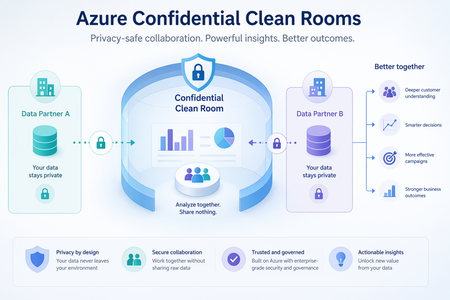
Today, we are excited to announce the preview of multiparty analytics feature of Azure Confidential Clean Rooms, a fully managed service that allows customers and their partners to securely analyze privacy-sensitive datasets from multiple parties. It uses confidential compute enabled Apache Spark-based big-data analytics (Spark SQL) which helps protect their raw data from other collaborators and from the Azure operator by performing computations in a Trusted Execution Environment (TEE). Privacy-sensitive datasets include personally identifiable information (PII), protected health information (PHI) and cryptographic secrets. Organizations across industries are increasingly looking to supplement their data with data from business partners, to build a complete view of their business. For example, brands, publishers, and their partners need to collaborate using datasets containing Intellectual Property (IP) to improve the relevance of their campaigns. Confidential data clean rooms help solve this challenge by enabling organizations to share and analyze granular datasets in a secure environment that helps prevent raw data exfiltration—protecting intellectual property, preserving customer privacy, and addressing concerns around regulatory compliance. You can sign up for the preview here Key Features Fully Managed: Azure takes care of the infrastructure provisioning and scaling with no user intervention. This significantly reduces your onboarding effort allowing you to focus on the queries and insights, not on infra management. Confidential Spark SQL: Spark SQL allows you to query large datasets and run complex queries in a distributed computing environment. In the confidential computing enabled version, the Spark driver and executors are fully attested policy-governed enclaves running as virtual nodes on confidential Azure Container Instances (ACI) which helps prevent exfiltration of collaborators’ data during query execution. Governance: Helps manage membership to cleanrooms, enables and verifies approval for queries from relevant collaborators before executing them and verifies consent to access sensitive collaborator data. It also helps generate tamper-resistant audit trails containing salient clean room events. This is made possible with the help of an implementation of the Confidential Consortium Framework (CCF). Telemetry: Throughout every clean-room run, detailed logs are streamed out in real time to monitor performance, troubleshoot issues, and keep the analytics healthy — all without ever exposing the collaborators’ data at any time. Verifiable trust: Cryptographic remote attestation viz. full attestation based on confidential hardware reports allows independent verification of the TEE along with along with all components that are part of it, without just trusting the cloud provider, before sensitive data and decryption keys are made available to the TEE Open-source containers: All Microsoft provided cleanroom containers and sidecars are open-sourced here and can be verified for provenance and integrity guarantees using GitHub artifact attestation Use Cases Multi-party confidential big-data analytics unlocks value in scenarios where data sensitivity, regulatory pressure, or competitive concerns previously blocked collaboration. These are some early scenarios that can benefit from this. Media & Advertising Collaboration of advertiser CRM data with publisher data for audience targeting and segment activation. Collaboration of audience data with measurement partners for measurement and attribution. Banking & Finance Collaboration between banks and insurance firms to upsell relevant products to existing bank customers without sharing raw data from either side Collaboration with retailers to generate customized offers for bank customers, without exposing either party’s underlying data. Government & Public Sector Secure collaboration of data across government departments to deliver better citizen welfare outcomes. Secure collaboration between government and private enterprises on shared-interest workloads such as traffic monitoring and weather systems. Healthcare Enable healthcare firms — including biopharma organizations — to combine their data with third-party institutions to accelerate clinical development, like identifying eligible participants for a clinical trial, without exposing underlying patient data. Combine patient datasets across hospitals to study disease patterns or outcomes without exposing sensitive protected health information. "A higher standard for protecting user privacy and trust, the phase-out of third-party cookies, and global regulations demand more sophisticated data collaboration tools to support advertising marketplaces. Azure Confidential Cleanrooms (ACCR) provides a secure, feature-rich, and flexible foundation to implement privacy-preserving functions and enable insights without sharing privacy-sensitive data outside of organization boundaries. Built on the Azure Confidential Compute (ACC) platform and offering cohesion with Azure's diverse set of services, ACCR offers the attestation, audit, fine-grained access control, and verifiable trust tools required for secure and privacy-safe data collaboration in today's world." — Andrei Mackenzie, Engineering Manager, Microsoft AI "Azure Confidential Clean Rooms enabled our team to evaluate how clean room capabilities can support secure, governed data collaboration at scale. Through the Proof-of-Concept (PoC), we explored how privacy-preserving workflows, trusted access controls, and scalable compute can create a stronger foundation for responsibly leveraging first-party data. This helps reduce operational friction while supporting business growth, improving customer engagement, and enabling more relevant customer experiences." — Nic Dregne, Director, Microsoft AdTech Engineering Beyond Spark SQL Realizing other multi-party scenarios like custom analytics, ML training and inferencing on Azure Confidential Clean Rooms is in our roadmap. If you have such a scenario to be realized, you can fill in and submit the preview signup form with the details of your scenario and we’ll get back to you. Learn More · Signup for the preview of Azure Confidential Clean Rooms for Analytics · Confidential Consortium Framework (CCF) · Virtual Nodes on Azure Container InstancesGA: DCasv6 and ECasv6 confidential VMs based on 4th Generation AMD EPYC™ processors
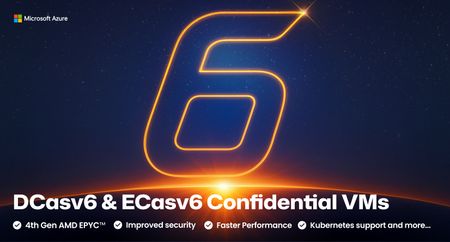
Today, Azure has expanded its confidential computing offerings with the general availability of the DCasv6 and ECasv6 confidential VMs. Regional availability June 03 2026: Australia Central, Australia Central 2, Australia Southeast, Austria East, Belgium Central, Brazil South, Brazil Southeast, Central India, Central US, Chile Central, Denmark East, East Asia, East US, East US 2, France Central, India South Central, Indonesia Central, Israel Central, Japan East, Japan West, Korea South, Malaysia West, Mexico Central, New Zealand North, North Central US, North Europe, Poland Central, South Africa West, South Central US, South India, Southeast Asia, Spain Central, Sweden Central, Sweden South, Switzerland West, Taiwan North, UAE Central, UK West, West US 2 April 13 2026: West Europe Jan 30 2026: Canada Central, Canada East, Norway East, Norway West, Italy North, Germany North, France South, Australia East, West US, West US 3, Germany West Central Sep 16 2025: Korea Central, South Africa North, Switzerland North, UAE North, UK South, West Central US These VMs are powered by 4th generation AMD EPYC™ processors and feature advanced Secure Encrypted Virtualization-Secure Nested Paging (SEV-SNP) technology. These confidential VMs offer: Hardware-rooted attestation Memory encryption in multi-tenant environments Enhanced data confidentiality Protection against cloud operators, administrators, and insider threats You can get started today by creating confidential VMs in the Azure portal as explained here. Highlights: 4th generation AMD EPYC processors with SEV-SNP 25% performance improvement over previous generation Ability to rotate keys online AES-256 memory encryption enabled by default Up to 96 vCPUs and 672 GiB RAM for demanding workloads Streamlined Security Organizations in certain regulated industries and sovereign customers migrating to Microsoft Azure need strict security and compliance across all layers of the stack. With Azure Confidential VMs, organizations can ensure the integrity of the boot sequence and the OS kernel while helping administrators safeguard sensitive data against advanced and persistent threats. The DCasv6 and ECasv6 family of confidential VMs support online key rotation to give organizations the ability to dynamically adapt their defenses to rapidly evolving threats. Additionally, these new VMs include AES-256 memory encryption as a default feature. Customers have the option to use Virtualization-Based Security (VBS) in Windows, which is currently in preview to protect private keys from exfiltration via the Guest OS or applications. With VBS enabled, keys are isolated within a secure process, allowing key operations to be carried out without exposing them outside this environment. Faster Performance In addition to the newly announced security upgrades, the new DCasv6 and ECasv6 family of confidential VMs have demonstrated up to 25% improvement in various benchmarks compared to our previous generation of confidential VMs powered by AMD. Organizations that need to run complex workflows like combining multiple private data sets to perform joint analysis, medical research or Confidential AI services can use these new VMs to accelerate their sensitive workload faster than ever before. "While we began our journey with v5 confidential VMs, now we’re seeing noticeable performance improvements with the new v6 confidential VMs based on 4th Gen AMD EPYC “Genoa” processors. These latest confidential VMs are being rolled out across many Azure regions worldwide, including the UAE. So as v6 becomes available in more regions, we can deploy AMD based confidential computing wherever we need, with the same consistency and higher performance." — Mohammed Retmi, Vice President - Sovereign Public Cloud, at Core42, a G42 company. "KT is leveraging Azure confidential computing to secure sensitive and regulated data from its telco business in the cloud. With new V6 CVM offerings in Korea Central Region, KT extends its use to help Korean customers with enhanced security requirements, including regulated industries, benefit from the highest data protection as well as the fastest performance by the latest AMD SEV-SNP technology through its Secure Public Cloud built with Azure confidential computing." — Woojin Jung, EVP, KT Corporation Kubernetes support Deploy resilient, globally available applications on confidential VMs with our managed Kubernetes experience - Azure Kubernetes Service (AKS). AKS now supports the new DCasv6 and ECasv6 family of confidential VMs, enabling organizations to easily deploy, scale and manage confidential Kubernetes clusters on Azure, streamlining developer workflows and reducing manual tasks with integrated continuous integration and continuous delivery (CI/CD) pipelines. AKS brings integrated monitoring and logging to confidential VM node pools with in-depth performance and health insights, the clusters and containerized applications. Azure Linux 3.0 and Ubuntu 24.04 support are now in preview. AKS integration in this generation of confidential VMs also brings support for Azure Linux 3.0, that contains the most essential packages to be resource efficient and contains a secure, hardened Linux kernel specifically tuned for Azure cloud deployments. Ubuntu 24.04 clusters are also supported in addition to Azure Linux 3.0. Organizations wanting to ease the orchestration issues associated with deploying, scaling and managing hundreds of confidential VM node pools can now choose from either of these two for their node pools. General purpose & Memory-intensive workloads Featuring general purpose optimized memory-to-vCPU ratios and support for up to 96 vCPUs and 384 GiB RAM, the DCasv6-series delivers enterprise-grade performance. The DCasv6-series enables organizations to run sensitive workloads with hardware-based security guarantees, making them ideal for applications processing regulated or confidential data. For more memory demanding workloads that exceed even the capabilities of the DCasv6 series, the new ECasv6-series offer high memory-to-vCPU ratios with increased scalability up to 96 vCPUs and 672 GiB of RAM, nearly doubling the memory capacity of DCasv6. You can get started today by creating confidential VMs in the Azure portal as explained here. Additional Resources: Quickstart: Create confidential VM with Azure portal Quickstart: Create confidential VM with ARM template Azure confidential virtual machines FAQSovereignty in Azure Belgium Central: A Three-Layer Technical Deep Dive
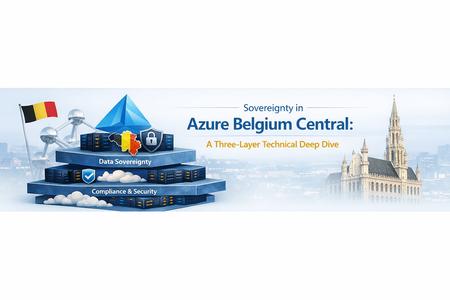
When Belgium Central went live in November 2025, it marked the launch of a new Azure region for Belgian organizations operating in the EU. For many scenarios, it enables customers to run workloads in-country and apply technical controls that can support sovereignty requirements. But "sovereignty" is one of those words that means different things to different people. So, let's break it down into something more tangible. In this post, we'll walk through sovereignty in Azure Belgium Central using three standardized technical layers. Think of them as concentric rings of protection around your data: Layer 1: Data Residency & Locality. Where your data physically lives and how it behaves during failure. Layer 2: Encryption at Rest & In Transit. How data is protected and who holds the keys. Layer 3: Confidential Computing. How data is protected while being processed in memory. Each layer builds on the previous one. Together, they form a comprehensive sovereignty posture. Let's find out what that looks like in practice. Layer 1: Data Residency & Locality This layer answers the most fundamental sovereignty question: where is my data, and does it stay there? In-Country Storage For regionally deployed Azure services, customer data at rest is stored in the selected Azure region. In Belgium Central, this means data at rest for supported services is stored in Belgium. Microsoft indicates the region’s datacenters are located in the Brussels area. When you deploy a resource with location = "belgiumcentral" in Terraform or location: 'belgiumcentral' in Bicep, you’re selecting that Azure region for the resource. This matters for organizations bound by Belgian or EU data residency requirements, and it matters for public sector customers who need assurance that sensitive data doesn't cross national borders without explicit action. Source: Microsoft Digital AmBEtion (microsoft.com/en-be) Three Availability Zones Belgium Central supports Availability Zones. Availability Zones are physically separate locations within an Azure region and are designed with independent power, cooling, and networking. This lets you deploy zone-redundant architectures (for example, spreading VMs, databases, and storage across zones) for high availability while keeping resources in the same Azure region. Availability Zones within a region are connected by high-bandwidth, low-latency networking designed to support zone-redundant services and architectures. Actual latency depends on workload placement and architecture and should be validated for your scenario. Source: The ABC of Azure Belgium Central (Microsoft Community Hub) Non-Paired Region: A Sovereignty Feature, Not a Limitation Azure Belgium Central is a non-paired region. For services that rely on region pairing for automatic geo-replication, behavior and options can differ from non-paired regions. Customers can configure cross-region disaster recovery explicitly and choose a target region based on their requirements. From a sovereignty perspective, some customers may prefer this model because cross-region replication and secondary data locations are customer-selected when configured. Replication and failover capabilities are service-specific, and customers should confirm the data residency and replication behavior for the services they use. Depending on the service and redundancy option, some geo-redundant features (for example, Geo-Redundant Storage (GRS) for Azure Storage) may not be available in non-paired regions. Many designs use Zone-Redundant Storage (ZRS) for in-region redundancy across Availability Zones. For cross-region replication, options such as object replication may be used where supported, with the destination region selected by the customer. Source: Azure region pairs and nonpaired regions (learn.microsoft.com) What This Means Architecturally When designing for Belgium Central, customers may consider: Intra-region redundancy via Availability Zones (for example, ZRS and zone-redundant deployments), where supported. Cross-region disaster recovery when explicitly configured, with a customer-chosen secondary region. Replication behavior that is service-dependent; customers should validate which services replicate within a region, across zones, or across regions, and what configuration is required. Layer 2: Encryption at Rest & In Transit Layer 1 keeps your data in Belgium. Layer 2 makes sure that even if someone gained physical access to the underlying infrastructure, they'd find nothing readable. Encryption at Rest: Platform-Managed by Default By default, all data stored at rest in Azure is encrypted to ensure security and compliance. Storage accounts, managed disks, databases: all use AES-256 encryption with Microsoft-managed keys out of the box. You don't have to configure anything to get this baseline protection. But for sovereignty scenarios, "Microsoft holds the keys" might not be enough. Data at rest is encrypted by default with platform managed keys but double encryption is possible with an extra layer of encryption with customer managed keys (CMK). Source: Double encryption in Azure (learn.microsoft.com) Customer-Managed Keys (CMK): You Hold the Keys Azure services in Belgium Central support Customer-Managed Keys (CMK) through Azure Key Vault. This shifts key ownership from Microsoft to you. You generate, rotate, and revoke keys on your own schedule. Azure services reference your key in Key Vault for encrypt/decrypt operations, but the key itself is under your control. This applies to a broad range of services: VM disk encryption, storage account encryption, Azure SQL Transparent Data Encryption, and more. But not all key storage is created equal. Azure offers three tiers of key management in Belgium Central, and the differences matter for sovereignty: Source: Azure encryption overview (learn.microsoft.com) Key Vault Standard: Software-Protected Keys The entry-level option. Keys are stored encrypted in software, protected by Microsoft's infrastructure, but not in dedicated HSM hardware. This is the entry-level option: software-protected keys stored in a vault, without dedicated HSM hardware. For many general-purpose workloads where regulatory demands don't mandate hardware key protection, Standard is cost-effective and fully functional for CMK scenarios. Key Vault Premium: HSM-Backed Keys (Multi-Tenant) Premium includes everything in Standard plus support for HSM-protected keys. When you create an HSM-backed key in a Premium vault, the key material lives inside Microsoft-managed Hardware Security Modules rather than in software. The HSM hardware is shared (multi-tenant, logically isolated per customer), but the key material is processed and stored within certified HSM devices. Microsoft documentation describes the compliance and validation posture of Key Vault and HSM-backed keys, including FIPS validation details that may vary by hardware generation, region, and service configuration. Customers should refer to the current product documentation and compliance listings for the specific SKU and region in scope. For many scenarios, Key Vault Premium provides HSM-backed key options in a multi-tenant service model and is priced differently than Key Vault Standard and Managed HSM. The right choice depends on regulatory requirements, operational model, and cost considerations. Managed HSM: Single-Tenant, Maximum Isolation For the highest level of key sovereignty, Azure Key Vault Managed HSM provides a single-tenant key management service backed by FIPS 140-3 Level 3 validated hardware. Unlike Key Vault Premium (where HSM-backed keys share a multi-tenant HSM infrastructure), a Managed HSM pool gives you a dedicated, cryptographically isolated HSM environment with your own security domain. Key facts about Managed HSM that matter for sovereignty: Compliance / validation: Managed HSM uses dedicated hardware security modules. Refer to current Microsoft documentation for FIPS validation level and applicability for your region and SKU. Regional deployment: Managed HSM is deployed to an Azure region. Customers should validate data residency and any service-specific data handling behavior for their workload and compliance needs. Security domain: Customers download and control the security domain (a cryptographic backup of HSM credentials), protected using customer-controlled keys. See product documentation for the shared responsibility model and operational details. Access control: Managed HSM provides role-based access controls for key operations. Customers should review the authorization model and administrative boundaries described in the documentation. Managed HSM has a different pricing and operational model than Key Vault (for example, pool-based billing and additional operational steps). It is typically considered when requirements call for dedicated HSM resources, security domain control, or specific compliance needs beyond a shared HSM service model. Choosing the Right Tier Managed HSM is typically considered when requirements call for dedicated HSM resources, security domain control, or administrative separation beyond a shared HSM service model. Key Vault Standard can be a fit for development/test or scenarios where software-protected keys meet your requirements. Key Vault and Managed HSM capabilities are available in Azure Belgium Central, but customers should verify current product, SKU, and service availability by region and validate service-specific data residency behavior for their workload. Source: Azure Key Vault Managed HSM overview (learn.microsoft.com), Managed HSM technical details (learn.microsoft.com), About keys (learn.microsoft.com) Encryption in Transit: MACsec + TLS On the wire, Azure provides two layers of transit encryption: IEEE 802.1AE MACsec. our documentation describes the use of MACsec on portions of the Azure backbone for in-network encryption on supported links. Availability and coverage can vary by scenario; customers should refer to current documentation for details. TLS. Azure services support TLS for client-to-service connections. Supported TLS versions and configuration requirements vary by service; customers should validate the specific service and endpoint configuration they use. Together, these mechanisms help protect data in transit at different layers, depending on the service and network path used. Layer 2 Summary Concern Mechanism Key Detail Data at rest (default) AES-256, platform-managed keys Automatic, no config needed CMK: software keys Key Vault Standard FIPS 140-2 L1, multi-tenant, lowest cost CMK: HSM-backed keys Key Vault Premium FIPS 140-3 L3 (new hardware), multi-tenant CMK: dedicated HSM Managed HSM FIPS 140-3 L3, single-tenant, security domain Data in transit (infra) MACsec (IEEE 802.1AE) Coverage varies by link/scenario; refer to current documentation Data in transit (client) TLS 1.2+ Supported versions vary by service and configuration Trusted Launch and protection of data at rest Trusted Launch is a security feature available for Azure Virtual Machines that helps protect against advanced threats such as rootkits and bootkits. It enables secure boot and virtual Trusted Platform Module (vTPM) on supported VM sizes, ensuring that only signed and verified operating system binaries are loaded during startup. This provides enhanced integrity for the boot process and helps organizations meet compliance requirements for workloads running in the cloud. By leveraging Trusted Launch, customers can monitor and attest to the health of their VMs at boot time, making it easier to detect and respond to potential tampering or compromise. The combination of secure boot and vTPM strengthens the security posture of Azure VMs, offering greater protection for sensitive workloads. Additionally, Trusted Launch strengthens data‑at‑rest protection by isolating encryption keys in a platform‑managed vTPM, binding key release to verified boot integrity, and preventing offline or unauthorized reuse of encrypted disks, even by privileged administrators. Source: Trusted Launch for Azure virtual machines Layer 3: Confidential Computing Layers 1 and 2 protect data where it lives and while it moves. Layer 3 closes the final gap: protecting data while it's being processed in memory. This is the domain of Azure Confidential Computing, and it's where things get genuinely interesting from a sovereignty perspective. Azure Confidential Computing is designed to help reduce certain operator-access risks by using hardware-backed isolation for data while it is being processed in memory. Confidential Virtual Machines Azure Confidential VMs use specialized hardware to create a Trusted Execution Environment (TEE) at the VM level. Two technology families are available: AMD SEV-SNP (DCasv6 / DCadsv6 / ECasv6 / ECadsv6 series) These VMs use AMD's Secure Encrypted Virtualization with Secure Nested Paging. The key properties: The VM's memory is encrypted with keys generated by the AMD processor. These keys are designed to remain within the CPU boundary. The platform is designed to help protect VM memory and state from access by the hypervisor and host management code. Supports Confidential OS disk encryption with either platform-managed keys (PMK) or customer-managed keys (CMK), binding encryption to the VM's virtual TPM on supported configurations. Each VM uses a virtual TPM (vTPM) for key sealing and integrity measurement. Intel TDX (DCesv6 / DCedsv6 series) These VMs use Intel Trust Domain Extensions, which provides full VM memory encryption and integrity protection: The entire VM runs inside a hardware-isolated Trust Domain (TD), designed to help protect data in memory from the hypervisor and host management code. Memory encryption and integrity are enforced by the Intel CPU using dedicated encryption keys per TD. Supports Confidential OS disk encryption (PMK/CMK) and vTPM integration on supported configurations. Additional performance characteristics and hardware details vary by VM size and generation; refer to the current VM size documentation for specifics. The AMD SEV-SNP VM families are currently available in Preview in Azure Belgium Central, with GA planned. The Intel SKU is not currently available in Azure Belgium Central. Source: About Azure confidential VMs (learn.microsoft.com), DC family VM sizes (learn.microsoft.com), Intel TDX confidential VMs GA announcement (techcommunity.microsoft.com) Azure Attestation: Trust, but Verify Confidential computing isn't just about encryption. It's about verifiable trust. Azure Attestation is a free service that validates the integrity of the hardware and firmware environment before your workload runs. Here's how platform attestation works for AMD SEV-SNP and Intel TDX Confidential VMs: When a confidential VM boots, the hardware generates an attestation report containing firmware and platform measurements (an SNP report for AMD, a TDX quote for Intel). Azure Attestation evaluates this report against expected values. Only if the platform passes attestation are decryption keys released from your Key Vault or Managed HSM. These keys unlock the vTPM state and the encrypted OS disk, and the VM starts. If the platform does not meet the attestation policy, key release can be blocked and the VM may not start, depending on configuration. In addition to platform attestation, customers can perform guest-initiated attestation from within the CVM to independently verify the VM's measured hardware and runtime state. This allows applications running inside a confidential VM to obtain an attestation token at runtime, which they can present to relying parties (like a key vault or external service) to prove they are executing in a genuine TEE. This can help reduce reliance on implicit trust by providing cryptographic evidence about the environment at boot and, where implemented, at runtime. Azure Attestation availability is region-dependent; customers should verify current availability in Belgium Central and select the appropriate provider configuration for their scenario. Source: Azure Attestation overview (learn.microsoft.com), Attestation types and scenarios (learn.microsoft.com) Confidential Computing on AKS For containerized workloads, Azure Kubernetes Service supports confidential computing through confidential node pools. You can add node pools backed by confidential VMs alongside regular node pools in the same cluster. You can add AKS node pools using supported confidential VM sizes. In this model, the worker node runs as a confidential VM, so the node’s memory is hardware-protected from the host and hypervisor. Containers scheduled onto that node can run without application refactoring, but the added protection is at the VM/node level. Exact region and SKU availability should be validated for the sizes you plan to deploy. AKS support for confidential VM sizes today includes AMD SEV-SNP with Intel TDX on the roadmap; customers should validate region and SKU availability for the exact AKS node pool sizes they intend to use. Azure Attestation can be integrated into confidential computing architectures on AKS to verify the trust state of nodes or workloads before secrets are released. This is typically implemented at the workload or confidential container level and is not enforced automatically for all AKS pods. Source: Confidential VM node pools on AKS (learn.microsoft.com), Use CVM in AKS (learn.microsoft.com) The Full Data Protection Chain When you combine all three layers, the protection chain when using confidential VMs in Belgium Central looks like this: [Confidential VM boots] → Hardware TEE encrypts VM memory (SEV-SNP or TDX, CPU-generated keys) → Azure Attestation validates platform report (SNP report or TDX quote) → Key Vault (Premium) or Managed HSM conditionally releases disk decryption keys → vTPM state unlocked → OS disk decrypted → VM starts → Data in memory: encrypted and isolated by hardware TEE (Layer 3 – Confidential Compute) → Data at rest: encrypted by CMK from Key Vault / Managed HSM (Layer 2 – Encryption) → Data in transit: protected using TLS (and MACsec on selected Azure backbone links) (Layer 2 – Encryption) → Data stored and processed in Belgium Central where supported and as configured (Layer 1 – Data Residency) These controls are designed to reduce operator-access risk through hardware-backed isolation, attestation, and customer-controlled key options. The exact protection level depends on the selected service, SKU, region, and configuration Bringing It All Together Here's the sovereignty stack for Azure Belgium Central in one view: Layer What It Protects Key Technologies Availability in Belgium Central 1: Data Residency Where data lives 3 AZs, non-paired region, ZRS GA. No cross-border replication by default. 2: Encryption Data at rest + in transit CMK, Key Vault (Std/Premium), Managed HSM, MACsec, TLS GA. All three Key Vault tiers available in-region. 3: Confidential Computing Data in use (memory) SEV-SNP / TDX VMs, Attestation, AKS Availability varies by SKU and region. Confirm confidential VM options (AMD/Intel), attestation, and AKS confidential node support for Belgium Central for the exact sizes you plan to use. Each layer is independently valuable, but the combination can help customers implement stronger technical controls for data residency, encryption, and in-use protection—subject to the specific services, SKUs, regions, and configurations selected. A Few Honest Caveats Because I want to keep this honest and useful: Check regional availability for specific SKUs. Availability can vary by region and can change over time. Before finalizing an architecture, confirm that the exact services and SKUs you plan to use are available in Azure Belgium Central (for example, specific confidential VM sizes, Azure Attestation, Managed HSM, and AKS node pool sizes) using the Azure products-by-region information. Sovereignty is not just technical. The layers above cover technical sovereignty, where data is, who encrypts it, and who can access it in memory. Legal sovereignty (jurisdiction, government access requests, contractual commitments) is a separate conversation. Managed HSM has different pricing and operational characteristics. Managed HSM uses pool-based billing and may require additional operational steps compared to Key Vault. Key Vault Premium supports HSM-backed keys in a multi-tenant model, which may be sufficient for many CMK scenarios. Select the option that meets your compliance and operational requirements. Confidential VM capabilities and integrations vary by VM size, generation, and feature. Some scenarios and integrations (for example, certain backup/DR options, live migration behaviors, accelerated networking, or resize paths) may be limited for specific confidential VM offerings. Validate the current limitations and supported features for the exact confidential VM series and region you plan to use, and plan DR based on the services and mechanisms supported for your scenario. These limitations are being actively worked on. Disclosure: Disaster recovery (DR) design and configuration remain a customer responsibility, including selecting a secondary region and implementing replication, failover, testing, and operational runbooks. Azure service availability and specific features can vary by region, SKU, and deployment model, and may change over time. Replication scope and behavior (in-zone, zone-redundant, regional, or cross-region) are service-specific and depend on the redundancy option selected; validate the data residency and replication details for each service in your architecture. References Microsoft Digital AmBEtion (microsoft.com/en-be) The ABC of Azure Belgium Central (Microsoft Community Hub) Azure region pairs and nonpaired regions (learn.microsoft.com) Azure encryption overview (learn.microsoft.com) Double encryption in Azure (learn.microsoft.com) Azure Key Vault Managed HSM overview (learn.microsoft.com) Managed HSM technical details (learn.microsoft.com) About keys (learn.microsoft.com) About Azure confidential VMs (learn.microsoft.com) DC family VM sizes (learn.microsoft.com) Confidential VM FAQ (learn.microsoft.com) Intel TDX confidential VMs GA announcement (techcommunity.microsoft.com) Confidential VM node pools on AKS (learn.microsoft.com) Use CVM in AKS (learn.microsoft.com) Azure Attestation overview (learn.microsoft.com) Attestation types and scenarios (learn.microsoft.com) Azure products by region (azure.microsoft.com) Trusted Launch for Azure virtual machines (learn.microsoft.com)960Views4likes0CommentsDCasv6 and ECasv6 confidential VMs in Azure Government Cloud
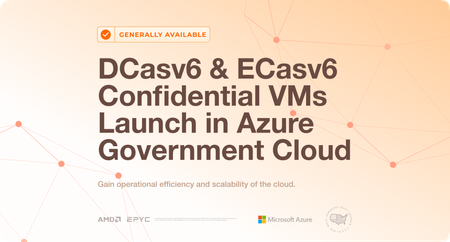
Today, we are announcing the launch of the DCasv6 and ECasv6 series of confidential virtual machines (CVMs) in Azure Government. Azure Government: Compliant, Hyperscale, Sovereign Cloud Azure Government was designed to remove the constraints that have historically limited federal cloud adoption by delivering hyperscale innovation without sacrificing regulatory certainty. Supporting over 180 services, Azure Government allows customers to consume advanced cloud capabilities without having to individually validate service availability or compliance. It is a complete end-to-end platform, delivering identity, DevOps, and services as commercial Azure, while operating entirely within accredited boundaries. Confidential virtual machines address one of the barriers to multi-tenant cloud adoption: When deployed on Azure Government, Confidential VMs combine physical isolation, sovereign operations, and hardware-enforced cryptographic isolation into a single execution environment. This enables customers to get additional protections from insider threats. At its core, Azure Government runs the same Azure codebase that powers Microsoft’s commercial cloud, providing access to compute, networking, storage, data, and AI services. DCasv6 and ECasv6: Confidential virtual machines in Azure government cloud The DCasv6 and ECasv6-series virtual machines built on 4th Generation AMD EPYC™ processors are the first in Azure Government to implement AMD SEV-SNP. This generation introduces several controls that change both security posture and operational readiness: Hardware-Enforced Memory Isolation: AMD SEV-SNP provides full, AES-256 encrypted memory with keys generated and managed by the onboard AMD Secure Processor. Online key rotation: Support for the online key rotation with the introduction of Virtual Machine Metablob disk (VMMD). Programmatic Attestation for Audit and Zero-Trust: Before provisioning any workload, customers can perform an attestation. This cryptographic procedure validates the integrity of the hardware and software, producing a signed report that proves the VM is a genuine confidential instance. Confidential OS Disk Encryption with Flexible Key Management: Cryptographic protection extends beyond runtime memory to the operating system disk itself. The disk's encryption keys are bound to the VM's virtual Trusted Platform Module (vTPM), which is protected within the TEE. Customers can choose between platform-managed keys (PMK) for simplicity and regulatory ease, or customer-managed keys (CKM) for full, sovereign control over the key lifecycle - a common requirement for the most stringent compliance regimes. Conclusion With the DCasv6 and ECasv6-series virtual machines now generally available in Azure government regions, customers can modernize their infrastructure deployments through confidential computing which replaces implicit trust with cryptographic isolation, and when deployed on Azure Government’s sovereign cloud within physically isolated data centers, it enables agencies to modernize at operational speed without compromising control. Azure Government is in a unique position to deliver the full operational depth of a hyperscale cloud, from identity and DevOps to monitoring and edge execution, inside an environment purpose-built for federal compliance. When combined with the latest Confidential VMs, customers gain secure infrastructure built on a platform where agility, visibility, and trust reinforce each other. Additional resources Azure Government documentation | Microsoft Learn Government Validation SystemGenerational Performance Leap for Azure Confidential Computing
At Microsoft, protecting customer data is a foundational commitment. Organizations moving their most sensitive workloads to the cloud require assurances beyond just encryption of data-at-rest and data-in-transit. They need robust protection while the data is in use, and they need it without sacrificing the performance of their business-critical applications. Confidential Computing emerged as a technology to address this need for data-in-use protection. For years, a key consideration for adopting confidential computing has been the perceived trade-off between stronger security and application performance. To provide our customers with transparent, third-party validation, Microsoft and AMD commissioned a technical analysis from Prowess Consulting, an independent research firm specializing in hands-on performance validation for the enterprise IT industry. Their report provides an assessment of our latest generation confidential VMs. Azure confidential VMs, powered by the latest 4th generation AMD EPYC™ processors, deliver both next-generation performance and hardware-enforced security, fundamentally shifting the conversation from a security trade-off to a performance dividend. Enterprises are required to handle sensitive information or personal data like transactions, analytics or intellectual property (IP) while operating under strict compliance regimes like GDPR or HIPAA can now seamlessly transition to the cloud, running their high performance, mission-critical applications on Azure’s latest confidential VMs. A Generational Leap in Performance While uncertainty surrounding the performance overhead of enabling confidential computing features and performance gaps, confidential computing has broadened its appeal as processors leap forward in both performance and capabilities with each successive generation. The motivation of the study was to identify a clear performance uplift by comparing the latest Azure DCasv6 confidential VMs, powered by 4th generation AMD EPYC™ processors, against the previous generation. The data confirms that upgrading delivers a significant and measurable performance uplift across the stack. A 77% gain in memory bandwidth, driven by architectural enhancements including the adoption of DDR5 memory, directly benefiting data-intensive applications. A 34% increase in Redis throughput, demonstrating substantial real-world gains for in-memory databases and caching workloads where latency is critical. A 30% rise in CPU throughput, confirming faster execution for compute-bound workloads on the latest generation of Azure confidential VMs. Quantifying the Overhead of SEV-SNP Beyond generational gains, the Prowess report sought to answer the critical question: What is the real performance overhead of enabling AMD Secure Encrypted Virtualization-Secure Nested Paging (SEV-SNP)? This hardware-level security feature isolates VMs by encrypting memory in use, protecting it even from the host hypervisor. The study compared confidential VMs (DCasv6) against general-purpose counterparts (Dasv6) running on identical 4th Gen AMD EPYC processors. The overhead introduced by these advanced protections was found to be minimal and predictable. An 8% overhead for CPU-intensive and Redis workloads. A mere 2% overhead for memory-intensive workloads. These results affirm that a robust security posture with a minimum impact on performance or latency, making it a practical choice for a broad spectrum of production workloads. From Technical Validation to Business Value For IT leaders and developers, these findings mean you no longer need to architect around performance limitations to achieve stronger security. The implications are clear: Confidentiality is a mainstream capability. With such minimal overhead, confidential computing is no longer a niche solution for only the most sensitive data, but a viable option for securing a diverse array of enterprise applications. Modernize with confidence. Organizations can now confidently migrate and modernize applications on Azure confidential VMs, gaining both hardware-enforced data protection and a significant performance boost. Unlock new possibilities. This validated performance enables the processing of sensitive data from financial analytics to healthcare insights in the cloud, scenarios that were previously constrained by security and performance concerns. This report validates our commitment to delivering a confidential cloud without compromise. Next Steps We encourage you to review the detailed report and explore how Azure confidential computing can fit into your security strategy. Read the full Prowess Consulting Technical Report for a deep dive into the methodology and results. Visit the confidential computing homepage to learn more about our comprehensive portfolio. Explore the DCasv6 and ECasv6-series VMs today.Azure Confidential VMs help keep BMW Group’s identities and passwords protected while in use
Evolving identity and access management for the cloud Security, performance, and reliability are the guiding principles behind Microsoft's identity and access management solutions. These solutions empower organizations to maintain their competitive edge by leveraging technology effectively. With Microsoft's robust cloud infrastructure, customer business teams, plant workers, and external vendors can manage huge workloads independently and around the clock. Collaborative success is facilitated, ensuring timely results and efficient release cycles, helping businesses like the BMW Group stay at the forefront of their markets. Before it can achieve results or make a measurable impact, the BMW Group must give every employee, including independent workers, highly safe and secure access to company systems and devices. It’s for that reason the whole company couldn’t function without identity management authentication. If employees can’t securely sign in to their systems and workstations, all work comes to a halt. Microsoft's identity and access management solutions play a crucial role in enhancing security, efficiency, and user experience across various industries. For the BMW Group specifically, conversations about identity systems are occurring against a backdrop of organization-wide modernization. The company chose to move to the cloud early on so it could unlock more opportunities for on-demand flexibility, scalability, and fast access to technological innovations, especially new and advanced security features. As the BMW Group started to migrate its IT estate to Microsoft Azure, it also wanted a more secure platform for its on-premises Microsoft Active Directory environment and domain controllers. The group has some older applications that require Active Directory identification and access services but aren’t yet compatible with next-generation, cloud-native Microsoft Entra ID protection. Some of these IT systems, servers, and applications are also old, difficult, and expensive to replace but essential to support onsite business or are standard in the automotive industry, such as the hardware and software components built into plant machinery used for car production. Use of this machinery can extend beyond 30 years. Given the dependencies, the BMW Group focuses more on building a foundation to boost reliability and stability for its production processes than integrating them with a modern authentication system. In response, the BMW Group wanted to use its on-premises Active Directory licenses to migrate existing Active Directory servers and domain controllers to Azure while actively protecting data and storage resources, the privacy of data in server memory, and its overall operations. Maintaining critical infrastructure with confidential virtual machines on Azure Considering the criticality and sensitivity of its services, the BMW Group was interested in evaluating confidential computing, a technology that helps protect highly sensitive data that is in use in server memory. When the BMW Group started to look at confidential computing, Microsoft was the only vendor offering a generally available confidential computing platform for the BMW Group to bring their Active Directory domain controllers to the cloud: the Azure DCasv5 confidential virtual machines (VMs) using 3rd generation AMD EPYC™ processors. This technology allowed them to do the migration without changing any code. BMW Group IT specialists decided to start with confidential VMs running Active Directory services as a tier 0 workload in Azure to tighten security and put those servers on a future-proven track for how to continue operating Active Directory for the next 5–10 years. As it started using confidential VMs, the BMW Group appreciated being able to eliminate several potential attack paths as it used domain controllers in a public cloud environment for the first time. Without confidential computing, the datacenter operator, host operator, and VM host operator could have been able to access company systems and the Active Directory database. On top of the added security benefits moving forward, the BMW Group IT specialists also remarked that performance for workloads and applications didn’t suffer running on the AMD based confidential VMs, which greatly reduced worries about potential lapses in availability while making the switch. The group’s Azure DCasv5 confidential VMs using 3rd generation AMD EPYC™ processors have quickly become the center of its architecture and the main component for its domain controllers. Staying within the Microsoft ecosystem for daily identity administration, its privileged access workstation relies on Intune, Azure Bastion, Azure Key Vault, Azure Key Vault Managed HSM, and other Microsoft Security services. Additionally, many of its modern applications that don’t require earlier Active Directory support are onboarded directly to Entra ID. Changing attitudes, adopting a Zero Trust security model, and measuring success Many organizations recognize that security and identity and access management are two pieces of the same puzzle, each with an essential role in their organization’s operations. The BMW Group’s staff have helped build a castle, strengthening security from the outside in, and any activity within the network is on the secure side. Now, they are moving to a Zero Trust framework, which removes any implicit trust and requires each component, supplier, and authentication process to be thoroughly assessed and validated before being granted access. From this internal perspective, the main challenge is to upskill everybody in their team. It’s a completely different way to deploy infrastructure, which is now mainly done by code instead of requesting and installing a physical server. But the result for BMW Group customers is an almost invisible benefit that’s extremely meaningful. It was key not to have any downtime or business impacts, and company staff successfully and seamlessly deployed services for customers with the first bunch of domain controllers running on Azure, without those customers noticing or having to worry about where services were coming from. The group’s main measure of success is getting rid of all its on-premises components, including all on-premises servers and many supporting systems previously needed to offer and support BMW Group services. In doing so, the BMW Group will have all of its systems needed for Active Directory operation hosted on Azure. Achieving security goals and sharing cloud experiences across the business The BMW Group’s new highly secure architecture and DCasv5 confidential VMs touch every part of the business across the full life cycle of identities and are used by internal and external employees, large and strategic partners, and joint venture partners. Boosting security and safeguarding its platform were the company’s main goals and are now its main benefits. The BMW Group is heavily reducing its risk, with the main goal of making it very difficult for an attacker to get into its systems. Microsoft's geographically widespread Azure datacenters enhance businesses' ability to support local branches and plants, increasing service availability and distribution around the globe. Planned IT projects at the BMW Group include transitioning to DCasv6 VMs, the newest confidential VMs on Azure using 4th generation AMD EPYC processors, which will bring with them a 30% performance increase over what the company has already gained. IT specialists are also installing Windows Hello for Business on all client devices within the group, letting employees sign in and authenticate themselves using biometrics. With continued success moving its sensitive workloads to Azure, the BMW Group plans to share its experiences with other teams across the organization. It also wants to bring the benefits of its architecture to other core systems that have high demand for identity and access protection, with everything it’s done so far showing what’s possible for the future. Discover more about BMW Group on Facebook, Instagram, LinkedIn, X/Twitter, and YouTube.Preview of Azure Confidential Clean Rooms for secure multiparty data collaboration
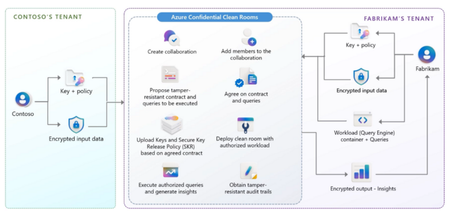
Today, we are excited to announce the preview of Azure Confidential Clean Rooms, a cutting-edge solution designed for organizations that require secure multi-party data collaboration. With Confidential Clean Rooms, you can share privacy sensitive data such as personally identifiable information (PII), protected health information (PHI) and cryptographic secrets confidently, thanks to robust trust guarantees that help ensure that your data remains protected throughout its lifecycle from other collaborators and from Azure operators. This secure data sharing is powered by confidential computing, which helps protect data in-use by performing computations in hardware-based, attested Trusted Execution Environments (TEEs). These TEEs help prevent unauthorized access or modification of application code and data during use. Organizations across industries need to perform multi-party data collaboration with business partners, outside organizations, and even within company silos to improve business outcomes and bolster innovation. Confidential Clean Rooms help derive true value from such collaborations by enabling granular and private data to be shared while providing safeguards on data exfiltration hence protecting the intellectual property of the organization and the privacy of its customers and addressing concerns around regulatory compliance. Whether you’re a data scientist looking to securely fine-tune your ML model with sensitive data from other organizations, or a data analyst wanting to perform secure analytics on joint data with your partner organizations, Confidential Clean Rooms will help you achieve the desired results. You can sign up for the preview here Key Features Secure Collaboration and Governance: Allows collaborators to create tamper-resistant contracts that contain the constraints which will be enforced by the clean room. Governance verifies validity of those constraints before allowing data to be released into clean rooms and helps generate tamper-resistant audit trails. This is made possible with the help of an implementation of the Confidential Consortium Framework CCF). Enhanced Data Privacy: Provides a sandboxed execution environment which allows only authorized workloads to execute and prevents any unauthorized network or IO operations from within the clean room. This helps keep your data secure throughout the workload execution. This is possible with the help of deploying clean rooms in confidential containers on Azure Container Instances (ACI) which provides container group level integrity with runtime enforcement of the same. Verifiable trust at each step with the help of cryptographic remote attestation forms the cornerstone of Confidential Clean Rooms. Salient Use Cases Azure Confidential Clean Rooms caters to use cases spanning multiple industries. Healthcare: For fine-tuning and inferencing with predictive healthcare machine-learning (ML) models and for joint data analysis for advancing pharmaceutical research. This can help protect the privacy of patients and intellectual property of organizations while demonstrating regulatory compliance. Finance: For financial fraud detection through analysis of combined data across banks and other financial institutions and for providing personalized offers to customers through secure analysis of transaction data and purchase data in retail outlets Media and Advertising: For improving marketing campaign effectiveness by combining data across advertisers, ad-techs, publishers and measurement firms for audience targeting and attribution and measurement Retail: For enhanced personalized marketing and improved inventory and supply chain management Government and Public Sector Organizations: For analysis of high security data across multiple government and public sector organizations to streamline benefits for citizens Customer Testimonials We are already partnering with several organizations to accelerate their secure multi-party collaboration journey with confidential clean rooms. Confidential computing in healthcare allows secure data processing within isolated environments, called 'clean rooms', protecting sensitive patient data during AI model development, validation and deployment. Apollo Hospitals uses Azure Confidential Clean Rooms to enhance data privacy, encrypt data, and securely train AI models. The benefits include secure collaboration, anonymized patient privacy, intellectual property protection, and enhanced cybersecurity. Apollo’s pilot with Confidential Clean Rooms showed promising results, and future efforts aim to scale secure AI solutions, ensuring patient safety, privacy, and compliance as the healthcare industry advances technologically. - Dr. Sujoy Kar, Chief Medical Information Officer and Vice President, Apollo Hospitals Azure Confidential Clean Rooms is a game changer to make collaborations on sensitive data both seamless and secure. When combined with Sarus, any data processing job is automatically analyzed using the most advanced privacy technology. Once validated, they are processed securely in Confidential Clean Rooms protecting both the privacy of data and the confidentiality of the analysis itself. This eliminates administrative overheads and makes it very easy to build advanced data processing pipelines. With our partner EY, we're already leveraging it to help international banks improve AML practices without compromising privacy. - Maxime Agostini, CEO & Cofounder of Sarus Read here to learn more about how Sarus is using Confidential Clean Rooms. As co-leaders on this Data Consortium Pilot, we are thrilled to be working with industry partners, Sarus and Microsoft, to drive this initiative forward. By combining Sarus’ privacy preserving technologies and Microsoft’s Azure Confidential Clean Rooms, not only does this project push the edge of technology innovation, but it strives to address a pivotal issue that affects us as Canadians. Through this work, we aim to help financial services organizations and regulators navigate the complexities of private and personal data sharing, without compromising the integrity of the data, and adhering to all relevant privacy regulations. For the purposes of this pilot, we are focusing our efforts on how this technology can play a pivotal role in helping better detect cases of human trafficking, however, we recognize that it can be used to help organizations for multiple other use cases, and cross industries, including health care and government & public sector. - Jessica Hansen, Privacy Partner EY Canada, and Dana Ohab, AI & Data Partner EY Canada Retrieval-Augmented Generation (RAG) applications accessing Large Language Models (LLMs) are common in private AI workflows, but managing secure access to sensitive data can be complex. SafeLiShare’s integration of its LLM Secure Data Proxy (SDP) with Azure Confidential Clean Rooms (ACCR) simplifies access control and token management. The joint solution helps ensure runtime security through advanced Public Key Infrastructure (PKI) and centralized policy management in Trusted Execution Environments (TEEs), enforcing strict access policies and admission controls to guarantee authorized access to sensitive data. This integration establishes trust bindings between the Identity Provider (IDP), applications, and data, safeguarding each layer without compromise. It also enables secure creation, sharing, and management of applications and data assets, ensuring compliance in high-performance AI environments. - Cynthia Hsieh, VP of Marketing, SafeLiShare Read here to learn more about how SafeLiShare is using Confidential Clean Rooms. Learn More Signup for the preview of Azure Confidential Clean Rooms Confidential Consortium Framework (CCF) Confidential containers on Azure Container Instances (ACI)Preview: New DCasv6 and ECasv6 confidential VMs based on 4th Generation AMD EPYC™ processors
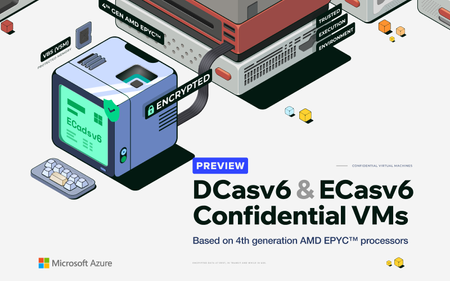
You can get started deploying your software on these confidential VMs by signing up here. Additional security enhancements With the launch of the DCasv6 and ECasv6 confidential VM family – we support AES-256 memory encryption enabled by default. Additionally, we now offer our customers the capability to leverage key protection with Virtualization-based Security (VBS) in Windows. By enabling key protection in Windows CVMs, customers can protect keys in-use from Guest OS and applications. This key protection is enforced by CPU hardware. Faster performance for confidential workloads These new CVMs have demonstrated up to 25% improvement in various benchmarks compared to our previous generation of AMD-based confidential VMs. KT is leveraging Azure confidential computing to secure sensitive and regulated data from its telco business in the cloud. With new V6 CVM offerings in Korea Central Region, KT extends its use to help Korean customers with enhanced security requirements, including regulated industries, benefit from the highest data protection as well as the fastest performance by the latest AMD SEV-SNP technology through its Secure Public Cloud built with Azure confidential computing. - Woojin Jung, EVP, KT Corporation Worldwide Region Availability These CVMs will be gradually made available across all supported Azure regions and availability zones. Please use the sign-up form to indicate interest in participating in the gated preview and regional requirements. General purpose & Memory-intensive workloads Featuring general purpose optimized memory-to-vCPU ratios and support up to 96 vCPUs and 384 GiB RAM, the DCasv6-series delivers enterprise-grade performance. The DCasv6-series enables organizations to run sensitive workloads with hardware-based security guarantees, making them ideal for applications processing regulated or confidential data. For more memory demanding workloads, the new ECasv6-series offer high memory-to-vCPU ratios with increased scalability up to 96 vCPUs and 672 GiB of RAM. The ECasv6-series is ideal for memory-intensive enterprise applications offering nearly double the memory capacity of DCasv6. The ECasv6-series scales 672 GiB RAM with up to 96 vCPUs, making them ideal for memory intensive applications that exceed even the capabilities of the DCasv6 series. DCasv6 DCadsv6 ECasv6 ECadsv6 vCPU 2 - 96 2 - 96 2 - 96 2 - 96 Memory 8 - 384 8 - 384 16 - 672 16 - 672 Max local disk NA 75-600GiB NA 75-600GiB OS Support These CVMs support the following guest operating systems: Windows Server 2019, 2022, 2025, Windows 11, Ubuntu 22.04, Ubuntu 24.04, and RHEL 9.4. Endorsements from our customers The BMW Group relies on Azure confidential VMs powered by AMD EPYC processors to enable a Zero Trust environment with end-to-end encryption for our identity authentication system, allowing over 200,000 associates to collaborate on building the future of individual mobility. The solution was made possible in part due to the fact that AMD EPYC processor based confidential VMs do not require code changes to protect data in memory. Further, our testing of the newest generation of DCasv6 VMs has shown significant improvements in performance, and we look forward to seeing them go live on Azure. - BMW Group Having early access to Microsoft’s latest confidential VMs is a game-changer, offering enhanced security and performance. Our customers are pleased that they won’t have to adapt existing algorithms to take advantage of computing within the optimal CVM environment available in their computing region and selected within the EscrowAI platform. - Mary Beth Chalk, Co-founder & Chief Commercial Officer, BeeKeeperAI Anjuna is thrilled to be among the first to access Microsoft’s latest confidential VMs, powered by the newest version of the AMD SEV-SNP technology. Our ongoing partnership with Microsoft Azure provides us with early access to explore advanced security and performance features. This collaboration empowers joint Azure and Anjuna customers to leverage the newest Azure technologies from day one, enhanced by the capabilities of the Anjuna Seaglass platform. - Ofir Azoulay-Rozanes, Director of Product Management, Anjuna Security Sign up now for exclusive access Joining our exclusive preview program gives you an opportunity to work with the product team. To get started deploying your software on the latest confidential VMs sign up here.Unlocking the potential of Privacy-Preserving AI with Azure Confidential Computing on NVIDIA H100
Learn how Azure and NVIDIA enable high-performance privacy-preserving machine learning scenarios by augmenting Azure Confidential VMs with confidential computing enabled NVIDIA H100 GPUs21KViews0likes0CommentsWhat’s new: RHEL 9.3 support for AMD confidential VMs, temp disk encryption, new regions
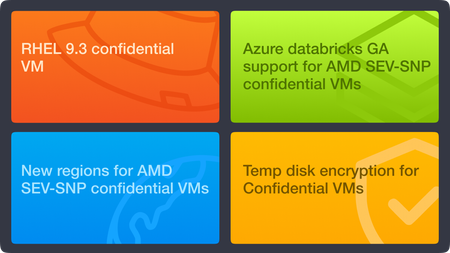
We are thrilled to announce the RHEL 9.3 support for AMD confidential VMs, expansion of Azure Confidential VMs featuring AMD SEV-SNP technology to the following new regions: Italy North, Germany West Central and UAE North, temp disk encryption support and General Availability (GA) release of Azure Databricks support for AMD-based confidential VMs.