ai skills
9 Topics
AI Skill Fest Voucher Issue
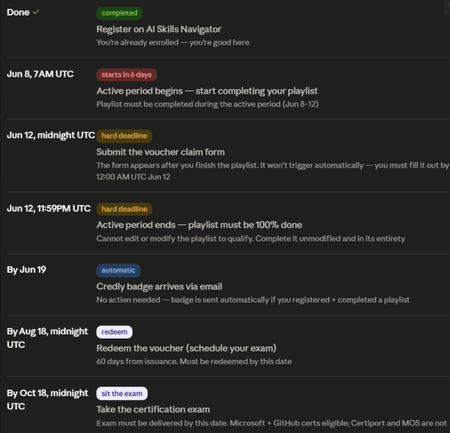
Hello support I got a voucher from AI Skill fest, I redeemed the voucher before August 18, but I need to reschedule the exam but I get this error The selected appointment cannot be scheduled. The registration was discounted with a voucher and the voucher has restrictions (********995E). The new appointment does not satisfy the following restriction: The voucher is Expired and can no longer be used. I am rescheduling in the allowed window as well which is before October 18, can you help me? PearsonVue support had really no idea they sent me with email address removed for privacy reasons and they say they "Voucher store only sells vouchers and there are not sold by us." like I said exam is scheduled but I need to take it some days before thins month but I am not able to do it thanks a lot557Views0likes2CommentsLenovo scales AI adoption worldwide with Copilot Chat training
Discover how Lenovo helped 30,000 employees build practical AI skills with scenario‑driven training to streamline daily tasks, strengthen communication, and achieve meaningful, measurable outcomes. Listed by Forbes as the world’s largest PC company, Lenovo is taking AI out of the abstract and delivering its power to people around the world through a full-stack portfolio of AI-enabled devices, infrastructure, and software. Lenovo’s vision of delivering smarter technology for all includes its own employees and processes. This goal informed its decision to deploy and adopt Microsoft 365 Copilot Chat and Microsoft Copilot Studio across the entire company. Empowering innovation and efficiency Lenovo aimed to establish enterprise leadership in AI, using it to enhance productivity and accelerate business processes across key functions, including research and development (R&D), marketing, and human resources (HR). The company did this by deploying Copilot Chat to its global workforce of over 75,000 employees. The initial onboarding target was more manageable but still ambitious: 30,000 employees in China—about 40% of its workforce. The primary challenge was not just the scale of deployment but also the need to ensure adoption. It was vital that employees could move beyond basic usage to effectively integrate these advanced AI tools into their specific, daily work scenarios to drive tangible business value. Lenovo recognized that success hinged on helping employees build confidence, understand real-world applications, and adopt an AI‑first mindset. Copilot Chat has fundamentally changed how we manage our daily workflow. What used to take hours now happens in minutes. It not only saves us time but also enhances the quality of our communication and strategic thinking. —Dan Zhao, Operations Management Professional, Lenovo China Laying the groundwork To achieve such massive upskilling at scale, Lenovo worked with Digital China Cloud Technology Limited, a leading digital transformation partner whose many services include helping enterprise-level clients establish future-oriented core capabilities. Together they created a training strategy to help employees move from casual interaction with AI tools to meaningful, scenario‑driven usage. The two-phased training combined targeted learning pathways, interactive workshops, and department-specific problem-solving. By embedding training into employees’ existing digital workflows, Lenovo helped to ensure minimal friction and maximum relevance. Phase one: Foundation building The first phase focused on delivering broad-based AI literacy across the targeted workforce so that every employee, regardless of technical background, could start implementing AI tools to streamline their work. Lenovo introduced an “Introduction to Prompt Engineering” course designed to teach employees how to interact effectively with AI systems. This core training provided: Essential AI concepts. Practical prompting skills. Confidence-building exercises. Foundational habits for high‑quality AI interaction. Phase two: Role‑based integration The second phase moved beyond generic training to deep, scenario-specific workshops for key departments. It focused on using Copilot Chat for complex querying and analysis and on working with Copilot Studio, a platform for designing and building custom agents to automate and execute specific business processes. “The key innovation,” Digital China Microsoft Certified Trainer (MCT) Yan Yan explains, “was our scenario-first and agent-centric learning methodology. Instead of teaching features, we focused on real-world business problems.” This mapped training directly to real needs rather than abstract hypothetical use cases. Phase two included: Customized agent development workshops tailored to unique departmental challenges, like automating HR inquiries and generating marketing content. Workflow‑embedded scenario training, designed around actual daily tasks, like meeting summaries, data analysis, strategic document drafting, and more. Measurable business impact Lenovo achieved significant results from its program, including: Accelerated core business processes. Teams across R&D, marketing, and HR saw faster project cycles—from accelerated code development and quicker market analysis to more streamlined employee onboarding. Higher productivity and efficiency. Employees showed major gains in handling complex tasks, such as data synthesis and content creation, reducing time spent on routine work. A more engaged workforce. The program boosted employee confidence and helped cultivate a culture of innovation and AI-first thinking. Transformational impact on customer-facing teams. Sales teams experienced dramatic improvements in communication quality, speed, and strategic preparation, reducing timelines from hours to minutes. Realizing significant gains with a practical approach Lenovo’s AI adoption journey demonstrates what’s possible when an organization pairs visionary goals with a practical, scenario‑driven implementation strategy. By empowering employees with foundational skills and then guiding them through real‑world applications, Lenovo achieved widespread adoption, substantial efficiency gains, and a more empowered global workforce. This project not only accelerated Lenovo’s internal transformation but also positioned the company as a leader in enterprise‑wide AI enablement. Explore AI skilling opportunities for all your teams—technical and non-technical alike—on Microsoft Learn for Organizations. For more inspiration, read AI and human potential: Advancing skills, innovation, and outcomes.1.2KViews2likes1Comment
Four Best Practices for Leading Through AI Adoption
Actionable guidance for building AI leadership skills—drawn from real customer conversations. Chris Henley is a Microsoft Trainer, part of a community of professionals at Microsoft Global Skilling, working with customer and partner leaders to help them build the skills required to drive their organization’s AI strategy. Where AI conversations are shifting for leaders I’ve been working with executives and company leaders for several years, and it feels like the AI conversation is finally shifting from “What can AI do?” to “How do we move forward with AI in a way that creates real value?” That shift often shows up as organizations move beyond isolated pilots and begin integrating AI across the business: into processes, employee experiences, customer engagement, and innovation. Microsoft refers to this broader shift as Frontier Transformation, where AI becomes a strategic priority and changes how intelligence operates inside the organization, not just which tools people use. From what we’re hearing from executives, one thing becomes clear: AI adoption rarely comes down to a single decision. Progress unfolds through small experiments, sharper priorities, and measured results that reveal what’s working and what to do next. What seems to help drive adoption progress isn’t a rigid plan. It’s returning to a few best practices that show up regularly in real business discussions: Reframe: recognizing that AI is not just another tool rollout, but a shift in how work is structured, how decisions are made, and where intelligence shows up across the business. Focus: identifying a specific business priority where AI can create measurable value, rather than spreading experimentation across too many disconnected pilots. Assess: taking an honest look at whether the organization is ready to move forward across data foundations, leadership alignment, team capabilities, and governance. Commit: selecting a defined AI initiative, assigning ownership, and establishing how success will be measured over a clear timeframe. These aren’t meant to be a strict sequence. Leaders often move between them as they clarify strategy, prioritize investments, and decide what to do next. The following sections take a closer look at how each of these best practices show up in real leadership discussions about AI adoption. 1. Reframing how to think about AI in the organization AI often begins framed as a tool rollout, but leaders I work with frequently find that this narrows the discussion too quickly. Many have shared that the most useful shift happens when the question moves beyond “How do we use this?” to something broader: “Where could AI change how our business actually works?” I was recently delivering a training session with one of our customers, a consulting firm that had rolled out Microsoft 365 Copilot. Early wins were familiar: faster emails, cleaner summaries, better documentation, and the team was energized. But in one session we paused and asked a tougher question: if AI is now part of the business, should client reporting and analysis still look the same? The focus shifted from incremental productivity gains to rethinking how insights were created and delivered. You start to see where work should be redesigned—not just sped up. The technology remained the same, but leadership perspectives evolved. 2. Choosing where to focus before moving forward Another common situation we’re seeing is companies trying to use many different AI solutions in hopes of finding an area where AI might have an impact. Pilots are running across the business, but their intended business impact is unclear. Activity isn’t the same as progress. Momentum usually picks up when leaders choose one area where AI clearly connects to a meaningful business outcome. The experience of one of our customers, a global automotive manufacturer, is a good example of this. Rather than trying to use AI everywhere, they pinpointed a bottleneck that was slowing down their accounting workflows. So, they applied AI document intelligence to that problem first. That targeted focus reclaimed thousands of hours of manual work. You can see what’s working and what it tells you about your organization. Investment conversations become easier, because you’re not funding “AI.” You’re funding a business outcome. 3. Assessing organizational readiness as aspiration meets reality One of the most useful shifts happens when leaders pause to examine how ready the organization actually is for AI. It’s easy to assume you’re “AI-ready,” but that closer look often reveals where ambition is moving faster than capability. In one executive discussion, a leader paused and said, “I thought this was an IT implementation. I didn’t realize how much AI would change how my leadership team operates.” That moment shifted the conversation from infrastructure and deployment to the real question: Was the organization ready to operate differently with AI? The team shifted its attention to making better decisions, ownership, and leadership readiness. You can see whether AI is tied to business priorities, whether teams have enough hands-on capability, whether the culture supports experimentation and learning, and whether risk and accountability are clearly defined. 4. Committing to shape your AI strategy through action Here’s something I see a lot: Leadership teams often agree AI is important, but progress stalls when no one defines the next step or who owns it. In one session, an executive team had been reviewing use cases for months. Mid-meeting, someone finally said, “We’ve been talking about this for a while. What have we accomplished?” That simple question immediately shifted the conversation from exploration to ownership. The team aligned on one outcome and how they’d measure it, and that’s when momentum finally started. The goal isn’t to have the perfect strategy upfront. It’s to commit to a focused, informed, effort that starts to transform your business in a meaningful way. The efforts that gain traction are usually clearly defined, have senior leadership behind them, and everyone on the team is aligned on how to measure progress. Time to roll up the sleeves and get to work In the end, leading through AI adoption isn’t about getting everything right from the start. What I see work most often is leaders building the skills to navigate it as they go, and learning how to judge where AI really matters, where to begin, and how to move forward through focused action. If you’d like a practical way to start that process, check out our new Develop AI Leadership Skills guide for a structured starting point. It’ll help you think about your organization's next steps with AI and it’ll give you a clear framework for prioritizing actions and moving ahead confidently.1.7KViews3likes2CommentsAkkodis and Microsoft share field‑tested tips for your AI skilling program
Generative AI technology is creating unprecedented opportunities to improve your business efficiency, fuel innovation, and gain a competitive edge. Given these benefits, equipping your workforce with the skills to effectively use AI-powered tools is a high priority. At the same time, the rapid evolution of AI technology, along with the potential impacts on your established processes, means that matching people with the right skills requires a deliberate approach. Akkodis and Microsoft partner to bring AI skilling to customers Across the Asia-Pacific region, global engineering and digital solutions company Akkodis helps organizations design, build, and operate technology driven solutions. Its Akkodis Academy integrates Microsoft technology and training, including industry-recognized Microsoft Credentials (role-based Microsoft Certifications and scenario-based Microsoft Applied Skills) that cover AI, into its customized learning and consulting programs. These programs help customers build learning cultures that keep up with the increasing pace of technological change. Building an AI skilling strategy that works Based on its extensive experience, Akkodis has found five strategies that can help you build (or sustain) a successful AI skilling program. 1. Start small, learn fast, iterate AI capabilities (and your business needs) evolve quickly. With iterative training cycles, you don’t need a perfect blueprint to get started. Instead, short, focused training sprints let you try ideas, collect feedback, and quickly improve. This lowers the intimidation factor for newcomers and helps build confidence and momentum with staff and stakeholders. 2. Tie skilling directly to your business goals The most successful skilling programs align training with technology and business goals. They also secure sponsorship from company leaders to help establish priorities and reinforce adoption efforts. Anchor training efforts to concrete business outcomes, like productivity, time‑to‑market, operational costs, or other real-world business metrics. 3. Establish a culture of continuous learning The traditional skilling model of “take a course, and you’re done” doesn’t work well for such rapidly evolving technology. Establishing an always‑on learning culture using webinars, tech talks, and collaborative community learning can move your teams from a “know-it-all” to a “learn-it-all” mindset, keeping your teams’ skills fresh and curiosity growing. 4. Combine technical skills with business and governance knowledge Organizations that realistically evaluate the business utility of AI tools tend to adopt this technology more effectively and efficiently. This means AI skills need to be complemented by business and operational knowledge. Alongside technical instruction, your teams should understand and apply your organization’s governance policies related to data privacy, ethical AI use, and other regulatory requirements. 5. Provide practical, applied learning Focus on real-world skills that show tangible application—not only what AI is but also how to effectively use it. Bootcamps, role‑based labs, and an emphasis on practical scenarios can help bridge the gap between theory and real-world use and can directly correlate with productivity gains and other key outcomes. Real-world AI skilling success stories Explore how AI skilling strategies have led to practical business gains: Commonwealth Bank of Australia invested heavily in AI skilling, equipping employees to effectively adopt AI tools. As a result, 84% of its 10,000 Microsoft 365 Copilot users report that they wouldn’t go back to working without it, and developers are adopting ~30% of GitHub Copilot code suggestions. Adecco Group’s AI skilling strategy has increased productivity for recruiters by 63%. Plus, the company’s AI-driven CV Maker generated 200,000 résumés, and 35,000 employees completed responsible AI training, driving better client interactions. Next steps An effective AI skilling program is about more than technology—it requires a workforce that can adapt and thrive as AI reshapes the business world around them. Successfully building AI fluency across your organization can accelerate your organization’s technology adoption, create improved business outcomes, and lead to tangible competitive advantages. Ready to grow your team’s AI skills? Read Create an AI Learning Culture.1.2KViews1like1CommentMicrosoft Learn AI Skills Challenge Pitch Winner: Watch Out
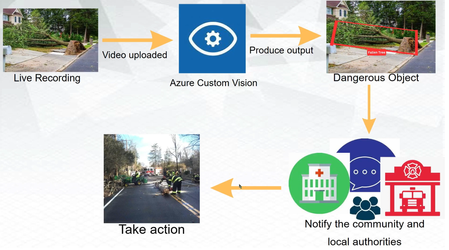
The Microsoft Learn AI Cloud Skills Challenge held in July wrapped up an incredible learning journey with the AI pitch Challenge; a showcase of innovation where passionate learners brought their visions to life through the power of AI. These creators shared how they would harness Microsoft's AI technology to craft solutions for the future in a 3-minute video pitch. Out of many, five outstanding winners emerged, each with a unique and compelling vision. This series of blog posts spotlights each creator sharing the transformative potential of their ideas. Get inspired by the winning project Watch Out.25KViews0likes0CommentsMicrosoft Learn AI Skills Challenge Pitch Winner: WriteSight
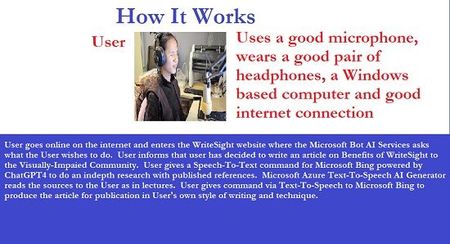
The Microsoft Learn AI Skills Challenge wrapped up an incredible learning journey with the AI Solution Pitch Challenge; a showcase of innovation where passionate learners brought their visions to life through the power of AI. One of the top five winning solutions WriteSight ensures that every human being of any ability can be well-informed and proactive in managing their writing with microphone, speakers or headphones, and an internet connection.2.6KViews1like0CommentsMicrosoft Learn AI Skills Challenge Pitch Winner: Smart Traffic Light System
Microsoft Learn AI Skills Challenge wrapped up an incredible learning journey with the AI Solution Pitch Challenge; a showcase of innovation where passionate learners brought their visions to life through the power of AI. One of the top five winning solutions, a Smart Traffic Light System which analyzes the amount of traffic incoming from each direction and gives the appropriate amount of green time to the busy lanes or lanes with emergency vehicles. 2.9KViews1like0Comments
Microsoft Learn AI Skills Challenge Pitch Winner: ECO-COGNIZE
Microsoft Learn AI Skills Challenge wrapped up an incredible learning journey with the AI Solution Pitch Challenge; a showcase of innovation where passionate learners brought their visions to life through the power of AI. One of the top five winning solutions ECO-COGNIZE is a simple yet effective way to continuously monitor plant health, soil conditions, and detect diseases at their earliest stages.3.6KViews1like1Comment