aci
7 Topics
C-ACI: Security Practices for Healthcare and Financial Services
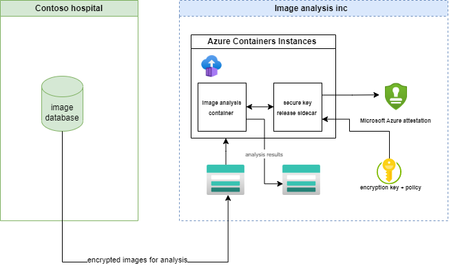
Healthcare and financial services organizations need to put sensitive data to work, whether analyzing patient records, detecting fraud, or running AI applications. Protecting that data means more than encrypting it in storage and during transmission. It also means limiting who and what can access it while an application is processing it. This post explores how confidential containers on Azure Container Instances (C-ACI) help address that challenge, using healthcare and financial services examples to explain security practices, architecture choices, and operational considerations. While this post focuses on healthcare and financial services, the same patterns extend to any industry or application that works with sensitive data or proprietary code, such as government, defense, and manufacturing. As AI companies and enterprises build agents that act autonomously and run code and workflows against sensitive data, confidential computing will be critical to keeping that data, and the code that processes it, protected and verifiable. For Linux workloads that run code they didn't write, such as AI-generated scripts, plug-ins, or third-party tools, enclaves for confidential containers on ACI (preview) let the main application hand that code to a separate confidential environment with no network access of its own. What are confidential containers on Azure Container Instances? C-ACI runs Linux and Windows (preview) containers in a hardware-protected environment without requiring customers to manage the underlying servers. This environment, called a trusted execution environment (TEE), helps protect application code and sensitive data during processing. For customers, this means reducing reliance on the underlying infrastructure and its administrators to keep that data confidential. Execution policies control permitted operations, while attestation provides verifiable evidence before granting access to sensitive information. How confidential containers achieve isolation Traditional containers rely on the host operating system and its administrators for isolation. C-ACI adds a hardware-backed boundary around the container group, reducing reliance on that infrastructure. Three capabilities work together: Hardware-backed isolation. The container group runs in a protected virtual machine using AMD SEV-SNP. This hardware technology encrypts memory and helps prevent the host and hypervisor from inspecting or changing it. Containers in the group share this security boundary. Execution-policy enforcement. A policy defines which container images, commands, and settings may run. Software inside the protected environment enforces these rules. Policies are generated with the Azure CLI confcom extension using az confcom acipolicygen and reviewed against the application’s security requirements. Permissive or debug policies weaken the protection. Attestation before access. Attestation provides hardware-signed evidence of the environment and its execution policy. Microsoft Azure Attestation (MAA) validates this evidence and issues a signed token. For Secure Key Release (SKR), Azure Key Vault Premium or Azure Key Vault Managed HSM checks the workload’s token against the key’s release rules and verifies authorization before releasing the key. Key Vault Standard does not support SKR. In short, hardware protects the environment, policy controls what may run, and attestation provides evidence of its trustworthiness. Attestation-based key release must be configured; it is not automatic in every deployment. Two ways to deploy confidential containers This security foundation supports two deployment paths: direct deployment through Azure Container Instances or integration with existing AKS workflows. For workloads already managed in AKS, virtual nodes preserve the existing orchestration workflow. For workloads that do not require Kubernetes, direct C-ACI deployment provides a simpler starting point. Direct deployment with C-ACI Direct C-ACI deployment provides serverless execution without operating a Kubernetes cluster. The following diagram shows the protected container group, execution-policy enforcement, and how attestation supports access to keys and sensitive data. Protect sensitive data during processing without managing servers or a Kubernetes cluster. AKS with confidential ACI execution For applications managed through Kubernetes, virtual nodes deploy AKS pods as confidential container groups running on ACI. AKS provides the orchestration workflow, while C-ACI provides the protected execution environment. The AKS control plane sits outside the TEE, and the enforced execution policy prevents cluster administrators from running images, commands, or settings that the policy does not allow inside the protected environment. The following diagram shows how these responsibilities fit together. C-ACI protects data during processing while AKS retains deployment and orchestration responsibilities. Applying these security practices in healthcare and financial services Secure workload design depends on which data needs protection, which software may process it, and what evidence is required before granting access. The following illustrative healthcare and financial services examples connect these choices to business value, security controls, and day-to-day operations. Each uses C-ACI directly for simplicity; the same pattern can also be deployed through AKS virtual nodes. Enclave support, mentioned in two of the examples, is currently available only with direct C-ACI deployment. Healthcare: putting sensitive data to work with controlled access The following examples show how C-ACI can support sensitive healthcare workloads. Validate clinical AI without handing over patient records or proprietary models A hospital wants to evaluate a third-party clinical AI model against its patient population while protecting patient records and the developer’s model intellectual property. The hospital and developer each retain control of their own encryption key and key-release policy, and both agree on the container image and execution policy. Their encrypted data and model are processed together in C-ACI, with each key released only when its owner’s attestation and release-policy requirements are met. Evaluation scripts and analysis tools, whether supplied by the developer or generated by AI, run in an enclave (preview), a separate confidential environment with its own execution policy and no network access. The main application keeps the data connections, and everything those tools return passes back through it. The hospital receives approved evaluation results, not unrestricted access to the model; the developer does not gain unrestricted access to patient records. This approach supports evaluation of third-party clinical AI while protecting patient records and model intellectual property. The essential controls are approved code, restricted connectivity, carefully reviewed outputs, and audit records that exclude sensitive payloads. C-ACI protects patient data from the infrastructure, and the enclave limits what third-party code can do with it. Analyze genomic data with controlled access to patient information A precision-medicine team needs to analyze genomic records alongside clinical histories without unnecessarily exposing patient information. In this C-ACI design, encrypted inputs are processed inside a confidential container group, with decryption keys released only when configured attestation requirements are met. The data provider supplies study identifiers instead of direct patient identifiers wherever possible and maintains the identity mapping under restricted access. The application controls which research results leave the environment, while access restrictions and logging practices help limit further exposure. For technology and security leaders, the value is enabling sensitive analysis with a clearer trust boundary, while recognizing that study identifiers alone do not make genomic data anonymous. Financial services: protecting transaction processing and payment data The following examples show how C-ACI can support sensitive transaction analysis and payment processing. Investigate suspicious transactions without broadening access to raw records A bank wants to investigate suspicious transactions without broadening access to raw account histories and customer information. Authorized analysts submit requests to an approved analysis container running in C-ACI, which returns a bounded set of risk indicators and supporting evidence rather than unrestricted access to the underlying records. When an AI agent writes queries or analysis code for an investigation, that code runs in an enclave (preview) with no network access, while the agent and the bank’s data connections stay in the main application. This approach expands analytical capability within a more explicit trust boundary. Engineering teams must still enforce least-privilege data access, restrict outbound connections, protect logs, and validate results. If an AI agent assists the investigation, its generated code should not automatically receive access to raw records or decryption keys. The enclave turns that principal into a boundary: generated code works on the data it is given but no network path of its own. Keep payment tokenization separate from the wider application A payment provider wants business applications and analytics to use tokens rather than raw card numbers. In this C-ACI design, a dedicated tokenization service processes encrypted payment data inside a confidential container group, with decryption keys released only when configured attestation requirements are met. The application returns tokens to downstream systems, while retrieval of original card details requires separate authorization and auditing. This approach limits how widely sensitive payment data flows. The operational priorities are least-privilege access, protected token mappings, restricted connectivity, and logs that exclude card details. Confidential processing does not by itself remove systems from Payment Card Industry Data Security Standard (PCI DSS) scope or replace its requirements; any scope reduction depends on the tokenization design and validated controls. See the PCI SSC tokenization guidance. Production readiness also requires testing end-to-end latency and sustained throughput under expected payment volumes, and validating high availability and failover across the tokenization service, token mappings, and key-release dependencies. To summarize all four scenarios follow the same pattern: encrypted data enters a protected environment, keys are released only when the environment and execution policy meet configured verification requirements, and only application-approved results leave it. The data and authorized recipients vary by workload. Workloads with these requirements are candidates for confidential containers. When part of a workload runs code you don't fully trust, such as AI-generated code, plug-ins, or analyst scripts, consider enclaves (preview) to give that code its own confidential execution boundary. Get started A practical starting point is a single sensitive workload, with clear requirements for permitted code, data access, and key release. Direct C-ACI deployment offers serverless execution, while AKS virtual nodes retain existing Kubernetes orchestration. The documentation for confidential containers on Azure Container Instances and Virtual Nodes v2 (preview), delivered as an AKS cluster extension, provides guidance for planning an initial deployment.Preview of multiparty analytics with Azure Confidential Clean Rooms
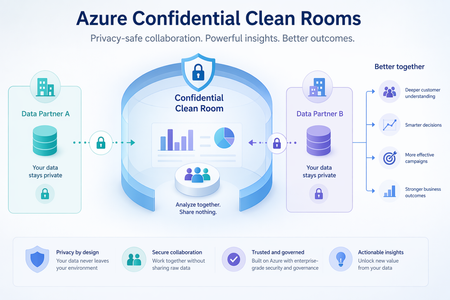
Today, we are excited to announce the preview of multiparty analytics feature of Azure Confidential Clean Rooms, a fully managed service that allows customers and their partners to securely analyze privacy-sensitive datasets from multiple parties. It uses confidential compute enabled Apache Spark-based big-data analytics (Spark SQL) which helps protect their raw data from other collaborators and from the Azure operator by performing computations in a Trusted Execution Environment (TEE). Privacy-sensitive datasets include personally identifiable information (PII), protected health information (PHI) and cryptographic secrets. Organizations across industries are increasingly looking to supplement their data with data from business partners, to build a complete view of their business. For example, brands, publishers, and their partners need to collaborate using datasets containing Intellectual Property (IP) to improve the relevance of their campaigns. Confidential data clean rooms help solve this challenge by enabling organizations to share and analyze granular datasets in a secure environment that helps prevent raw data exfiltration—protecting intellectual property, preserving customer privacy, and addressing concerns around regulatory compliance. You can sign up for the preview here Key Features Fully Managed: Azure takes care of the infrastructure provisioning and scaling with no user intervention. This significantly reduces your onboarding effort allowing you to focus on the queries and insights, not on infra management. Confidential Spark SQL: Spark SQL allows you to query large datasets and run complex queries in a distributed computing environment. In the confidential computing enabled version, the Spark driver and executors are fully attested policy-governed enclaves running as virtual nodes on confidential Azure Container Instances (ACI) which helps prevent exfiltration of collaborators’ data during query execution. Governance: Helps manage membership to cleanrooms, enables and verifies approval for queries from relevant collaborators before executing them and verifies consent to access sensitive collaborator data. It also helps generate tamper-resistant audit trails containing salient clean room events. This is made possible with the help of an implementation of the Confidential Consortium Framework (CCF). Telemetry: Throughout every clean-room run, detailed logs are streamed out in real time to monitor performance, troubleshoot issues, and keep the analytics healthy — all without ever exposing the collaborators’ data at any time. Verifiable trust: Cryptographic remote attestation viz. full attestation based on confidential hardware reports allows independent verification of the TEE along with along with all components that are part of it, without just trusting the cloud provider, before sensitive data and decryption keys are made available to the TEE Open-source containers: All Microsoft provided cleanroom containers and sidecars are open-sourced here and can be verified for provenance and integrity guarantees using GitHub artifact attestation Use Cases Multi-party confidential big-data analytics unlocks value in scenarios where data sensitivity, regulatory pressure, or competitive concerns previously blocked collaboration. These are some early scenarios that can benefit from this. Media & Advertising Collaboration of advertiser CRM data with publisher data for audience targeting and segment activation. Collaboration of audience data with measurement partners for measurement and attribution. Banking & Finance Collaboration between banks and insurance firms to upsell relevant products to existing bank customers without sharing raw data from either side Collaboration with retailers to generate customized offers for bank customers, without exposing either party’s underlying data. Government & Public Sector Secure collaboration of data across government departments to deliver better citizen welfare outcomes. Secure collaboration between government and private enterprises on shared-interest workloads such as traffic monitoring and weather systems. Healthcare Enable healthcare firms — including biopharma organizations — to combine their data with third-party institutions to accelerate clinical development, like identifying eligible participants for a clinical trial, without exposing underlying patient data. Combine patient datasets across hospitals to study disease patterns or outcomes without exposing sensitive protected health information. "A higher standard for protecting user privacy and trust, the phase-out of third-party cookies, and global regulations demand more sophisticated data collaboration tools to support advertising marketplaces. Azure Confidential Cleanrooms (ACCR) provides a secure, feature-rich, and flexible foundation to implement privacy-preserving functions and enable insights without sharing privacy-sensitive data outside of organization boundaries. Built on the Azure Confidential Compute (ACC) platform and offering cohesion with Azure's diverse set of services, ACCR offers the attestation, audit, fine-grained access control, and verifiable trust tools required for secure and privacy-safe data collaboration in today's world." — Andrei Mackenzie, Engineering Manager, Microsoft AI "Azure Confidential Clean Rooms enabled our team to evaluate how clean room capabilities can support secure, governed data collaboration at scale. Through the Proof-of-Concept (PoC), we explored how privacy-preserving workflows, trusted access controls, and scalable compute can create a stronger foundation for responsibly leveraging first-party data. This helps reduce operational friction while supporting business growth, improving customer engagement, and enabling more relevant customer experiences." — Nic Dregne, Director, Microsoft AdTech Engineering Beyond Spark SQL Realizing other multi-party scenarios like custom analytics, ML training and inferencing on Azure Confidential Clean Rooms is in our roadmap. If you have such a scenario to be realized, you can fill in and submit the preview signup form with the details of your scenario and we’ll get back to you. Learn More · Signup for the preview of Azure Confidential Clean Rooms for Analytics · Confidential Consortium Framework (CCF) · Virtual Nodes on Azure Container InstancesPreview of Azure Confidential Clean Rooms for secure multiparty data collaboration
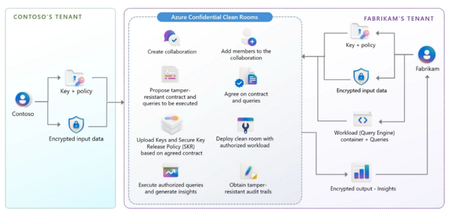
Today, we are excited to announce the preview of Azure Confidential Clean Rooms, a cutting-edge solution designed for organizations that require secure multi-party data collaboration. With Confidential Clean Rooms, you can share privacy sensitive data such as personally identifiable information (PII), protected health information (PHI) and cryptographic secrets confidently, thanks to robust trust guarantees that help ensure that your data remains protected throughout its lifecycle from other collaborators and from Azure operators. This secure data sharing is powered by confidential computing, which helps protect data in-use by performing computations in hardware-based, attested Trusted Execution Environments (TEEs). These TEEs help prevent unauthorized access or modification of application code and data during use. Organizations across industries need to perform multi-party data collaboration with business partners, outside organizations, and even within company silos to improve business outcomes and bolster innovation. Confidential Clean Rooms help derive true value from such collaborations by enabling granular and private data to be shared while providing safeguards on data exfiltration hence protecting the intellectual property of the organization and the privacy of its customers and addressing concerns around regulatory compliance. Whether you’re a data scientist looking to securely fine-tune your ML model with sensitive data from other organizations, or a data analyst wanting to perform secure analytics on joint data with your partner organizations, Confidential Clean Rooms will help you achieve the desired results. You can sign up for the preview here Key Features Secure Collaboration and Governance: Allows collaborators to create tamper-resistant contracts that contain the constraints which will be enforced by the clean room. Governance verifies validity of those constraints before allowing data to be released into clean rooms and helps generate tamper-resistant audit trails. This is made possible with the help of an implementation of the Confidential Consortium Framework CCF). Enhanced Data Privacy: Provides a sandboxed execution environment which allows only authorized workloads to execute and prevents any unauthorized network or IO operations from within the clean room. This helps keep your data secure throughout the workload execution. This is possible with the help of deploying clean rooms in confidential containers on Azure Container Instances (ACI) which provides container group level integrity with runtime enforcement of the same. Verifiable trust at each step with the help of cryptographic remote attestation forms the cornerstone of Confidential Clean Rooms. Salient Use Cases Azure Confidential Clean Rooms caters to use cases spanning multiple industries. Healthcare: For fine-tuning and inferencing with predictive healthcare machine-learning (ML) models and for joint data analysis for advancing pharmaceutical research. This can help protect the privacy of patients and intellectual property of organizations while demonstrating regulatory compliance. Finance: For financial fraud detection through analysis of combined data across banks and other financial institutions and for providing personalized offers to customers through secure analysis of transaction data and purchase data in retail outlets Media and Advertising: For improving marketing campaign effectiveness by combining data across advertisers, ad-techs, publishers and measurement firms for audience targeting and attribution and measurement Retail: For enhanced personalized marketing and improved inventory and supply chain management Government and Public Sector Organizations: For analysis of high security data across multiple government and public sector organizations to streamline benefits for citizens Customer Testimonials We are already partnering with several organizations to accelerate their secure multi-party collaboration journey with confidential clean rooms. Confidential computing in healthcare allows secure data processing within isolated environments, called 'clean rooms', protecting sensitive patient data during AI model development, validation and deployment. Apollo Hospitals uses Azure Confidential Clean Rooms to enhance data privacy, encrypt data, and securely train AI models. The benefits include secure collaboration, anonymized patient privacy, intellectual property protection, and enhanced cybersecurity. Apollo’s pilot with Confidential Clean Rooms showed promising results, and future efforts aim to scale secure AI solutions, ensuring patient safety, privacy, and compliance as the healthcare industry advances technologically. - Dr. Sujoy Kar, Chief Medical Information Officer and Vice President, Apollo Hospitals Azure Confidential Clean Rooms is a game changer to make collaborations on sensitive data both seamless and secure. When combined with Sarus, any data processing job is automatically analyzed using the most advanced privacy technology. Once validated, they are processed securely in Confidential Clean Rooms protecting both the privacy of data and the confidentiality of the analysis itself. This eliminates administrative overheads and makes it very easy to build advanced data processing pipelines. With our partner EY, we're already leveraging it to help international banks improve AML practices without compromising privacy. - Maxime Agostini, CEO & Cofounder of Sarus Read here to learn more about how Sarus is using Confidential Clean Rooms. As co-leaders on this Data Consortium Pilot, we are thrilled to be working with industry partners, Sarus and Microsoft, to drive this initiative forward. By combining Sarus’ privacy preserving technologies and Microsoft’s Azure Confidential Clean Rooms, not only does this project push the edge of technology innovation, but it strives to address a pivotal issue that affects us as Canadians. Through this work, we aim to help financial services organizations and regulators navigate the complexities of private and personal data sharing, without compromising the integrity of the data, and adhering to all relevant privacy regulations. For the purposes of this pilot, we are focusing our efforts on how this technology can play a pivotal role in helping better detect cases of human trafficking, however, we recognize that it can be used to help organizations for multiple other use cases, and cross industries, including health care and government & public sector. - Jessica Hansen, Privacy Partner EY Canada, and Dana Ohab, AI & Data Partner EY Canada Retrieval-Augmented Generation (RAG) applications accessing Large Language Models (LLMs) are common in private AI workflows, but managing secure access to sensitive data can be complex. SafeLiShare’s integration of its LLM Secure Data Proxy (SDP) with Azure Confidential Clean Rooms (ACCR) simplifies access control and token management. The joint solution helps ensure runtime security through advanced Public Key Infrastructure (PKI) and centralized policy management in Trusted Execution Environments (TEEs), enforcing strict access policies and admission controls to guarantee authorized access to sensitive data. This integration establishes trust bindings between the Identity Provider (IDP), applications, and data, safeguarding each layer without compromise. It also enables secure creation, sharing, and management of applications and data assets, ensuring compliance in high-performance AI environments. - Cynthia Hsieh, VP of Marketing, SafeLiShare Read here to learn more about how SafeLiShare is using Confidential Clean Rooms. Learn More Signup for the preview of Azure Confidential Clean Rooms Confidential Consortium Framework (CCF) Confidential containers on Azure Container Instances (ACI)Unlocking the Power of Serverless Confidential Computing in the Cloud
Discover the transformative power of Serverless Confidential Containers on Azure Container Instances (ACI) for industries like healthcare technology, fintech, and RegTech. This solution harnesses the benefits of serverless and confidential computing, ensuring robust data security while processing, compliance with regulations, and seamless deployment. Ideal for managing sensitive data, mitigating risks, and fostering trust and innovation in a cloud-based digital landscape..Confidential Computing is Child's Play with ACI
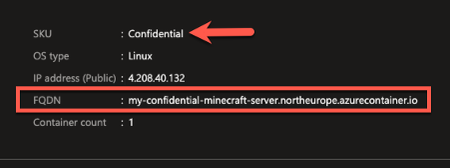
In this fun example we’ll be using a containerised version of the Minecraft game server to demonstrate how easy it is to take an existing container and deploy it unmodified using Azure Confidential Containers on Azure Container Instances to give you the tools you need to try this with ‘real’ workloads in your environment.Microsoft introduces preview of confidential containers on Azure Container Instances (ACI)
Microsoft announces a limited preview of confidential containers on Azure Container Instances (ACI) enabling customers to easily lift-and-shift Linux containers on Azure. Confidential containers on ACI are the first in the market serverless offering that helps running Linux containers in a hardware-based trusted execution environment with AMD SEV-SNP technology.