Windows Server
8 Topics
Announcing Native NVMe in Windows Server 2025: Ushering in a New Era of Storage Performance
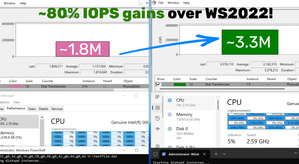
We’re thrilled to announce the arrival of Native NVMe support in Windows Server 2025—a leap forward in storage innovation that will redefine what’s possible for your most demanding workloads. Modern NVMe (Non-Volatile Memory Express) SSDs now operate more efficiently with Windows Server. This improvement comes from a redesigned Windows storage stack that no longer treats all storage devices as SCSI (Small Computer System Interface) devices—a method traditionally used for older, slower drives. By eliminating the need to convert NVMe commands into SCSI commands, Windows Server reduces processing overhead and latency. Additionally, the whole I/O processing workflow is redesigned for extreme performance. This release is the result of close collaboration between our engineering teams and hardware partners, and it serves as a cornerstone in modernizing our storage stack. Native NVMe is now generally available (GA) with an opt-in model (disabled by default as of October’s latest cumulative update for WS2025). Switch onto Native NVMe as soon as possible or you are leaving performance gains on the table! Stay tuned for more updates from our team as we transition to a dramatically faster, more efficient storage future. Why Native NVMe and why now? Modern NVMe devices—like PCIe Gen5 enterprise SSDs capable of 3.3 million IOPS, or HBAs delivering over 10 million IOPS on a single disk—are pushing the boundaries of what storage can do. SCSI-based I/O processing can’t keep up because it uses a single-queue model, originally designed for rotational disks, where protocols like SATA support just one queue with up to 32 commands. In contrast, NVMe was designed from the ground up for flash storage and supports up to 64,000 queues, with each queue capable of handling up to 64,000 commands simultaneously. With Native NVMe in Windows Server 2025, the storage stack is purpose-built for modern hardware—eliminating translation layers and legacy constraints. Here’s what that means for you: Massive IOPS Gains: Direct, multi-queue access to NVMe devices means you can finally reach the true limits of your hardware. Lower Latency: Traditional SCSI-based stacks rely on shared locks and synchronization mechanisms in the kernel I/O path to manage resources. Native NVMe enables streamlined, lock-free I/O paths that slash round-trip times for every operation. CPU Efficiency: A leaner, optimized stack frees up compute for your workloads instead of storage overhead. Future-Ready Features: Native support for advanced NVMe capabilities like multi-queue and direct submission ensures you’re ready for next-gen storage innovation. Performance Data Using DiskSpd.exe, basic performance testing shows that with Native NVMe enabled, WS2025 systems can deliver up to ~80% more IOPS and a ~45% savings in CPU cycles per I/O on 4K random read workloads on NTFS volumes when compared to WS2022. This test ran on a host with Intel Dual Socket CPU (208 logical processors, 128GB RAM) and a Solidigm SB5PH27X038T 3.5TB NVMe device. The test can be recreated by running "diskspd.exe -b4k -r -Su –t8 -L -o32 -W10 -d30" and modifying the parameters as desired. Results may vary. Top Use Cases: Where You’ll See the Difference Try Native NVMe on servers running your enterprise applications. These gains are not just for synthetic benchmarks—they translate directly to faster database transactions, quicker VM operations, and more responsive file and analytics workloads. SQL Server and OLTP: Shorter transaction times, higher IOPS, and lower tail latency under mixed read/write workloads. Hyper‑V and virtualization: Faster VM boot, checkpoint operations, and live migration with reduced storage contention. High‑performance file servers: Faster large‑file reads/writes and quicker metadata operations (copy, backup, restore). AI/ML and analytics: Low‑latency access to large datasets and faster ETL, shuffle, and cache/scratch I/O. How to Get Started Check your hardware: Ensure you have NVMe-capable devices that are currently using the Windows NVMe driver (StorNVMe.sys). Note that some NVMe device vendors provide their own drivers, so unless using the in-box Windows NVMe driver, you will not notice any differences. Enable Native NVMe: After applying the 2510-B Latest Cumulative Update (or most recent), add the registry key with the following PowerShell command: reg add HKEY_LOCAL_MACHINE\SYSTEM\CurrentControlSet\Policies\Microsoft\FeatureManagement\Overrides /v 1176759950 /t REG_DWORD /d 1 /f Alternatively, use this Group Policy MSI to add the policy that controls the feature then run the local Group Policy Editor to enable the policy (found under Local Computer Policy > Computer Configuration > Administrative Templates > KB5066835 251014_21251 Feature Preview > Windows 11, version 24H2, 25H2). Once Native NVMe is enabled, open Device Manager and ensure that all attached NVMe devices are displayed under the “Storage disks” section. Monitor and Validate: Use Performance Monitor and Windows Admin Center to see the gains for yourself. Or try DiskSpd.exe yourself to measure microbenchmarks in your own environment! A quick way to measure IOPS in Performance Monitor is to set up a histogram chart and add a counter for Physical Disk>Disk Transfers/sec (where the selected instance is a drive that corresponds to one of your attached NVMe devices) then run a synthetic workload with DiskSpd. Compare the numbers before and after enabling Native NVMe to see the realized difference in your real environment! Join the Storage Revolution This is more than just a feature—it’s a new foundation for Windows Server storage, built for the future. We can’t wait for you to experience the difference. Share your feedback, ask questions, and join the conversation. Let’s build the future of high-performance Windows Server storage together. Send us your feedback or questions at nativenvme@microsoft.com! — Yash Shekar (and the Windows Server team)Introducing the VM Conversion tool in Windows Admin Center – Public Preview
As organizations update their infrastructure, a growing number are seeking adaptable, Microsoft-supported solutions that address current requirements while laying the path for future cloud and AI adoption. Azure provides an agile, scalable, cost-effective platform for infrastructure and innovation. Whether by modernizing to cloud technologies like Windows or Linux VMs, containers, Azure VMware Solution or PaaS services, Azure offers a world-class cloud experience. However, we recognize that some organizations must retain workloads on-premises due to data compliance, governance, or other regulatory requirements. For customers wanting to adopt Windows Server and Hyper-V for this use case, we are excited to provide a new option within Windows Admin Center, the VM Conversion tool, in public preview now. This agentless, cost-free tool streamlines the conversion of virtual machines from VMware to Windows Server with Hyper-V, providing customers flexibility with their on-premises virtualization environments while enabling a seamless transition path to Azure when desired. With minimal infrastructure requirements, the tool is particularly beneficial for small and medium-sized organizations. Additionally, with minimal setup time you can download the new VM Conversion tool extension in Windows Admin Center and begin converting virtual machines in under five minutes. Figure 1- VM Conversion tool in Windows Admin Center 🔑Key Features : Agentless, appliance-free discovery After establishing a connection to the virtualization environment, the tool conducts discovery of all virtual machines without requiring agents or appliances and does so in a non-intrusive manner. Minimal downtime The VM Conversion tool enables initial data replication while the source virtual machine remains operational, thereby preventing any interruptions to ongoing applications. After completing this initial replication, on user consent, the source VM is powered down so a subsequent replication pass can capture any data changes made during the first phase. This two-step process ensures that the cutover time from the source to the target VM is minimized. Group servers You can select and migrate up to 10 virtual machines at a time. This reduces manual effort and accelerates the transition to Windows Server. Boot configuration The tool automatically maps BIOS-based virtual machines to Generation 1 and UEFI-based machines to Generation 2, preserving boot configurations and ensuring compatibility. OS agnostic The tool supports conversion of both Linux and Windows guest OS VMs to Windows Server host. Multi-disk VM support Virtual machines that use several virtual hard disks—common in production environments—are fully supported. The operating system, data, and application disks all migrated together, so manual setup is not needed. ⚙️How It Works To ensure a smooth and reliable transition, the tool performs a comprehensive set of built-in prechecks. These checks validate critical VM attributes such as disk types, boot configuration (BIOS or UEFI), destination disk, memory requirements, and several more. By identifying potential issues early, administrators can proactively address them—minimizing the risk of migration failures and reducing downtime during the final cutover. The VM Conversion tool uses change block tracking (CBT) to efficiently replicate data from one virtual disk format to another. During the initial seeding phase, a full copy of the virtual machine is created while it remains online. This minimizes downtime and ensures data integrity. Before the final cutover, a delta replication captures all changes made since the initial copy, ensuring the destination VM is fully up-to-date post conversion to Hyper-V hosts. 🚀Ready to Take the Next Step? The VM Conversion tool is available now in the public feed of Windows Admin Center. You can install it directly from the Extensions settings in Windows Admin Center. To get started, ensure you're running the Windows Admin Center v2 GA release. 📘 For detailed setup instructions and prerequisites, refer to the Public Preview Documentation. 📍 Summary The VM Conversion tool offers a simple, supported path for organizations to streamline VM conversion to Hyper-V virtualization environments. With no added cost and minimal setup, it empowers customers to streamline VM migration and prepare for the cloud at their own pace. Support for Azure Arc-enabled servers is also planned for future releases, further enhancing hybrid management capabilities. We’re continuously evolving the VM Conversion tool based on user feedback. Please continue to share your feedback here and help us prioritize our efforts for future releases. Happy converting!
Hotpatching for Azure Arc–Connected Servers: General Availability and Subscription Details
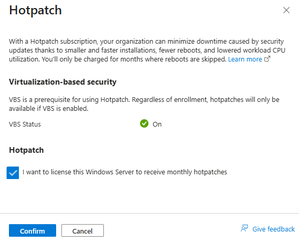
Effective July 16, 2025, Hotpatching for Windows Server 2025 on Azure Arc–connected machines will be generally available (GA) and transition to a paid subscription model. This post provides technical details on the service, the value of hotpatching for on-premises servers, and important enrollment information for customers. What Is hotpatching? Hotpatching enables you to install OS security updates on Windows Server without requiring a reboot. This technology, previously exclusive to Windows Server Datacenter: Azure Edition, is now available for on-premises and hybrid environments through Azure Arc. Hotpatching has been in public preview at no cost, but as of July 16, 2025, a monthly subscription fee of $1.50 USD per CPU core will apply. Why hotpatching for on-premises servers? Minimize downtime: Apply critical security updates without interrupting workloads or requiring planned maintenance windows. Improve security posture: Reduce the window of vulnerability by deploying patches as soon as they are available. Operational efficiency: Eliminate the need for frequent reboots, simplifying patch management for IT teams. Consistent experience: Use the same hotpatching process across Azure, on-premises, and hybrid environments with Azure Arc. Enrollment and billing To receive hotpatches on Windows Servers outside of Azure, customers must enroll their servers. The servers must be on the latest cumulative update released during a baseline month (January, April, July and October) by Microsoft on the second Tuesday of the month. Only enrolled servers will continue to receive hotpatches and be billed accordingly. Preview customers: If already enrolled during the preview period, then no action is needed to continue to receive hotpatches. If you enrolled in hotpatching during the Preview and do not wish to be billed after GA, you must disenroll your servers before July 16, 2025, to avoid charges. New customers: Enroll your eligible Windows Server 2025 machines via Azure Arc to activate hotpatching and start receiving updates. How to enroll in hotpatching To begin receiving hotpatches for your Azure Arc–connected Windows Server 2025 machines, follow these steps: Prerequisites Ensure your machine is connected to Azure Arc. Ensure Virtualization Based Security (VBS) is enabled and running. Confirm that the latest cumulative update from a baseline month (January, April, July, or October) is installed. Hotpatching is only offered if this requirement is met. Enrollment via Azure Portal Connect your server to Azure Arc. Navigate to the Windows Server resource in the Azure Arc portal. Click on the Hotpatch blade Check the box “I want to license this Windows Server to receive monthly hotpatches” and click on confirm under the hotpatch blade. Note: Enrollment operation takes a few minutes, so you may need to manually refresh the Azure portal to see the updated status. How to disenroll from hotpatching If you no longer wish to receive hotpatches or want to avoid billing after the preview period ending on July 16, 2025, you must disenroll from hotpatching service on Azure Arc portal. Disenrollment via Azure portal Go to the Azure Arc–connected server in the Azure Arc portal. Open the hotpatch blade. Uncheck the box “I want to license this Windows Server to receive monthly hotpatches” and click on confirm. Important: Disenroll before disconnecting the machine from Azure Arc. If you disconnect first, billing may continue for up to 30 days after the last connection. See this blog post for additional details. Disenrollment via API Set subscriptionStatus to "Disable" in the license profile payload. This action is synchronous and should reflect immediately, though portal refresh may still be required. Learn more If you’re interested in learning more, check out our April blog post and the on-demand session on Hotpatching and Update Management from our recent Windows Server Summit virtual event.