microsoft defender for identity
233 TopicsMonthly news - December 2025
Microsoft Defender Monthly news - December 2025 Edition This is our monthly "What's new" blog post, summarizing product updates and various new assets we released over the past month across our Defender products. In this edition, we are looking at all the goodness from November 2025. Defender for Cloud has its own Monthly News post, have a look at their blog space. 😎 Microsoft Ignite 2025 - now on-demand! 🚀 New Virtual Ninja Show episode: Advancements in Attack Disruption Vulnerability Remediation Agent in Microsoft Intune Microsoft Defender Ignite 2025: What's new in Microsoft Defender? This blog summarizes our big announcements we made at Ignite. (Public Preview) Defender XDR now includes the predictive shielding capability, which uses predictive analytics and real-time insights to dynamically infer risk, anticipate attacker progression, and harden your environment before threats materialize. Learn more about predictive shielding. Security Copilot for SOC: bringing agentic AI to every defender. This blog post gives a great overview of the various agents supporting SOC teams. Account correlation links related accounts and corresponding insights to provide identity-level visibility and insights to the SOC. Coordinated response allows Defenders to take action comprehensively across connected accounts, accelerating response and minimizing the potential for lateral movement. Enhancing visibility into your identity fabric with Microsoft Defender. This blog describes new enhancements to the identity security experience within Defender that will help enrich your security team’s visibility and understanding into your unique identity fabric. (Public Preview) The IdentityAccountInfo table in advanced hunting is now available for preview. This table contains information about account information from various sources, including Microsoft Entra ID. It also includes information and link to the identity that owns the account. Microsoft Sentinel customers using the Defender portal, or the Azure portal with the Microsoft Sentinel Defender XDR data connector, now also benefit from Microsoft Threat Intelligence alerts that highlight activity from nation-state actors, major ransomware campaigns, and fraudulent operations. For more information, see Incidents and alerts in the Microsoft Defender portal. (Public Preview) New Entity Behavior Analytics (UEBA) experiences in the Defender portal! Microsoft Sentinel introduces new UEBA experiences in the Defender portal, bringing behavioral insights directly into key analyst workflows. These enhancements help analysts prioritize investigations and apply UEBA context more effectively. Learn more on our docs. (Public Preview) A new Restrict pod access response action is now available when investigating container threats in the Defender portal. This response action blocks sensitive interfaces that allow lateral movement and privilege escalation. (Public Preview) Threat analytics now has an Indicators tab that provides a list of all indicators of compromise (IOCs) associated with a threat. Microsoft researchers update these IOCs in real time as they find new evidence related to the threat. This information helps your security operations center (SOC) and threat intelligence analysts with remediation and proactive hunting. Learn more. In addition the overview section of threat analytics now includes additional details about a threat, such as alias, origin, and related intelligence, providing you with more insights on what the threat is and how it might impact your organization. Microsoft Defender for Identity (Public Preview) In addition to the GA release of scoping by Active Directory domains a few months ago, you can now scope by Organizational Units (OUs) as part of XDR User Role-Based Access Control. This enhancement provides even more granular control over which entities and resources are included in security analysis. For more information, see Configure scoped access for Microsoft Defender for Identity. (Public Preview). New security posture assessment: Change password for on-prem account with potentially leaked credentials. The new security posture assessment lists users whose valid credentials have been leaked. For more information, see: Change password for on-prem account with potentially leaked credentials. Defender for Identity is slowly rolling out automatic Windows event auditing for sensors v3.x, streamlining deployment by applying required auditing settings to new sensors and fixing misconfigurations on existing ones. As it becomes available, you will be able to enable automatic Windows event-auditing in the Advanced settings section in the Defender portal, or using the Graph API. Identity Inventory enhancements: Accounts tab, manual account linking and unlinking, and expanded remediation actions are now available. Learn more in our docs. Microsoft Defender for Cloud Apps (Public Preview) Defender for Cloud Apps automatically discovers AI agents created in Microsoft Copilot Studio and Azure AI Foundry, collects audit logs, continuously monitors for suspicious activity, and integrates detections and alerts into the XDR Incidents and Alerts experience with a dedicated Agent entity. For more information, see Protect your AI agents. Microsoft Defender for Endpoint Ignite 2025: Microsoft Defender now prevents threats on endpoints during an attack. This year at Microsoft Ignite, Microsoft Defender is announcing exciting innovations for endpoint protection that help security teams deploy faster, gain more visibility, and proactively block attackers during active attacks. (Public Preview) Defender for Endpoint now includes the GPO hardening and Safeboot hardening response actions. These actions are part of the predictive shielding feature, which anticipates and mitigates potential threats before they materialize. (Public Preview) Custom data collection enables organizations to expand and customize telemetry collection beyond default configurations to support specialized threat hunting and security monitoring needs. (Public Preview) Native root detection support for Microsoft Defender on Android. This enables proactive detection of rooted devices without requiring Intune policies, ensuring stronger security and validating that Defender is running on an uncompromised device, ensuring more reliable telemetry that is not vulnerable to attacker manipulation. (Public Preview) The new Defender deployment tool is a lightweight, self-updating application that streamlines onboarding devices to the Defender endpoint security solution. The tool takes care of prerequisites, automates migrations from older solutions, and removes the need for complex onboarding scripts, separate downloads, and manual installations. It currently supports Windows and Linux devices. Defender deployment tool: for Windows devices for Linux devices (Public Preview) Defender endpoint security solution for Windows 7 SP1 and Windows Server 2008 R2 SP1. A Defender for endpoint security solution is now available for legacy Windows 7 SP1 and Windows Server 2008 R2 SP1 devices. The solution provides advanced protection capabilities and improved functionality for these devices compared to other solutions. The new solution is available using the new Defender deployment tool. Microsoft Defender Vulnerability Management (Public Preview) The Vulnerability Management section in the Microsoft Defender portal is now located under Exposure management. This change is part of the vulnerability management integration to Microsoft Security Exposure Management, which significantly expands the scope and capabilities of the platform. Learn more. (General Availability) Microsoft Secure Score now includes new recommendations to help organizations proactively prevent common endpoint attack techniques. Require LDAP client signing and Require LDAP server signing - help ensure integrity of directory requests so attackers can't tamper with or manipulate group memberships or permissions in transit. Encrypt LDAP client traffic - prevents exposure of credentials and sensitive user information by enforcing encrypted communication instead of clear-text LDAP. Enforce LDAP channel binding - prevents man-in-the-middle relay attacks by ensuring the authentication is cryptographically tied to the TLS session. If the TLS channel changes, the bind fails, stopping credential replay. (General Availability) These Microsoft Secure Score recommendations are now generally available: Block web shell creation on servers Block use of copied or impersonated system tools Block rebooting a machine in Safe Mode Microsoft Defender for Office 365 Microsoft Ignite 2025: Transforming Phishing Response with Agentic Innovation. This blog post summarizes the following announcements: General Availability of the Security Copilot Phishing Triage Agent Agentic Email Grading System in Microsoft Defender Cisco and VIPRE Security Group join the Microsoft Defender ICES ecosystem. A separate blog explains these best practices in more detail and outline three other routing techniques commonly used across ICES vendors. Blog series: Best practices from the Microsoft Community Microsoft Defender for Office 365: Fine-Tuning: This blog covers our top recommendations for fine-tuning Microsoft Defender for Office 365 configuration from hundreds of deployments and recovery engagements, by Microsoft MVP Joe Stocker. You may be right after all! Disputing Submission Responses in Microsoft Defender for Office 365: Microsoft MVP Mona Ghadiri spotlights a new place AI has been inserted into a workflow to make it better… a feature that elevates the transparency and responsiveness of threat management: the ability to dispute a submission response directly within Microsoft Defender for Office 365. Blog post: Strengthening calendar security through enhanced remediation.3.5KViews0likes0Comments
Artificial Intelligence & Security
Understanding Artificial Intelligence Artificial intelligence (AI) is a computational system that perform human‑intelligence tasks, learning, reasoning, problem‑solving, perception, and language understanding by leveraging algorithmic and statistical methods to analyse data and make informed decisions. Artificial Intelligence (AI) can also be abbreviated as is the simulation of human intelligence through machines programmed to learn, reason, and act. It blends statistics, machine learning, and robotics to deliver following outcomes: Prediction: The application of statistical modelling and machine learning techniques to anticipate future outcomes, such as detecting fraudulent transactions. Automation: The utilisation of robotics and artificial intelligence to streamline and execute routine processes, exemplified by automated invoice processing. Augmentation: The enhancement of human decision-making and operational capabilities through AI-driven tools, for instance, AI-assisted sales enablement. Artificial Intelligence: Core Capabilities and Market Outlook Key capabilities of AI include: Data-driven decision-making: Analysing large datasets to generate actionable insights and optimise outcomes. Anomaly detection: Identifying irregular patterns or deviations in data for risk mitigation and quality assurance. Visual interpretation: Processing and understanding visual inputs such as images and videos for applications like computer vision. Natural language understanding: Comprehending and interpreting human language to enable accurate information extraction and contextual responses. Conversational engagement: Facilitating human-like interactions through chatbots, virtual assistants, and dialogue systems. With the exponential growth of data, ML learning models and computing power. AI is advancing much faster and as According to industry analyst reports breakthroughs in deep learning and neural network architectures have enabled highly sophisticated applications across diverse sectors, including healthcare, finance, manufacturing, and retail. The global AI market is on a trajectory of significant expansion, projected to increase nearly 5X by 2030, from $391 billion in 2025 to $1.81 trillion. This growth corresponds to a compound annual growth rate (CAGR) of 35.9% during the forecast period. These projections are estimates and subject to change as per rapid growth and advancement in the AI Era. AI and Cloud Synergy AI, and cloud computing form a powerful technological mixture. Digital assistants are offering scalable, cloud-powered intelligence. Cloud platforms such as Azure provide pre-trained models and services, enabling businesses to deploy AI solutions efficiently. Core AI Workloads Capabilities Machine Learning Machine learning (ML) underpins most AI systems by enabling models to learn from historical and real-time data to make predictions, classifications, and recommendations. These models adapt over time as they are exposed to new data, improving accuracy and robustness. Example use cases: Credit risk scoring in banking, demand forecasting in retail, and predictive maintenance in manufacturing. Anomaly Detection Anomaly detection techniques identify deviations from expected patterns in data, systems, or processes. This capability is critical for risk management and operational resilience, as it enables early detection of fraud, security breaches, or equipment failures. Example use cases: Fraud detection in financial transactions, network intrusion monitoring in cybersecurity, and quality control in industrial production. Natural Language Processing (NLP) NLP focuses on enabling machines to understand, interpret, and generate human language in both text and speech formats. This capability powers a wide range of applications that require contextual comprehension and semantic accuracy. Example use cases: Sentiment analysis for customer feedback, document summarisation for legal and compliance teams, and multilingual translation for global operations. Principles of Responsible AI To ensure ethical and trustworthy AI, organisations must embrace: Reliability & Safety Privacy & Security Inclusiveness Fairness Transparency Accountability These principles are embedded in frameworks like the Responsible-AI-Standard and reinforced by governance models such as Microsoft AI Governance Framework. Responsible AI Principles and Approach | Microsoft AI AI and Security AI introduces both opportunities and risks. A responsible approach to AI security involves three dimensions: Risk Mitigation: It Is addressing threats from immature or malicious AI applications. Security Applications: These are used to enhance AI security and public safety. Governance Systems: Establishing frameworks to manage AI risks and ensure safe development. Security Risks and Opportunities Due to AI Transformation AI’s transformative nature brings new challenges: Cybersecurity: This brings the opportunities and advancement to track, detect and act against Vulnerabilities in infrastructure and learning models. Data Security: This helps the tool and solutions such as Microsoft Purview to prevent data security by performing assessments, creating Data loss prevention policies applying sensitivity labels. Information Security: The biggest risk is securing the information and due to the AI era of transformation securing IS using various AI security frameworks. These concerns are echoed in The Crucial Role of Data Security Posture Management in the AI Era, which highlights insider threats, generative AI risks, and the need for robust data governance. AI in Security Applications AI’s capabilities in data analysis and decision-making enable innovative security solutions: Network Protection: applications include use of AI algorithms for intrusion detection, malware detection, security situational awareness, and threat early warning, etc. Data Management: applications refer to the use of AI technologies to achieve data protection objectives such as hierarchical classification, leak prevention, and leak traceability. Intelligent Security: applications refer to the use of AI technology to upgrade the security field from passive defence toward the intelligent direction, developing of active judgment and timely early warning. Financial Risk Control: applications use AI technology to improve the efficiency and accuracy of credit assessment, risk management, etc., and assisting governments in the regulation of financial transactions. AI Security Management Effective AI security requires: Regulations & Policies: Establish and safety management laws specifically designed to for governance by regulatory authorities and management policies for key application domains of AI and prominent security risks. Standards & Specifications: Industry-wide benchmarks, along with international and domestic standards can be used to support AI safety. Technological Methods: Early detection with Modern set of tools such as Defender for AI can be used to support to detect and mitigate and remediate AI threats. Security Assessments: Organization should use proper tools and platforms for evaluating AI risks and perform assessments regularly using automated tools approach Conclusion AI is transforming how organizations operate, innovate, and secure their environments. As AI capabilities evolve, integrating security and governance considerations from the outset remains critical. By combining responsible AI principles, effective governance, and appropriate security measures, organizations can work toward deploying AI technologies in a manner that supports both innovation and trust. Industry projections suggest continued growth in AI‑related security investments over the coming years, reflecting increased focus on managing AI risks alongside its benefits. These estimates are subject to change and should be interpreted in the context of evolving technologies and regulatory developments. Disclaimer References to Microsoft products and frameworks are for informational purposes only and do not imply endorsement, guarantee, or contractual commitment. Market projections referenced are based on publicly available industry analyses and are subject to change.
Host Microsoft Defender data locally in the United Arab Emirates
We are pleased to announce that local data residency support in the UAE is now generally available for Microsoft Defender for Endpoint and Microsoft Defender for Identity. This announcement reinforces our ongoing commitment to delivering secure, compliant services aligned with local data sovereignty requirements. Customers can now confidently onboard to Defender for Endpoint and Defender for Identity in the UAE, knowing that this Defender data will remain at rest within the UAE data boundary. This allows customers to meet their regulatory obligations and maintain control over their data. For more details on the Defender data storage and privacy policies, refer to Microsoft Defender for Endpoint data storage and privacy and Microsoft Defender for Identity data security and privacy. Note: Defender for Endpoint and Defender for Identity may potentially use other Microsoft services (i.e. Microsoft Intune for security settings management). Each Microsoft service is governed by its own data storage and privacy policies and may have varying regional availability. For more information, refer to our Online Product Terms. In addition to the UAE, Defender data residency capabilities are available in the United States, the European Union, the United Kingdom, Australia, Switzerland and India (see our recent announcement for local data hosting in India). Customers with Existing deployments for Defender for Endpoint and/or Defender for Identity Existing customers can check their deployment geo within the portal by going to Settings -> Microsoft Defender XDR-> Account; and see where the service is storing your data at rest. For example, in the image below, the service location for the Defender XDR tenant is UAE. ation information If you would like to update your service location, please reach out to Customer Service and Support for a tenant reset. Support can be accessed by clicking on the “?” icon in the top right corner of the portal when signed in as an Admin (see image below). If you are a Microsoft Unified support customer, please reach out to your Customer Success Account Manager for assistance with the migration process. More information: Ready to go local? Read our documentation for more information on how to get started. Microsoft Defender XDR data center location Not yet a customer? Take Defender XDR for a spin via a 90-day trial for Office 365 E5 or Defender for Endpoint via a 90-day trial for Defender for Endpoint Check out the Defender for Endpoint website to learn more about our industry leading Endpoint protection platform Check out the Defender for Identity website to learn how to keep your organization safe against rising identity threats887Views1like2Comments
Defender Entity Page w/ Sentinel Events Tab
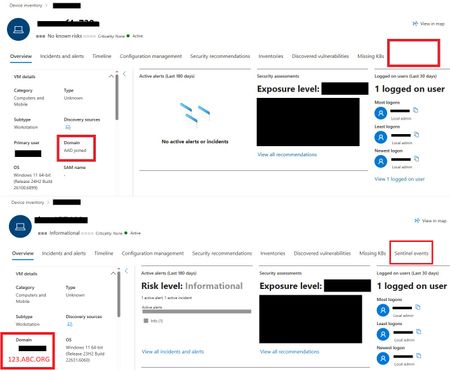
One device is displaying the Sentinel Events Tab, while the other is not. The only difference observed is that one device is Azure AD (AAD) joined and the other is Domain Joined. Could this difference account for the missing Sentinel events data? Any insight would be appreciated!172Views0likes2CommentsMicrosoft Ignite 2025: Top Security Innovations You Need to Know
🤖 Security & AI -The Big Story This Year 2025 marks a turning point for cybersecurity. Rapid adoption of AI across enterprises has unlocked innovation but introduced new risks. AI agents are now part of everyday workflows-automating tasks and interacting with sensitive data—creating new attack surfaces that traditional security models cannot fully address. Threat actors are leveraging AI to accelerate attacks, making speed and automation critical for defense. Organizations need solutions that deliver visibility, governance, and proactive risk management for both human and machine identities. Microsoft Ignite 2025 reflects this shift with announcements focused on securing AI at scale, extending Zero Trust principles to AI agents, and embedding intelligent automation into security operations. As a Senior Cybersecurity Solution Architect, I’ve curated the top security announcements from Microsoft Ignite 2025 to help you stay ahead of evolving threats and understand the latest innovations in enterprise security. Agent 365: Control Plane for AI Agents Agent 365 is a centralized platform that gives organizations full visibility, governance, and risk management over AI agents across Microsoft and third-party ecosystems. Why it matters: Unmanaged AI agents can introduce compliance gaps and security risks. Agent 365 ensures full lifecycle control. Key Features: Complete agent registry and discovery Access control and conditional policies Visualization of agent interactions and risk posture Built-in integration with Defender, Entra, and Purview Available via the Frontier Program Microsoft Agent 365: The control plane for AI agents Deep dive blog on Agent 365 Entra Agent ID: Zero Trust for AI Identities Microsoft Entra is the identity and access management suite (covering Azure AD, permissions, and secure access). Entra Agent ID extends Zero Trust identity principles to AI agents, ensuring they are governed like human identities. Why it matters: Unmanaged or over-privileged AI agents can create major security gaps. Agent ID enforces identity governance on AI agents and reduces automation risks. Key Features: Provides unique identities for AI agents Lifecycle governance and sponsorship for agents Conditional access policies applied to agent activity Integrated with open SDKs/APIs for third‑party platforms Microsoft Entra Agent ID Overview Entra Ignite 2025 announcements Public Preview details Security Copilot Expansion Security Copilot is Microsoft’s AI assistant for security teams, now expanded to automate threat hunting, phishing triage, identity risk remediation, and compliance tasks. Why it matters: Security teams face alert fatigue and resource constraints. Copilot accelerates response and reduces manual effort. Key Features: 12 new Microsoft-built agents across Defender, Entra, Intune, and Purview. 30+ partner-built agents available in the Microsoft Security Store. Automates threat hunting, phishing triage, identity risk remediation, and compliance tasks. Included for Microsoft 365 E5 customers at no extra cost. Security Copilot inclusion in Microsoft 365 E5 Security Copilot Ignite blog Security Dashboard for AI A unified dashboard for CISOs and risk leaders to monitor AI risks, aggregate signals from Microsoft security services, and assign tasks via Security Copilot - included at no extra cost. Why it matters: Provides a single pane of glass for AI risk management, improving visibility and decision-making. Key Features: Aggregates signals from Entra, Defender, and Purview Supports natural language queries for risk insights Enables task assignment via Security Copilot Ignite Session: Securing AI at Scale Microsoft Security Blog Microsoft Defender Innovations Microsoft Defender serves as Microsoft’s CNAPP solution, offering comprehensive, AI-driven threat protection that spans endpoints, email, cloud workloads, and SIEM/SOAR integrations. Why It Matters Modern attacks target multi-cloud environments and software supply chains. These innovations provide proactive defense, reduce breach risks before exploitation, and extend protection beyond Microsoft ecosystems-helping organizations secure endpoints, identities, and workloads at scale. Key Features: Predictive Shielding: Proactively hardens attack paths before adversaries pivot. Automatic Attack Disruption: Extended to AWS, Okta, and Proofpoint via Sentinel. Supply Chain Security: Defender for Cloud now integrates with GitHub Advanced Security. What’s new in Microsoft Defender at Ignite Defender for Cloud innovations Global Secure Access & AI Gateway Part of Microsoft Entra’s secure access portfolio, providing secure connectivity and inspection for web and AI traffic. Why it matters: Protects against lateral movement and AI-specific threats while maintaining secure connectivity. Key Features: TLS inspection, URL/file filtering AI Prompt Injection protection Private access for domain controllers to prevent lateral movement attacks. Learn about Secure Web and AI Gateway for agents Microsoft Entra: What’s new in secure access on the AI frontier Purview Enhancements Microsoft Purview is the data governance and compliance platform, ensuring sensitive data is classified, protected, and monitored. Why it matters: Ensures sensitive data remains protected and compliant in AI-driven environments. Key Features: AI Observability: Monitor agent activities and prevent sensitive data leakage. Compliance Guardrails: Communication compliance for AI interactions. Expanded DSPM: Data Security Posture Management for AI workloads. Announcing new Microsoft Purview capabilities to protect GenAI agents Intune Updates Microsoft Intune is a cloud-based endpoint device management solution that secures apps, devices, and data across platforms. It simplifies endpoint security management and accelerates response to device risks using AI. Why it matters: Endpoint security is critical as organizations manage diverse devices in hybrid environments. These updates reduce complexity, speed up remediation, and leverage AI-driven automation-helping security teams stay ahead of evolving threats. Key Features: Security Copilot agents automate policy reviews, device offboarding, and risk-based remediation. Enhanced remote management for Windows Recovery Environment (WinRE). Policy Configuration Agent in Intune lets IT admins create and validate policies with natural language What’s new in Microsoft Intune at Ignite Your guide to Intune at Ignite Closing Thoughts Microsoft Ignite 2025 signals the start of an AI-driven security era. From visibility and governance for AI agents to Zero Trust for machine identities, automation in security operations, and stronger compliance for AI workloads-these innovations empower organizations to anticipate threats, simplify governance, and accelerate secure AI adoption without compromising compliance or control. 📘 Full Coverage: Microsoft Ignite 2025 Book of News2.2KViews2likes0CommentsMicrosoft Defender for Identity Ninja Training
Microsoft Defender for Identity identifies, detects, and investigates advanced threats, compromised identities, and malicious insider actions directed at your organization. Dig in to the features, detentions, and functions of Microsoft Defender for Identity.142KViews30likes30Comments
Understand New Sentinel Pricing Model with Sentinel Data Lake Tier
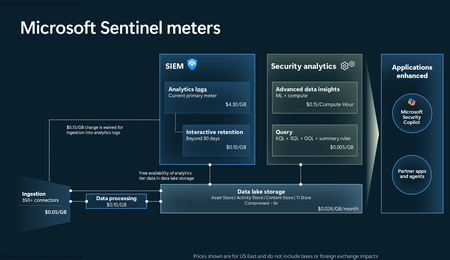
Introduction on Sentinel and its New Pricing Model Microsoft Sentinel is a cloud-native Security Information and Event Management (SIEM) and Security Orchestration, Automation, and Response (SOAR) platform that collects, analyzes, and correlates security data from across your environment to detect threats and automate response. Traditionally, Sentinel stored all ingested data in the Analytics tier (Log Analytics workspace), which is powerful but expensive for high-volume logs. To reduce cost and enable customers to retain all security data without compromise, Microsoft introduced a new dual-tier pricing model consisting of the Analytics tier and the Data Lake tier. The Analytics tier continues to support fast, real-time querying and analytics for core security scenarios, while the new Data Lake tier provides very low-cost storage for long-term retention and high-volume datasets. Customers can now choose where each data type lands—analytics for high-value detections and investigations, and data lake for large or archival types—allowing organizations to significantly lower cost while still retaining all their security data for analytics, compliance, and hunting. Please flow diagram depicts new sentinel pricing model: Now let's understand this new pricing model with below scenarios: Scenario 1A (PAY GO) Scenario 1B (Usage Commitment) Scenario 2 (Data Lake Tier Only) Scenario 1A (PAY GO) Requirement Suppose you need to ingest 10 GB of data per day, and you must retain that data for 2 years. However, you will only frequently use, query, and analyze the data for the first 6 months. Solution To optimize cost, you can ingest the data into the Analytics tier and retain it there for the first 6 months, where active querying and investigation happen. After that period, the remaining 18 months of retention can be shifted to the Data Lake tier, which provides low-cost storage for compliance and auditing needs. But you will be charged separately for data lake tier querying and analytics which depicted as Compute (D) in pricing flow diagram. Pricing Flow / Notes The first 10 GB/day ingested into the Analytics tier is free for 31 days under the Analytics logs plan. All data ingested into the Analytics tier is automatically mirrored to the Data Lake tier at no additional ingestion or retention cost. For the first 6 months, you pay only for Analytics tier ingestion and retention, excluding any free capacity. For the next 18 months, you pay only for Data Lake tier retention, which is significantly cheaper. Azure Pricing Calculator Equivalent Assuming no data is queried or analyzed during the 18-month Data Lake tier retention period: Although the Analytics tier retention is set to 6 months, the first 3 months of retention fall under the free retention limit, so retention charges apply only for the remaining 3 months of the analytics retention window. Azure pricing calculator will adjust accordingly. Scenario 1B (Usage Commitment) Now, suppose you are ingesting 100 GB per day. If you follow the same pay-as-you-go pricing model described above, your estimated cost would be approximately $15,204 per month. However, you can reduce this cost by choosing a Commitment Tier, where Analytics tier ingestion is billed at a discounted rate. Note that the discount applies only to Analytics tier ingestion—it does not apply to Analytics tier retention costs or to any Data Lake tier–related charges. Please refer to the pricing flow and the equivalent pricing calculator results shown below. Monthly cost savings: $15,204 – $11,184 = $4,020 per month Now the question is: What happens if your usage reaches 150 GB per day? Will the additional 50 GB be billed at the Pay-As-You-Go rate? No. The entire 150 GB/day will still be billed at the discounted rate associated with the 100 GB/day commitment tier bucket. Azure Pricing Calculator Equivalent (100 GB/ Day) Azure Pricing Calculator Equivalent (150 GB/ Day) Scenario 2 (Data Lake Tier Only) Requirement Suppose you need to store certain audit or compliance logs amounting to 10 GB per day. These logs are not used for querying, analytics, or investigations on a regular basis, but must be retained for 2 years as per your organization’s compliance or forensic policies. Solution Since these logs are not actively analyzed, you should avoid ingesting them into the Analytics tier, which is more expensive and optimized for active querying. Instead, send them directly to the Data Lake tier, where they can be retained cost-effectively for future audit, compliance, or forensic needs. Pricing Flow Because the data is ingested directly into the Data Lake tier, you pay both ingestion and retention costs there for the entire 2-year period. If, at any point in the future, you need to perform advanced analytics, querying, or search, you will incur additional compute charges, based on actual usage. Even with occasional compute charges, the cost remains significantly lower than storing the same data in the Analytics tier. Realized Savings Scenario Cost per Month Scenario 1: 10 GB/day in Analytics tier $1,520.40 Scenario 2: 10 GB/day directly into Data Lake tier $202.20 (without compute) $257.20 (with sample compute price) Savings with no compute activity: $1,520.40 – $202.20 = $1,318.20 per month Savings with some compute activity (sample value): $1,520.40 – $257.20 = $1,263.20 per month Azure calculator equivalent without compute Azure calculator equivalent with Sample Compute Conclusion The combination of the Analytics tier and the Data Lake tier in Microsoft Sentinel enables organizations to optimize cost based on how their security data is used. High-value logs that require frequent querying, real-time analytics, and investigation can be stored in the Analytics tier, which provides powerful search performance and built-in detection capabilities. At the same time, large-volume or infrequently accessed logs—such as audit, compliance, or long-term retention data—can be directed to the Data Lake tier, which offers dramatically lower storage and ingestion costs. Because all Analytics tier data is automatically mirrored to the Data Lake tier at no extra cost, customers can use the Analytics tier only for the period they actively query data, and rely on the Data Lake tier for the remaining retention. This tiered model allows different scenarios—active investigation, archival storage, compliance retention, or large-scale telemetry ingestion—to be handled at the most cost-effective layer, ultimately delivering substantial savings without sacrificing visibility, retention, or future analytical capabilities.1.2KViews0likes0CommentsMicrosoft Security Store: Now Generally Available
When we launched the Microsoft Security Store in public preview on September 30, our goal was simple: make it easier for organizations to discover, purchase, and deploy trusted security solutions and AI agents that integrate seamlessly with Microsoft Security products. Today, Microsoft Security Store is generally available—with three major enhancements: Embedded where you work: Security Store is now built into Microsoft Defender, featuring SOC-focused agents, and into Microsoft Entra for Verified ID and External ID scenarios like fraud protection. By bringing these capabilities into familiar workflows, organizations can combine Microsoft and partner innovation to strengthen security operations and outcomes. Expanded catalog: Security Store now offers more than 100 third-party solutions, including advanced fraud prevention, forensic analysis, and threat intelligence agents. Security services available: Partners can now list and sell services such as managed detection and response and threat hunting directly through Security Store. Real-World Impact: What We Learned in Public Preview Thousands of customers explored Microsoft Security Store and tried a growing catalog of agents and SaaS solutions. While we are at the beginning of our journey, customer feedback shows these solutions are helping teams apply AI to improve security operations and reduce manual effort. Spairliners, a cloud-first aviation services joint venture between Air France and Lufthansa, strengthened identity and access controls by deploying Glueckkanja’s Privileged Admin Watchdog to enforce just-in-time access. “Using the Security Store felt easy, like adding an app in Entra. For a small team, being able to find and deploy security innovations in minutes is huge.” – Jonathan Mayer, Head of Innovation, Data and Quality GTD, a Chilean technology and telecommunications company, is testing a variety of agents from the Security Store: “As any security team, we’re always looking for ways to automate and simplify our operations. We are exploring and applying the world of agents more and more each day so having the Security Store is convenient—it’s easy to find and deploy agents. We’re excited about the possibilities for further automation and integrations into our workflows, like event-triggered agents, deeper Outlook integration, and more." – Jonathan Lopez Saez, Cybersecurity Architect Partners echoed the momentum they are seeing with the Security Store: “We’re excited by the early momentum with Security Store. We’ve already received multiple new leads since going live, including one in a new market for us, and we have multiple large deals we’re looking to drive through Security Store this quarter.” - Kim Brault, Head of Alliances, Delinea “Partnering with Microsoft through the Security Store has unlocked new ways to reach enterprise customers at scale. The store is pivotal as the industry shifts toward AI, enabling us to monetize agents without building our own billing infrastructure. With the new embedded experience, our solutions appear at the exact moment customers are looking to solve real problems. And by working with Microsoft’s vetting process, we help provide customers confidence to adopt AI agents” – Milan Patel, Co-founder and CEO, BlueVoyant “Agents and the Microsoft Security Store represent a major step forward in bringing AI into security operations. We’ve turned years of service experience into agentic automations, and it’s resonating with customers—we’ve been positively surprised by how quickly they’re adopting these solutions and embedding our automated agentic expertise into their workflows.” – Christian Kanja, Founder and CEO of glueckkanja New at GA: Embedded in Defender, Entra—Security Solutions right where you work Microsoft Security Store is now embedded in the Defender and Entra portals with partner solutions that extend your Microsoft Security products. By placing Security Store in front of security practitioners, it’s now easier than ever to use the best of partner and Microsoft capabilities in combination to drive stronger security outcomes. As Dorothy Li, Corporate Vice President of Security Copilot and Ecosystem put it, “Embedding the Security Store in our core security products is about giving customers access to innovative solutions that tap into the expertise of our partners. These solutions integrate with Microsoft Security products to complete end-to-end workflows, helping customers improve their security” Within the Microsoft Defender portal, SOC teams can now discover Copilot agents from both Microsoft and partners in the embedded Security Store, and run them all from a single, familiar interface. Let’s look at an example of how these agents might help in the day of the life of a SOC analyst. The day starts with Watchtower (BlueVoyant) confirming Sentinel connectors and Defender sensors are healthy, so investigations begin with full visibility. As alerts arrive, the Microsoft Defender Copilot Alert Triage Agent groups related signals, extracts key evidence, and proposes next steps; identity related cases are then validated with Login Investigator (adaQuest), which baselines recent sign-in behavior and device posture to cut false positives. To stay ahead of emerging campaigns, the analyst checks the Microsoft Threat Intelligence Briefing Agent for concise threat rundowns tied to relevant indicators, informing hunts and temporary hardening. When HR flags an offboarding, GuardianIQ (People Tech Group) correlates activity across Entra ID, email, and files to surface possible data exfiltration with evidence and risk scores. After containment, Automated Closing Comment Generator (Ascent Global Inc.) produces clear, consistent closure notes from Defender incident details, keeping documentation tight without hours of writing. Together, these Microsoft and partner agents maintain platform health, accelerate triage, sharpen identity decisions, add timely threat context, reduce insider risk blind spots, and standardize reporting—all inside the Defender portal. You can read more about the new agents available in the Defender portal in this blog. In addition, Security Store is now integrated into Microsoft Entra, focused on identity-centric solutions. Identity admins can discover and activate partner offerings for DDoS protection, intelligent bot defense, and government ID–based verification for account recovery —all within the Entra portal. With these capabilities, Microsoft Entra delivers a seamless, multi-layered defense that combines built-in identity protection with best-in-class partner technologies, making it easier than ever for enterprises to strengthen resilience against modern identity threats. Learn more here. Levent Besik, VP of Microsoft Entra, shared that “This sets a new benchmark for identity security and partner innovation at Microsoft. Attacks on digital identities can come from anywhere. True security comes from defense in depth, layering protection across the entire user journey so every interaction, from the first request to identity recovery, stays secure. This launch marks only the beginning; we will continue to introduce additional layers of protection to safeguard every aspect of the identity journey” New at GA: Services Added to a Growing Catalog of Agents and SaaS For the first time, partners can offer their security services directly through the Security Store. Customers can now find, buy, and activate managed detection and response, threat hunting, and other expert services—making it easier to augment internal teams and scale security operations. Every listing has a MXDR Verification that certifies they are providing next generation advanced threat detection and response services. You can browse all the services available at launch here, and read about some of our exciting partners below: Avanade is proud to be a launch partner for professional services in the Microsoft Security Store. As a leading global Microsoft Security Services provider, we’re excited to make our offerings easier to find and help clients strengthen cyber defenses faster through this streamlined platform - Jason Revill, Avanade Global Security Technology Lead ProServeIT partnering with Microsoft to have our offers in the Microsoft Security Store helps ProServeIT protect our joint customers and allows us to sell better with Microsoft sellers. It shows customers how our technology and services support each other to create a safe and secure platform - Eric Sugar, President Having Reply’s security services showcased in the Microsoft Security Store is a significant milestone for us. It amplifies our ability to reach customers at the exact point where they evaluate and activate Microsoft security solutions, ensuring our offerings are visible alongside Microsoft’s trusted technologies. Notable New Selections Since public preview, the Security Store catalog has grown significantly. Customers can now choose from over 100 third-party solutions, including 60+ SaaS offerings and 50+ Security Copilot agents, with new additions every week. Recent highlights include Cisco Duo and Rubrik: Cisco Duo IAM delivers comprehensive, AI-driven identity protection combining MFA, SSO, passwordless and unified directory management. Duo IAM seamlessly integrates across the Microsoft Security suite—enhancing Entra ID with risk-based authentication and unified access policy management across cloud and on-premises applications seamlessly in just a few clicks. Intune for device compliance and access enforcement. Sentinel for centralized security monitoring and threat detection through critical log ingestion about authentication events, administrator actions, and risk-based alerts, providing real-time visibility across the identity stack. Rubrik's data security platform delivers complete cyber resilience across enterprise, cloud, and SaaS alongside Microsoft. Through the Microsoft Sentinel integration, Rubrik’s data management capabilities are combined with Sentinel’s security analytics to accelerate issue resolution, enabling unified visibility and streamlined responses. Furthermore, Rubrik empowers organizations to reduce identity risk and ensure operational continuity with real-time protection, unified visibility and rapid recovery across Microsoft Active Directory and Entra ID infrastructure. The Road Ahead This is just the beginning. Microsoft Security Store will continue to make it even easier for customers to improve their security outcomes by tapping into the innovation and expertise of our growing partner ecosystem. The momentum we’re seeing is clear—customers are already gaining real efficiencies and stronger outcomes by adopting AI-powered agents. As we work together with partners, we’ll unlock even more automation, deeper integrations, and new capabilities that help security teams move faster and respond smarter. Explore the Security Store today to see what’s possible. For a more detailed walk-through of the capabilities, read our previous public preview Tech Community post If you’re a partner, now is the time to list your solutions and join us in shaping the future of security.1.1KViews3likes0CommentsEnhancing visibility into your identity fabric with Microsoft Defender
Attackers don’t move in straight lines or follow predictable, sequential steps. Instead, they think in graphs, seeking the path of least resistance, surveying your environment for weak spots and then leverage legitimate connections and permissions to quietly traverse your IT landscape. Just a single compromised account can be a powerful foothold, helping an attacker bypass your other security protocols. To put this simply, while your account may not be what the attacker is looking for, it’s one step on the path to their ultimate goal. Its estimated that less than 1% of your organizational footprint is actually of interest to attackers, but 80% of organizations have at least one open attack path to these critical assets. This is why it is so critical to have a deep understanding of the connected identities, accounts and applications that make up your identity fabric. Layered identity security for the modern enterprise Identity Threat Detection and Response (ITDR) has to combine modern identity and access management (IAM) and security operations (SOC) through an integrated partnership between identity and security teams. Because of this, our vision remains focused on streamlining how these groups collaborate, breaking down siloes to unite these teams, their tools and processes. Today, I am excited to announce new enhancements to the identity security experience within Defender that will help enrich your security team’s visibility and understanding into your unique identity fabric. These new capabilities include: Account correlation links related accounts and corresponding insights to provide identity-level visibility and insights to the SOC. Coordinated response allows Defenders to take action comprehensively across connected accounts, accelerating response and minimizing the potential for lateral movement. Account correlation: Mapping the identity fabric, one account at a time. Modern identity fabrics are often complex, reflecting the reality of today’s hybrid and multi-cloud enterprise environments. To understand vulnerabilities and map potential attack paths, security teams must first decipher the relationships between identities, accounts, infrastructure, and a myriad of identity related apps and tools. But the complexity doesn’t end with the fabric itself, each identity typically consists of several related accounts. Take the identity footprint in Figure 1 above: here we see a visual representation of the accounts associated with a single user. At the top you’ll see an on-premises Active Directory (AD) account that is synced with a corresponding Entra ID account. This type of hybrid scenario is found in more than 90% of our customers as a way to allow their users to authenticate seamlessly, to both legacy on-premises environments and cloud services like Microsoft 365. In this example the user also has two other accounts, one an administrator account with elevated privileges and the other a misconfigured cloud account. Now, as I mentioned earlier, attackers will use whatever connections they can to move laterally towards their target and in this case the misconfigured cloud account puts the identity and all its accounts at risk, including the privileged admin. Defender now links accounts, privileges, and activity patterns across the components of your unique identity fabric, augmenting the powerful graph capabilities within Microsoft Sentinel to provide defenders with one trusted view into the identity’s entire footprint. Figure 2: Identity page in Microsoft Defender showing related accounts The detailed understanding of how accounts are connected helps Defender better showcase these risks at the identity level. Posture alerts and recommendations for every related account are now surfaced within a single view. But we don’t stop there: with a relational understanding of your unique identity fabric, Defender maps potential attack paths, showing how an attacker could leverage these vulnerabilities on their way to access critical assets. The easiest way to bring this value to life is using a scenario involving leaked credentials. Earlier this year we unveiled a new leaked credentials alert that extends the powerful detection from Entra to on-premises identities. Figure 4: a sample attack path showing leaked credentials as an entry point To do this Microsoft continuously scans public and private breach resources to identify leaked credentials. If a match is found, Microsoft Security Exposure Management automatically identifies the affected user and surfaces the exposure with clear severity and context. Defender then further validates and correlates that exposure, linking that account to other cross-domain security signals to detect unusual authentications or privilege escalations. These attack paths map are now expanded to show how that compromised account could be leveraged to reach other accounts and ultimately critical assets. One leaked password doesn’t have to become a breach. With Microsoft’s identity security stack, it becomes a closed path and a measurable step toward resilience showing exactly which routes an attacker could take and what controls will break that path. Turning visibility into coordinated response Just as security professionals can now see all the related alerts and posture recommendations across the accounts associated with an identity, they can also take direct action across all accounts with one action. Figure 5: Screenshot of the new "Disable user" experience in Defender Once analysts confirm that an identity is compromised, they can disable compromised identities comprehensively across providers and applications - turning previously complex, multi-portal process into a coordinated, identity-wide response. Get started today Microsoft Defender’s latest identity security enhancements empower organizations to see and understand their entire identity fabric with unprecedented clarity. By surfacing connected accounts and posture recommendations into a single view, and coordinating response actions, Defender enables security teams to better remediate identity before, during and after a breach. This holistic approach not only strengthens identity posture but also transforms response actions from isolated steps into coordinated, organization-wide defenses. With these innovations, organizations are better equipped to outpace attackers, close open paths, and build lasting resilience in an ever-evolving threat landscape. Learn more about these capabilities here and join us in San Francisco, November 17–21, or online, November 18–20, for deep dives and practical labs to help you maximize your Microsoft Defender investments and to get more from the Microsoft capabilities you already use. Featured sessions: Microsoft Defender: Building the agentic SOC with guest Allie Mellen Blueprint for building the SOC of the future Empowering the SOC: Security Copilot and the rise of agentic defense Identity Under Siege: Modern ITDR from Microsoft AI vs AI: Protect email and collaboration tools with Microsoft Defender AI-powered defense for cloud workloads2KViews2likes0Comments