Updates announced at Microsoft Build
Every day, your applications process thousands of emails, transcripts, and documents containing sensitive information—names, phone numbers, medical details. Manually identifying and protecting this data doesn't scale. Here's how the latest PII (Personally Identifiable Information) detection capabilities within Azure Language in Foundry tools can help you automate privacy protection across text, conversations, and healthcare scenarios
At Microsoft Build, we’re announcing new and updated capabilities in Azure Language in Foundry Tools designed to help developers work with sensitive information across text, conversations, documents, and healthcare-related text scenarios.
At a glance, these updates include:
- A generally available (GA) Text PII API with additional redaction options and updates to detection behavior
- New preview releases for Text PII and Conversational PII
- New Microsoft Foundry playgrounds to help teams explore and evaluate capabilities before integrating APIs
- Expanded support for a wider range of text and conversational scenarios
With Azure Language in Foundry Tools, organizations can help identify and manage sensitive information in textual content, transcripts, and documents, and analyze healthcare-related text for use cases such as privacy workflows, data processing, and downstream application scenarios.
|
Azure Language in Foundry Tools Capability |
Best for |
Example inputs |
|
Text PII |
Detecting and redacting sensitive information in written text |
Emails, forms, support tickets, notes |
|
Conversational PII |
Redacting sensitive information in multi-speaker or spoken-language transcripts |
Call transcripts, meetings, chat-style dialog |
|
Text Analytics for Health |
Extracting and structuring medical information from healthcare text |
Clinical notes, patient summaries, medical reports |
New Microsoft Foundry playgrounds for easy product testing
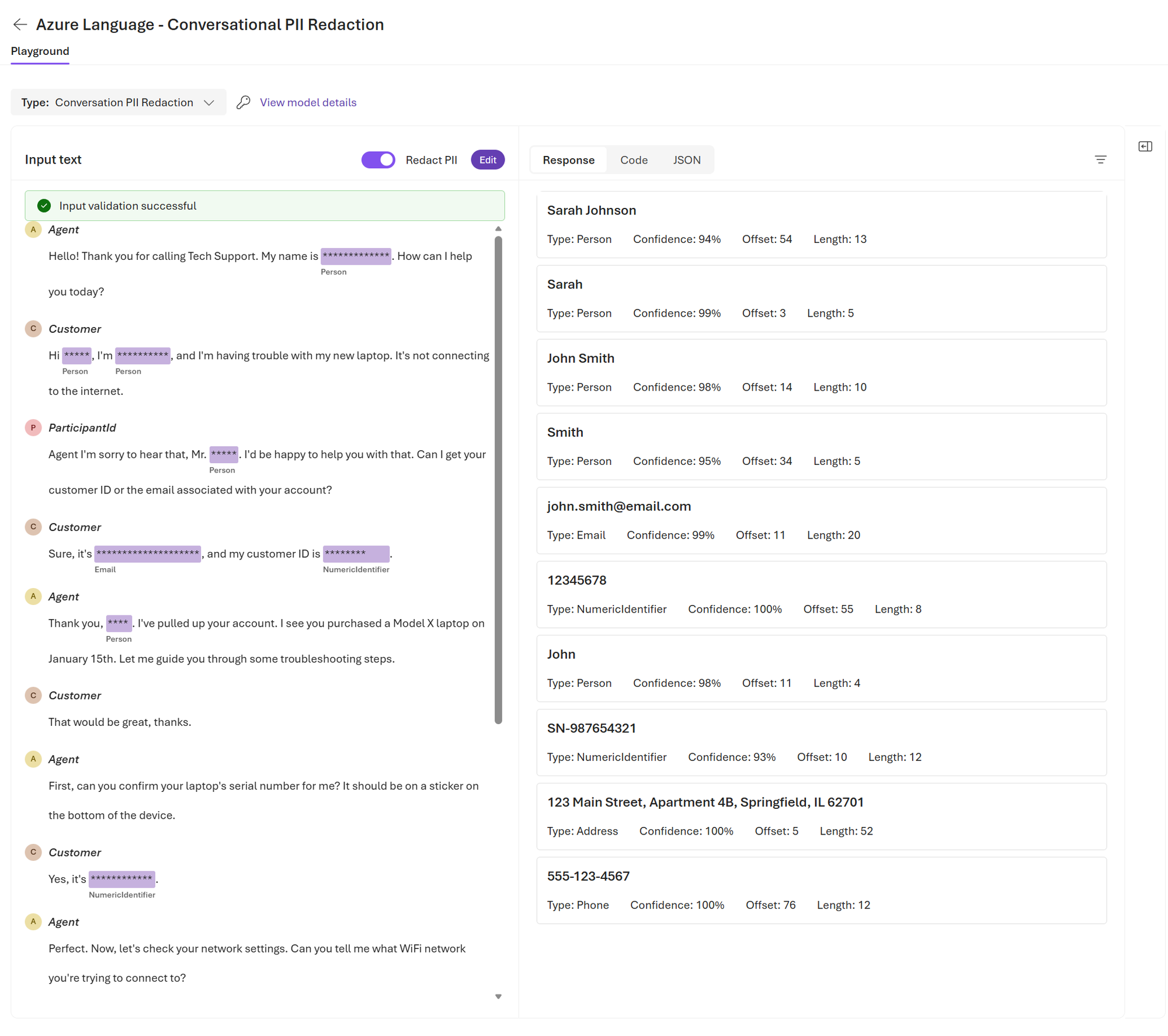
We’re introducing several Microsoft Foundry playground experiences that allow teams to explore language capabilities, review outputs, and assess how the APIs may fit into their workflows before production use.
- Text PII redaction Playground
- Conversational PII redaction Playground
- Text Analytics for Health Playground
These playgrounds are intended to support hands-on experimentation and evaluation in a controlled environment.
Image 1: Screenshot of Text Analytics for Health Playground in action.
Updated Text PII API (GA – 2026-05-01)
The GA Text PII API includes updates across new supported entity types and additional configuration options that allow developers to tailor how sensitive information is processed.
Customer customization features now generally available:
- Anonymization: Support for `syntheticReplacement` redaction policy enables masking detected PII entities with synthetic replacement values. For example, "John Doe received a call from 424-878-9193" can be transformed into "Sam Johnson received a call from 401-255-6901."
- Optional type validation controls: Ability to disable entity type validation to bypass strict validation when operational efficiency is prioritized over data integrity checks.
- Confidence threshold configuration: Ability to set a minimum confidence score threshold to control which entities appear in the output based on detection confidence.
- Specify values to exclude from PII output
- Use entity synonyms for tailored PII detection
These options provide more flexibility for adapting PII processing to specific application requirements.
Preview releases
Text PII (Preview)
The latest preview introduces support for additional entity categories and broader coverage across scenarios. New entities include Password, PIN code, Zip code, and Airport code. For a full list, see our public docs.
Conversational PII (Preview)
For transcript and dialogue-based use cases, our Conversational PII redaction service is optimized for spoken-language patterns such as interruptions, filler words, speaker turns, and incomplete sentences that are common in transcripts and calls. Preview updates extend support for spoken-language patterns such as interruptions, speaker turns, and conversational structure.
Updates include:
- A new Conversational PII model (2026-04-15-preview)
- A new Conversational PII API (2026-11-15-preview), expanding on model capabilities
Additional supported entities include GitHub account identifiers, credit card expiration dates, and zip codes. For a full list, see our public docs.
These preview updates expand the range of supported inputs and scenarios for conversational data processing.
Summary of API and Model version updates
|
Azure Language in Foundry Tools Capability |
Release |
Status |
What’s new |
|
Text PII |
2026-05-01 |
GA |
Additional configuration options and updates across supported entities |
|
Text PII |
2026-04-15-preview |
Preview |
Expanded entity support |
|
Conversational PII |
2026-04-15-preview |
Preview |
Updates to conversational handling and entity coverage |
|
Conversational PII |
2026-11-15-preview |
Preview |
API updates building on model changes |
Get started
- Explore language playgrounds in Microsoft Foundry
- Try the latest GA and preview APIs for Text PII and Conversational PII
- Review documentation for detailed entity lists, versioning, and usage guidance
As with all preview features, capabilities are subject to change. Outputs generated by AI systems should be evaluated and validated for your specific use cases.
Start building privacy-aware applications today — explore the playgrounds, try the APIs, and share your feedback in the comments below.

 Microsoft