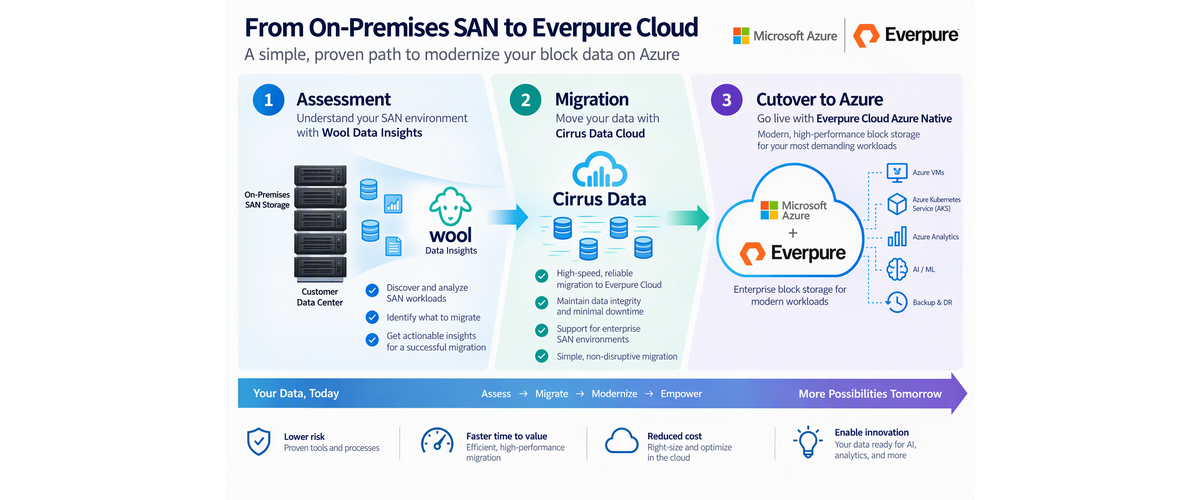
In our previous posts, we explored how Qumulo and Azure can modernize legacy scale-out file storage, and how Rubrik and Azure can turn a backup hardware refresh into a cyber resilience upgrade. Now we turn to block storage with Everpure Cloud Azure Native. Everpure’s data efficiency can help you rethink your next on-premises storage refresh, modernize block storage management, and free resources for innovation. The potential free assessment and migration services available to our customers make it easier to take advantage of this moment in time to modernize your infrastructure!
Unless you have spent the last two years in a cave without Internet access or television, you know firsthand how impactful AI has been on every aspect of our industry and society in general.
One of the impacts that has gained traction in Industry articles, blogs, and newsletters is the impact that AI Infrastructure buildout is having on storage media pricing and availability. I felt this personally when purchasing a laptop over the summer for my youngest son, an engineering major. Again, as I attempted to buy a hot spare for my home NAS (when RAID alone will not do - once an IT Pro, always an IT Pro). I spent 2x what I expected to on that laptop and decided to forego the 4x more expensive hot spare. I do have yet another kid in college after all. 😉
My personal experiences and recent conversations with customers and channel partners, like AHEAD, inspired me to think about how Azure Storage and our robust ecosystem of partners can help customers during what industry experts believe will be a prolonged event.
Whether you are facing long delays in delivery of a new on-premises array or drive shelves to expand an existing one, or are receiving “good for the next 14 days” quotes that are 4x to 10x higher than they were last year – we have the means to help. Azure Storage has capacity available worldwide, simple tooling to migrate data, and an outstanding partner ecosystem ready to meet every storage need.
I’ve always been a believer in “end-to-end” real-world solutions rather than visionary “marketecture.” This series of blog posts includes content co-authored with our partners Everpure, Qumulo, and Rubrik. We will not only cover the technical benefits of migrating on-premises data and applications to Azure – but HOW to do so, including right-sizing to achieve optimal price/performance when replacing legacy block, file, and data protection platforms via a FREE assessment.
Yesterday at Ignite, we shared how you can request an assessment of your NAS, SAN, and data protection appliances here and quickly find out if you qualify. For example, you must be a current Azure customer to qualify.
-Karl
The process and tooling needed to modernize to Everpure Cloud
The constraint no one planned for
Across the industry, demand for high-performance SSD capacity is accelerating faster than supply. In 2026 alone, 1TB drives jumped from $60 to $200+, with lead times sometimes exceeding 16 weeks. What was once an abundant resource is quickly becoming a strategic constraint.
If you are an IT decision maker weighing your next array expansion or refresh, you are feeling the pressure:
- AI, analytics, and mission-critical workloads are all competing for the same finite pool of storage resources.
- Storage platform expansion and refresh quotes expire in days.
- The hostorcial answer, buy more of the same, keeps getting more expensive.
As we outlined in the first posts in this series, the question is shifting from “how much storage can we buy?” to “what are our alternatives or how much more can we get from the storage we already have?”
What is driving the Storage media crunch
The AI infrastructure buildout is creating a demand for storage media that is unprecedented in our industry. AI workloads are also fundamentally different from what enterprise storage was originally designed to support and place high demand on compute and storage infrastructure. Meanwhile, traditional application growth and their performance expectations have not changed. If anything, they have increased. The result is a perfect storm:
- Massive data growth from AI pipelines, analytics, and operational systems
- Faster access requirements for databases, AI training, fine-tuning, and inference and less tolerance for latency in nearly every application
- Higher infrastructure demands that pull more compute, network, and storage into every project
- Finite high-performance storage supply that cannot scale as quickly as demand
The hidden inefficiency problem
Buying more storage is only half of the story. Most environments are carrying capacity they never use:
- Data duplication, overprovisioning, and snapshot sprawl consume premium flash that holds no unique data
- Hybrid fragmentation across on-premises and cloud storage reduces visibility and control
- An estimated 15–20% of IT spend is lost to this inefficiency
The challenge is not just “how do we get more performant storage?” It is also “how do we modernize and optimize our entire storage environment to absorb this shift?”
From capacity to operational and resource efficiency
Leading organizations are now treating efficiency as a first-class design principle. They are reducing redundant data and storage footprint, increasing effective capacity without provisioning more storage, aligning performance tiers with actual workload needs, and designing systems that minimize unnecessary duplication. The payoff is unlocking stranded capacity and avoiding linear cost scaling. They are also looking for ways to achieve this that include a modern hybrid data management solution to gain portability across on-premises and Cloud infrastructures. This allows them to place or relocate deployments based on where infrastructure resources are available to support growth of both incumbent and new innovative applications.
How data reduction changes the equation
When applied effectively, data reduction does not just save space. It changes the economics of storage. Organizations can store more data, delay or avoid additional capacity purchases, improve workload density and utilization, and reduce the overall cost per effective terabyte.
In hybrid environments that use Azure, this becomes particularly powerful. Instead of treating storage as a linear cost tied directly to raw capacity, you can begin to think in terms of effective capacity: what you actually store and use. Mars, Incorporated offers a real-world example. Using Everpure Cloud as part of its hybrid cloud transformation with Microsoft and Everpure, Mars achieved 18:1 data reduction, nine times its expected compression ratio, and is on track to reduce cloud storage costs by up to 50%, freeing resources to invest in initiatives such as AI.
Everpure Cloud Azure Native: enterprise block storage, built into Azure
Everpure Cloud Azure Native is a fully managed block storage service jointly developed by Everpure and Microsoft. It lets you provision, manage, and attach enterprise-grade block volumes directly to Azure Virtual Machines or Azure VMware Solution (AVS) using the Azure portal, ARM templates, Bicep, and Terraform, with billing through Azure that leverages your existing Azure monetary commitment. It builds on the industry leading Purity operating environment that powers the Everpure platform, but with no storage infrastructure for you to deploy, size, or manage.
Key capabilities include:
- Pay for data written, not capacity reserved. Always-on inline deduplication, compression, and thin provisioning drive up to 40% lower storage TCO compared to alternative storage solutions.
- Independent scaling of storage and compute. Grow capacity and tune performance without resizing a VM or changing its SKU. For AVS, this separates storage growth from compute scaling and can reduce cloud storage costs by up to 40%.
- A native Azure experience. The service lives in your subscription and inside your own virtual network. Storage traffic stays private, with no public endpoint and no egress charges, and Microsoft Entra ID single sign-on simplifies access.
- Built-in protection. Always-on encryption, space-efficient snapshots and clones, and immutable snapshots support rapid recovery and dev/test use cases.
- Fast, simple deployment. An Azure VM extension automates iSCSI and multipath setup on supported Windows and Linux hosts, so teams can be up and running in minutes rather than scripting host configuration by hand.
- Operational flexibility. Instant volume resizing, shareable volumes, and adjustable performance let storage keep pace as workloads evolve.
For customers already running Everpure on-premises, it also extends a consistent data plane and management experience across the data center and Azure, which simplifies operations and reduces the fragmentation that erodes visibility and control. Support is led by Everpure and backed by Microsoft.
By integrating these capabilities, organizations can increase effective SSD capacity within Azure, eliminate unnecessary storage consumption, lower spend on premium storage tiers, and minimize dependency on constrained SSD supply.
Optimize first, then innovate
The next phase of innovation and growth will not be defined by how much infrastructure organizations can provision, but by how intelligently they use it. SSD capacity will remain a critical resource, and the real differentiator will be how efficiently it is used and how flexible they can be to adapt to changing resource availability. By pairing Everpure Cloud with Microsoft Azure, you can optimize your existing footprint before expanding, rather than paying more for the same hardware on someone else’s timeline in a constrained market. You also gain the ability to deploy and move applications to meet available resources wherever they can be found across your hybrid cloud.
How does Everpure Cloud compare with traditional on-premises block storage?
The table below summarizes the differences between a legacy SAN refresh and Everpure Cloud Azure Native.
|
Capability |
Legacy on-premises Block |
Everpure Cloud Azure Native |
|
Cost model |
Pay for provisioned capacity plus hardware refresh and maintenance cycles |
Pay for data written; inline deduplication, compression, and thin provisioning drive up to 40% lower storage TCO |
|
Procurement and lead time |
Hardware quotes with short validity windows and long delivery cycles |
Provisioned on demand from Azure, with no hardware to order or install |
|
Scaling |
Capacity and performance typically scale together; overprovision to avoid the next purchase |
Scale storage independently from compute; instant volume resizing without application interruption |
|
Operations |
Dedicated array administration, host configuration, and firmware upkeep |
Fully managed service; Azure portal, ARM, Bicep, and Terraform; VM extension automates iSCSI and multipath setup |
|
Data protection |
Snapshots and replication vary by platform and consume premium capacity |
Always-on encryption, space-efficient snapshots and clones, and immutable snapshots |
|
Hybrid consistency |
Separate tools and visibility on-premises versus cloud |
Consistent data management across data center and Azure for Everpure customers |
|
Network and security |
Dedicated SAN fabric to design and maintain |
Deployed in your own virtual network; private traffic, no public endpoint, no egress charges |
|
Support and billing |
Separate vendor contracts and invoicing |
Everpure-led support backed by Microsoft; billing through Azure |
How do you get started?
For a limited time, you can take advantage of a FREE assessment of your current SAN from Wool Data and use the results to scope your migration to Everpure Cloud on Azure using Cirrus Data Cloud to migrate your data. Fill out this form to find out if you qualify.
Have questions about Everpure? Reach out to cloudsales@everpuredata.com .
Learn more about Everpure Cloud Azure Native for Azure VMs and the Everpure Cloud Azure Native overview on Microsoft Learn.
With Everpure Cloud, you become AI ready with a modernized storage infrastructure built to not only survive, but thrive, in a resource constrained world.
By Dan Kogan, Everpure and Karl Rautenstrauch, Microsoft Azure

 Microsoft