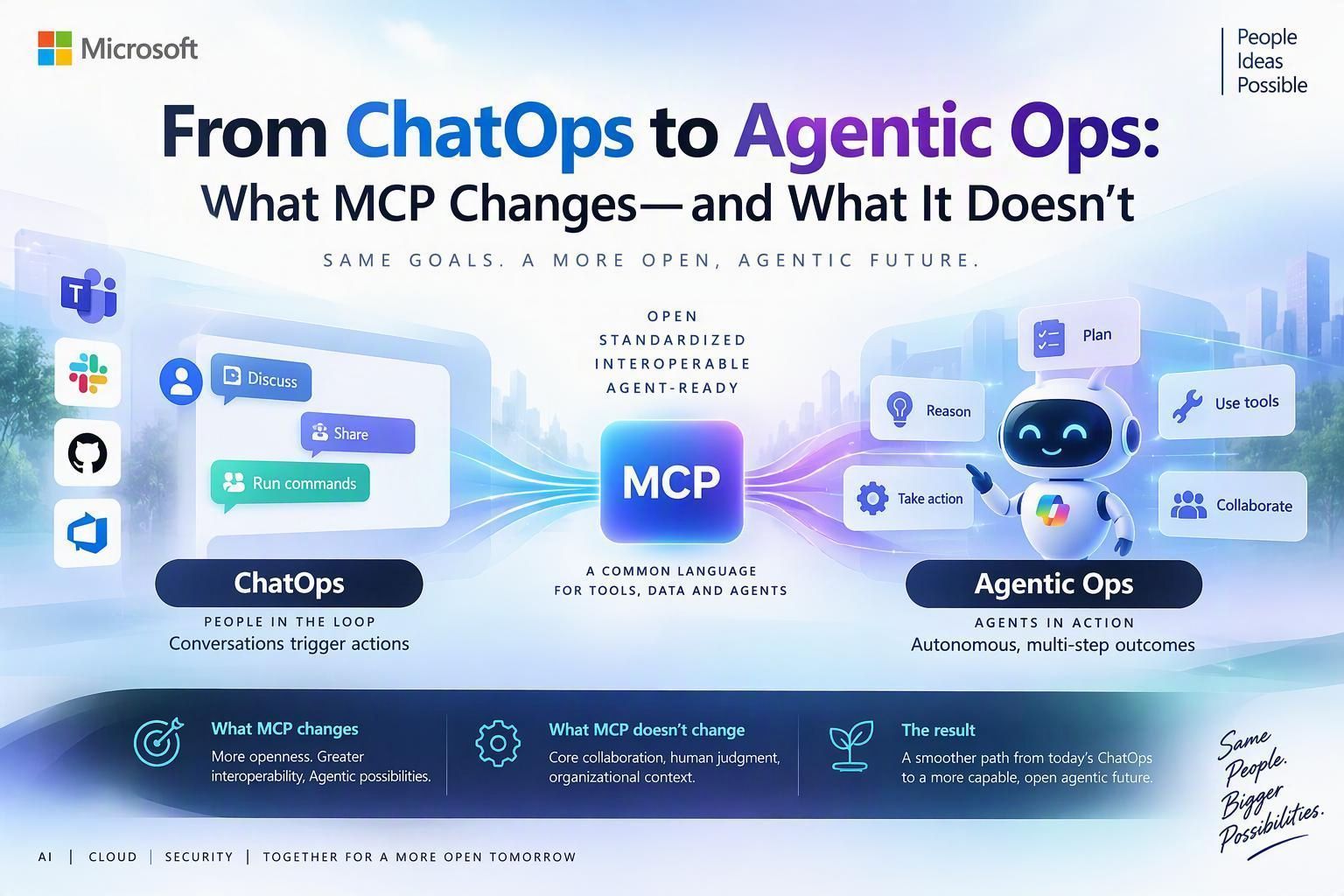
Agentic Ops is emerging as the next evolution in operational practice: moving from command execution to context synthesis and guided decision-making. Instead of manually stitching signals across systems under pressure, teams can use AI assistants to assemble evidence, surface likely causes, and recommend safe next steps. MCP accelerates this shift by giving assistants a standard way to connect to operational tools—while keeping governance, controls, and human accountability firmly in place.
Most teams already run a form of ChatOps today. During incidents or change windows, people jump into chat, run known commands, check dashboards, and coordinate in real time. It works because it centralizes communication and keeps operational actions visible.
But the model has a ceiling. Modern outages are rarely solved by one command or one dashboard. Critical clues are distributed across alerts, deploy timelines, ownership records, tickets, runbooks, and cloud activity. The limitation isn’t access to tools—it’s the human effort required to gather, correlate, and interpret fragmented context quickly and safely.
That’s the gap Agentic Ops aims to close. Instead of only executing prompts, an assistant can pull context from multiple systems, reason across it, and present decision-ready guidance. MCP is the key enabler here: a standard way for AI applications to connect to operational tools and data so workflows become more connected, conversational, and actionable—without replacing existing platforms or governance.
1. ChatOps Today: Strong for Execution, Evolving for Cross-System Reasoning
ChatOps is an operating model where teams use chat as the front door to operational work. Instead of switching tools for every step, engineers collaborate in a shared channel, invoke commands, review outputs, and coordinate response in real time. It combines communication and execution in one place, which is why it became central to incident response, change coordination, and on-call workflows.
At its best, ChatOps creates a transparent operational rhythm: what was run, by whom, when, and why is visible to everyone in the thread. That visibility improves speed, reduces duplicate effort, and helps newer responders learn from live context.
Where ChatOps is strongest
- Shared visibility: actions and decisions are visible to the whole team.
- Faster coordination: responders align quickly during incidents and change windows.
- Operational consistency: common commands and runbooks reduce variation in execution.
- Traceable activity: chat history creates a practical audit trail of response steps.
- Lower tool friction: teams can execute and discuss from one collaboration surface.
These strengths are real—and they are why ChatOps remains valuable. But as environments become more distributed, the model can strain when responders must synthesize context across many systems, not just run commands in one.
Where limitations begin to show
- Manual context stitching: signals still need to be correlated across multiple tools.
- Tool-by-tool querying: responders must know where each data point lives.
- High cognitive load under pressure: interpretation burden stays with humans.
- Context latency: assembling a full picture can lag behind incident progression.
- Variable outcomes by experience: stronger responders connect clues faster than others.
What this can lead to in practice
- Slower triage for multi-system incidents
- Longer time to confident root-cause hypotheses
- More back-and-forth before safe remediation steps
- Increased risk of acting on incomplete context
- Harder handoffs when incident state lives across tools and people
So ChatOps is not the problem—it is the foundation. The next shift is about augmenting that foundation with better cross-system context synthesis, not replacing its core strengths.
2. Agentic Ops Shift: From Commands to Context Synthesis
Agentic Ops is an operating model where an AI assistant does more than execute instructions—it helps assemble, interpret, and operationalize context across systems. In this model, chat is still the interface, but the interaction changes: instead of only asking “run this command,” teams can ask “what changed, what is impacted, and what should we do next?” The assistant then gathers evidence from relevant tools, reasons across it, and returns a structured, decision-ready view.
This is a shift from command fulfillment to context synthesis.
Core strengths of Agentic Ops
- Cross-system correlation: combines signals across telemetry, deployments, ownership, runbooks, and change records.
- Decision-ready summaries: returns prioritized findings, not just raw outputs.
- Faster situational clarity: reduces time spent collecting and reconciling evidence.
- Guided next steps: suggests actions aligned to runbooks and operational policy.
- Scalable support quality: helps less-experienced responders work with stronger context.
Agentic Ops does not remove human responsibility; it improves the quality and speed of the context humans use to decide.
How it addresses the limitations established in ChatOps
- Manual context stitching → automated correlation
Instead of responders manually joining clues from multiple systems, the assistant assembles a coherent incident picture. - Tool-by-tool querying → unified operational conversation
Teams ask once in chat; the assistant retrieves from the right sources behind the scenes. - High cognitive load under pressure → structured reasoning support
The assistant can surface anomalies, dependencies, and likely impact paths in an ordered narrative. - Context latency → faster hypothesis formation
With context pre-assembled, teams move sooner from detection to credible root-cause hypotheses. - Experience-driven variability → more consistent first response quality
Standardized context synthesis narrows the gap between senior and junior responders during early triage.
What improves in practice
- Faster triage on multi-system incidents
- Quicker alignment on probable cause and blast radius
- Cleaner handoffs across shifts and escalation tiers
- Fewer decisions made on partial context
- Better use of expert time on judgment, not data gathering
Agentic Ops, therefore, is not a replacement for ChatOps. It is the next layer on top of it: preserving visibility and collaboration while upgrading how operational context is gathered and interpreted.
3. MCP Explained: A Standard Connection Layer
MCP (Model Context Protocol) is best understood as a common interface contract between AI assistants and operational systems. In practical terms, it defines a standard way for an assistant to discover tools, request context, and invoke capabilities across different platforms without requiring a custom, one-off integration for every system.
Before this model, teams often had fragmented integrations: one script for monitoring, another for CI/CD metadata, another for ownership data, another for ticketing. Each integration worked, but the assistant experience was inconsistent and brittle. MCP addresses this by introducing a shared pattern for how tools expose context and actions to AI applications.
That does not mean MCP replaces existing platforms. It does not replace your observability stack, cloud control plane, deployment engine, or ITSM system. Those remain the systems of record and execution. MCP sits between the assistant and those systems as a standardized connectivity layer that helps the assistant use them coherently.
Why MCP matters operationally
MCP improves three things that are hard in real-world operations:
- Interoperability: one assistant can work across heterogeneous tools through a consistent protocol shape.
- Context continuity: evidence from multiple systems can be assembled in one conversational flow.
- Action consistency: tool use becomes more structured and governable than ad hoc plugin behavior.
This is what enables a shift from “ask for one command output” to “assemble and reason over incident context.”
Why MCP matters across this transition
- ChatOps today: Chat remains the collaboration surface, but MCP expands what the assistant can pull into that surface.
- Agentic Ops shift: MCP provides the connective tissue that allows assistants to synthesize cross-system context rather than return isolated outputs.
- Boundaries and risks: MCP enables access, not correctness; governance, approvals, and human accountability remain mandatory.
- Adoption blueprint: MCP supports progressive rollout by allowing read-only integrations first, then tightly scoped action paths.
Example workflow: Incident triage with MCP-enabled assistant
- Trigger and framing
An alert fires. The responder asks in chat: “What changed around service X in the last 30 minutes, and what else is impacted?” - Read-path context assembly
The assistant retrieves:- recent deployments and config changes
- correlated error and latency signals
- dependency graph and service ownership
- relevant runbook references
- open incident/ticket context
- Synthesis and hypothesis
The assistant returns:- a timeline of likely causal events
- probable blast radius
- top candidate root-cause hypotheses
- confidence notes and missing evidence
- Guided next steps
It proposes ordered actions (for example: validate rollback guardrails, run diagnostic checks, notify owning team). - Controlled action path
For any write/change action, approvals and policy gates are enforced. High-impact actions remain explicitly human-authorized. - Traceability and handoff
The conversation captures evidence, decisions, and actions in sequence, improving auditability and shift handoffs.
This is the practical value of MCP in operations: not replacing tools, but making them work together in a way that gives responders faster, clearer, and safer decision context.
4. Boundaries and Risks: What MCP Doesn’t Do
MCP does not replace observability stacks, cloud platforms, ITSM systems, or security tooling.
MCP does not guarantee correct AI reasoning.
MCP does not remove the need for human accountability.
Safe usage still depends on established controls:
- Least-privilege access and role boundaries
- Approval gates for high-impact changes
- Auditability and traceability
- Blast-radius constraints and rollback readiness
- Human incident command for critical decisions
Better connectivity should improve clarity, not bypass governance.
5. Adoption Blueprint: Phased Scale, Continuous Control
Adopting Agentic Ops is less about switching on a feature and more about building operating maturity. The most effective path is phased: start with low-risk value, prove reliability, and expand autonomy only when governance and trust keep pace.
Phase 1: Observe (Read-only foundation)
Enable assistants to retrieve and summarize context across systems without taking action.
- Cross-system incident context aggregation
- Timeline and change-correlation summaries
- Ownership/runbook discovery support
Objective: improve triage speed and clarity without operational risk.
Phase 2: Recommend (Decision support)
Move from context retrieval to structured guidance.
- Ranked hypotheses with supporting evidence
- Ordered, runbook-aligned next steps
- Explicit confidence and evidence gaps
Objective: improve decision quality and reduce cognitive load under pressure.
Phase 3: Execute with Guardrails (Constrained action)
Allow narrowly scoped actions where controls are explicit and auditable.
- Pre-approved low-risk actions only
- Human approval for high-impact changes
- Policy checks, role boundaries, and full traceability
Objective: accelerate response while preserving accountability.
Phase 4: Institutionalize (Operational hardening)
Embed the model into standard operations and governance cycles.
- Standard operating patterns and ownership model
- Periodic policy/risk reviews
- Post-incident learning loop to refine assistant behavior
Objective: make the capability dependable, repeatable, and governable at scale.
Control principles that apply in every phase
- Least privilege by default
- Human accountability for production outcomes
- Auditability for every decision and action
- Progressive expansion only after proven reliability
The core idea is simple: scale capability at the same pace as control. That is how organizations gain speed without trading away safety.
Closing Thought
Agentic Ops represents a practical evolution in how modern operations teams work: less time spent collecting fragmented signals, more time spent making high-quality decisions under pressure. Its value is not in removing humans from critical workflows, but in augmenting human judgment with faster, more structured operational context.
MCP is what makes that evolution implementable at scale. By providing a standard way for assistants to connect to operational systems, MCP turns isolated tools into a connected decision environment. It doesn’t replace platforms or governance—but it does make Agentic Ops real, usable, and operationally meaningful.

 Microsoft