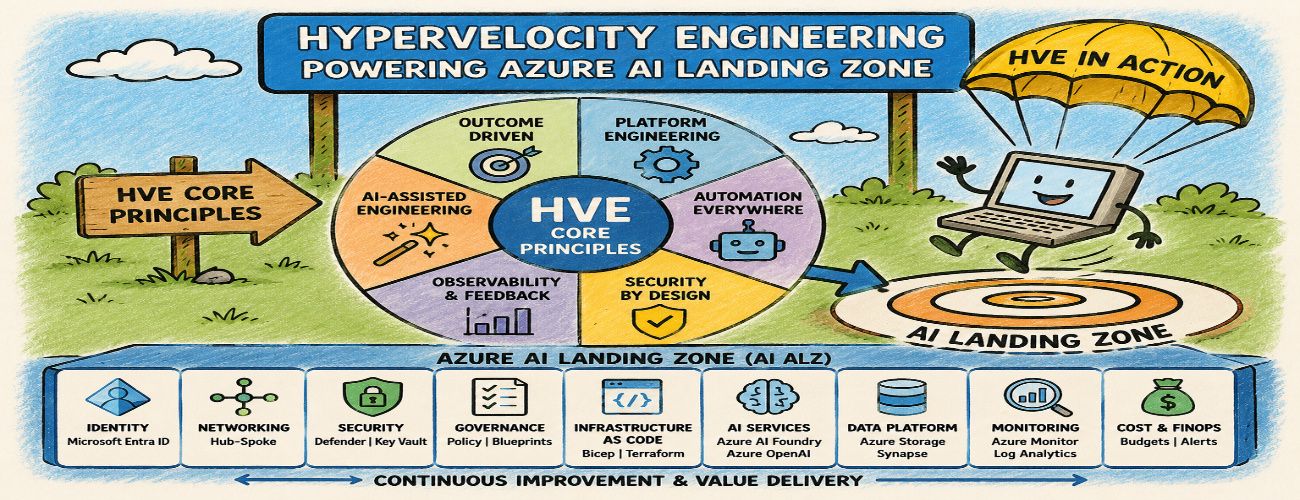
How Hypervelocity Engineering (HVE) transforms Azure AI Landing Zones into continuously evolving, secure, and scalable enterprise AI platforms
Artificial Intelligence is evolving at unprecedented speed. The challenge for enterprises is no longer building AI solutions—it is engineering AI platforms that can adapt, scale, and govern innovation continuously. Hypervelocity Engineering (HVE) provides the engineering operating model that enables this transformation.
Executive Summary
Artificial Intelligence is transforming how enterprises design and operate digital platforms. Traditional Enterprise Architecture practices—built around static documentation, periodic governance reviews, and manual implementation—are struggling to keep pace with the rapid evolution of AI workloads.
HyperVelocity Engineering (HVE) introduces a disciplined engineering operating model that combines AI-assisted decision making, platform engineering, automation, and continuous governance. When applied to Azure AI Landing Zone, HVE enables architects to evolve from producing architecture documents to continuously engineering secure, governed, and scalable AI platforms.
This article demonstrates how HVE Core principles map naturally to Azure AI Landing Zone and how Enterprise Architects can use RPIR (Research, Plan, Implement, Review) as a continuous architecture lifecycle.
Why Enterprise AI Needs a New Engineering Model
Organizations across every industry are rapidly adopting Generative AI, intelligent agents, and AI-assisted business processes. Yet many enterprise AI initiatives encounter the same obstacles:
- AI projects are developed independently across business units.
- Platform capabilities evolve slower than AI innovation.
- Governance and security become reactive rather than proactive.
- Infrastructure is treated as a one-time deployment instead of a continuously evolving product.
- Engineering teams spend excessive time provisioning environments instead of delivering business value.
Traditional cloud engineering practices were designed for application modernization. Enterprise AI introduces new demands—rapid experimentation, scalable model deployment, secure data access, and continuous compliance. Meeting these demands requires a fundamentally different engineering approach.
Hypervelocity Engineering (HVE) addresses this challenge by enabling organizations to build platforms that evolve at the speed of AI while maintaining enterprise-grade governance, security, and operational excellence.
From Traditional Engineering to Hypervelocity Engineering
Enterprise architecture is shifting from project-centric delivery to platform-centric engineering.
|
Traditional Engineering |
Hypervelocity Engineering |
|
Project-based delivery |
Product & platform engineering |
|
Manual provisioning |
Infrastructure as Code |
|
Governance after deployment |
Governance by Design |
|
Static architecture |
Continuous evolution |
|
Infrastructure owned by IT |
Self-service engineering platforms |
|
Periodic releases |
Continuous delivery |
|
Manual operations |
AI-assisted engineering |
This transformation allows engineering organizations to focus less on repetitive operational tasks and more on innovation.
What is HyperVelocity Engineering?
Hypervelocity Engineering (HVE) is Microsoft's engineering operating model designed to accelerate software and platform delivery through automation, reusable engineering patterns, platform engineering, AI-assisted development, and continuous feedback.
Unlike traditional methodologies, HVE is not another architecture framework or software product. Instead, it defines how engineering organizations operate to deliver secure, governed, and continuously improving solutions.
Its core philosophy is straightforward:
Engineer platforms, automate everything practical, measure continuously, and improve through rapid feedback while keeping humans accountable for critical decisions.
HVE combines several modern engineering disciplines into a unified operating model:
- Platform Engineering
- Infrastructure as Code (IaC)
- Policy as Code
- Security by Design
- AI-assisted engineering
- Continuous observability
- DevSecOps
- Human-in-the-loop governance
Together, these capabilities enable organizations to innovate faster without compromising security or compliance.
Azure AI Landing Zone as the Reference Implementation
Azure AI Landing Zone provides the foundational platform required to deploy enterprise AI workloads securely and consistently.
Typical capabilities include:
- Microsoft Entra ID
- Management Groups
- Azure Policy
- Hub-and-Spoke Networking
- Private Endpoints
- Azure Firewall
- Azure API Management
- Azure AI Foundry
- Azure AI Search
- Azure Kubernetes Service (AKS)
- Azure Monitor
- Defender for Cloud
- Infrastructure as Code (Bicep/Terraform)
HVE provides the engineering operating model that continuously evolves this platform.
The Core Principles of Hypervelocity Engineering
Hypervelocity Engineering is built around six complementary principles.
Outcome-Driven Engineering
Every engineering decision should align with measurable business outcomes rather than technology adoption alone. Success is measured by customer value, not infrastructure deployment.
Platform Engineering
Rather than building infrastructure repeatedly for every project, organizations create reusable, self-service platforms that accelerate application delivery while maintaining consistency.
Automation Everywhere
Automation extends beyond deployments. Infrastructure provisioning, governance, security validation, policy enforcement, testing, and operations should all be automated wherever possible.
Security by Design
Security is integrated into every engineering stage—from identity and networking to deployment pipelines and operational monitoring—reducing risk while improving delivery speed.
AI-Assisted Engineering
AI enhances developer productivity by generating code, documentation, infrastructure templates, architecture recommendations, and testing artifacts. Humans remain responsible for validation and governance.
Continuous Observability and Feedback
Operational insights, telemetry, cost analysis, and user feedback continuously improve future engineering decisions.
Applying RPIR to Enterprise Architecture
Rather than treating architecture as a one-time activity, HVE applies the RPIR cycle continuously.
|
Phase |
Enterprise Architecture Activities |
Azure Capabilities |
Expected Outcome |
|
Research |
Gather business requirements, architecture standards, security baselines, and reference guidance |
Azure AI Search, CAF, Well-Architected Framework |
Evidence-based architecture decisions |
|
Plan |
Define target architecture, evaluate options, create ADRs, prioritize roadmap |
Azure Landing Zones, Azure Policy, Management Groups |
Governed architecture blueprint |
|
Implement |
Deploy infrastructure, policies, networking, AI services, and automation |
Bicep, Terraform, Azure DevOps, GitHub Actions |
Repeatable, automated platform deployment |
|
Review |
Validate security, compliance, reliability, cost, and operational readiness |
Defender for Cloud, Azure Monitor, Azure Advisor |
Continuous improvement and governance |
Instead of ending after deployment, the Review phase feeds directly back into Research, enabling continuous architecture evolution.
Mapping HVE Principles to Azure AI Landing Zone
|
HVE Principle |
Azure AI Landing Zone Implementation |
|
Outcome Driven |
Align landing zone design with business outcomes and AI strategy |
|
Platform Engineering |
Shared AI Hub, reusable landing zone modules, self-service provisioning |
|
Automation Everywhere |
Infrastructure as Code, CI/CD pipelines, Policy as Code |
|
Security by Design |
Zero Trust, Microsoft Entra ID, Key Vault, Defender for Cloud |
|
Observability & Feedback |
Azure Monitor, Log Analytics, cost insights, operational metrics |
|
AI-Assisted Engineering |
Azure AI Foundry, GitHub Copilot, AI Search, architecture assistants |
These principles ensure that governance, security, and operational excellence are embedded throughout the platform lifecycle rather than applied only during reviews.
Reference Architecture Walkthrough
The architecture consists of four logical layers:
- AI Hub
The AI Hub provides centralized ingress and shared platform services using Azure Application Gateway, Azure Firewall, and Azure API Management. These services enforce security, routing, and governance before requests reach AI workloads.
- Shared Platform Services
Shared Azure Kubernetes Service (AKS), Azure AI Foundry, and Azure AI Search provide reusable AI capabilities for multiple business units. Centralizing these services improves scalability, operational consistency, and cost efficiency.
- AI Spoke Environments
Each business unit deploys isolated AI workloads into dedicated spoke environments. Private networking, isolated data stores, and workload-specific resources maintain tenant separation while consuming shared platform capabilities.
- Platform Governance
Infrastructure as Code, Azure Policy, Microsoft Entra ID, Defender for Cloud, Azure Monitor, and FinOps capabilities operate across every layer to provide continuous governance, security, and operational visibility.
This architecture reflects HVE's platform engineering philosophy by separating shared capabilities from workload-specific implementations while maintaining centralized governance.
Benefits for Enterprise Architects
Adopting HVE alongside Azure AI Landing Zone provides measurable advantages:
- Accelerates architecture delivery through AI-assisted design.
- Standardizes landing zone deployments using reusable platform modules.
- Embeds governance through Policy as Code and Infrastructure as Code.
- Improves security with Zero Trust and continuous compliance validation.
- Enables continuous architecture evolution using the RPIR lifecycle.
- Reduces operational overhead through automation and observability.
- Supports FinOps practices with integrated cost monitoring and optimization.
- Creates auditable architecture decisions through Architecture Decision Records (ADRs).
Rather than replacing architects, HVE allows architects to focus on strategic decisions while AI assists with repetitive engineering activities.
Common Anti-Patterns to Avoid
Organizations should avoid several common pitfalls when adopting enterprise AI:
- Building separate AI platforms for every project
- Treating governance as a post-deployment activity
- Relying on manual infrastructure provisioning
- Operating without continuous telemetry and feedback
- Deploying AI services without standardized platform engineering
Hypervelocity Engineering addresses these anti-patterns by embedding automation, governance, and continuous improvement into the engineering lifecycle.
Design Recommendations
When adopting Hypervelocity Engineering for Azure AI Landing Zones:
- Start with measurable business outcomes rather than technology selection.
- Treat your AI Landing Zone as a reusable platform product.
- Automate infrastructure, security, and governance using Infrastructure as Code and Policy as Code.
- Integrate AI-assisted engineering while maintaining human oversight for architectural decisions.
- Use the RPIR loop to continuously evolve your platform based on operational insights and business feedback.
- Embed security, observability, and FinOps from the outset to support sustainable growth.
Conclusion
Enterprise AI success depends on more than deploying advanced models—it requires an engineering operating model capable of delivering secure, scalable, and continuously evolving platforms.
Hypervelocity Engineering provides that model by combining platform engineering, automation, AI-assisted development, and continuous feedback into a unified approach. When paired with Azure AI Landing Zones, it transforms static infrastructure into a living platform that accelerates innovation while preserving governance, security, and operational excellence.
For enterprise architects, the value is clear: Azure AI Landing Zones establish the foundation, and Hypervelocity Engineering ensures that foundation continuously adapts to changing business needs and the rapid pace of AI innovation.
In the era of enterprise AI, success belongs to organizations that engineer for continuous evolution—not just initial deployment. Hypervelocity Engineering offers the operating model to achieve exactly that.

 Microsoft