By Mayuri Gupta, Senior Product Manager, Microsoft
Red Hat OpenShift momentum on Azure keeps building, driven by teams standardizing on Kubernetes for application modernization and, increasingly, by AI-enabled applications that need a consistent platform for the services around them. Azure Red Hat OpenShift gives those teams a jointly engineered, first-party Azure service, and today's announcement adds a new way to run it.
Today we are excited to announce the public preview of Azure Red Hat OpenShift with hosted control planes. Hosted control planes is a new deployment option that runs the OpenShift control plane as a fully managed service in a Microsoft-managed Azure subscription, operated by Microsoft and Red Hat site reliability engineers (SREs), separate from the worker nodes that run your applications. This deployment option helps organizations accelerate application modernization, increase developer velocity, streamline operations, and strengthen security while maintaining the familiar OpenShift experience jointly engineered and supported by Microsoft and Red Hat. Azure Red Hat OpenShift with standard architecture remains fully supported and actively developed.
Azure Red Hat OpenShift provides a unified platform for managing different workloads such as AI-enabled applications alongside VMs and containers, offloading ongoing infrastructure management to a team of Red Hat SREs, giving you a robust foundation to build, deploy and manage applications at scale.
One service, two places the control plane can live
The two deployment models compare like this:
| Dimension | Control plane in your subscription | Hosted control plane |
| Control-plane location | Your Azure subscription | Microsoft-managed Azure subscription |
| Who operates it | Red Hat SREs, in a single-tenant control plane. You pay for control-plane nodes on every cluster | Red Hat SREs, in a multi-tenant hosted control plane |
| Upgrade coupling | Control plane and workers move as one | Independent; Control plane can run on 2 minor versions ahead of worker node pools. Nodepools can also be on different versions with each other. |
| Minimum cluster footprint | 3 Control-plane nodes plus 3 worker nodes | Two worker nodes |
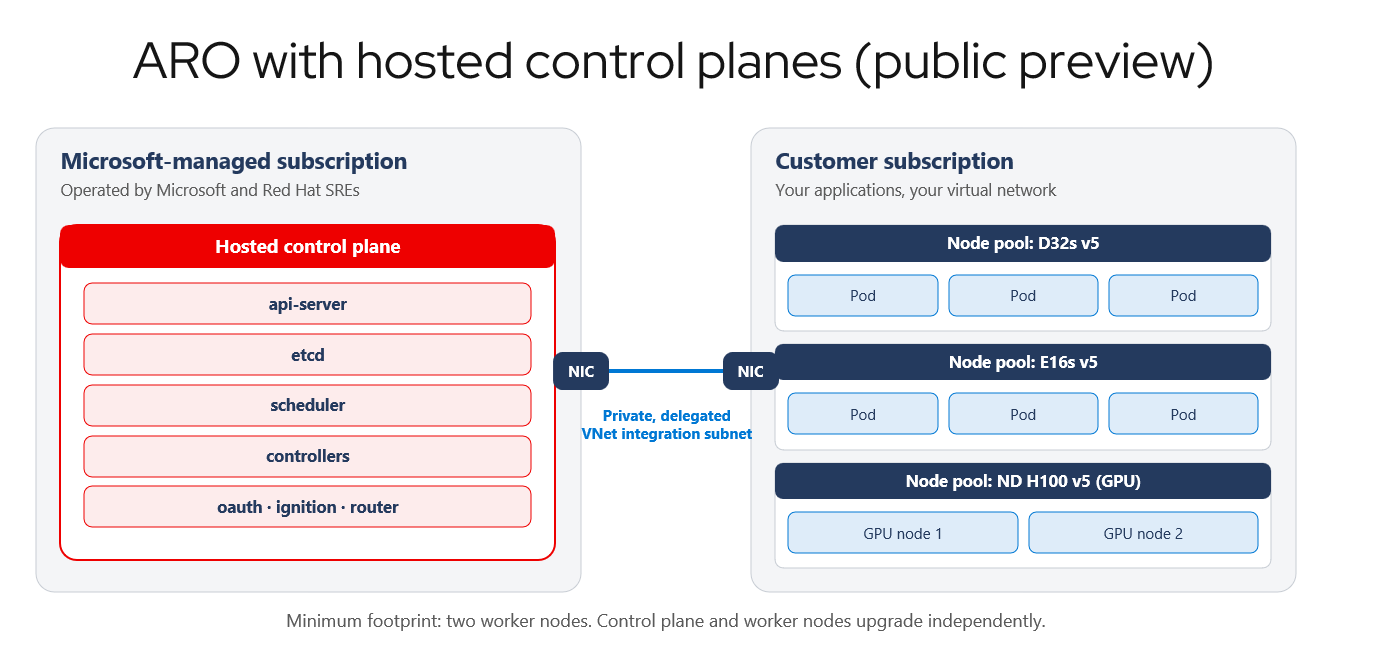
Figure 1. Today the control plane runs in your subscription alongside your workers. With a hosted control plane, it moves into a Microsoft-managed Azure subscription operated by Red Hat SREs, and the two planes meet through a delegated VNet integration subnet.
Key benefits of Azure Red Hat Openshift with hosted control planes
Organizations can modernize at their own pace and run virtual machines, containers, and cloud-native applications on a single platform while extending existing applications for AI-ready workloads.
Hosted control planes also help developers move faster. Clusters provision in minutes, and development and test environments can scale down during idle periods and scale back up when needed. This enables teams to accelerate experimentation, shorten testing cycles, and bring applications to production more quickly while optimizing infrastructure spend.
To support growing multi-cluster environments, hosted control planes simplify platform operations and provide greater flexibility and control. Independent control plane and worker node lifecycles give organizations more control over application upgrade timing while Microsoft and Red Hat manage the underlying platform. Organizations can scale clusters across teams, environments, and regions, customize networking with bring-your-own container network interface (CNI), and maintain operational consistency without increasing management complexity.
What the Azure platform adds
What sets Azure Red Hat OpenShift apart is how deeply it integrates with the broader Azure platform, helping organizations simplify operations, accelerate adoption of OpenShift, and reduce the complexity of running cloud-native applications at scale.
Customers gain access to Azure's global infrastructure, enterprise security capabilities, and rich portfolio of data and AI services, accelerating modernization and innovation without requiring changes to familiar OpenShift tools and workflows.
For organizations already invested in Azure, Azure Red Hat OpenShift operates as a first-party Azure service that fits naturally into existing cloud operations. Clusters can be managed, governed, secured, and monitored using the same Azure tools, policies, and automation practices already used across the broader Azure estate. Customers also benefit from a unified commercial model, integrated billing, and Azure-native management experience, while Azure Red Hat OpenShift consumption contributes toward Microsoft Azure Consumption Commitment, helping maximize the value of existing cloud investments.
Customers are already building on that foundation. Banco Bradesco, one of the largest financial institutions in Latin America, runs its enterprise AI platform on Azure Red Hat OpenShift, using integration with Azure identity, security, and policy capabilities to unify governance across more than 200 AI initiatives in a highly regulated environment. Topicus runs its Akkuro lending platform on Azure Red Hat OpenShift and deploys in Switzerland North to keep financial data in-country, using the same Azure-native controls to maintain a repeatable deployment model across regions. Both illustrate what the Azure platform adds: a consistent operating model, enterprise-grade security and compliance, and native access to Azure data and AI services on a service jointly operated by Microsoft and Red Hat.
Figure 2. The Azure platform around the service: Microsoft Entra ID managed and workload identities, a customer-managed key in Azure Key Vault for etcd encryption, Azure Monitor diagnostic settings for control-plane logs, Customer Lockbox for Microsoft Azure for support-access approval, portal (upcoming), CLI, REST API and Bicep self-service, and native integration with Azure compute, database, analytics, and machine learning services.
Secure by design
Azure Red Hat OpenShift with hosted control planes is secure by design, helping you run sensitive and regulated workloads with confidence without adding operational complexity. By running the control plane in a Microsoft-managed subscription, the platform reduces infrastructure exposure while maintaining secure access to applications through managed ingress.
Identity management is seamless. Cluster operators and applications use managed identities and workload identities that authenticate with short-lived, automatically rotated tokens, eliminating the need to manage service principals or long-lived credentials. Organizations can also integrate with their existing identity providers, preserving established authentication and access management practices.
Azure-native protections help safeguard data and support compliance requirements. Data is encrypted by default with etcd encryption, with the option to use customer-managed keys through Azure Key Vault for additional control. Confidential and sandboxed containers provide additional protection for data in use, helping organizations address stringent security, data residency, and digital sovereignty requirements without deploying a separate cloud environment.
The platform is backed by enterprise-grade compliance and support. Azure Red Hat OpenShift (with standard architecture) is pre-certified for HIPAA, FedRAMP, DoD IL4, PCI-DSS, ISO, and SOC standards, supported by joint Microsoft and Red Hat incident response. Customer Lockbox for Microsoft Azure adds another layer of control by requiring explicit customer approval before Microsoft support personnel can access cluster resources.
Get started now
Availability is expanding, with UK South, Canada Central, Australia East, Switzerland North, Brazil South, Central India, US East 2, and West Europe among the regions supported at public preview launch. The fastest way to get started is to create three resources: a cluster, a node pool, and an external authentication provider, using either the Azure CLI extension or a Bicep template. From there, deploy a single application using workload identity to see the full flow end to end, signing in with your existing identity provider, and an application reaching Azure services with no stored credentials. See the Azure Red Hat OpenShift documentation for the current region list, supported versions, and the deployment reference, and tell us in the comments what you would like covered next.
What it costs
| Component | Price | Purchasing Options |
| OpenShift license (per worker core) | $0.171 per hour per 4 worker vCPUs. The same flat rate applies to every VM series, size, and generation. | Pay-as-you-go, or a 1- or 3-year reservation on the OpenShift license (available at GA) |
| Azure infrastructure (worker VMs, storage, networking, plus control-plane nodes) | Billed separately at standard Azure rates for Linux VMs. Standard clusters are also billed for the control-plane deployment; clusters with a hosted control plane are not. | Pay-as-you-go, reservations, or Azure savings plan for compute |
| Cluster management (only applicable to Azure Red Openshift with hosted control planes) | A flat $0.25 per cluster per hour. Applies only to clusters with a hosted control plane. | Pay-as-you-go |
A hosted control plane takes control-plane node cost off your bill and replaces it with a single, predictable cluster management fee.
Pricing for hosted control planes is not yet reflected on the Azure Red Hat OpenShift pricing page; pricing calculator support is coming soon. Azure Red Hat OpenShift with hosted control planes is in public preview, and this pricing is preliminary and subject to change prior to general availability.

 Microsoft