Forum Discussion

RobinOfSheffield
Aug 29, 2023Copper Contributor
Pull First Date and Price
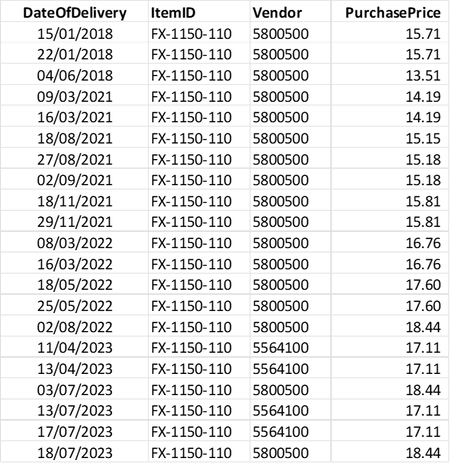
Hi, I have a table like in the example below. I need to pull the first Date of Delivery for each Purchase Price Change. The expected result should look like this. This...
- Aug 29, 2023
I couldn't bring myself to type in all of those rows so I focused on the final six and came up with the following.
See if it gets you any closer to what you're after.
Staging the data
CREATE TABLE [dbo].[PurchaseHistory]
(
	[DateOfDelivery] [datetime] NOT NULL
	, [ItemID] [varchar](32) NOT NULL
	, [Vendor] [int] NOT NULL
	, [PurchasePrice] [float] NOT NULL
)
GO

INSERT INTO
	[dbo].[PurchaseHistory]
VALUES
	('2023-04-11', 'FX-1150-110', 5564100, 17.11)
	, ('2023-04-13', 'FX-1150-110', 5564100, 17.11)
	, ('2023-07-03', 'FX-1150-110', 5800500, 18.44)
	, ('2023-07-13', 'FX-1150-110', 5564100, 17.11)
	, ('2023-07-17', 'FX-1150-110', 5564100, 17.11)
	, ('2023-07-18', 'FX-1150-110', 5800500, 18.44)
GO
Example
Note: The LAG() function was introduced in SQL 2012, so if you're running an older edition (hopefully that isn't the case in this day and age), this example won't work.
SELECT
	 [data].[DateOfDelivery]
	 , [data].[ItemID]
	 , [data].[Vendor]
	 , [data].[PurchasePrice]
FROM
(
	SELECT
		ph.DateOfDelivery
		, ph.ItemID
		, ph.Vendor
		, ph.PurchasePrice
		, CASE
			WHEN
				LAG(ph.PurchasePrice, 1) OVER
				(
					PARTITION BY
						ph.ItemID
					ORDER BY
						ph.DateOfDelivery
				) = ph.PurchasePrice
			THEN 0
			ELSE 1
		END AS [Include]
	FROM
		PurchaseHistory AS ph
) AS [data]
WHERE
	[data].[Include] = 1;
Output
Cheers,
Lain

LainRobertson
Aug 29, 2023Silver Contributor
I couldn't bring myself to type in all of those rows so I focused on the final six and came up with the following.
See if it gets you any closer to what you're after.
Staging the data
CREATE TABLE [dbo].[PurchaseHistory]
(
	[DateOfDelivery] [datetime] NOT NULL
	, [ItemID] [varchar](32) NOT NULL
	, [Vendor] [int] NOT NULL
	, [PurchasePrice] [float] NOT NULL
)
GO

INSERT INTO
	[dbo].[PurchaseHistory]
VALUES
	('2023-04-11', 'FX-1150-110', 5564100, 17.11)
	, ('2023-04-13', 'FX-1150-110', 5564100, 17.11)
	, ('2023-07-03', 'FX-1150-110', 5800500, 18.44)
	, ('2023-07-13', 'FX-1150-110', 5564100, 17.11)
	, ('2023-07-17', 'FX-1150-110', 5564100, 17.11)
	, ('2023-07-18', 'FX-1150-110', 5800500, 18.44)
GO
Example
Note: The LAG() function was introduced in SQL 2012, so if you're running an older edition (hopefully that isn't the case in this day and age), this example won't work.
SELECT
	 [data].[DateOfDelivery]
	 , [data].[ItemID]
	 , [data].[Vendor]
	 , [data].[PurchasePrice]
FROM
(
	SELECT
		ph.DateOfDelivery
		, ph.ItemID
		, ph.Vendor
		, ph.PurchasePrice
		, CASE
			WHEN
				LAG(ph.PurchasePrice, 1) OVER
				(
					PARTITION BY
						ph.ItemID
					ORDER BY
						ph.DateOfDelivery
				) = ph.PurchasePrice
			THEN 0
			ELSE 1
		END AS [Include]
	FROM
		PurchaseHistory AS ph
) AS [data]
WHERE
	[data].[Include] = 1;
Output
Cheers,
Lain

RobinOfSheffield
Aug 30, 2023Copper Contributor