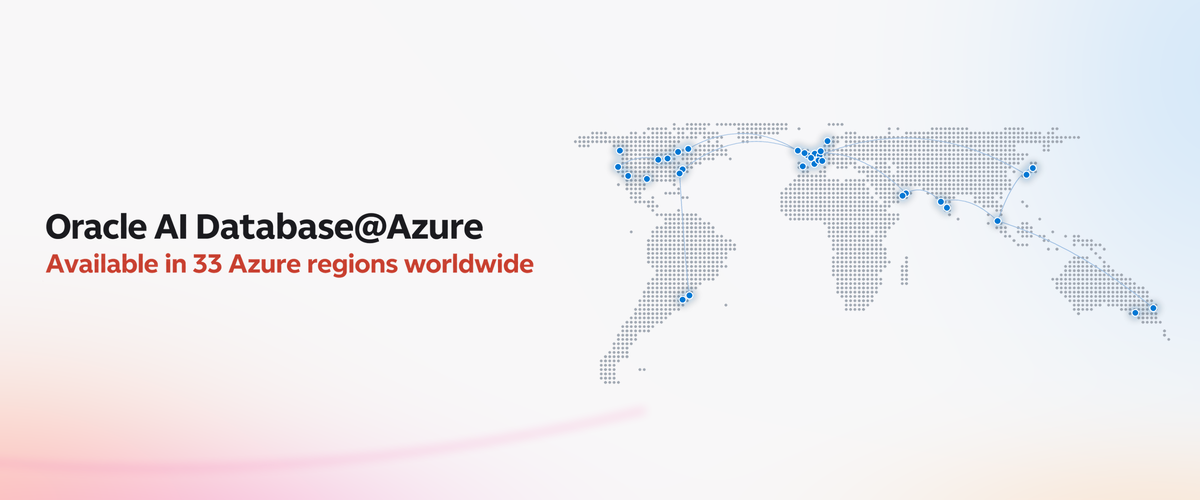
At Oracle AI World 2026, Microsoft and Oracle are adding more value for joint customers who bring Oracle data to Microsoft Azure with Oracle AI Database@Azure.
The newest wave of enhancements includes plans to bring Oracle AI Database@Azure to Microsoft Azure Government Cloud, new sovereign controls, like EU Data Boundary and Azure Policy support, and Proximity Placement Group. These new capabilities offer customers more control over where and how they run their most demanding Oracle workloads.
Here's what's new:
- Expanding to US government: Oracle plans to obtain FedRAMP Class D certification for Oracle AI Database@Azure in Azure Government.
- Sovereign controls in the public cloud: EU Data Boundary and Azure Policy support for the most regulated customers.
- Proximity Placement Groups: place Azure applications closer to Oracle database for lower latency.
Oracle AI Database@Azure is coming to Azure Government
For many government agencies and public sector organizations, strict compliance requirements have kept their most critical Oracle workloads out of the cloud. Oracle has announced plans to obtain FedRAMP Class D (formerly FedRAMP High) certification for Oracle AI Database@Azure in Microsoft Azure Government. Once certified, US government and public sector organizations with FedRAMP requirements will be able to:
- Run regulated Oracle workloads in Azure Government. Deploy Oracle Exadata Database Service on dedicated Exadata infrastructure in US Gov Virginia and US Gov Arizona.
- Build on a cloud they already trust. The service builds on Azure Government's existing FedRAMP-certified environment and is provisioned through customers' existing Azure Government tenancies and purchase through Microsoft Marketplace or qualified channel partners.
- Modernize and put government data to work with AI. Customers can move on-premises Oracle databases with minimal application changes, keep the same architecture as their existing Oracle deployments, and build AI-powered solutions with the AI and analytics services available in Azure Government.
EU Data Boundary and Azure Policy support strengthen sovereign controls for Oracle AI Database@Azure
Regulated industries like banking, healthcare, and government face non-negotiable requirements for data localization, privacy, operational control, and compliance. The Oracle Azure Resource Provider now supports the EU Data Boundary, so customers can deploy in the EU and EFTA with less friction, and Azure Policy support makes sure every deployment follows the rules from day one.
These build on the controls already in Oracle AI Database@Azure: customer-managed keys in Azure Key Vault, private networking inside your virtual network, Oracle Operator Access Control, and audit data in Azure Monitor and Microsoft Sentinel. Because Oracle runs the control plane in OCI, sovereignty spans both clouds. Our sovereign controls blog covers the Azure and OCI controls and what the boundary does and doesn't cover
Bring Azure applications closer to Oracle AI Database@Azure with Proximity Placement Groups
When applications make thousands of calls to an Oracle database, delays add up. Azure Proximity Placement Group (PPG) integration is now generally available for Exadata Database Service on Dedicated Infrastructure in Oracle AI Database@Azure, so you can place application VMs close to your Exadata infrastructure for a predictable lower sub-millisecond latencies.
PPG support is available for new deployments, and customers with existing Exadata infrastructure can contact Oracle Support about their options. Read the PPG blog for how it works and how to get started.
Get started with Oracle AI Database@Azure today
- Explore Oracle AI Database@Azure. Visit https://aka.ms/oracleand technical docs pages to learn more.
- Connect with your Microsoft sales team. Work with Microsoft and certified partners to plan, deploy, and optimize Oracle Database@Azure solutions tailored to your business.
- Stay up to date on what’s new. Follow the Oracle AI Database@Azure TechCommunity page for the latest updates, announcements, and learning resources.
- Get skilled on the Oracle solutions on Azure with the free skilling challenge - Challenge | Microsoft Learn
- Engage with the community. Sign up to be a Microsoft Valued Professional

 Microsoft