In November 2025, we announced the private preview of Windows CLAT, marking a major milestone in helping customers operate successfully on IPv6-only and IPv6‑mostly networks.
Updated Jun 17, 2026
Version 3.0
JimAlumbaugh Microsoft
 Microsoft

First of all, very cool to see this coming. On the linux (desktop) side the next networkmanager 1.58 will also support clat, so next year, (or 2028) all latest versions of generic OSes will support this. This is a huge step forward since this way you actually only need ipv6 locally and only the border gateway needs a plat, there is no need to keep two address ranges, firewalls, subnettings,...
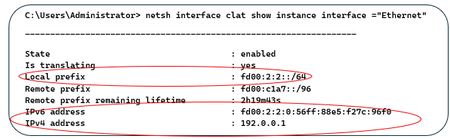
There is one thing that I would say could be improved: If the client is AD joined it will register itself in the dns domain. Currently it registers its 192.0.0.1 address. The mentioned rfc's do not mention this, but I would have thought that 192.0.0.1 is to be treated like 127.0.0.1: it should not be "on the wire" and is valid only locally. As a consequence I think this address should not be registered on dns.
 Microsoft
hi saxl23, do you mind reaching out to me directly? I'd like to understand more about this issue. Thank you!

Hi Jim,
In my testing, it seems that when using the CLAT, my Windows client (my testing version is 10.0.26200.9448) is still exhibiting the DNS behaviour mentioned by saxl23 : in our environment, where computers are Active Directory domain-joined and the DNS servers are serving AD-integrated DNS zones, computers that have the CLAT enabled are registering their hostnames in the DNS zones using two addresses:
For example, if my computer's name is TEST-LAPTOP.ad.contoso.com, if I receive the IPv6 address of 2001:db8:cof:fee:1:2:3:4, and the CLAT is activated when I connect to the network due to activating PREF64 and DHCP option 108, performing a DNS lookup for "TEST-LAPTOP.ad.contoso.com" will return two records:
The second record is useless to all other devices on the network. Ideally, the computer should never register an IPv4 CLAT address like 192.0.0.1 in DNS, the same way it wouldn't register the address 127.0.0.1.
Is Microsoft aware of this issue?