Why We Built Shift+Enter Summit
Originally authored by: Mate Toth
Every conference name means something to the people who picked it. Ours is a keyboard shortcut. Most people read it as "Shift Plus Enter" the first time they see it, the way you'd say it out loud in a sentence. That's fine, because it's exactly how everyone starts. Nobody says "Shift Plus Enter" once they actually use it every day. It becomes reflex: the shortcut that gets you a new line without submitting the form, sends a message without closing the thread, or breaks a formula into something more readable. It's the small move that changes what happens next, without starting over.
We wanted the name itself to work the same way the event does. On day one, it reads like a phrase. Once you've been in the room, it reads like a habit.
That's what we wanted this event to be for the people who came. Not a reset. A line break.
Why we started it
Hungary has a strong, but quiet Microsoft community. People who run Power Platform in production, who've built Copilot Studio agents that actually ship, who know Fabric or Dynamics 365 well enough to teach it. What we didn't have was a place for that community to stand in one room together, once a year, and be visible to itself.
There were user groups. There were scattered meetups. There wasn't a single day where the whole ecosystem - Power Platform, AI & Copilot, Cloud & M365, Dynamics 365, Fabric & Data, and the human and career side of all of it - showed up under one roof. So a small group of us, all volunteers with full-time jobs elsewhere, decided to build that day ourselves.
We didn't set out to build a business. We do this with a not-for-profit mindset, and we like to bring charity into the work wherever we can. In previous years, our catering was provided by a foundation that helps people with disabilities find employment. This year, we donated half of our ticket income to another foundation, Bátor Tábor, which runs camps for seriously ill children. The event pays for itself and for something bigger than itself. That was a deliberate choice from day one, not something we added later to look good.
Why English, in Hungary
This is the part we debated the most, and we still debate it.
Running a Hungarian community event entirely in English creates real friction. It filters out some people who'd otherwise come. It's not the "safe" choice for a first-year grassroots event trying to fill a room. We knew that going in, and we did it anyway, on purpose.
The Microsoft ecosystem doesn't stop at a border, and neither does the talent in it. Speakers from across Europe don't speak Hungarian. Neither do the international sponsors, or the attendees who cross a border to be in the room. If we'd run the event in Hungarian, we'd have built something warmer for the people already here, and closed the door on everyone else. English was the trade we made to open the room to Central and Eastern Europe instead of just to Budapest.
It's not a neutral choice. Some people who would have loved this event never considered it because of the language. We know that cost is real, and we've felt it in the CfS submissions and ticket conversations. But the alternative was a ceiling on what this could ever become -a solid local meetup, forever local. We wanted the option to grow into something regional. English was how we kept that door open.
What we're actually trying to build
Not a bigger version of what exists. A different kind of room.
No vendor pitches on stage. Sessions selected on merit, reviewed without seeing who submitted them, so a first-time speaker and an MVP get judged on the same footing. A day built by people who wanted the same thing from a conference: good sessions, good energy, no unnecessary formality, and space to learn about Microsoft technology as well as the human skills around it.
If it worked, the shortcut metaphor holds: a room that gets you somewhere new, without starting over. That's still the goal. We're not done building it.
Last year answered the question we'd been asking ourselves: could a conference built on human skill, without the formality, actually work? It did. This year, we built on that instead of starting over, and the direction held. If you're looking to build something different in your own community, the lesson we'd pass on is simple: find your people, and they'll find you too.
A few other things we'd tell any organizer starting from scratch:
Venue is a trade-off, not a checklist. We've held our events in unconventional spaces, a coworking office, a comedy club & restaurant, and each time some things got noticeably better while others got worse. Catering was excellent because the venue already did that well every day. Soundproofing between rooms was not, because the venue was never built for parallel tracks. You don't get the upside without the downside; you just get to pick which trade-offs you can live with.
Show up where people are already searching. Some of our attendees found us not through LinkedIn or word of mouth, but by asking ChatGPT what Microsoft community events were happening in the region. If your event doesn't have a real online footprint, search engines and AI assistants alike have nothing to point people to, and neither do the people who'd have come.
Trust your read, then adjust. Most of our decisions didn't come from a playbook, they came from testing what felt right and course-correcting when it didn't. That's still how we're doing it.
Our 2026 edition already happened, on September 4th. We'll cover how that one went in a separate article.
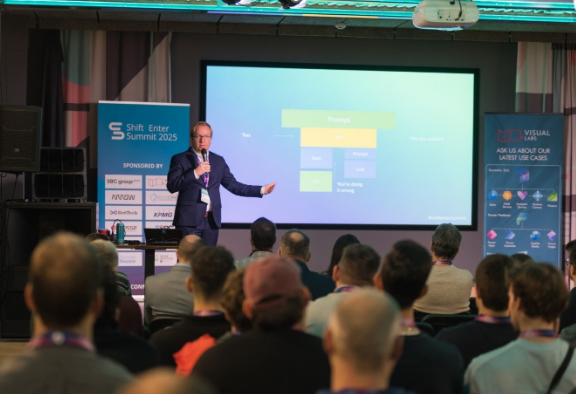
Images of Shift+Enter Summit 2025 by Rafael Orczy.

 Microsoft