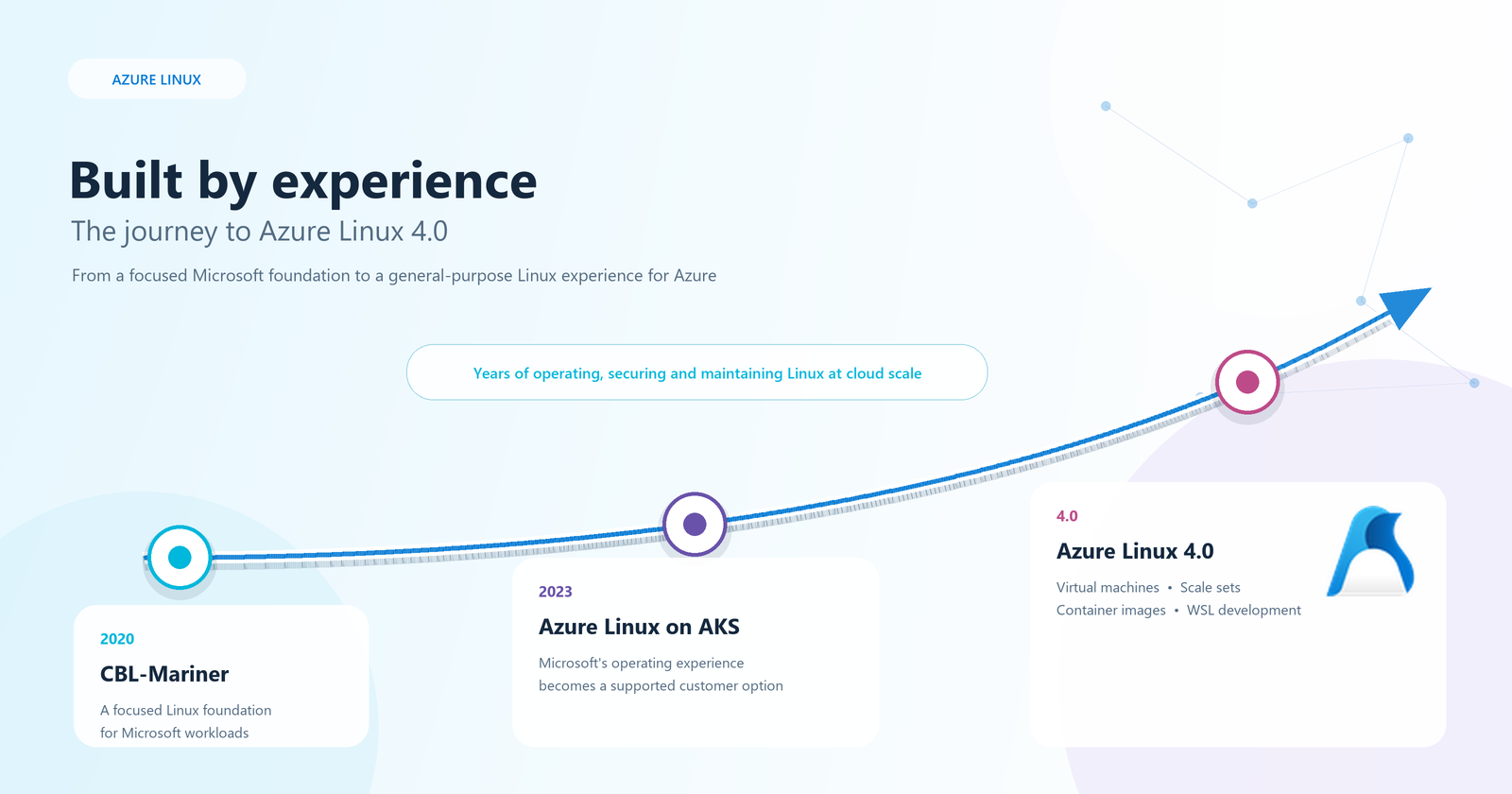
Azure Linux 4.0 builds on years of experience creating, operating, securing, and maintaining a Linux distribution for cloud-scale workloads. That journey began with CBL-Mariner, which emerged publicly in 2020 as Microsoft’s open-source Linux distribution for its cloud infrastructure and edge products and services. The distribution was built around a focused goal: provide a consistent, lightweight Linux foundation for Microsoft workloads.
Over time, the scope grew. The project became Azure Linux, and in May 2023 it became generally available to customers as a container host for Azure Kubernetes Service (AKS). That was an important step: technology developed through Microsoft’s own operating experience was now available as a supported option for customers running production Kubernetes workloads. Azure Linux 4.0 is the next step in that evolution. It brings the lessons accumulated across Microsoft and AKS scenarios to a broader audience as a general-purpose server distribution for Azure Virtual Machines and Virtual Machine Scale Sets, as well as a foundation for container images.
A distribution is more than a collection of packages
Building a distribution involves much more than assembling open-source packages. Every package introduces decisions: which version to carry, how it interacts with the rest of the system, how changes are validated, how security fixes are delivered, and how customers move forward without unnecessary disruption. As a distribution grows, so does the long-term responsibility attached to each of those choices.
Earlier Azure Linux releases were designed around focused Microsoft and container-host scenarios. Preparing Azure Linux for a broader range of customer workloads required a larger package ecosystem and a model that could remain sustainable as that ecosystem evolved. Azure Linux 4.0 uses Fedora Linux package sources as its upstream foundation, giving the team a coherent starting point, a mature RPM ecosystem, and an active open-source community.
Azure Linux curates that foundation for Azure server and container scenarios rather than simply reproducing Fedora. It builds its own packages and images, integrates with Azure, and maintains its own support and release policies. The result combines a strong and sustainable upstream foundation with deliberate choices for Azure workloads.
Stay close to upstream - and make differences clear
Every downstream difference carries an ongoing cost. The team must understand, test, maintain, and reconsider it as upstream evolves. Azure Linux 4.0 therefore stays close to Fedora where practical. When an Azure scenario requires a difference, the team documents and intentionally scopes that difference so it remains understandable, reviewable, and maintainable over time.
The same principle applies beyond package content. Azure Linux 4.0 increasingly uses familiar tools and practices from the Fedora and RPM ecosystems. This reduces the need for distribution-specific processes and makes the project more approachable to developers who already know that ecosystem. Staying close to upstream also strengthens our relationship with the open-source communities on which Azure Linux depends and helps us contribute broadly useful improvements wherever possible.
Balance stability with a modern cloud platform
Customers need a stable foundation, but they also need access to current cloud and developer capabilities. Hardware advances, security requirements change, and application runtimes introduce new supported versions. A lifecycle that is too short creates constant migration pressure, while one that is too rigid can leave customers waiting too long for important platform improvements. Our experience operating a distribution has taught us to treat predictability as a product feature.
Azure Linux 4.0 is designed around a deliberately balanced support lifecycle: long enough for customers to plan and operate with confidence, while allowing the platform to evolve at a cadence that fits modern cloud workloads. It includes four years of full support, and its maintenance model is intended to keep routine servicing conservative while placing more impactful package changes into planned, clearly communicated refresh windows.
Security updates and critical fixes continue throughout the lifecycle, while planned refreshes provide a clear path to newer capabilities and give customers time to prepare, test, and deploy changes. This model creates a dependable base without treating stability and progress as opposing goals.
Built for cloud workloads
Azure Linux is general purpose, but it is purposefully focused on server and cloud workloads. Customers can use the core image as-is or extend it for their applications, while its focused composition reduces unnecessary software and the security and maintenance surface that comes with it.
The same foundation can support multiple Azure deployment models. Customers can use Azure Linux 4.0 on individual virtual machines, scale it through Virtual Machine Scale Sets, or use Microsoft-maintained Azure Linux container images as a starting point for containerized applications. That consistency can simplify how teams approach images, packages, security baselines, and operations across VM and container environments.
From Microsoft’s workloads to yours
The Azure Linux team did not begin this journey by designing a distribution in the abstract. The distribution evolved through real operating experience across Microsoft’s cloud infrastructure, edge products and services, and AKS. Those experiences shaped the priorities behind Azure Linux 4.0:
- Keep the base focused and reduce unnecessary components.
- Treat security servicing as a continuous responsibility.
- Make changes understandable and intentional.
- Stay close to upstream to improve long-term maintainability.
- Provide customers with a predictable lifecycle and refresh model.
- Design for consistent use across server and container scenarios.
- Make support part of the product experience rather than an afterthought.
Azure Linux 4.0 brings those lessons together for a broader customer audience. It is a Microsoft-built and supported Linux option, optimized for Azure and available at no additional operating-system charge beyond the underlying Azure compute.
It also remains one choice within the broad Linux ecosystem on Azure. Microsoft continues to work closely with established Linux distribution partners, and customers should choose the distribution that best fits their workload, ecosystem, and support needs.
The next chapter
With Azure Linux 4.0, we are bringing years of distribution engineering and operating experience to Azure customers in a new way. What began as a focused Linux foundation for Microsoft workloads expanded to a supported AKS container host and is now becoming a general-purpose option for Azure VMs, scale sets, and container images.
We are excited for customers to evaluate Azure Linux 4.0, tell us what works, and help shape what comes next. Azure Linux 4.0 is currently available in public preview for evaluation and testing.

 Microsoft
