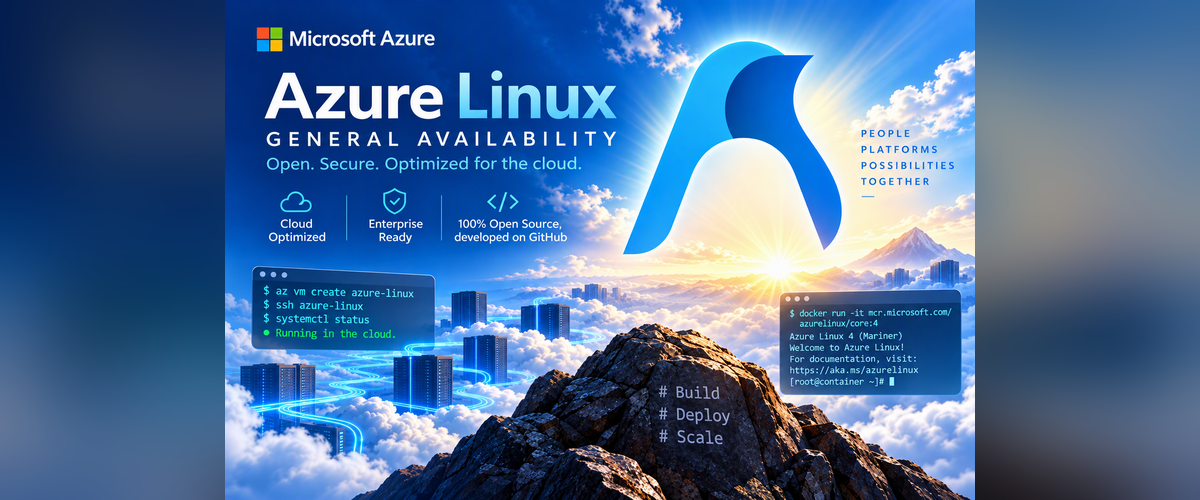
The Linux distro that runs Azure, is now available for your workloads
Today, we're announcing the general availability of Azure Linux 4, Microsoft's own Linux distribution, purpose-built for Azure. Azure Linux is open source, with its code and tooling on GitHub, and already powers millions of cores across Azure services, including AI workloads, Azure Kubernetes Service (AKS), App Service and Azure Cosmos DB. With this release, every Azure customer can run the OS Microsoft trusts for its own cloud, with no additional OS licensing cost.
What is Azure Linux?
Azure Linux is a Fedora-derived, RPM-based Linux distribution built and maintained by Microsoft. It is tailored for cloud workloads and designed with a minimal footprint for faster deployment, and a smaller attack surface. Azure Linux is not designed for desktop use or GUI applications.
Why it matters
Many teams run one Linux distribution on VMs, another on Kubernetes nodes and a third in container images, each with its own patch schedule and security baseline. Azure Linux gives you one consistent Microsoft-supported foundation across all of them.
- Optimized for Azure: validated across Azure VM SKUs and tuned for Azure compute, storage and networking, with built-in optional support for Microsoft Defender for Cloud, Azure Monitor and Trusted Launch.
- Secure by default: a smaller attack surface, SELinux enabled by default, signed drivers, and OpenSSL 3.5 with post-quantum cryptography support.
- One accountable vendor: Microsoft builds the OS and runs the cloud beneath it, with predictable kernel and CVE updates.
- Lower cost: no additional OS licensing fee, plus faster boot and scale-out from a leaner OS.
What's new in Azure Linux 4
Azure Linux 4 is the first release of Azure Linux designed as a general-purpose server OS for customer virtual machines. It moves the platform onto a modern, Fedora-based stack:
|
Component |
Version |
What it means for you |
|
Linux kernel |
6.18 LTS |
New hardware drivers, improved Hyper-V integration and GPU and AI accelerator support |
|
OpenSSL |
3.5 |
Post-quantum cryptography support and improved QUIC support |
|
dnf5 |
New package manager |
Faster dependency resolution and lower memory use |
|
systemd |
258 |
Faster boot sequences and improved service management |
|
glibc |
2.42 |
Performance gains in string operations, memory allocation and thread handling |
|
RPM |
6.0 |
Modernized database backend and stronger signature verification |
|
Python |
3.14 |
JIT compiler and new language features |
Azure Linux 4 also supports multiple container runtimes, including containerd and Podman.
Azure Linux on Virtual Machines
Azure Linux 4 is now ready for production on Azure Virtual Machines and Virtual Machine Scale Sets. Whether you run web applications, databases or GPU-accelerated AI workloads, you get a consistent, secure foundation that starts. You pay only for the underlying Azure compute. Deploy your first VM in minutes from the Azure Marketplace.
Azure Linux container images
Today we're also announcing general availability of Azure Linux 4 container images, built from the same supply chain as your VMs. You get one Linux experience from VM to container, with the same security updates and compliance posture.
|
Image type |
Use case |
|
Core |
Full flexibility to install any packages you need |
|
Runtime (Python, Node.js, Java, .NET) |
Preconfigured language stacks |
|
Distroless |
Minimal attack surface: no shell, no package manager |
All images are on Microsoft Artifact Registry. Microsoft Defender, Azure CLI and PowerShell are also available in the Azure Linux repositories.
Develop locally with WSL
With Azure Linux on Windows Subsystem for Linux, developers can build and test on the same OS they deploy to Azure, using familiar VS Code and CLI workflows.
Partners
Azure Linux 4.0 brings customers more choice in how they secure and run their workloads on Azure. Palo Alto Networks and AquaSec provide workload and container protection capabilities; Qualys helps teams identify vulnerabilities and monitor compliance; and Upwind and Wiz bring runtime visibility and cloud context to help prioritize security risks. NVIDIA broadens options for GPU-accelerated AI and compute-intensive workloads. Together, these partnerships help customers adopt Azure Linux 4.0 while retaining familiar tools, extending existing security workflows, and reducing integration effort. See the Azure Linux partner solutions documentation for each solution’s validated deployment options.
Get started
Azure Linux 4 gives you the foundation Azure runs on, open source and included at no additional OS cost.
- Deploy Azure Linux 4 from the Azure Marketplace
- Read what's new on Microsoft Learn
- Set up Azure Linux on WSL
- Explore the source on GitHub

 Microsoft