Premium MedImageInsight & CxrReportGen on Microsoft Foundry
Authors: Ivan Tarapov, Naiteek Sangani, Mu Wei, Noel Codella, Mert Oez and Naveen Valluri, Microsoft Healthcare and Life Sciences
At HLTH 2024, we introduced three open-source healthcare AI foundation models on Microsoft Foundry: MedImageInsight (MI2), CxrReportGen (CXRRG), and MedImageParse (MIP). They quickly became the most popular healthcare industry models in the Foundry catalog, with consistent, growing usage by researchers, ISVs, and clinical teams over more than 15 months. Customer momentum has been real:
- SECTRA has explored integrating MedImageInsight for real-time exam parameter determination.
- University of Wisconsin is exploring the use of CxrReportGen to automate normal-case triage, focusing radiologists on complex work.
- University of Washington fine-tuned MedImageInsight for brain tumor typing and localization from multi-sequence brain MRI scans.
- Milvue is fine-tuning CxrReportGen to extend its capabilities into musculoskeletal pathologies and image-based reporting.
Early experimentation with these models across different scenarios provided clear signals on where customers needed more support. Across these efforts, four themes consistently emerged:
- “We don’t want to manage our own VMs.” Radiology IT or ML platform teams don’t want to manage GPU infrastructure for provisioning and scaling.
- “We want to pay for what we use.” Idle GPUs are a tax. Customers want elastic endpoints that scale with workload.
- “We need enterprise-ready endpoints.” Production deployments require HIPAA coverage, BAAs, SLAs, managed security, and a pathway to integration into the surfaces clinicians already use — PowerScribe, PowerShare Image Sharing, and PACS.
- “We want a simplified fine-tuning process.” Foundation models require fine-tuning for integration into clinical workflows. Fine-tuning needs to be fast, efficient, and easy to perform.
We set out to address these priorities to make it easier for customers to experiment, evaluate, and build on these models.
Introducing healthcare AI premium models
Microsoft now offers premium versions of its medical imaging foundation models on Foundry, available today as a private preview to approved customers. The trusted core architecture has been further optimized and enhanced, with frequent updates using larger, curated datasets and the models are delivered as fully managed endpoints. With the introduction of these premium models, we are committing to maintaining state-of-the-art performance across a broad range of medical image processing tasks.
Premium models on Foundry are designed for teams aiming to build medical imaging AI - including developers, ISVs, and enterprise health systems standardizing on managed AI endpoints within their Azure environments. They provide a strong starting point for researchers and advanced practitioners who want to experiment and extend capabilities without requiring access to large, specialized datasets.
These models are not medical devices and are not intended for out-of-the-box clinical use or autonomous clinical decision-making. Instead, they are designed to be fine-tuned, validated, and deployed within customer-controlled workflows, with appropriate human oversight and regulatory processes applied by the implementing organization.
Unlike the open-weight versions of the models which run on a dedicated virtual machine hosted in customer subscription, the premium models are available as “managed endpoints” (also known as “serverless models“) where the models are hosted on Microsoft-owned infrastructure. Customers benefit from a more flexible, “pay-as-you-go” billing model with charges based on images processed rather than per hour of VM uptime.
These first premium models - MedImageInsight Premium and CxrReportGen Premium bring managed, commercial-ready delivery to two high-value imaging scenarios: multimodal image encoding and chest X-ray findings generation.
MedImageInsight Premium: a multimodal embedding model for medical imaging
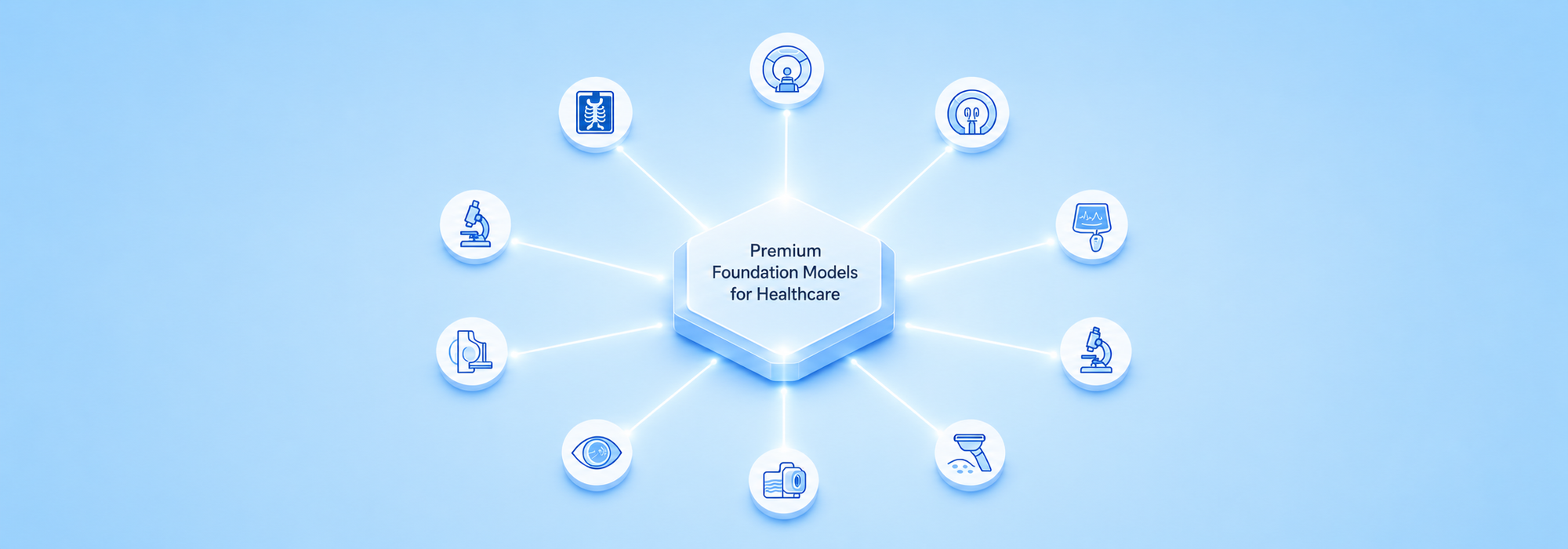
MedImageInsight Premium builds on the open-source version with up to 16% performance gains on imaging benchmarks. It’s a single general-purpose embedding backbone across nine modalities including X-ray, CT, MRI, ultrasound, pathology, dermoscopy, OCT, fundus photography, and mammography, that powers:
- Image quality analysis and study routing
- Image-to-image similarity search
- Zero-shot and fine-tuned classification
- Metadata extraction and outlier detection
- Downstream report generation (as an encoder)
How does it compare to other similar models?
The table below summarizes results from a published comparison of radiographic classification performance across several foundation-model backbones. In the benchmarks shown, MedImageInsight Premium achieves the highest reported mAUC among the models listed, supporting its use as a general-purpose imaging representation for downstream classification and fine-tuning workflows.
|
|
MedImageInsight Premium |
MedImageInsight OSS |
MedSigLip |
|
LTCXR (Chest Xray mAUC) |
0.83 |
0.79 |
0.74 |
|
IRMA2009 (X-ray Exam Params) |
0.94 |
0.92 |
0.90 |
|
BUSI (Breast Cancer Ultrasound mAUC) |
0.98 |
0.97 |
0.93 |
|
HMCQU (Echocardiography view mAUC) |
0.97 |
0.97 |
0.86 |
|
PCAM (Histopathology mAUC) |
0.95 |
0.94 |
0.93 |
|
RSNAMAMM (Mammography AUC) |
0.86 |
0.84 |
0.77 |
|
Gastrovision (Endoscopy (GI) AUC) |
0.92 |
0.89 |
0.89 |
Why it matters: a stronger embedding space can help reduce the amount of labeled examples needed for downstream tasks, lower fine-tuning cost, and support faster iteration during model evaluation and application development.
Read more about using MedImageInsight to power medical imaging pipelines for cohort building.
For more details about datasets and benchmarking methodology please refer to our MedImageInsight paper.
CxrReportGen Premium: chest X-ray findings generation
CxrReportGen Premium generates a structured list of findings for chest X-rays. It accepts current and prior studies plus clinical context such as indication, technique, and comparison and can run inference in well under a second. It offers best-in-class performance and a solid foundation for production workloads.
In Microsoft testing on a proprietary real-world dataset, CxrReportGen Premium showed an approximately 330% performance increase compared to the open-weight version. Results may vary by dataset, workflow, and evaluation approach, so teams should validate performance using their own data and clinical requirements.
Findings generation on MIMIC-CXR dataset:
|
|
CXRReportGen Premium |
CXRReportGen OSS |
|
1/RadCliq-v1 |
1.26 |
1.34 |
|
BLEU-2 |
0.27 |
0.31 |
|
BERTScore |
0.47 |
0.50 |
|
SembScore |
0.50 |
0.50 |
|
RadGraph |
0.31 |
0.31 |
Findings generation on proprietary real-world dataset
|
|
CXRReportGen Premium |
CXRReportGen OSS |
|
1/RadCliq-v1 |
2.74 |
0.83 |
|
BLEU-2 |
0.38 |
0.16 |
|
BERTScore |
0.57 |
0.37 |
|
SembScore |
0.60 |
0.43 |
|
RadGraph |
0.43 |
0.18 |
“Milvue is building a radiology-native VLM. By working with Microsoft and leveraging CXRReportGen, we could start from a strong foundation allowing our team to focus on what matters most: turning foundation-model capability into clinically validated, workflow-ready radiology solutions.”
— Alexandre Parpaleix, Co-Founder/CEO, Milvue (milvue.com)
How does it compare to other similar models?
The comparison below highlights how CxrReportGen Premium differs from open-source and publicly available chest X-ray reporting approaches across availability, output style, grounding, training data, and benchmark context.
|
Model |
Availability |
Output Style |
Grounded |
Key Training Data |
Benchmark |
|
CXRReportGen Premium |
Internal |
Findings ± |
Yes |
MIMIC-CXR + |
Internal only: 1/RadCliQ↑ 1.88; |
|
CXRReportGen (open) |
Public |
Grounded |
Yes |
MIMIC-CXR + |
MIMIC-CXR: RadGraph F1↑ 1.34; |
|
UniRG-CXR |
Public (research) |
Findings ± |
No |
ReXrank datasets |
RexRank family: RadGraph F1↑ |
|
MAIRA-2 |
Public |
Findings ± |
Yes |
CXR reporting data + |
ReXrank family: RadGraph F1↑ |
|
CXR-RePaiR |
Public |
Free-text |
No |
MIMIC-CXR corpus; |
External CheXpert: F1↑ 0.352 |
|
R2Gen |
Public |
Free-text |
No |
IU X-Ray + |
External CheXpert: F1↑ 0.191 |
|
CvT2DistilGPT2 |
Public |
Free-text |
No |
MIMIC-CXR + |
ReXrank family: RadGraph F1↑ |
|
MedGemma |
Public |
Findings / |
No / mixed |
Broad medical |
ReXrank family: RadGraph F1↑ |
Benchmarks cited here are not apples-to-apples comparisons. “Internal / Proprietary Performance” reflects Microsoft internal or proprietary evaluations for CXRReportGen Premium/open CXRReportGen. “Public Benchmark Performance” reflects the best headline metric explicitly reported in the public benchmark family cited for each model (for example, MIMIC-CXR card metrics, CheXpert clinical-efficacy metrics, or ReXrank-style RadGraph results). Metric families represented here include composite quality metrics such as 1/RadCliQ, clinical structure metrics such as RadGraph F1, and lexical metrics such as ROUGE-L
For more details on model architecture, datasets and evaluation methodology, please refer to our technical paper.
Building our premium healthcare AI models
The premium models achieve a different performance checkpoint trained on a materially larger, curated, clinically-vetted data mix and are designed for an ongoing training cadence. Key details developers typically ask about include:
- Curated, licensed data mix. Expanded coverage across modalities and underrepresented pathologies, with particular attention to dataset provenance, patient de-identification, and license compatibility with commercial deployment.
- Architecture-compatible. Same embedding dimensionality for MedImageInsight and same input/output contract for CxrReportGen, so code written against the OSS endpoints can move over with minimal changes.
- Fine-tuning friendly. Stronger base representations can help reduce the amount of data needed and thus support more efficient fine-tuning and adapter-based specialization.
- Managed inference. Packaged and deployed on Azure ML managed endpoints with elastic autoscaling, using A100-class GPUs.
Responsible AI
Every premium model has gone through Microsoft’s Responsible AI review, and Data Science Board review — the same internal gates that govern our 1P healthcare AI surfaces. Each model ships with a detailed model card covering intended use, out-of-scope use, dataset provenance, known limitations, subgroup performance, and evaluation methodology. These models are not medical devices and are not cleared for autonomous clinical decision-making. They are designed to be fine-tuned, validated, and deployed by customers into their own clinical workflows, with Microsoft supporting partners through SaMD submission paths where applicable.
Managed Security
Managed endpoints in Foundry act as a secure, policy-enforced gateway to model execution rather than direct access to underlying models. Every request to an endpoint is authenticated and authorized through Microsoft Entra ID or scoped API credentials so that only approved users and services can invoke specific deployments. Endpoints can be isolated within private networks and exposed through controlled access paths to control unintended public exposure. All data is encrypted in transit using TLS and protected at rest within Azure, while built-in controls such as content filtering, rate limiting, and activity logging provide continuous governance and auditability. As Azure resources, these endpoints inherit enterprise-grade security, compliance, and monitoring capabilities - helping ensure that model access remains tightly controlled, observable, and aligned with organizational policies.
Open source vs premium at a glance
The driving force behind premium models is enabling teams to deploy solutions faster, with less overhead. For many teams, the biggest gain isn’t just in model quality - it’s in how these capabilities are delivered and supported in production. Premium models are designed to remove the operational burden of managing infrastructure while giving organizations the flexibility, commercial terms, and integrations they need to move from experimentation to deployment.
- Fully managed endpoints. No GPU VMs to provision, patch, or scale. Elastic by default.
- Pay for what you use. Usage-based inference pricing helps reduce idle GPU costs by charging for model usage rather than continuously running self-managed infrastructure
- Integrated where you work. Designed to plug into PowerScribe via Dragon Copilot for radiology
- Improved performance. Unlike the open-source models, the premium models achieve a different performance checkpoint trained on a materially larger, curated, clinically-vetted data mix and are designed for an ongoing training cadence.
|
|
Open source (2024) |
Premium (2026) |
|
Benchmark performance |
SOTA baseline at release |
+7–15% on imaging benchmarks |
|
License |
Research / academic only |
Commercial use |
|
Deployment |
Self-managed GPU VMs |
Fully managed Microsoft Foundry endpoints |
|
Pricing |
Compute you provision |
Per-hour inferencing — pay for what you use |
|
Scaling |
Customer-managed |
Autoscale, elastic from zero |
|
Fine-tuning |
DIY via Azure Machine Learning |
Native Foundry UX |
Comparing costs
From a cost perspective, the tradeoff between managed endpoints and self-managed infrastructure depends on the workload.
Customers incur a fixed cost for a self-managed endpoint regardless of how many images processed. With serverless models the costs are incurred only when images are processed by the models.
As a general guideline, self-managed endpoints may become more cost-effective at higher sustained throughput, while managed endpoints can be more cost-efficient for lower or variable workloads, especially when operational overhead for GPU infrastructure is included. The exact break-even point depends on model choice, endpoint configuration, utilization pattern, and current pricing. With launch private preview pricing self-managed endpoints break even with managed endpoints at approximately 6,000 images/hour for MedImageInsight and 1,500 images/hour for CxrReportGen.
Getting started
MedImageInsight Premium and CXRReportGen Premium are available in a limited preview. To request access, use the links below:
MedImageInsight Premium: https://aka.ms/hls/mi2premium
CxrReportGen Premium: https://aka.ms/hls/cxrrgpremium
To learn more about premium models as well as other models for healthcare and life sciences in the Foundry catalog, as well as review additional resources, take a look at our project page.
Premium models are one part of a broader shift in how healthcare organizations adopt and operationalize AI. For a wider industry perspective on how these capabilities are shaping healthcare delivery, read more in our latest industry blog.

 Microsoft