Many of you have seen our previous blog post announcing the Exchange documentation URL changes, and have provided us with your feedback on the matter. Starting off, we want to thank you for all of it; we learned quite a bit from it, and we think it’s fantastic that we have such passionate and vocal community.
First, a little bit of history. How did we get here?
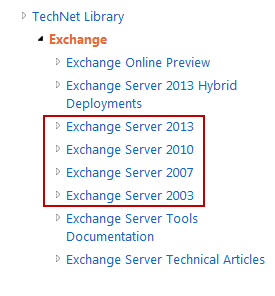
As an enterprise product with a long lifecycle, product documentation for multiple Exchange versions is published on TechNet. If you look at Exchange documentation library, you will find content for Exchange Server 2013, Exchange Server 2010, Exchange Server 2007 and Exchange Server 2003.
As part of our content publishing process, we have historically used version-less URLs (URLs with no version info) that point to the most recent version of a topic. This has been our practice for both our IT Pro and Developer documentation for multiple releases of Exchange. Interestingly, we didn’t get any negative feedback, or really any feedback at all the previous time we made this switch, when we moved from Exchange 2007 to Exchange 2010.
One could speculate as to why the previous switch wasn’t painful, but this one was, but the main point is — this last switch was.
Where do we go from here?
Taking all of the feedback we received into consideration, and based upon upcoming documentation publishing milestones, we have decided on the following course of action to prevent this sort of pain from happening with future product releases (the changes are not live yet, but will be starting tomorrow):
- Bad news first: we will not be switching the documentation URLs back to where they were pre-November 2012. While this was a painful decision, we do not want to increase the pain more by doing another switch after 3 months.
- Looking forward, we will make it so that all of our documentation exposes the version information in the URL. So, for Exchange 2010, that would mean that you will see (EXCHG.141) as part of the URL, and for Exchange 2013 you’ll see (EXCHG.150). These are the URLs that will be used in the navigation elements on TechNet and in links in the content. Version-less URLs will still point to the latest version of the specific article. However, as version-specific URLs will be available (and visible when you browse our documentation) for everything, we expect that the use of version-less URLs will decrease over time. In other words, any Library topics you link to (by copying from your browser's address bar) will have the version identifier.
We are hoping that this course of action will provide the right balance of what a set of our customers want and our ability to still optimize discoverability of content across multiple product versions.
Exchange Documentation Team

