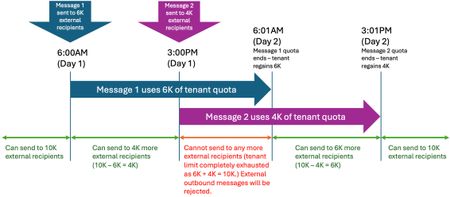
We are finding that the Observed Value in the Admin Center's report is considerably higher than what is returned by the PS command Get-LimitsEnforcementStatus. A case was opened on this. The explanation for the difference is the following:
- The Tenant Outbound External Recipients report reflects the total number of external recipients across all outbound messages. This includes scenarios such as multiple emails sent to the same recipient, distribution list expansions, and retry attempts, which can significantly increase the overall count.
- The Get-LimitsEnforcementStatus cmdlet provides a processed value that is used for enforcement purposes. This value is calculated after applying internal filtering and deduplication logic and therefore represents a more refined count of recipients relevant to service limits.
However the Blog explanation with respect to the bolded text above is:
- If I send a message to a Distribution Group (DG) in my tenant that in turn has 1,000 external recipients on it will that get counted as 1 external recipient or 1,000 external recipients?
- It counts as 1,000. The counting of external recipients happens after the DG (and its nested groups) is fully expanded to individual recipients.
- If I send 1,000 messages to the same external recipient in a day does that count as 1 external recipient or 1,000 external recipients?
- It counts as 1,000. The tenant external recipient rate limit doesn’t track unique external recipients.
What is more correct, the report or the PowerShell command? What is used to enforce the limit?