MSFrodo - I have to step back and ask "Who does this impact?"
I went and reread the article post and it looks like this may only impact Exchange on-premises systems that create remote EOL mailboxes(?):
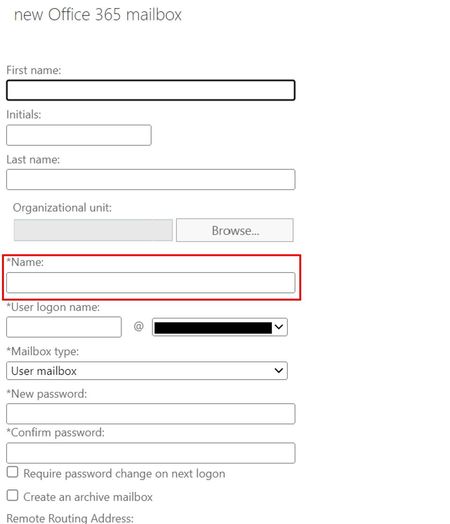
With this new change, when creating a new Office 365 (remote) mailbox from on-premises Exchange Admin Center, the Name field will no longer synchronize to Exchange Online.
If we have AD on-premises and sync our AD objects using AAD Connect, will this change impact us? I ask because I also read:
Will this change not allow modification of the Name property?
Customers can still use Exchange PowerShell cmdlets (New-MailUser, New-Mailbox, Set-User, Set-MailUser, Set-Mailbox with -Name parameter) to update the Name property in Exchange Online. Since the cmdlets ensure uniqueness, it would allow the operation to succeed only when the passed Name is unique in the tenant.
So, I ran a test to see if the above statement posted by MS was indeed true (test.user is synced from on-premises AD and mailbox migrated using New-MoveRequest):
$arrRenameEOLmailboxes = @(Get-Mailbox test.user)
$arrRenameEOLmailboxes | % { $objTemp = $_ ; Set-Mailbox -Identity $objTemp.ExternalDirectoryObjectId -Name $objTemp.ExternalDirectoryObjectId }
And I get the following expected error:
The operation on mailbox "Test User" failed because it's out of the current user's write scope.
The action 'Set-Mailbox', 'Name', can't be performed on the object '<ExternalDirectoryObjectId removed>' because the object is being synchronized from your on-premises organization. This action should be performed on the object in your on-premises organization.
Of course, we get that error because we sync some of our on-premises AD objects to the MSOL DB and so we can't make this change in EOL as stated in the original MS article. I am left to question whether or not this change to the Name attribute will impact objects synchronized from on-premises AD in the first place? Does this change only impact cloud-only objects?