1.4 billion people are financially excluded, and the compliance systems meant to stop financial crime are often the reason why. ARGUS is a multi-agent Azure AI Foundry system built to fix that — and it just won Hack for Good(1 of 3) at the Microsoft Agents League AI Skills Fest 2026.
Guest post by 𝐀𝐫𝐣𝐮𝐧 𝐆𝐚𝐧𝐞𝐬𝐡 Winner of Hack for Good category Microsoft Agents League Hackathon
A refugee family in Germany spends 18 months trying to open a bank account. Their documents are legitimate. But an automated KYC system — never designed with them in mind — scores their jurisdiction as high risk and closes the case. No human review. No plain-language explanation. No appeal path.
An NGO doing legitimate microfinance work in Southeast Asia gets de-risked by their correspondent bank. The letter cites "risk appetite." The lending operation, which supports 4,000 families, can no longer move money.
These aren't edge cases. 1.4 billion people remain financially excluded globally — and compliance systems built to protect institutions are a leading cause. The same technology meant to stop financial crime routinely shuts out the people who most need access.
That's the problem I set out to fix with ARGUS (Agentic Risk & Governance Unified Screening) at the Microsoft Agents League — AI Skills Fest 2026, where it was selected as 1 of 3 Hack for Good winners — awarded to the best solutions to solve a community need.
What ARGUS does
ARGUS is compliance infrastructure that is explainable, accessible, and open — designed from the ground up for the humans most likely to be failed by the systems they depend on, not just for the institutions running the checks.
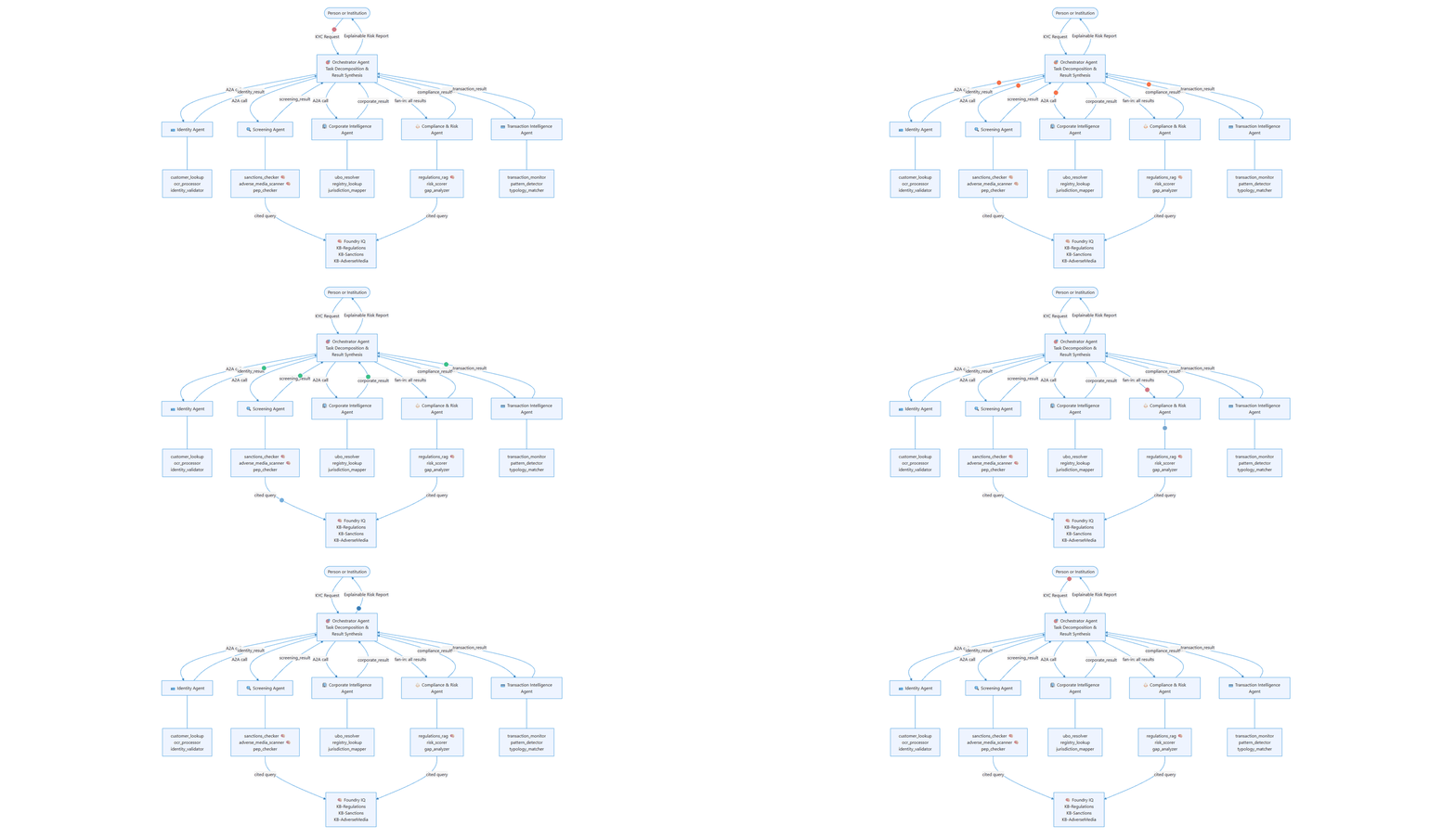
A single KYC request fans out across five specialist AI agents, coordinated via the Agent-to-Agent (A2A) protocol on Azure AI Foundry:
- 🎯 Orchestrator Agent — task decomposition and result synthesis
- 🪪 Identity Agent — customer lookup, OCR processing, identity validation
- 🔍 Screening Agent — sanctions checks, adverse media scanning, PEP checks
- 🏢 Corporate Intelligence Agent — UBO resolution, registry lookups, jurisdiction mapping
- 💳 Transaction Intelligence Agent — transaction monitoring, pattern detection, typology matching
Each of these fans back into a Compliance & Risk Agent, which synthesizes everything into a single traceable risk report.
The part I'm proudest of: nothing in that report is a black box. Every finding is grounded in cited regulatory knowledge via Foundry IQ — sanctions checks and regulatory triggers cite the exact knowledge base, source document, and article behind them. Every risk score comes with a plain-English reason. Every decision leaves a full audit trail: agent by agent, tool by tool, citation by citation.
Submit entity → 5 agents run in parallel → Compliance fan-in → Traceable risk report
What's next: ARGUS v2
The hackathon build proved the architecture holds up. The v2 roadmap is where it grows into something NGOs and microfinance institutions can actually run:
| Feature | Status |
|---|---|
| ♿ Full WCAG 2.1 AA compliance | In progress |
| 🗣 Explain Mode — plain-language reports for the person being screened | In progress |
| 🌍 Community Edition — free, self-hostable, zero Azure subscription required | Designed |
| 📊 Real-time Azure Monitor compliance dashboard | Designed |
| 🔓 Open Knowledge Graph — FATF, Basel AML Index, OFAC/EU/UN lists as open data | Planned |
Explain Mode is the one I'd highlight for an educator audience. Today's report is written for compliance analysts:
"Dimension score 78 — HIGH tier — regulatory trigger: FATF Recommendation 16 (KB-Regulations › FATF-40 › R.16)"
Explain Mode generates the same finding for the person being screened, or the NGO caseworker who has to explain a decision to a family:
"This account review flagged a potential concern with how money moved through the transaction chain. This is a standard check for large or cross-border transfers. A compliance officer will review this before a final decision is made. You don't need to do anything right now."
Same underlying data. Entirely different outcome for the person on the receiving end.
Community Edition is the biggest bet: a zero-cost, self-hostable configuration for NGOs, microfinance institutions, community banks, and researchers — a pre-seeded public knowledge base, a one-command Docker Compose stack, and a lower-cost LLM path, so an Azure subscription isn't a prerequisite for the core flow.
Try it yourself
ARGUS is open source under MIT. If you're teaching agentic AI, Azure AI Foundry, or Semantic Kernel, the repo is built to be a working example of multi-agent orchestration with A2A and grounded retrieval via Foundry IQ:
git clone https://github.com/iarjunganesh/argus.git
cd argus
pip install -r requirements.txt
cp .env.example .env
make generate-data && make generate-ocr-docs
make index-knowledge-bases
.\scripts\start_demo.ps1
The Community Edition — no Azure subscription required — is scaffolded in community/ as part of the v2 roadmap, but isn't runnable yet.
The most-needed contributions right now are WCAG contrast tests for the Gradio UI, translations of Explain Mode output, and finishing the Community Edition Docker Compose stack (Dockerfile + local knowledge base seed) — all good starter issues for students exploring accessible AI system design.
Repo: https://github.com/iarjunganesh/argus
Demo video: https://youtu.be/yaTNCgCwX4s
ARGUS is a technology demonstration and is not a licensed compliance tool — it must not be used to make real KYC/AML decisions.


