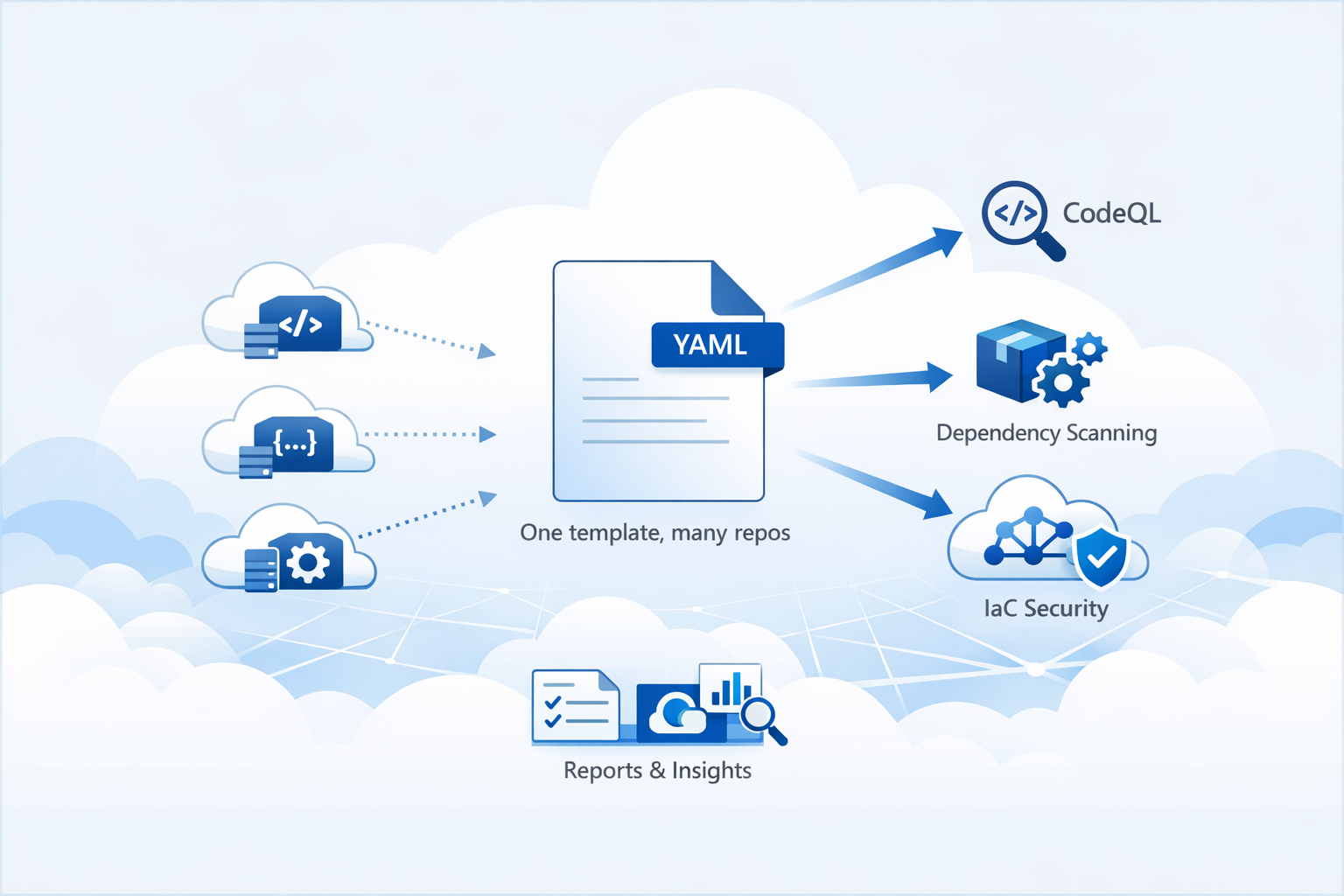
A detection-driven Azure DevOps pipeline to run CodeQL and IaC security scans across polyglot repositories using one reusable template.
Scaling GitHub Advanced Security in Azure DevOps with a single reusable YAML template
Managing security scanning across dozens of repositories can quickly become complex—especially when each repository uses different languages, frameworks, and infrastructure patterns.
In our environment, we needed a scalable way to apply GitHub Advanced Security (GHAS) consistently across:
- Application code (Python, C#, Java, JavaScript)
- Infrastructure as Code (Terraform, ARM, Bicep)
- Mixed (polyglot) repositories
Instead of maintaining multiple pipelines, we built a single reusable Azure DevOps YAML template that dynamically adapts to any repository.
The problem
Most teams struggle with:
- Multiple pipelines for different tech stacks
- Inconsistent security coverage
- Maintenance overhead across repositories
- Unnecessary scans increasing build time
We needed a solution that:
- Detects repository content automatically
- Runs only relevant scans
- Standardizes security across all repos
- Minimizes duplication
Solution overview
The solution is a single-stage pipeline template with three key jobs:
- Detect repository content
- Run CodeQL for application code
- Run IaC security scanning
Scanning behavior is driven entirely by detection outputs.
Architecture
🟦 High-level flow
Key design patterns
1. Detection-driven execution
Instead of hardcoding logic, the pipeline first detects repository content.
✅ Runs only when code is present
✅ Avoids unnecessary execution
2. Single template for all repositories
A single YAML template works for:
- Backend services
- Frontend apps
- IaC repositories
- Mixed projects
No duplication. No branching logic across repos.
3. Dynamic CodeQL configuration
The pipeline generates a runtime CodeQL config file:
✅ Keeps configuration centralized
✅ Avoids scan failures due to irrelevant directories
4. Language-aware setup
The pipeline dynamically prepares environments:
✅ No need for separate pipelines
✅ Works across polyglot repos
5. Correct CodeQL build strategy
For compiled languages like C#, the pipeline performs build tracing:
✅ Ensures proper CodeQL extraction
✅ Avoids empty-database failures
6. Integrated IaC security scanning
Infrastructure scanning is handled in the same pipeline:
✅ Covers Terraform, ARM, Bicep
✅ Unified reporting across code and infrastructure
7. Centralized reporting
Artifacts are published for traceability:
- Code scanning results → CodeScanningReports
- IaC results → IaCSecurityReports
✅ Easy audit and troubleshooting
✅ Retains SARIF outputs
Benefits
This approach delivers:
✔ One pipeline for all repositories
✔ Reduced maintenance overhead
✔ Consistent security enforcement
✔ Faster pipeline execution
✔ Scalable DevSecOps model
Lessons learned
- Detection-first pipelines are critical for scale
- Config-driven CodeQL execution prevents failures
- Build tracing must be handled explicitly for compiled languages
- IaC scanning should not be a separate workflow
Conclusion
Scaling GitHub Advanced Security across Azure DevOps doesn’t require multiple pipelines—it requires the right architecture.
By combining:
- Detection-driven execution
- Dynamic configuration
- Conditional setup
- Unified scanning
You can operationalize security at scale with a single reusable YAML template.

 Microsoft
