If a deployment can fail, make it fail early, consistently, and with a message that teaches the fix. Over time, Azure DevOps pipeline becomes a platform guardrail—not just an execution engine.
When Terraform deploys Azure Functions, the most expensive failures are rarely “syntax” problems. They’re environmental mismatches discovered too late—during terraform apply, after approvals, after a change window starts, and often after multiple teams are already watching the pipeline.
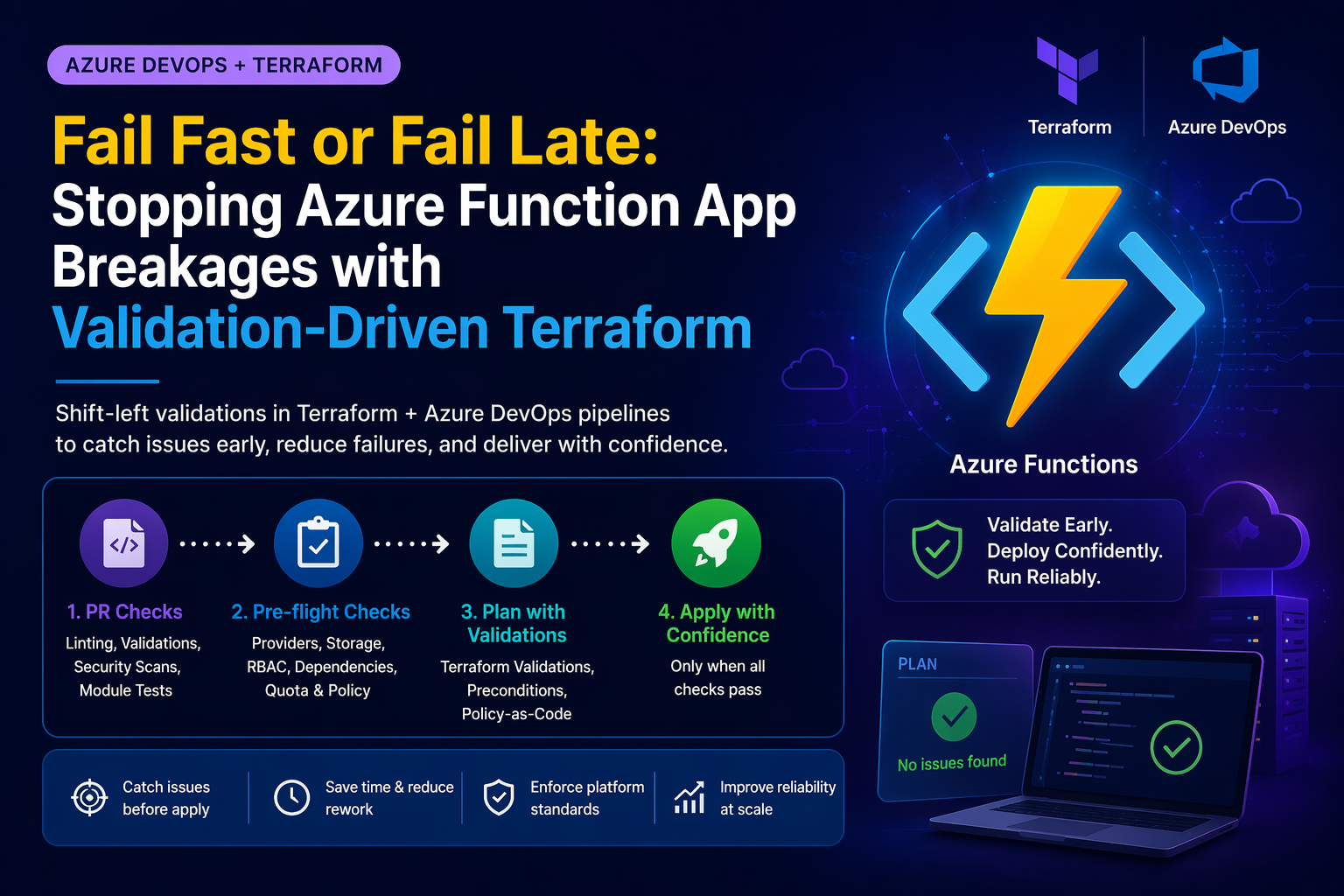
After a few painful production-grade rollouts, we shifted to a validation-driven approach: instead of letting Azure reject misconfigurations at apply time, we fail fast at PR/plan time with clear messages that engineers can fix immediately.
What we mean by “validation‑driven”
Validation-driven Terraform uses three guardrails together:
- PR checks: formatting, linting, security scanning, module contract tests
- Pre-flight checks: quick Azure sanity checks (provider registration, storage prerequisites, RBAC basics)
- Terraform-native validations: input validations + preconditions that stop invalid configurations before they reach Azure
The idea is simple: apply should be boring. If something is going to fail, it should fail earlier with better errors.
Azure Functions as the example: where failures actually happen
Azure Functions bring a few recurring “gotchas” that tend to show up late:
- mismatch between plan/SKU and features (e.g., VNET integration expectations)
- missing or inaccessible storage account settings
- unsupported/incorrect runtime stack/version for a chosen hosting model/region/policy
- inconsistent app settings required by your org platform standards
We converted these into guardrails with minimal code and clearer pipeline signals.
Case study 1: Wrong plan SKU causing runtime capability failures
Problem
A team deployed a Function App expecting network integration behavior, but the selected plan/SKU didn’t align with what the workload required. The pipeline failed late, after approvals, and the rollback discussion took longer than the fix.
What we changed
We added a small validation/precondition rule: if a team enables a capability that requires a certain class of plan, Terraform fails early with a targeted message.
Outcome
- Failure moved from apply-time → plan-time
- 2+ hours saved per failed deployment cycle
- Zero repeat incidents for that class of issue
Case study 2: Missing storage configuration blocking deployments
Problem
Function Apps depend heavily on storage configuration. We saw intermittent failures when storage settings pointed to deleted/incorrect resources, or when access expectations didn’t match reality.
What we changed
We introduced a pre-flight check step in Azure DevOps: verify storage existence/access and fail fast before plan/apply.
Outcome
- Deployments stopped failing mid-run
- Fewer “investigation loops” across teams
- Reduced incident noise (the pipeline became self-explanatory)
Case study 3: Unsupported runtime version (region/org guardrails mismatch)
Problem
Engineers selected a runtime stack/version that was valid in isolation, but not aligned with platform support or readiness in the target environment. Failures appeared in apply or after release.
What we changed
We centralized an “allowed runtime list” (per org standards) and validated runtime inputs at plan time.
Outcome
- Plan failed fast with clear explanation
- No redeploy cycles
- Better compliance posture (standards became enforceable code)
Why this matters (beyond “fewer red pipelines”)
Validation-driven Terraform improved more than deployment success rate:
- Developer experience: errors became precise and actionable
- Operational safety: fewer emergency approvals and late-night fixes
- Standardization: platform rules stopped living in tribal knowledge and wikis
- Manager-visible impact: less delivery friction, fewer escalations, faster releases
The best part: this wasn’t achieved by writing massive frameworks. It was achieved by adding small, high-leverage validations in the right places.
Minimal code approach (what we actually used)
We intentionally kept Terraform code small:
- A few input validations (environment, runtime, naming contracts)
- A few preconditions (must-have settings and plan constraints)
- A light Azure DevOps pre-flight step for checks Terraform can’t reliably infer (like “does this dependency exist and is it accessible?”)
This way, the module stays readable, and the pipeline remains fast.
Conclusion
In one of our Azure Function platforms, repeated deployment failures were not caused by bugs in application code or gaps in Terraform itself—they were caused by discovering platform constraints too late. Each failed terraform apply triggered rework, additional approvals, and unnecessary operational noise across teams.
By introducing a validation‑driven approach—combining Terraform input validations, targeted preconditions, and lightweight Azure DevOps pre‑flight checks—we moved failure discovery to the right place: pull requests and plan stages. Azure Function‑specific issues such as incorrect plan capabilities, unsupported runtimes, and missing storage prerequisites were surfaced early, with clear, actionable messages.
If your Azure DevOps pipelines still use terraform apply as a discovery mechanism, validation is not an optimization—it’s a foundational platform capability.

 Microsoft