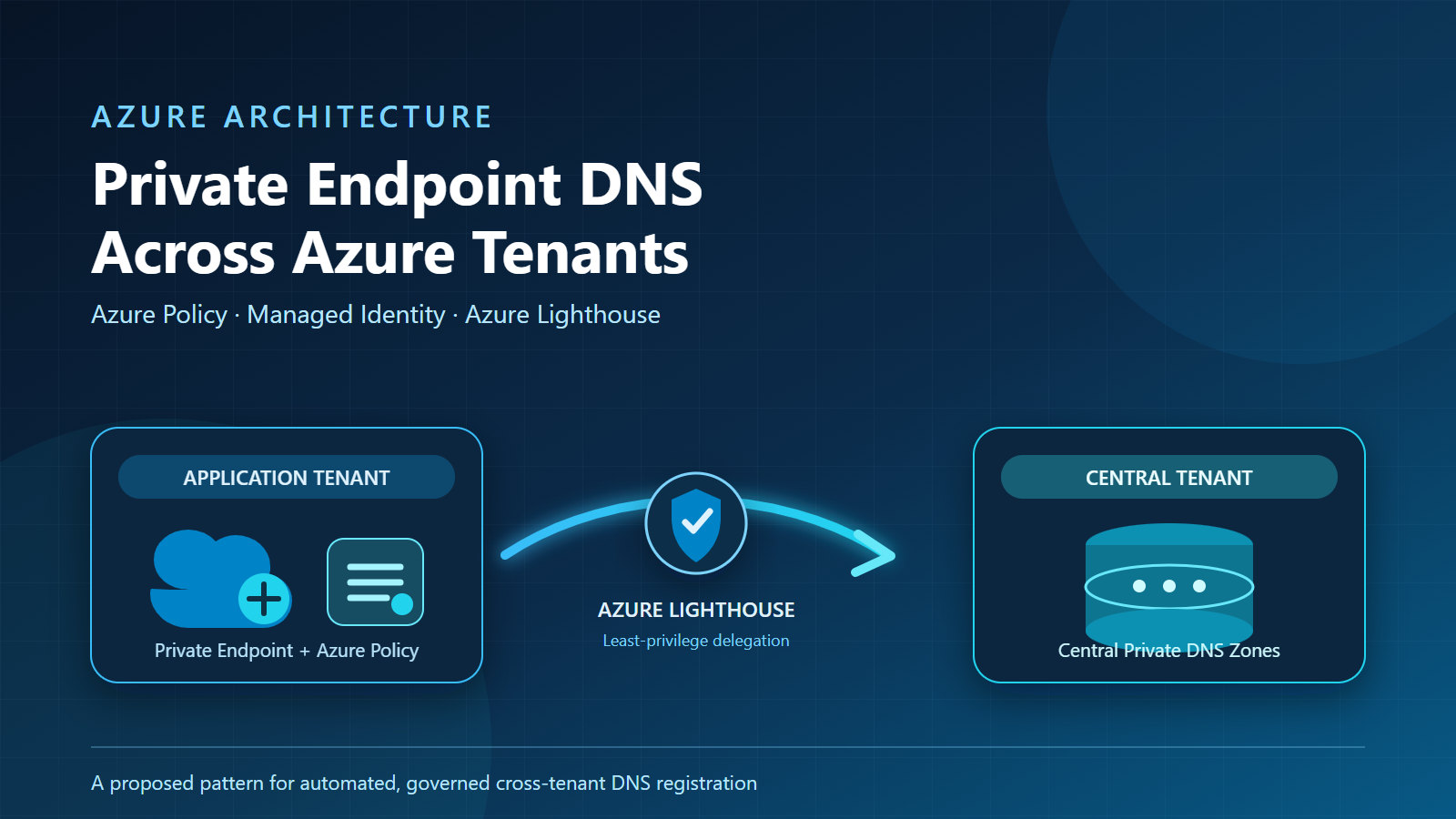
A practical reference architecture for centrally managing Private DNS zones while application workloads and Private Endpoints run across multiple Microsoft Entra tenants.
Problem statement
Azure Private Endpoints let applications connect to Azure platform services through private IP addresses. They reduce public exposure, keep traffic on private networks, and support a Zero Trust architecture.
In a single Microsoft Entra tenant, Azure Policy can automatically associate a Private Endpoint with a centrally managed Private DNS zone. The problem becomes more complex when an organization uses several tenants:
- A central management tenant owns the shared Private DNS zones.
- Separate application tenants host workloads and Private Endpoints.
- Application teams cannot modify resources in the central networking subscription.
- DNS records must be created and removed automatically as Private Endpoints are created and deleted.
- Cross-tenant access must be limited, auditable, and free from long-lived shared credentials.
When an application creates a Private Endpoint, Azure must create a privateDnsZoneGroup and register an A record in the appropriate Private DNS zone. However, the Azure Policy identity in the application tenant cannot update a DNS zone in the central tenant unless it receives explicitly delegated access.
Application tenant                         Central management tenant
------------------                         -------------------------
Application workload
        |
Private Endpoint
        |
Azure Policy
        |
Policy managed identity
        |          Cross-tenant delegation
        +------------------------------------> Central Private DNS zone
                                                  |
                                                  +-- Private A record
Why not use a custom synchronization service?
A central pipeline or Azure Function could copy DNS records between tenants. That approach can work, but it introduces more credentials, custom code, retry and reconciliation logic, monitoring, hosting costs, and record-cleanup responsibilities.
An Azure-native alternative is to combine Azure Policy with a carefully scoped Azure Lighthouse delegation. Azure Policy controls the Private Endpoint DNS lifecycle, while Azure Lighthouse gives its managed identity only the access required to work with the dedicated central DNS resource group.
Note: This article describes a proposed design assembled from publicly documented Azure capabilities; it is not an official Microsoft reference architecture or a claim of production implementation. Validate it through security review, threat modeling, and a non-production proof of concept before use.
Azure resources used in the solution
Azure Private Endpoint
A Private Endpoint is a network interface with a private IP address from a virtual network. It provides private connectivity to an Azure service such as Storage, Key Vault, or Azure SQL.
Azure Private DNS Zone
A Private DNS zone resolves an Azure service name to the private IP address of its Private Endpoint. Hosting these zones centrally gives the platform team consistent ownership and allows cloud and on-premises networks to use a common DNS resolution path.
Private DNS zone group
A privateDnsZoneGroup is a child resource of a Private Endpoint. It associates the endpoint with one or more Private DNS zones. Azure then creates and removes the relevant DNS records as part of the endpoint lifecycle.
Azure Policy
A DeployIfNotExists policy detects a supported Private Endpoint and deploys the required DNS zone group when it is missing. Policy parameters identify the correct central zone for each Azure service and private-link group ID.
User-assigned managed identity
A dedicated identity in each application tenant performs policy remediation. Unlike a stored service-principal secret, a managed identity has no credential that operators need to rotate or distribute. A user-assigned identity also has a stable principal ID and an independent lifecycle.
Azure Lighthouse
Azure Lighthouse provides delegated resource management across Entra tenants. In this design, an application-tenant identity receives narrowly scoped access to DNS resources in the central tenant. In Azure Lighthouse terminology, the application tenant is the managing tenant for this specific delegation, while the central tenant owns the delegated resource group.
Terraform and GitHub Actions
Terraform creates the Lighthouse registration definition and assignment consistently for every tenant. GitHub Actions runs validation, planning, approval, and deployment. OpenID Connect workload identity federation should be used instead of a long-lived client secret.
Proposed solution
The solution gives each application tenant a dedicated policy identity and delegates that identity the Private DNS Zone Contributor role over only the required central DNS scope.
+---------------- Application tenant ----------------+
|                                                     |
|  Workload --> Private Endpoint                      |
|                    |                                |
|            DeployIfNotExists Policy                 |
|                    |                                |
|          User-assigned managed identity             |
+--------------------|--------------------------------+
                     | Azure Lighthouse delegation
                     | Private DNS Zone Contributor
+--------------------v--------------------------------+
|              Central management tenant              |
|                                                     |
|  Central Private DNS zones -- DNS resolution path   |
+-----------------------------------------------------+
The identity does not receive general access to the central networking platform. Its delegation is limited to the dedicated resource group containing the centrally managed Private DNS zones.
How the solution works
- An application deploys an Azure service and a Private Endpoint in its tenant.
- Azure Policy evaluates the new Private Endpoint.
- The policy identifies the service using properties such as
groupIdandprivateLinkServiceId. - The policy uses its managed identity to deploy a Private DNS zone group.
- The zone group references the appropriate Private DNS zone in the central tenant.
- Azure registers the endpoint's private IP address in the central zone.
- Cloud or on-premises clients resolve the service name through the central DNS path.
- When the Private Endpoint is deleted, Azure removes the associated DNS record through the zone-group lifecycle.
Deployment sequence
Deploying this pattern is best approached as a sequence of platform onboarding phases rather than a single infrastructure deployment. Each phase establishes a dependency required by the next.
Begin with the central DNS foundation
Start in the central management tenant. Create the required Private DNS zones and connect them to the approved resolution path. Depending on the wider network design, this may include virtual network links, Azure DNS Private Resolver, forwarding rules, and integration with on-premises DNS. Completing this foundation first ensures that application tenants have a valid destination for their Private Endpoint records.
Prepare the application tenant identity
Next, create a dedicated user-assigned managed identity in the application tenant. Record its tenant ID and principal ID because these values identify who will receive delegated access. Keeping this identity dedicated to DNS policy remediation makes its purpose, permissions, and audit trail easier to understand.
Establish the Lighthouse delegation
Create the Azure Lighthouse registration definition and assignment in the central tenant. Delegate only the dedicated DNS resource group using the Private DNS Zone Contributor role. Before continuing, confirm that the managing tenant, principal, role, and scope are all correct. This step must finish before Azure Policy attempts remediation; otherwise, the identity will not be able to work with the central zones.
Introduce the policy automation
With delegation active, deploy the relevant DNS policy definitions or initiative in the application tenant. Assign the policy to the managed identity and provide the central Private DNS zone resource IDs as parameters. For Private Endpoints that already exist, start a remediation task so that they receive the same configuration as newly created endpoints.
Prove the complete lifecycle
Finally, deploy a test Private Endpoint. Confirm that Azure Policy creates the Private DNS zone group, that the correct A record appears in the central zone, and that an approved workload resolves the service name to its private IP address. Delete the endpoint and verify that Azure also removes the DNS record. This final cleanup test is important: automation is only complete when it handles both creation and deletion.
How to validate the solution
A successful deployment does not prove that name resolution and application connectivity work. Validation should cover three layers.
1. Control-plane validation
- The Lighthouse registration definition exists.
- The registration assignment references the correct definition.
- The managing tenant, principal ID, role, and scope are correct.
- The policy assignment uses the intended managed identity.
- The policy parameters contain the correct central zone resource IDs.
2. Resource validation
- The test Private Endpoint exists.
- The policy reports compliance or completes remediation successfully.
- A Private DNS zone group exists below the endpoint.
- The zone group references the intended central zone.
- The expected A record exists and matches the endpoint's private IP address.
3. Resolution and lifecycle validation
From an approved application network, resolve the service name and confirm that it returns a private IP address:
Resolve-DnsName myservice.blob.core.windows.netTest application connectivity over the private path. Then delete the test Private Endpoint and confirm that the corresponding record is removed from the central zone.
Security considerations
- Use a dedicated identity for DNS policy remediation.
- Scope the Lighthouse delegation to only the dedicated DNS resource group.
- Separate deployment identities from runtime identities.
- Use workload identity federation instead of stored secrets.
- Require approval before applying delegation changes.
- Protect tenant configuration and Terraform state.
- Monitor Lighthouse registration assignments, policy remediation, and DNS changes.
- Test both DNS record creation and deletion.
- Review every new Private Link service before enabling its policy.
Benefits and trade-offs
This pattern can provide central DNS governance, automatic registration and cleanup, repeatable tenant onboarding, reduced custom code, and narrowly scoped cross-tenant access. Azure Lighthouse itself does not add a service charge.
The design also has trade-offs. Each application tenant requires an explicit delegation, and the central platform must govern identities originating in multiple tenants. Azure Lighthouse primarily delegates Azure control-plane access; it does not solve every data-plane authorization requirement. Policy definitions must also be maintained as new Private Link services are introduced.
When to use this pattern
Consider this architecture when workloads span multiple Entra tenants, Private DNS zones must remain centrally owned, application teams should not receive broad central-network access, and the organization prefers an Azure-native lifecycle over custom synchronization code.
A simpler design may be more suitable when all resources are in one tenant, only a few endpoints exist, or organizational policy does not permit cross-tenant delegated identities.
Conclusion
Cross-tenant Private Endpoint DNS is more than a DNS challenge. It combines networking, identity, governance, automation, and resource lifecycle management.
Azure Policy and Azure Lighthouse provide a promising Azure-native pattern: policy manages the endpoint-to-zone association, Azure manages the DNS record lifecycle, and Lighthouse supplies only the cross-tenant permission required for the operation.
Grant the smallest required DNS scope, automate the complete lifecycle, and validate the result from policy evaluation through application connectivity.
Further reading

 Microsoft