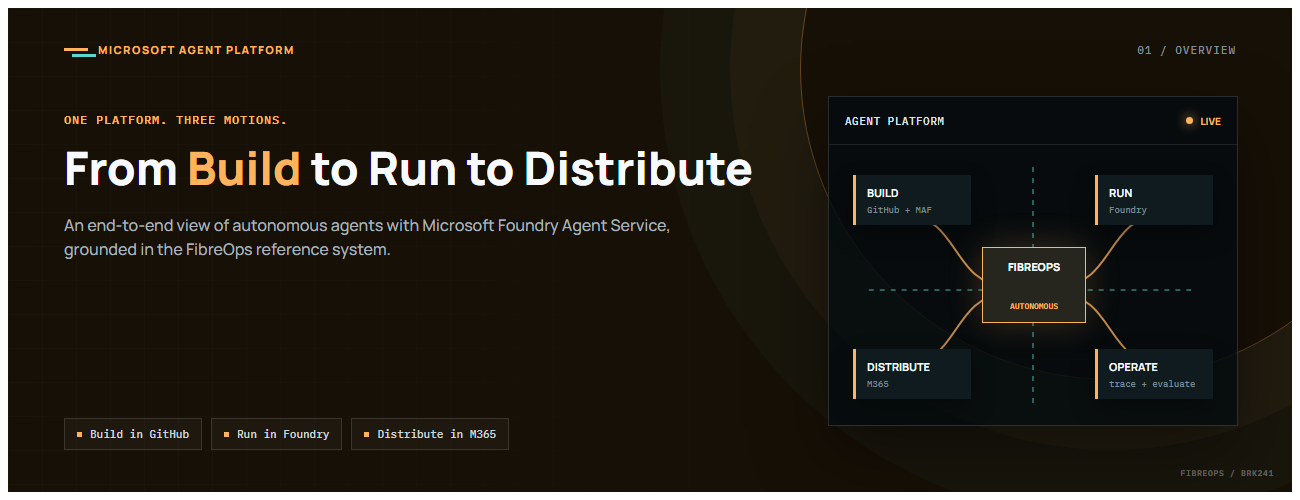
At Build 2026, we previewed the future of autonomous agents on the Microsoft platform. Now, those promises are delivered. Microsoft Foundry Agent Service, the Microsoft Agent Framework, and the GitHub Copilot SDK have reached General Availability, giving developers a single, end-to-end platform to build agents in GitHub, run them in Foundry, and distribute them across Microsoft Teams and Microsoft 365 Copilot.
This blog series uses FibreOps an autonomous fibre outage response system — as a reference implementation to walk through every layer of the platform. FibreOps was demonstrated live at Microsoft Buid BRK241 and is open source on GitHub.
The Three Pillars
The agent platform story is simple: one platform, three motions.
- Build in GitHub Copilot— Microsoft Agent Framework integration with GitHub Copilot SDK, Foundry Toolkit for VS Code, and multi-model support (including Claude Code connectors and Magentic-One).
- Run in Foundry — Hosted Agents, Agent Optimizer, Routines (with event-triggers), Toolboxes, Memory (procedural, user, session), Tracing and Evaluation, and Voice Live integration.
- Distribute in M365 — Publish agents to Microsoft Teams and Microsoft 365 Copilot with a single command; deploy as Autopilots for fully autonomous operation.
What is FibreOps?
FibreOps is an Autonomous Fibre Outage Response System built on Microsoft Foundry Agent Service. When an optical line terminal (OLT) reports a fault, loss of light, high bit-error rate, or signal degradation, FibreOps autonomously classifies the incident, files a ticket, notifies the operations team, and dispatches a field engineer.
The architecture uses three role-specialised agents orchestrated in a pipeline:
- IncidentAnalysisAgent — Classifies severity, identifies root cause, retrieves the correct Standard Operating Procedure.
- NetOpsCoordinatorAgent — Files a Dynamics 365 Field Service incident and posts a Teams Adaptive Card outage notice.
- FieldDispatchAgent — Selects the best-qualified engineer, books the resource, and updates the team.
The end-to-end flow:
OLT telemetry ──▶ Event Hub ──▶ Orchestrator ──┬─▶ IncidentAnalysisAgent
                                                ├─▶ NetOpsCoordinatorAgent ──▶ D365 + Teams
                                                └─▶ FieldDispatchAgent     ──▶ D365 booking + Teams update
                                                          │
                                                          ▼
                                              OpenTelemetry → Application Insights
                                                          │
                                                          ▼
                                              Optimiser (rubric → suggestions)
Key Platform Features Demonstrated
Hosted Agents (GA)
Agents are hosted Prompt Agents in Microsoft Foundry Agent Service. They run as containerised services serving the OpenAI /responses contract. FibreOps packages its entire agent pipeline as a single hosted agent deployed via agent.yaml and a Dockerfile — no infrastructure management required.
Agent Optimizer (Public Preview)
Every run is scored against a rubric evaluating classification accuracy, dispatch appropriateness, SLA compliance, and communication quality. The optimizer produces actionable improvement suggestions and integrates with Foundry cloud Evaluators for production-grade evaluation.
Routines (Public Preview)
The NetOps coordinator has two interchangeable implementations: a prompt-driven chat agent and a Foundry Routine — a deterministic, declarative execution plan. Steps execute in order (file_ticket → post_teams_notice → remember_ticket), then a decision expression routes to dispatch or monitoring. Routines now support event-triggers for reactive automation.
Foundry IQ — Web IQ and Work IQ
The Incident Analysis agent grounds its reasoning using Foundry IQ. Web IQ provides public-web context (roadworks, weather, power outages, splice guidance). Work IQ surfaces enterprise context (site surveys, SLA tiers, competency matrices, MTTR trends). Every lookup is persisted and visible in the NOC console.
Memory (Public Preview)
Agents maintain procedural memory — lessons learned from previous incidents — using the Foundry Memory store. This enables progressive improvement without retraining.
GitHub Copilot SDK (GA)
FibreOps exposes a FibreOpsCopilotClient with the same create_session() / send_and_wait() shape as github/copilot-sdk. The same calling code works against either the local adapter or a hosted endpoint, enabling conversational interaction with the agent system.
Microsoft 365 Copilot Publishing (GA)
A single command (python -m fibreops.demo publish-m365) produces a declarative agent + action plugin package ready for sideload via Teams Admin Center. The agent inherits publisher metadata, advertises conversation starters, and proxies tool calls to the deployed FastAPI backend.
Voice Live Integration
Status updates are spoken through Azure AI Voice Live with SSML utterances, voice selection, and prosody chosen per severity level — providing an accessible, hands-free operations experience.
Running the Demo
The entire system runs locally with zero Azure credentials using the deterministic local backend:
# Clone and install
git clone https://github.com/leestott/BRK241-frontier
cd BRK241-frontier
python -m venv .venv
.\.venv\Scripts\python.exe -m pip install -r requirements.txt
.\.venv\Scripts\python.exe -m pip install -e .

# Run with local backend (no Azure needed)
.\.venv\Scripts\python.exe -m fibreops.demo --signals 3
For production deployment with real Foundry agents:
# Authenticate and deploy
az login
azd auth login
azd env new fibreops-demo
azd env set AZURE_AI_PROJECT_ENDPOINT "https://<account>.services.ai.azure.com/api/projects/<project>"
azd env set AZURE_AI_MODEL_DEPLOYMENT "gpt-4.1-mini"
azd up
Blog Series Roadmap
This is the first in a five-part series exploring the platform end-to-end:
- This post — Platform overview and the Build → Run → Distribute story
- Building Autonomous Agents with Microsoft Agent Framework and GitHub Copilot SDK — Deep dive into agent construction, tool design, and the development experience
- Running Hosted Agents in Microsoft Foundry Agent Service — Hosted agents, optimizer, routines, memory, and toolboxes
- Distributing Agents to Teams and Microsoft 365 Copilot — Publishing, declarative agents, action plugins, and autopilots
- Voice Live and Observability for Production Agent Systems — Azure AI Voice Live, OpenTelemetry, Application Insights, and operational excellence
Key Takeaways
- The Microsoft agent platform is now GA across all three pillars: Build, Run, and Distribute.
- Hosted Agents eliminate infrastructure management — deploy a container, get a production agent.
- The Agent Optimizer and Routines bring determinism and continuous improvement to autonomous systems.
- Publishing to Teams and M365 Copilot is a single command — no separate app registration workflow.
- The entire FibreOps reference implementation runs offline with zero Azure credentials for development and demo purposes.
Next Steps

 Microsoft